
bout de papier, Vol. 27, No. 2 (2013) — Spring 2013 // Printemps 2013, pp. 5–9
Note de la rédaction : Faye Kert est l’une des premières autorités du Canada concernant un drôle de subterfuge de notre histoire : les vaisseaux corsaires. Pour le dire crûment, c’était de la piraterie légalisée. Par lettres patentes de la Couronne, des vaisseaux « marchands » étaient autorisés à capturer les navires ennemis et, dans la plupart des cas, à conserver une grande partie de leur butin. Beaucoup ont fait fortune durant la guerre de 1812, dont le procureur général de la Nouvelle-Écosse à l’époque ne fut pas le moindre; son manoir, Mt Uniake près de Halifax, est aujourd’hui un musée provincial et un trésor de parures de l’époque géorgienne comparable à nul autre au Canada. Si les corsaires sont aujourd’hui choses du passé, un autre legs ne l’est pas : un jugement de la Cour supérieure de l’amirauté de Halifax a fait jurisprudence en matière de propriété d’œuvres d’art saisies en temps de guerre. Qui aurait cru que les vaisseaux corsaires, un juge de Halifax irritable et la guerre de 1812 auraient inspiré le droit international de la propriété culturelle de nos jours? M” Kert en fait la preuve.
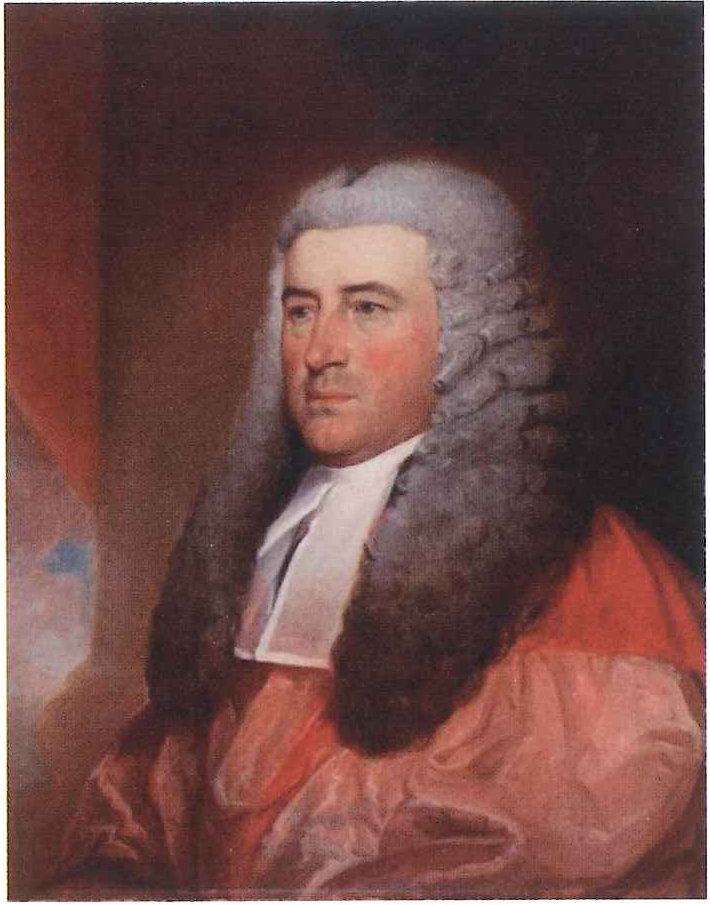
Robert Field, Sir Alexander Croke, c. 1808 Photo National Gallery of Canada, Ottawa/Musée des beaux-arts du Canada, Ottawa The Prize
On July 10, 1812, Captain Frederick Hickey of HM Sloop of War Atalante was about 100 nautical miles east of Halifax when he encountered an American merchant vessel heading home to Salem, Massachusetts. Compared to the 416-ton sloop of war Atalante, the Marquis de Somerueles was a square-sterned merchant ship of about 360 tons, owned by Richard Gardner. Having left their respective ports more than a month earlier, neither Captain Hickey nor Thomas Moriarty, the master of the American ship, was aware that their countries were now at war. Hickey, however, was under orders to stop American vessels and ensure that their papers were in order and that they had not violated the Orders in Council that were in force when he left England. Similarly, John Gardner, Jr., acting as supercargo aboard his brother’s ship had been cautioned, “by no means go contrary to the British Orders in Council but conform yourself strictly to a Neutral line of Conduct…”
The Somerueles, named after a late 18th century Governor of Cuba, was returning from Italy after nearly a year abroad and carried a rich and varied cargo intended for the American market. As Hickey examined the invoices and cargo lists he noted paper, marble, silks, feathers, artificial flowers, wine, brandy, umbrellas, hats and cases and crates containing 21 paintings and 52 prints and engravings consigned to Mr. Joseph Allen Smith of Philadelphia.
Aware of the profit that could be made from confiscating such a cargo on behalf of His Majesty, Captain Hickey minutely examined the hundreds of bills of lading and letters handed to him. The ship had loaded its cargo at Civita Vecchia, the port of Rome, and the goods had come from well south of the line drawn by the Orders in Council of 26 April 1809. Ostensibly, everything was in order.
According to the letter of the law, any cargo brought to Civita Vecchia by water from an unauthorized port was equally liable to confiscation. Among the documents was a list of articles shipped from Leghorn, an excluded port, accompanied by an exchange of correspondence between John Gardner, Jr. and representatives of the firm of PH & A Filicchi of Leghorn. One, dated 28 March 1810, refers to hats and umbrellas which had not been sent but would be shipped at the first opportunity. The other, dated Leghorn, 5 April 1812, mentions “two boxes prints etc. forwarded by Messrs Morelli and Guentini” which would be shipped with 20 boxes umbrellas, hats, trunks and 20 half chests at a cost of $11,842.29 along with goods received from Florence for $150.98 shipping.
Had Captain Hickey decided that there were insufficient grounds for delaying the vessel further, he could have sent it on its way. Instead, his sense of duty (heightened, no doubt, by the prospect of a rich cargo) led him to suspect that some of the hats and other fashionable goods on board might have been purchased in Leghorn, in violation of the Orders of Council. As he was bound for Halifax anyway, Hickey ordered the Somerueles to follow him.
There was no point in resisting. While evenly matched in terms of size and weight, the Atalante carried 18 guns worth of persuasion. The Somerueles, pierced for 20, carried only six guns, stored in the hold and only used “to keep off the small Corsairs in the Straight, the Sardinians and the Corsicans.” Mindful of the owner’s instructions to cause no trouble, the Somerueles dutifully followed the Atalante into Halifax.
The minute he reached port and discovered the state of war, Captain Hickey claimed the Somerueles as his prize, submitted its papers to the Customs House and set the Vice-Admiralty Court process in motion. Even though Great Britain had not yet responded to the American declaration of war with a similar declaration of hostility, the United States was considered an enemy and the ships of the Royal Navy were obliged to capture enemy vessels as prize. Without a state of war and a Prize Act, however, vessels like the Somerueles would be condemned jure corone as the prerogative of the crown rather than awarded to the captor. Fortunately for Captain Hickey, the decision lay with the judge of the Vice-Admiralty Court.
The Vice-Admiralty Court
By the War of 1812, the Halifax Court of Vice-Admiralty, established in 1749, had had more than half a century of experience in the adjudication of prize. With England at war with France off and on from 1793, the Halifax court had plenty of opportunities to hone its expertise in the international law of prize. From 1801 on, the court was under the watchful eye of Judge (later Sir) Alexander Croke, LLD. Argumentative, conservative and undoubtedly brilliant, Croke’s difficult personality set him apart from, if not at odds with, his neighbours and earned him the title of “the most disliked man in Halifax”. Nevertheless, it is the “detestable” Alexander Croke who is the hero of this story.
At first, it looked as if the Somerueles would be a simple case of capture and condemnation, although not likely to the captor. The ship arrived in port 14 July 1812. The next day a “monition” was nailed to the mast advising anyone with a claim to the prize or cargo that they had 20 days to show the court why the prize should not be condemned as enemy property. Next a sworn statement was taken from the prize-master for the captured ship, Lt. James Rogers Drew of Atalante, regarding where, why and how the prize was taken, and the contents of the cargo and the papers relating to it. Then one or more members of the captured crew were questioned according to a set list of 34 Standing Interrogatories designed to determine whether the capture had been properly conducted and the ship’s papers were true and fair. Captain Moriarty and supercargo John Gardner, Jr. were selected to respond to the questions and gave similar answers.
Unlike regular legal process, the adjudication of prize law did not require a jury. Instead, the ship itself was considered the plaintiff whose credibility depended solely on the truth and accuracy of the documents related to it. The affidavits and Standing Interrogatories by various participants in the capture served to ensure that the ship had been lawfully taken and that none of the documents on board were falsified, lost, thrown overboard or otherwise intended to mislead the court.
Behind the Scenes
As the court process moved ahead, John Gardner Jr. regretfully informed his brother of their loss. Not only was the Somerueles a sturdily-built vessel in good condition, it was laden with a valuable cargo representing a considerable capital investment on the part of the owners. Worse, Richard Gardner had confided to his brother, “you will know the Ship & Cargo is nearly everything that I possess and have no insurance done.” No wonder the Gardners felt compelled to write to President James Madison in the middle of a war to ask for his intervention.
As well as complaining that the capture was legally, if not morally questionable, Gardner appealed to Madison’s sympathy. Estimating the value of the vessel and property on board at the time to be $125,000 to $140,000, Gardner claimed that no other capture thus far in the war was likely to generate such “loss and suffering, depriving each of us and our father, not only of all we possess and rendering us unable to meet many demands that are against us” but further denying them the means to support their families.
Unfortunately for the Gardners, the war went on, and in February 1813, Judge Croke finally condemned the ship and cargo to the captors under the Orders-in-Council.
The Paintings
While the Gardners were unsuccessfully lobbying President Madison in August 1812, the Board of Trustees of the Pennsylvania Academy of the Fine Arts was scrambling to recover the artworks aboard the Somerueles. Established in 1805 as the first art gallery and school in the United States, the Pennsylvania Academy of the Fine Arts was created as a public museum by a group of wealthy citizens, rather than by a group of artists as in the European model. Among its earliest benefactors was Joseph Allen Smith (1769-1828), a native of Charleston, South Carolina, who had moved to Philadelphia in 1807. An inveterate traveller and art lover, Smith began acquiring classical works of art on his travels through Italy between 1793 and 1796 with an eye to donating them for the benefit of his fellow Americans. Deciding Philadelphia was more accessible than Charleston, Smith decided to place his collections there.
At the same time that Smith was acquiring his initial collection of classical art, the army of revolutionary France, under the young Corsican general, Napoleon Bonaparte, was storming into Italy acquiring art and territory with equal enthusiasm.
The art was destined for the Musée Napoléon in Paris (later part of the Louvre) while Italy was added to Napoleon’s growing collection of European countries. Smith’s carefully collected paintings and sculptures were caught up in the Napoleonic maelstrom and most of the pieces were never seen again.
Caught between the warring ambitions of England and France, the United States struggled to maintain its neutral status. Although the signing of John Jay’s Treaty with England in 1794 tidied up some loose ends left over from the American Revolution (including borders with Canada) and bought the United States a few years of peace, it infuriated the French and led to diplomatic incidents in Europe and attacks against American shipping in the Caribbean and elsewhere. The chances of Charles Pinckney, American Ambassador to France, bringing Smith’s complaints to sympathetic French ears were slim to non-existent. According to a letter from Pinckney’s wife in 1797, Mr. Smith had told her husband that he had lost 13 cases of wonderful paintings, (“near 3,000 gems’). Also confiscated were a number of sculptures, some antique originals, and some copies of the most famous statues of Rome, Florence and Naples which he had personally commissioned “to gratify his countrymen”.
Endowed with wealth and optimism, Smith persevered with his demands for restoration and by 1800, was able to arrange for the release of two cases of statuary, plaster casts, books, engravings and a collection of impressions of gems to be shipped to Philadelphia. His donation eventually formed the basis of the new Pennsylvania Academy of the Fine Arts. Over the next decade, Smith was able to secure additional pieces from his original collection but left them in storage at Civita Vecchia since it was still too dangerous to ship them home. Finally in 1812, a window of opportunity opened as the Somerueles was loading cargo for the United States. After consigning his long-lost art to the Pennsylvania Academy in Philadelphia aboard the Somerueles, Smith must have waited anxiously to see the 21 paintings and 52 prints he had purchased so long ago.
As soon as the Directors of the Pennsylvania Academy learned of the capture of the Somerueles, they authorized John Vaughan of the Pennsylvania Philosophical Society to write to Halifax and see if he could get the paintings returned, and if not, authorized him to offer to buy them back for a price not exceeding $500. Given the state of war between the two nations, negotiations for the return of the art were conducted by the agents for prisoners of war on both sides; Anthony St. John Baker for the British in Washington and John Mitchell for the Americans in Halifax. In November, Admiral Sawyer, who had originally intended to purchase the paintings for himself, told Mitchell that if the paintings were condemned, he would buy them back on his account and turn them over to the Academy as originally intended.
The Precedent
On 26 February 1813, with both countries well into the war, Judge Croke delivered his verdict concerning the capture of the Somerueles: “I condemn vessel and cargo to the captors under the Order-in-Council of April 26.” He then turned to the matter of the Solicitor General’s petition for the release of the paintings, opposed “but not strenuously” by the King’s Advocate. Although the text of the Academy’s original petition seems to have been lost, Croke’s decision reiterates the basis of the claim: “That in the Somerueles, from Italy, was taken a case belonging to the Academy of Arts in that city, containing twenty-one paintings and fifty-two prints; that they were presented to the Academy by Mr. Joseph Allen Smith, who has already given more objects of the statuary, paintings, and prints which they possess; indeed this is a remnant of what he collected for the purpose of assisting its formation. The value we know not, but in this country, and in an infant establishment, every accession is important.”
In outlining the Academy’s case, Croke repeated its argument that “even war does not leave science and art unprotected” and since Britons have often considered themselves at peace with these, the Academy was hopeful the paintings would be returned. Their trust was not misplaced. For all his prickly personality, Croke obviously had a soft spot in his heart for art and culture. While the law of nations clearly allowed the confiscation of enemy property during war, Croke believed that “The arts and sciences are admitted amongst all civilized nations, as forming an exception to the severe right of warfare, and as entitled to favour and protection.” He pointed out that even Napoleon, despite trampling on justice and humanity and reducing France to barbarism, had enough respect for the natural sciences to release a fellow of the Royal Society when requested to by Sir Joseph Banks, a famed botanist and naturalist who had sailed with Captain Cook.
“We are at war in the just defence of our national rights, not to violate the charities of human nature,” Croke declared. Returning the paintings would not only contribute to the reciprocal exchange of civilities between England and its former colony but could only improve taste and public standards of morality on both sides. As he said: “Contemplation of the picturesque arts cannot but reinforce support for moral beauty” to the mutual benefit of all. He was confident that such improvements would happen in the United States since Americans had already proven themselves capable of artistic genius. He observed that Benjamin West, the president of the Royal Academy in Britain and already famous for his painting of The Death of Wolfe, had been born in America (in Pennsylvania, in fact).
Despite sounding pompous and paternalistic to modern ears, Croke’s rationale for his decision was sincere. He speculated that an institution like the Philadelphia Academy might well promote an advanced state of the arts capable of turning out new Wests to “revive the school of Rafaelle in the wilds of America.” He felt the improved moral feeling this would generate would cultivate public taste to the point where a people who prided themselves on liberty like the Americans couldn’t bear to become the tool of a foreign despot, presumably Napoleon. Nor would they continue to spurn the hand of friendship held out to them by the land of their forefathers. Croke was sure that once society reached this level, England and America would be united in the bonds of friendship, common interest and enlightened commerce. They would “experience no other enmity than liberal rivalship in every elegant and manly accomplishment.”
Not wishing to disappoint American expectations of British liberality and seeking to encourage the laudable cultural aspirations of “an infant society”, Croke wished America success and prosperity according to the law of nations as practised by all civilized countries and pronounced: “T deem the restitution of the property which has been thus claimed.”
Croke’s judgement essentially declared that works of art belonging to a public institution should be considered the cultural patrimony of that nation and, therefore, not subject to the ordinary laws of war. His decision affirmed: “the arts and sciences are admitted amongst all civilized nations, as forming an exception to the severe rights of warfare, and as entitled to favour and protection. They are considered not as the peculium of this or of that nation, but as the property of mankind at large, and as belonging to the common interests of the whole species.” Here was the first statement recognizing art as cultural property belonging not just to the country that housed it, but to mankind as a whole. Unaware that this early-nineteenth century opinion would set a precedent for the way the law regards items of cultural significance today, a very grateful Joseph Allen Smith and the members of the Board of the Pennsylvania Academy of the Fine Arts doubtless breathed a huge sigh of relief.
Back to the Paintings
Lest the artwork fall prey to another passing naval vessel or privateer on its way to Philadelphia in June 1813, it was arranged that it be sent to Boston aboard the cartel ship Agnes. It must have been a rough trip, on arrival everything was found soaked in sea water. Although only one painting was damaged beyond repair, the 52 prints probably did not survive the voyage. To preserve what was left, it was recommended that the paintings complete their journey by wagon, safe from recapture by the French, the English or the sea. On July 15, one final painting was removed from the surviving collection as the directors of the academy presented a painting to Captain Hickey of HMS Atalante in gratitude for agreeing to give up a valuable portion of his prize. A charming portrait of a young woman entitled Petrarch’s Laura by an unknown late-sixteenth, early-seventeenth century artist was sent to Captain Hickey with a letter from the president of the Academy thanking him for his generosity and offering the painting as “a memorial of a transaction of your life which without some token of remembrance may escape your memory, although I trust it never will ours.”
Postscript
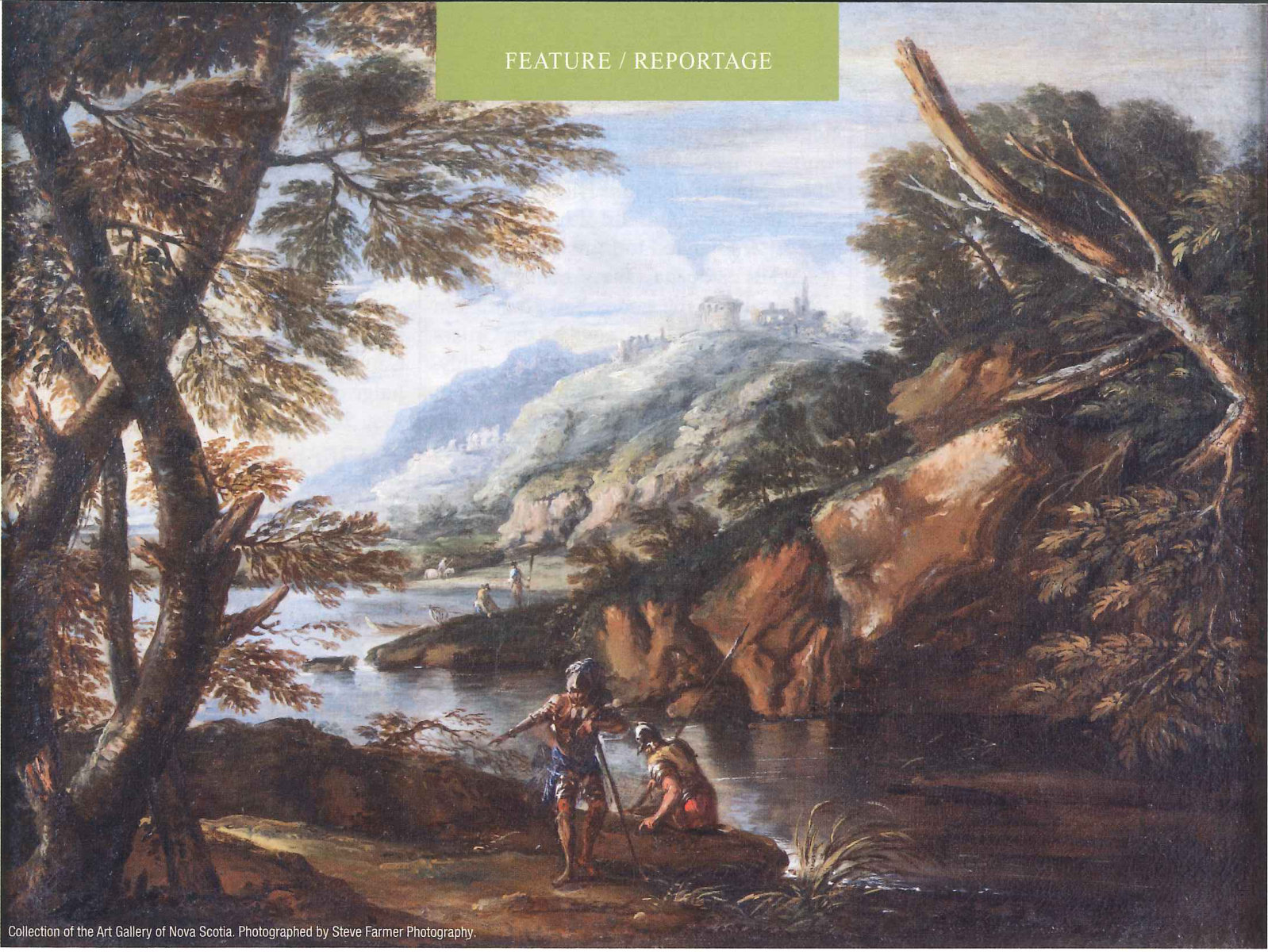
One would think that with the judgement handed down, the paintings handed over and the participants thanked, the story would be over. But, as Judge Croke observed, art is not subject to the ordinary laws of war, let alone history! In 1948, the American Consul General in Halifax, A.A. Klieforth, sent a copy of Croke’s 1813 judgement to the Pennsylvania Academy of the Fine Arts suggesting that they might like to commemorate their appreciation by donating a work of art from their collection to the province of Nova Scotia. As it turned out, the Academy had gradually revised its collection policy to focus on American art and was quite happy to present the province with a couple of lovely classical landscapes by the well-known Italian artist, Salvator Rosa (1615-1673).
The Paintings
were presented to the Nova Scotia Museum of the Fine Arts on Thursday, March 18, 1952, by Cabot Colville, Klieforth’s successor, on behalf of the Pennsylvania Academy of the Fine Arts. They were received by the Rt. Hon. J.L. Illsley, Honourary President of the Nova Scotia Museum and as Chief Justice of Nova Scotia, a fitting representative for Judge Croke. Interestingly, because Halifax had no provincial art gallery at the time, the paintings were hung in the Provincial Archives building on what is now the property of Dalhousie University and was, in 1813, almost on the site of Sir Alexander Croke’s former home, “Studley”.
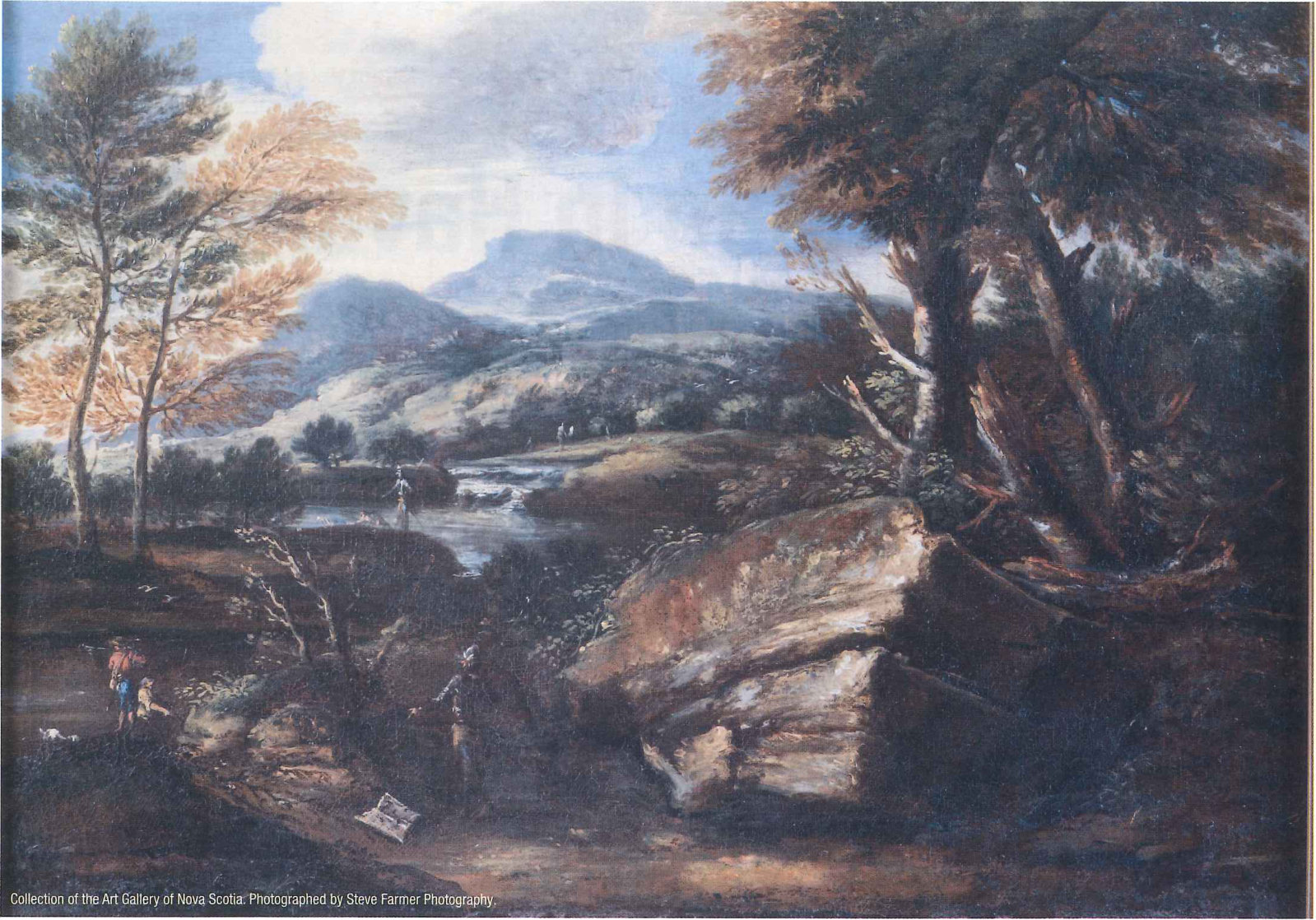
Salvator Rosa, Rocky Landscape with Figures, c. the Honourable Sir Alexander Croke, Justice of th Consul-General at Halifax, 1952.
Is the case of the captured paintings closed? Not quite. In 1958, Joseph T. Fraser, the Director of the Pennsylvania Academy of the Fine Arts, received a letter from a woman in Bristol, England. She and her brother-in-law had inherited the contents of a home in Wales no longer owned by the family. Included in this bequest was a painting of Petrarch’s Laura originally belonging to one of their ancestors, a Captain Hickey. As neither she nor her brother-in-law had family to inherit the painting, would the Academy be interested in receiving it back? In September 1958, the last of Joseph Allen Smith’s collection of paintings finally returned to Philadelphia nearly 150 years after it was first captured.
Conclusion
Judge Alexander Croke’s decision altered forever our acceptance of art as spoils of war and set a precedent for future generations to follow. It was referenced in the dispute between Greece and England over the “Elgin Marbles” which, depending on your perspective, were either stolen or removed to the British Museum for safekeeping by Lord Elgin in the early nineteenth century. It was also used to support national claims for restitution following Hitler’s looting of the great galleries of Europe. Croke’s judgement formed part of the premise of the Hague Convention for the Protection of Cultural Property in the Event of Armed Conflict signed in 1954 and emerged in discussions about the destruction of museums in Afghanistan and Egypt. Who would have imagined that today’s international law governing art as spoils of war owes its inspiration to the war of 1812 and the then “most disliked” man in Halifax?
Ottawa native Faye Kert retired from the federal government having served with the War Museum, the National Museums Corporation, and Health Canada (as a communications specialist). She worked as an underwater archaeologist in the icy waters of Red Bay, Labrador on early 16th century Basque whaling settlements and the murky waters of the English Channel on Henry the Sth’s Mary Rose. With an MA in History from Carleton University and a Phd from the University of Leiden, she is among Canada’s foremost authorities on privateering (or “licensed piracy” in the view of some) in Atlantic Canada and has published several related key works. She is working on a volume on privateering in the War of 1812 with Johns Hopkins University Press and is the Book Review Editor for The Northern Mariner/ Le marin du nord (of the Canadian Nautical Research Society and the North American Society for Oceanic History).
View the original scanned pages →
Originally published in bout de papier, Vol. 27, No. 2 (2013) — Spring 2013 // Printemps 2013, pp. 5–9. Read the rest of this issue →



