
bout de papier, Vol. 7, No. 4 (1990), pp. 24–28
n April 4, 1990, an auction took place at Sotheby’s in London. On offer were, among other things, 20 works from the George Costakis collection of the Russian avant-garde, and four of Costakis’ own paintings, done late in this life.
The auction was a disaster, a calamity, to use the language of the next day’s London newspapers. 76% of the works went unsold, according to one newspaper an unprecedented failure at Sotheby’s. There were dark predictions that the bottom was about to fall out of the world art market. The Daily Telegraph asserted that the reason for the failure was that “Costakis dictated his own impossible estimates to Sotheby’s.” Whatever the cause, it seems clear that many years must elapse before works from the Costakis collection will have any chance of reaching the kind bout de papier Vol.
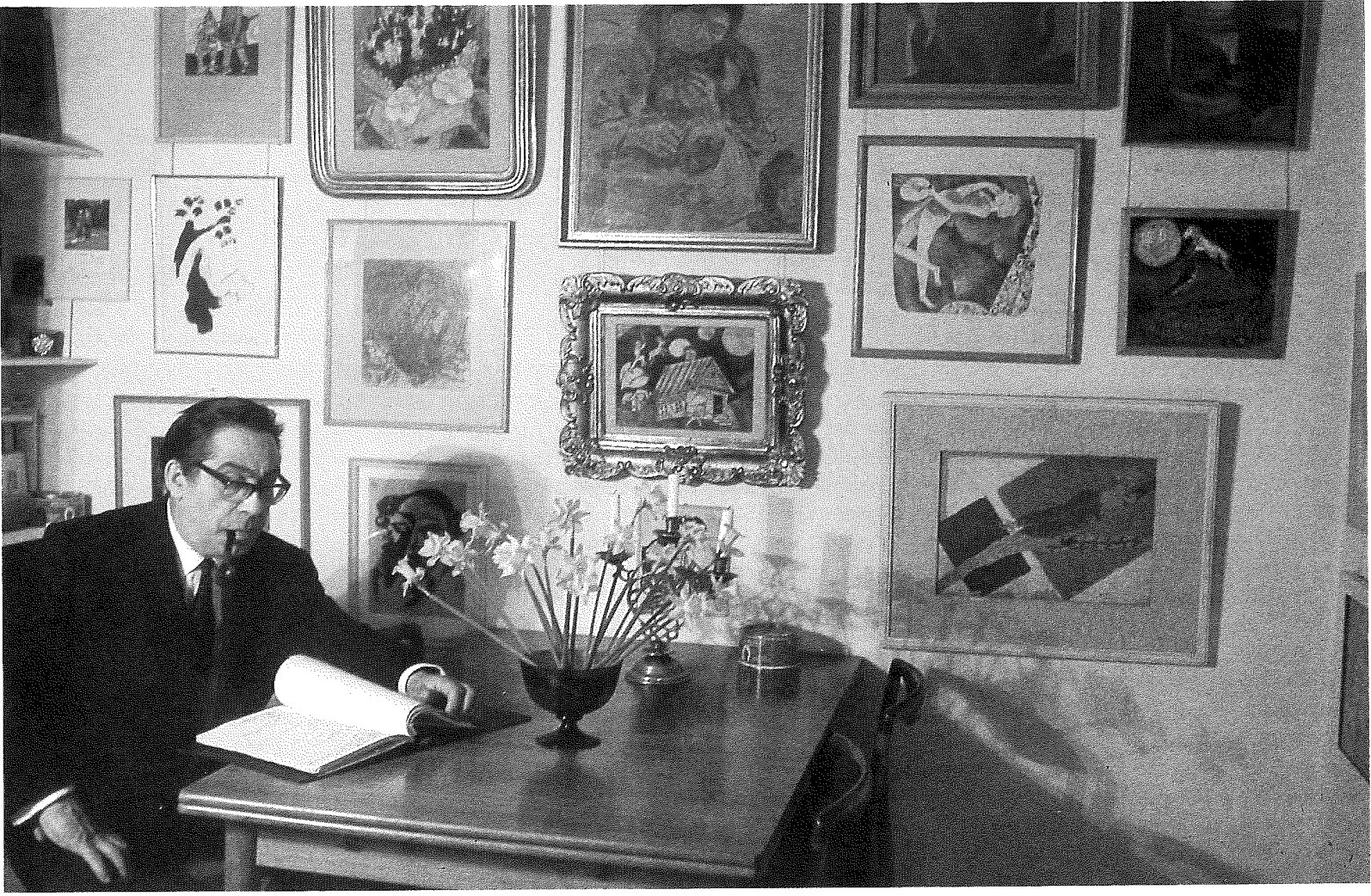
Moscow apartment in 1971. Of price at auction that they deserve in today’s market. One of the world’s most important collections of modern art is on the shelf.
It is perhaps as well that George Costakis did not live to suffer this blow, which would have been a terrible one, to his pride and confidence. He died in Athens on March 9, 1990, aged 77, and was buried there according to the Greek Orthodox rite, no Russian priest being available. His family, the Canadian and Soviet Ambassadors, and about 50 friends were present to mourn him.
Moving and appropriate as the Athens ceremony was — under an unusually clear Greek sky, full of trees, flowers and birdsong — George Costakis himself would probably, if he were permitted a view on the matter, have preferred the other ceremony. This took place on the same day in Moscow, in his old apartment on Vernadsky Prospekt, now occupied by his youngest daughter Natasha, her husband and children. Natasha herself was at the Athens funeral, but the inhabitants of Costakis’ old Russian world, those who remained, crowded by the hundred into the little apartment – half as big as when he had it — and under the benign gaze of the saints and martyrs of his priceless icon collection, left behind with Natasha in 1978 when Costakis and his wife went into what they regarded as exile, marked the passing of their friend.
Who was George Costakis — or to give him his proper Russian name, Georgii Dionysevich Kostaki? He was, first of all, a Russian art collector of great distinction. He is known in the West (and is at last becoming known in Russia too, thanks to glasnost) for his collection of the Russian avant-garde, a collection unique in the world and certainly one of the greatest and most important collections of modern art anywhere. But he was also a collector of icons: the collection on Natasha’s walls is among the best in the Soviet Union, despite the fact that the Soviet authorities helped themselves to the best pieces in it, without compensation, when the Costakis left Russia. He was a prodigious collector of the work of young “unofficial” painters in Russia during the days of Khrushchev and Brezhnev, when it was possible for an artist to work but not to be paid or exhibited if the work was unorthodox in any way. Costakis’ collecting of these paintings put bread on the table of many a young artist, then unknown but in some cases now celebrated in the Soviet Union and abroad. In his early days he had collected more conventionally – carpets, Dutch masters, silver. In his later years, in exile, he collected the Soviet artists who have sprouted like mushrooms under perestroika. Collecting was in his blood, and what he has left to the world are his collections, a rich legacy.
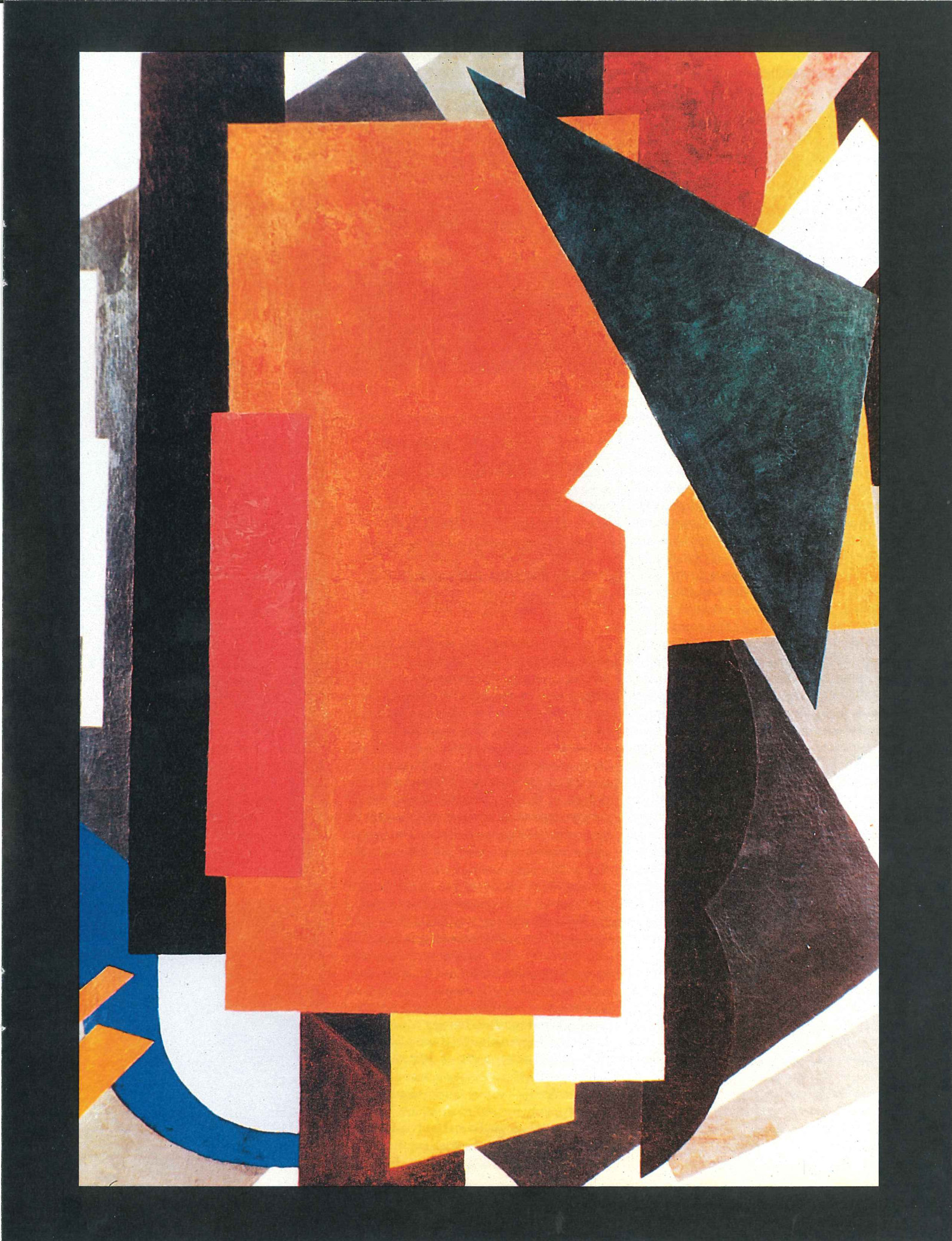
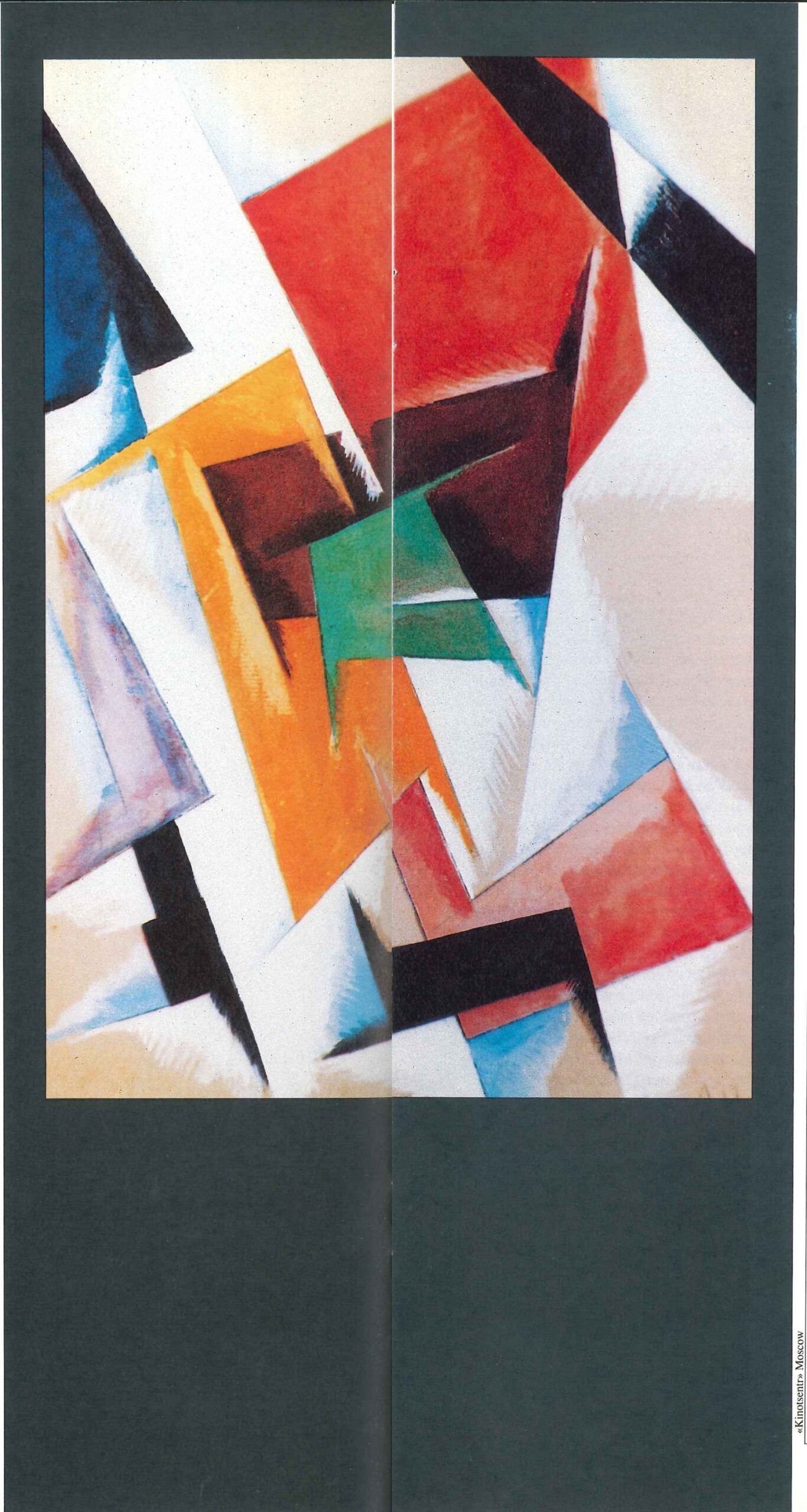
Besides being a collector, Costakis was a person of charm, and wit, and generosity, and great tenacity. Above all tenacity. The painters of what is now called the Russian avant-garde (names such as Chagall, Kandinsky, Malevich are best known in the West, but others like Popova, Kliun, Rodchenko, are becoming known) between 1910 and 1922 took an entirely new artistic path, created the first wholly abstract paintings, developed theories about what they were doing and wrote them down. They were artists of great imagination, remarkable intellect, and the highest technical competence. They supported, for the most part, the Bolshevik revolution, and for a time it supported them, giving them jobs in institutes and letting them have their head. But during the 1920’s reaction set in, in art as elsewhere. You had to prove you were useful. Gradually, the vast innovations of the avant-garde were choked off. After Stalin became omnipotent in 1928, the flow of air to them became minimal, and ceased altogether in 1934, with the promulgation of socialist realism as the only acceptable style in any art form. It became extremely dangerous to paint (or write, or compose music) in any but the approved way, and even to possess the works of these artists was something no sensible person wanted to do. The artists died, the works were hidden under beds and lost in attics, the whole glorious thing was consigned to the memory hole.
That was the situation in 1946 when George Costakis, a locally-engaged clerk at the Canadian Embassy in Moscow, who collected carpets and old silver as a hobby, saw two or three works of a long-since dead artist called Olga Rozanova. Overnight his life changed. He decided that his mission in life was to find and collect the paintings and other works of Rozanova and her group. “God sent me into the world,” he remarked once, “to save this art for the Russian people.”
1946 he set about his assignment.
26 bout de papier Vol.
Those were dangerous times for artists in Russia. Stalin was still alive and bent on repairing the cracks in his autocracy created by the wartime alliance with the West. His cultural henchman was the unspeakable Yury Zhdanov. Between them they brought Russian literature and art to its most abysmal depths, during the years between the end of the war and Stalin’s death in 1953. But to the clerk in the Canadian Embassy none of this meant much. Nobody knew about him, and the few who had heard of the avant-garde artists, most of whom were by then dead, regarded them and their work as junk. So Costakis set about making his collection — helped, to be sure, by the fact that when Ambassador Dana Wilgress had hired him, they struck a deal which included Costakis’ being paid partly in dollars.
So, when he was not busy finding cabbages and carrots for a hungry Canadian Embassy, or meeting shipments at the customs house, or dealing with unhappy Canadians who could not understand what their maids were saying, Costakis was out in the art market. He found works now worth millions stopping up drafty barn windows, moldering on the tops of Russian stoves, hidden in dusty cupboards by the artists’ devoted but fearful widows and children. He paid what he could — far more than anyone else was prepared to offer, but still very little. The works had, literally, no value in that market. There was no market. Nor at that time would most of them have had any value in the West. Within 10 years of beginning, he had created a collection extraordinary by any standard, all of it hanging on the walls or reposing under the beds of his little apartment on Bolshaya Bronnaya St., very near to where the Canadian McDonalds now dispenses hamburgers to hungry Muscovites. Urged on by successive Canadian Heads of Post and their staffs – John Holmes, John Watkins, David Johnson, Arnold Smith, Robert Ford – all of whom were themselves deeply interested in art and in what Costakis was doing, he spent his nights and weekends in the great search for the avant-garde, and he found it.
Costakis was born in Moscow in 1912, the fourth of five children of a well-off Greek tobacco merchant. The Revolution in 1917 threw the family more or less into the street: George barely finished ten years of education, and was, of course, discriminated against because of his foreign nationality and bourgeois origins. His life during the 1920’s and 1930’s was a scramble to stay alive; the vast and terrible drama which unfolded in Russia in those years made remarkably little impression on him. He married his delightful Russian wife Zinaida (Zina to most Canadians who know her) in 1932, produced four children (she and they all survive him, as do several grandchildren) and eventually managed to land a job as a driver in the Greek Embassy. It was probably this job, and the fact that he was registered as a Greek while they were not, that saved him from following his brother, aunt and mother into Stalin’s gulag, where they spent several years but lived to return home. The Greek Embassy job led to another in the British Embassy, and that to the distinctly better one of administrator, or trouble shooter, in the Canadian Embassy when it moved from Kuibyshev and opened for the first time in Moscow in 1943. Dana Wilgress records in his memoirs: “I decided to give him a trial and took him on. Immediately our troubles were over. When any difficulty arose, Costakis would be advised and somehow or other he always found the solution.”
Russians love to collect and Costakis — who was Russian to the core except for his passport, olive skin and brown eyes— must have been one of a fairly large population who spent their days at ordinary jobs and their nights in exotic corners of the art market. Costakis knew many collectors, and was full of marvellous stories about them. Most of them were even poorer than he. Some had no job, others totally menial ones. In his case, however, his two occupations meshed in an interesting way. The skills which made him so good at his job in the Embassy, his trouble-shooting genius, his ability to find his way around, past or between the legs of the Soviet bureaucracy, his ingenuity at making do, at improvisation, at talking Soviet officials into doing things they thought they would rather not do, were the same skills that brought him to the paintings of the great masters of the avant-garde, and brought those paintings into this collection. Not a small element in his success at both jobs was his common humanity. He liked people, was interested in them, and was generous to a fault with them. They reciprocated in kind. The locally-engaged Soviet staff in the Embassy, those few who remain from his time, speak of him still with obvious affection, as do most of the hundreds of Canadians who knew him as they served their two or three or four years at 23 Starokonyushenny Pereulok. Certainly, he was not a great administrator. The little office which he shared with an untidy Soviet woman helper (definitely a KGB employee, according to Costakis) was always a meaningless jumble of paper. George himself seldom arrived at work on time. But if results are what matter, he got them, in the Embassy as in the art market.
The collection grew and grew, as did the Costakis family. They moved to a larger apartment, then to a still larger one (this last the one where the second “funeral” took place on March 13). The walls continued to glow with the brilliant colours of Chagall, Kandinsky, Malevich, Goncharova, Larionov, Kliun, Popova, Kudriashev, Rozanova (who had started the whole thing, and whose marvellous “Green Stripe” ’, painted in 1917, is one of the masterpieces of what remains of the collection in the West) and some forty others. After Stalin’s death in 1953, it became possible (but not easy) to travel abroad. In 1956, Costakis got permission to go to Stockholm for a kidney operation. The operation turned out to be unnecessary (later it became necessary) but, finding himself in freedom and with time on his hands, he decided to go to Paris to see two of the avant-garde painters with whom he had been corresponding, Natalia Goncharova and Mikhail Larionov, who lived together in very poor circumstances. They, however, were in touch with Marc Chagall, whom Costakis also met and stayed with at St-Paul de Vence, before returning to his humble clerk’s desk in Moscow. It was the beginning of fame, and for that very reason the beginning of a 20-year process which culminated in Costakis’ virtual expulsion from the country he regarded as his own.
From the start, Costakis had been supremely generous about showing his treasures to his Canadian employers, and even giving or selling them works from it. Zina would set the table in the confined apartment, there would be caviar with blinis and sour cream and a little vodka and chicken kiev or some other good Russian thing, four or five Canadians would crowd in, sitting with their collars rubbing some priceless Chagall or 15th century icon, and after supper they could admire the marvels of the collection and the newest acquisitions. But until 1956 or thereabouts, this was a privilege reserved for Canadians. Until then Costakis had been careful not to make much noise about what he was doing, because his avant-garde collecting had been illegal and very dangerous. But in the more relaxed atmosphere of Khruschev’s Russia, he began to succumb to a quite natural wish to let other interested people in on his secrets. Foreign diplomats heard about and sometimes saw the collections. So did foreign journalists. Articles began to appear in the Western press. The first full-length book about the Russian avant-garde was published in England, and Costakis figured largely in it. About this time, 1956 and 1957, visitors began arriving in Russia in considerable numbers, among them art historians and curators longing to see the fabulous treasures of the vaults and cellars of the great Soviet museums, the Tretyakov in Moscow, the Hermitage and the Russian Museum in Leningrad. They were not at first looking for the avant-garde. They were for the most part coming to see the Impressionist and post- Impressionist collections of these museums, especially of the Hermitage, to which foreigners could sometimes get access but Soviet citizens still could not because of the morally corrosive effect of Matisse, Van Gogh, Corot, and others still more dangerous. But, of course, once in Moscow they heard about an extraordinary collector called Costakis, and they went to see him. The numbers and the importance of these visitors grew every year. Costakis was soon on the “must do” list of every Western Embassy for its VIP visitors. Chagall came, Stravinsky came, David Rockefeller came, Senator Edward Kennedy came, Pierre Trudeau came, when he was Prime Minister. Costakis, being human, was flattered, but he was sticking his head into a noose.
With benefit of hindsight, it is possible to see that the Soviet cultural authorities of the day simply lost their tempers with Costakis. Here was a nobody, a foreigner, collecting junk art banned from the walls of any Soviet gallery, banned for sale in any public place, officially denounced as unworthy of the new Soviet society. Perhaps that would not matter if only he kept quiet about it. But he trumpeted his collection from the rooftops! Foreign art experts came to Moscow. Do they want to meet our greatest Soviet artists, members of the Academy, high officials from the Ministry of Culture? No, they do not. They want to go to Costakis’ miserable apartment and look at his decadent, rotten art, quite properly discredited and proscribed for the past 30 years. And, when this practice extends to Prime Ministers, Senators, heads
28 bout de papier Vol. of important delegations, guests of the Soviet government, things that have gone too far. The authorities decided to act, and, in the middle of the 1970’s, the job was given to the KGB.
Costakis’ relations with the KGB have been the subject of speculation. How, people have asked, could he have worked all those years in a Western embassy, a NATO embassy, and been left alone to form his very valuable collections, unless he were a KGB agent of some kind, or protected in some way by the authorities? The evidence available, and even more so common sense, are strongly against any such conclusion. If he was protected, it was by his Greek nationality, his long embassy connection, and the fact that successive ambassadors gave him their complete confidence. And, it is not the style of the KGB to persecute their own agents and finally hound them out of the country, which is what happened.
Characteristically, the KGB decided to use a kind of personal terror against Costakis. The objective was to force him to emigrate from the Soviet Union, leaving all his collections behind. Beginning in 1975, Costakis became aware that the KGB surveillance, which had been with him for many years, was becoming closer and heavier and more threatening. Strange things started happening. His apartment was broken into by someone who had a key, and many art works were stolen. That happened twice before he began to suspect more than ordinary burglary. Then, the summer cottage which he and his brother and their families shared, caught mysteriously on fire and many art works were destroyed or damaged. The pressure built up. He feared for his life and his family’s lives. He insisted that his children not travel with him in the car, car accidents being a preferred way of dealing with difficult people. Finally, to compress a long story, he appealed to a fellow art collector who was also politically influential. This man spoke to others in high places, and Costakis and his family were allowed, in 1978, to leave the country with about one-fifth of his avant-garde collection. The other 80% went as his gift to the Tretyakov Gallery in Moscow — which, of course, made no announcement of the fact, and put the works in storage. But he had to leave his icon collection and most of his other property behind. He left without recognition or honour. He was at least once described by a Soviet official as a traitor. The KGB could say they had carried out their task in a reasonably satisfactory way: George Costakis was gone and no longer a thorn in the side of the Soviet government. If a small part of his collection has gone with him, most had stayed behind.
Once in the West, Costakis sold some major works from the collection to provide him with a living, then settled down in Athens with two of his four children. He was thoroughly homesick for Russia, and remained so until his death. The part of his collection he had brought with him toured the world — which had by then (1981) found out what the Russian avant-garde was.
Then there was Gorbachev. In 1986, with glasnost in flower, Costakis suddenly found himself in favour in Moscow. Hailed as a great collector, a benefactor of the Soviet people, he was invited back to Moscow for a red-carpet reception and an exhibition of part of his collection which continues to be exhibited from time to time. The Soviet Ambassador attended his funeral. His rehabilitation, and that of the Russian avant-garde, has been total. His mission was accomplished. It is this, rather than the sale prices at Sotheby’s, which in the end matters. The place of the Russian avant-garde in art is assured and recognized, whatever the prices may do.
Costakis’ best friends were his Russian friends, but the Canadians came next. In 1989, just a year before his death, crippled and ill, he came to Montreal for a spectacular exhibition of his avant-garde collection at the Musée des Beaux-arts. He said he had never seen “my children”, which was how he called the paintings of his collection, so finely exhibited. The Minister of Communications came from Ottawa, the Mayor of Montreal was there. Then, George travelled to Ottawa to meet his old Canadian friends, men and women who had served in the Canadian Embassy in Moscow since 1943, and treasured their friendship with him. He said hello to them and, obviously, goodbye. It was his last appearance in public.
View the original scanned pages →
Originally published in bout de papier, Vol. 7, No. 4 (1990), pp. 24–28. Read the rest of this issue →



