
bout de papier, Vol. 7, No. 4 (1990), pp. 18–19
Author’s Note: In February, 1990, I was in Nicaragua for the elections. In the tense days before the election, random travel was not to be taken casually, but most foreigners are very partisan about Nicaragua and I wanted to test the reality for myself. I visited Leon, Masaya, and Granada and attended the final Sandinista rally in Managua.
On the way to Leon is the barrio of Ciudad Sandina. Many families here have opened their homes to orphans of the fighting but one woman is doing something very special. In a dilapidated, poorly lit house, a few dozen orphans are being taught to paint the little wooden plaques with the quaint typical scenes that tourists love to buy. Dona Blanca is a small, quiet person who never raises her voice to the children. They come after breakfast when they can. Sometimes the older ones have to go out to work, but the young ones come nearly every day. The plaques are bought by a government distributor and the children receive some money for producing them. Several of the children are very talented, however, and also create oil paintings of naive poignancy. These are sold directly and the money goes to the young artist. More than money, these children receive love, attention and consistency, something their young lives have rarely known.
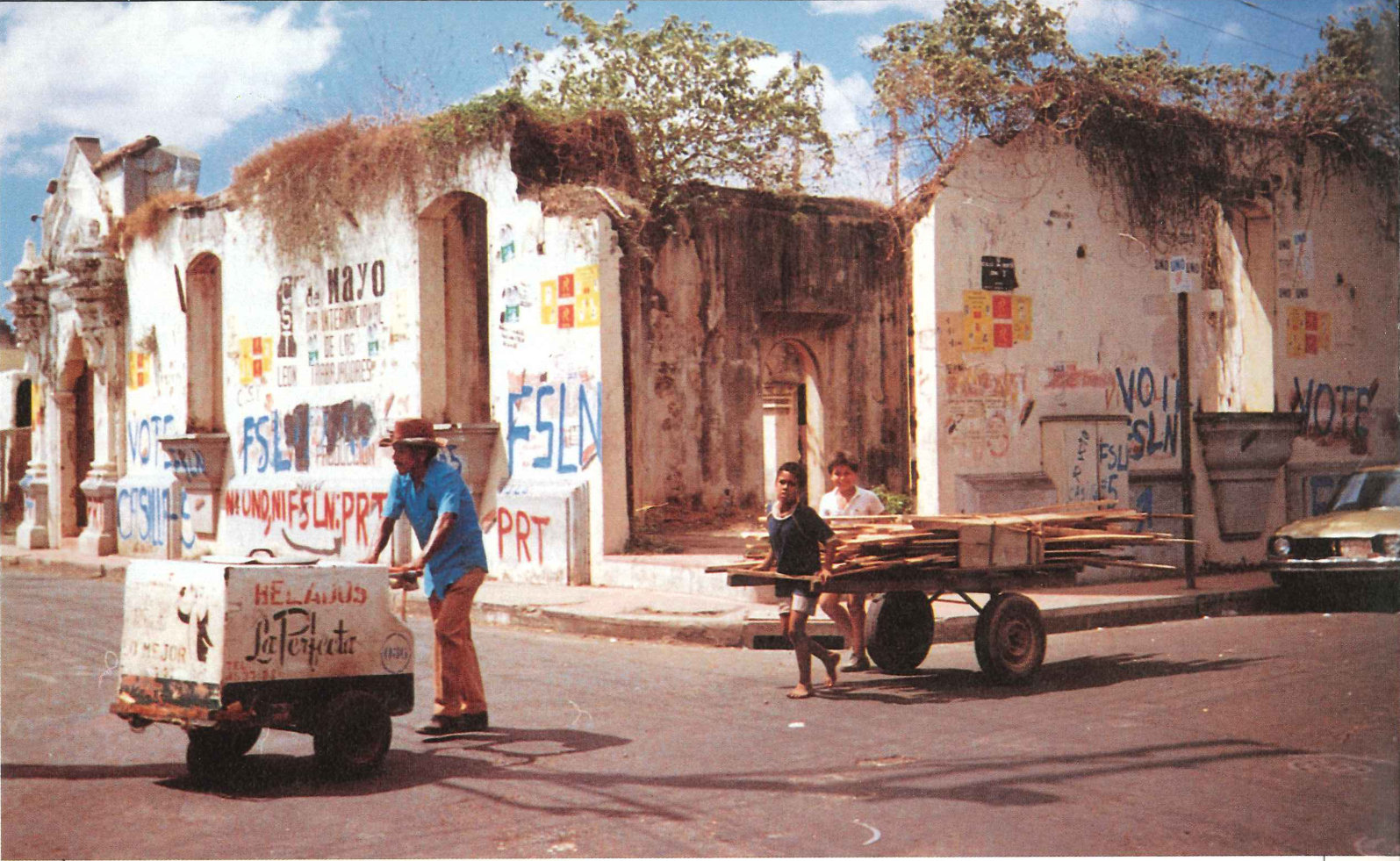
The sturdy stone walls of Leon are pockmarked with bullet holes from the Sandinista revolution and the cathedral clock still marks the hour that the Somoza bombs fell. Outside the cathedral a few people were selling home crafts and sour oranges and two small boys played tag among the pews. One of them cut his foot on a piece of garbage and nonchalantly washed it off in the gutter. Farther down the street, three teen-aged soldiers with automatic weapons watched an old woman sweep the street and a girl child fill a bucket of water from the public fountain.
In another direction lies Masaya, the artisan centre. Masaya is not a beautiful town, not even a quaint one. It is old, shabby and splotched with political graffiti. In fact, political graffiti had been painted onto every flat surface in all of the towns and villages. There will be no way to remove it except to paint it over which might not be a bad thing. The buildings all need painting and the people need to start healing their differences.
Outside the market under-nourished ponies waited patiently in their shafts for the next client wanting a taxi carriage. Inside the market painted plaques and crude leather goods, typical paintings and wooden goblets attracted more flies than tourists. There were some creative soapstone carvings but most famous are the colourful sisal mats.
At the edge of town, a small open air factory cards, twists and dyes the tough rope. The carding machine was made of rows of rusty spikes pounded into a hand-hewn timber and the spinning wheel was counter weighted with stones and scrap metal. The little girl hanging up the dyed skeins was too short to reach the wire line but she tossed them over with practised accuracy. In a room with two tables and space to stand a woman and boy are hand stitching the sisal into mats.
She told me it takes her about four days to complete a 3 by 5 foot mat because the sisal cuts her fingers so she cannot work more than a few hours a day. I asked her how much she would make from such a mat but she just shrugged; her boss was leaning over the window frame listening to our conversation. She never once took her eyes off the mat or stopped working.
Beyond Masaya is the beautiful lakeside town of Granada. In the park tall, graceful royal palms swayed against the blue sky. In front of the church a fine black funeral wagon drawn by matched horses, decorated with flowers and black net, waited in solemn ceremony. Granada did not seem to have as much political graffiti and some of the buildings had fresh paint. In fact, there must have been a sale of shocking pink and turquoise paint because in one street nearly every building sported doors, balconies and entrances in these colours.
There are several hundred small islets around the edge of Lake Nicaragua, each one inhabited by one family. It was possible to rent a launch and spend an hour amid the peaceful channels and water lilies watching the storks and pelicans catch fish. From the rocks old men tossed round fishnets and for some minutes I watched two young boys tend two fishing cormorants. The young man driving our launch had his home on one of these islets as had his father and grandfather. All the property is hereditary and cannot belong to anyone except these families. The inhabitants, who live independently of the municipal electrical and water supply systems, who go to market by water instead of road and who harvest the lake for food and income seemed more fortunate than the campesinos who had had to flee their small farms and trust to the beneficence of the capital.
Nothing has been rebuilt since the centre of Managua was flattened by the 1972 earthquake. The designated international funds did a Somoza sidestep. There is no city centre, no downtown. There are various sections with a few stores, houses and restaurants but there is no commercial centre. There is no need for one because there is no significant merchant class. A few large nationalized agro-industries produce export crops but there is very little opportunity for entrepreneurs. One open-air cement block factory with half-a-dozen workers was operating along the road to Leon and somewhere there must have been a factory for kapok mattresses because stacks of these brightly-coloured mattresses were common along the streets of Managua.
Managua probably has more parkland than any other city in the world. This is not by design but because levelling the rubble and covering it over was the only affordable way to clean up the city. Acres of flat construction sites await their opportunity, in the meantime, they provide pasturage for small wandering herds of cattle. The standing ruins shelter the homeless or house nesting birds. The lake which could provide water, food and recreation is polluted by raw sewage beyond any use. It is completely ignored by everyone.
In what had been the commercial centre of the city, the soaring skeleton of the Basilica stands in mute reminder of other days. A gang of boys has made it their clubhouse and they perch on the stone arches, silently remote from the activity on the streets below.
José sold cigarettes while his mother swept the street around the parking lot.
In the parking lot below were displayed twenty-four shiny new buses. On the streets people rode in battered, smoke-spewing antiques or, more commonly, on benches in open slate-sided trucks. Roadsides were littered with burnt-out and abandoned car bodies and most vehicles were miracles of ingenious reparations.
Next to the parking lot is the small concrete Plaza de la Cultura were, in a unique display of togetherness, were flying both the red and black banners of the Sandinistas and the blue and white banners of the UNO, the main opposition party. Nearby is located La Plaza de la Revolución, a huge open field with a grandstand, where a quarter million supporters gathered for the final Sandinista rally. On the day of the rally, I went to the Canadian consulate which abuts these two plazas to form a triangle.
First to arrive were the women and children with their charcoal braziers and round-bottomed pans for cooking rice and beans, fried bananas and pork. The children decanted soft drinks and beers into plastic bags to be sold to the thirsty crowds. There were few men at this hour. They arrived later, brought in by truck. Most of the men wore clothing advertising the Sandinista party. Full political dress would have been a white Ortega T-shirt, a baseball cap in red or black with appropriate slogan, a red and black neckerchief and a red or white kami-kazi strip tied around the forehead or thigh.
I did not have courage enough to taste the greasy food, even after the flies were shooed away, but they talked with me anyway. One of the women said her daughter had a good job and was earning twenty dollars a month; one bragged of a son-in-law earning sixty dollars a month. They all shrugged their shoulders over the economic and civil conditions and had no plans beyond tomorrow. This strata of society, which is most of the civilian population, exist in a nearly cashless economy. One man opined that attendance at the rally was more practical than political. As in turned out two days later, he was right.
The rally started in mid-afternoon with a raucous stage show to entertain people as they streamed down the central street into the plaza. The field itself was masterfully managed with long lines of young men placed around the plaza to separate large groups and give the appearance of huge numbers. They responded obediently to calls for flag waving and cheering. It was well-staged but not enthusiastic. Even the uninhibited lambada music inspired only a few modest hip swings throughout the crowd. At nine o’clock. after several hours of speeches and five minutes of fireworks, the crowds went in search of the trucks to take them back to their villages. I watched the fireworks from the terrace of a hillside restaurant; six hours of slogans, thirst, dust and heat is enough.
Today political leadership was transferred after a democratic election. The ceremony was inexpert and marred by some instances of rowdyism, but no one was killed. That’s progress in Nicaragua. Today in Columbia, they shot another political candidate.
An old, dour-looking market woman comes to mind. Her gray hair indicated that she had survived a lot of history and I wondered if she had any insights on human nature to share. After a few minutes she looked up and asked me if I wanted to buy some of her dried calabashes. When I shook my head in denial, she returned to contemplating the rooster tied up under her table. The look on her face was quite explicit — if I wasn’t a customer, I was irrelevant, and a nuisance to boot. As a comment on foreign presence in Nicaragua, she may have had something to say after all.
View the original scanned pages →
Originally published in bout de papier, Vol. 7, No. 4 (1990), pp. 18–19. Read the rest of this issue →



