
bout de papier, Vol. 7, No. 4 (1990), p. 13
This article is adapted from a chapter of Sidney Freifeld’s new book Undiplomatic Notes: Tales from the Canadian Foreign Service, to be published by Hounslow Press in October. The book will be illustrated, like this article, with drawings by Susan Macartney.
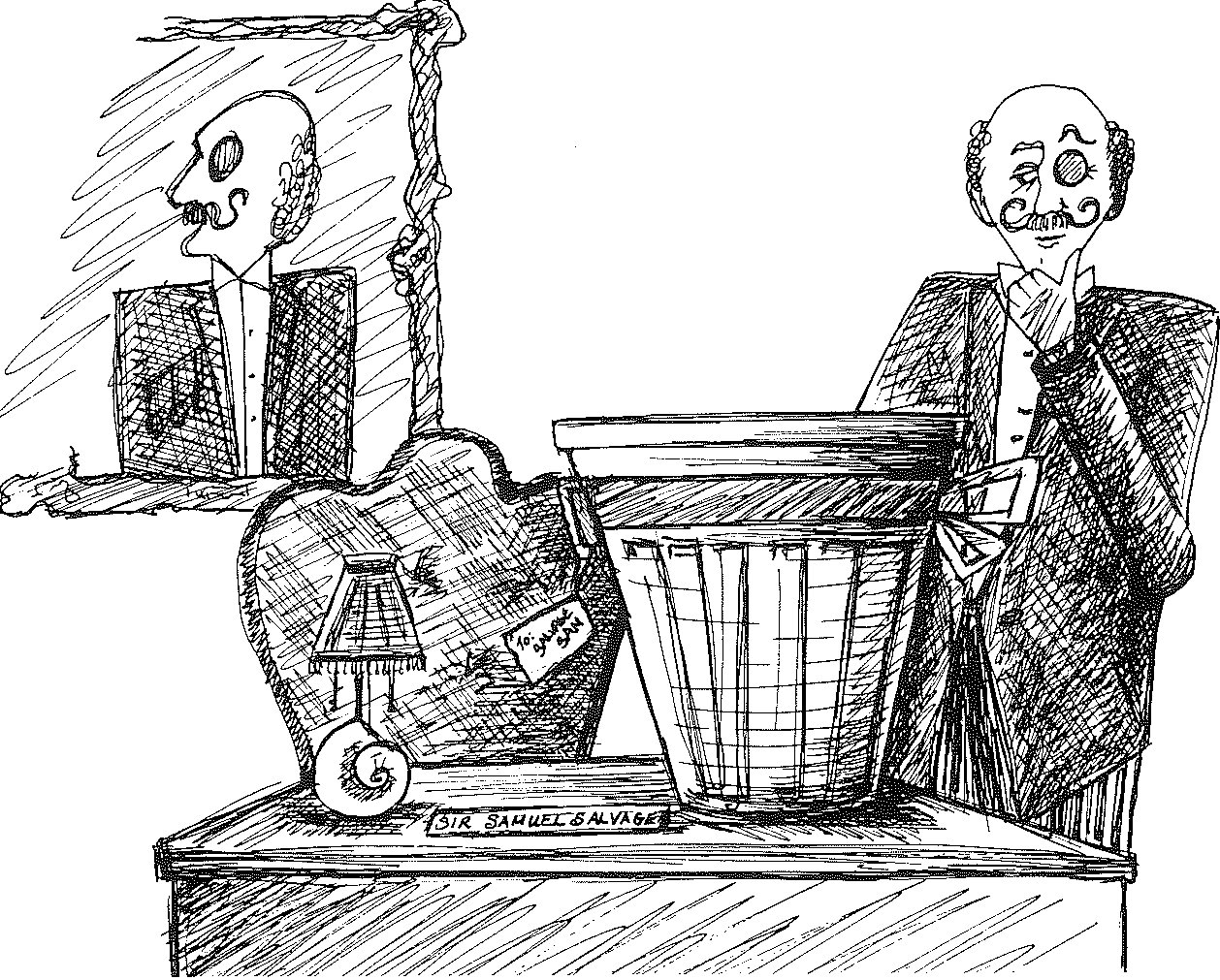
Whenever Canada Post comes back into the news — with talks about privatization, more cuts in service and whatnot — my mind goes back nearly half a century to some bizarre events enveloping my wife’s mail when she was working in the Empire State Building in New York City during World War II. I was serving as Consul at the newly-created Canadian Consulate General in New York at the time.
Before the war, Crenia had been working as a public relations officer for the National Association of Manufacturers. After the United States entered the war and built up an enormous war machine, shortages of many kinds began to be felt, especially in metals. The NAM created the American Industries War Salvage Committee to promote the saving of scrap metal by householders nationwide.
The NAM designated Crenia to run this salvage campaign, and installed her in a modest one-room office on the second floor of the Empire State Building, then the highest office building in the world and, higher up than Crenia, one of the grandest. Unbeknownst to her, on a floor very high above hers were the imposing offices of the Celanese Corporation, a far-flung transnational enterprise headed in the United States by Sir Samuel Salvage. Celanese’s headquarters were in London.
Crenia started her salvage campaign by setting up voluntary committees in communities across the United States. To inspire them to ever new heights, she created and sent out to them a little weekly paper which she called The Scrapper. She sent it to newspapers and local community committees far and wide.
One of our very best friends in New York at that time was an illustrator and cartoonist, Elliot Caplin, who happened to be a younger brother of the creator — Al Capp — of the most famous newspaper comic strip in the United States, Li’l Abner. Overshadowed by his brother, Elliot found it very difficult to market a comic strip of his own, so he pioneered in adapting the comic strip and cartoon technique for educational purposes, le Mix-Up in thi particularly for the United States Armed Forces.
At that time, Elliot also worked for the prestigious Parents Magazine Press, where he created two monthlies which achieved nation-wide circulation, True Comics and Real Heroes. These publications, using comic strip form, depicted the lives or exploits of the world’s great. From the Canadian Consulate General, I made sure he had material for a sequence on a Canadian for every issue: Mackenzie King, Andrew McNaughton, Mike Pearson, Billy Bishop, Buzz Buerling, and many others.
On Crenia’s request, Elliot came up with an idea for her scrap and salvage drive. He created Salvage Sam who, in comic strip form in the weekly Scrapper, would show Americans out in the boondocks how they could help win the war by turning in old garbage cans, empty tins and bottle to their local scrap committees.
Now what’s all this got to do with the Post Office?
Not long after Crenia and Elliot launched Salvage Sam, a strange thing began happening in their mail. In the nether regions of the Empire State Building, Crenia and Elliot — Salvage Sam’s parents — were puzzled to receive letters in The Scrapper office inviting Samuel, or Sir Samuel, to tea at the Harvard Club, or to dinner with Oxford and Cambridge graduates in the metropolitan area. One day a formidable embossed invitation card arrived, inviting Sir Samuel to the annual dinner of New York members of the Pilgrims Society.
In fact, Sir Samuel was asked to speak. This impressed the occupants of The Scrapper office no end.
Meanwhile, up in the posh penthouse floors of the Empire State Building housing the mighty Celanese Corporation, Sir Samuel Salvage began receiving no less puzzling mail. In would come a letter saying “Great tip you gave us on old garbage cans last week, Sam,” and another, saying “Sam, you’ve helped Walla Walla to meet its goal on bottle tops.” One letter asked “Salvage Sam, should we step on tin cans to straighten them out before turning them in to your scrap committee?”
It took some undercover investigation and a diplomatic intermediary (me) to get these oddities in the mail straightened out. Regretfully, Salvage Sam on the second floor and Sir Samuel Salvage on the 92nd never did get to meet one another formally. Host track of what became of Celanese Corporation’s Sir Samuel. But Salvage Sam’s creator went on to outdo his world-famous brother. Today, under pseudonyms, he is the creator behind half a dozen of the world’s most popular comic strips in our daily newspapers.
As for Crenia, she was soon plunged into even more bizarre hazards of spousedom in la vie diplomatique.
View the original scanned pages →
Originally published in bout de papier, Vol. 7, No. 4 (1990), p. 13. Read the rest of this issue →



