
bout de papier, Vol. 5, No. 4 (1988) — Winter 1988 // Hiver 1988, pp. 12–14
What was it like to join the Department of External Affairs 50 years ago?
For some of us — and it was an event for seven Third Secretaries to be appointed within 12 months — the process may have been a lengthy one. I first wrote examinations at Canada House in London (where the invigilator was the then Official Secretary, Colonel Georges Vanier). I was then orally examined in Ottawa nearly 10 months later, and placed on the eligibility list, which, lapsing the efflux of time, meant that I wrote the examinations a second time, in Montreal. Oral examination in Ottawa, Dr. Skelton again presiding, I appearing with rather more confidence, was followed by 15 months before I finally reported smartly for duty at the East Block in mid-July 1938.
Though I had been born in Ottawa, it had been home only to age two; and although I had had visits from 1931 onward, travelling to or returning from England, I still had to get to know the city, which was then to become home for 25 years.
I was greeted officially by John Read, Legal Adviser and Acting Under-Secretary, who shortly informed me that I was to begin in the Prime Minister’s Office (who was of course also Secretary of State for External Affairs). There was precedent for such secondment: Norman Robertson had been briefly in the PMO before being detailed to trade negotiations at Washington; Jack Pickersgill had followed, without much specification as to duties, several months ahead of me. The intention was that I should spend six months in the Red Carpet Department, little suspecting that I would spend nine years on secondment — 22 months at the East Block, 7 years and three months at Laurier House, less four weeks on the fourth floor of the new Post Office Building, now called Station B. But on that first July day, having filled in some establishment forms, I was ushered down the corridor with a variant of what J.W. Dafoe had once called “every assurance of distinguished consideration.”
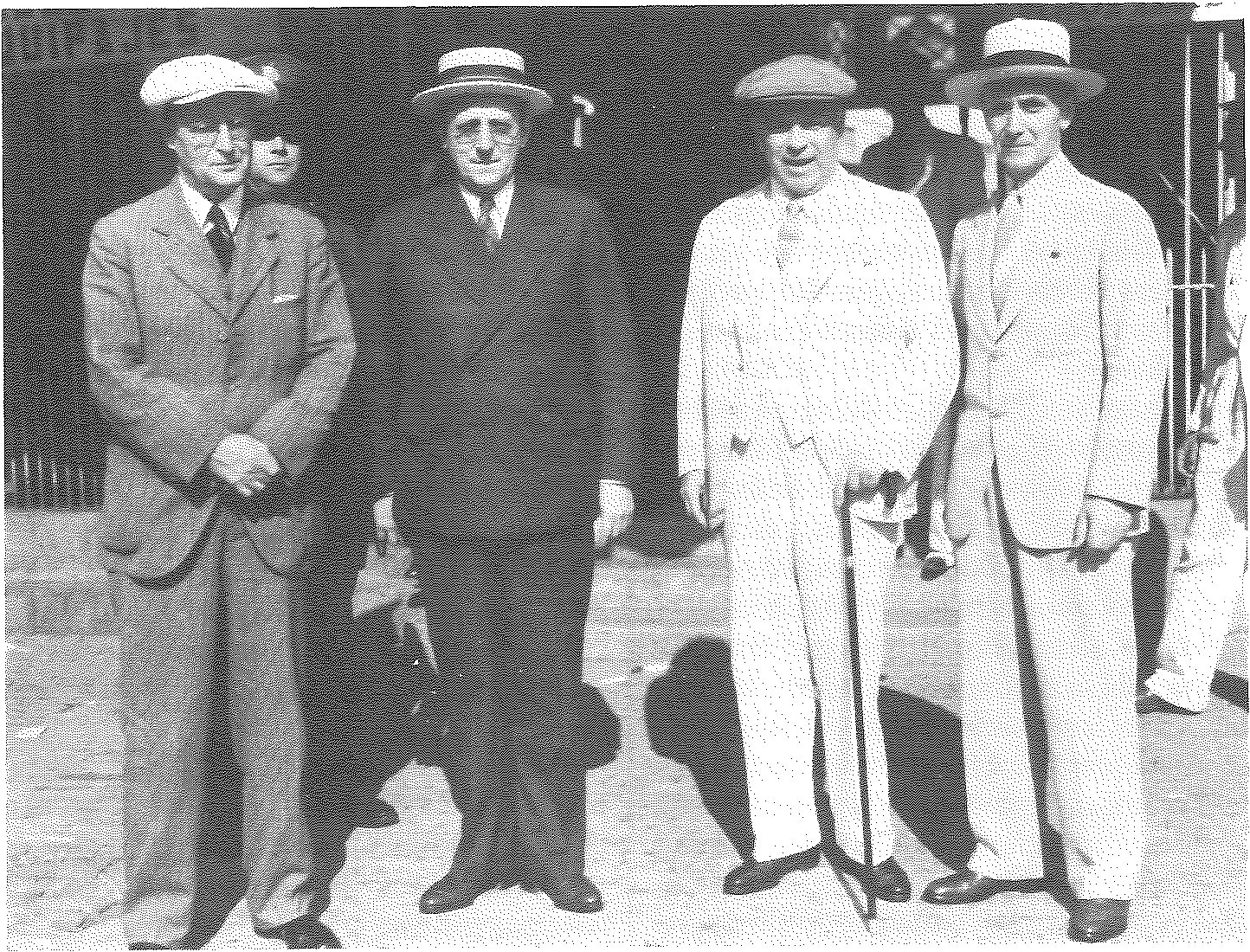
I worked for eight days in a cubby-hole in the attic — not I think originally designed for human habitation – and then moved down to a spacious high-ceilinged room with deep window embrasures, on the second floor opposite Mr. Mackenzie King’s outer office. Apart from the candlestick telephone, it could not have changed very much from Victorian times. The desk at which I worked was polished walnut, with fluted legs, a green baize top, and drawer handles shaped as bunches of grapes. (When I moved to the top floor of Laurier House, I asked if the desk might go with me, but was told there was no authority to move it from the East Block. I then made do with a standard oak desk, in a room perhaps one eighth the size of my earlier domain.) There was a fireplace, in which one could light a coal fire for winter afternoons, after assurances from three public works functionaries, in ascending order, that coal would be provided. Over a period of months I shared this office with a variety of colleagues — some now deceased — of whom the most notable was Jules Léger (later Governor General), in those far-off days my principal mentor in “assured French.”
Though I was by way of being junior generalist, my main preoccupation was with “short notes” for speeches and public occasions. Without embarking on flights of fancy I would put down what I thought might be appropriate, the field extending to messages for commemorative occasions. the Spring of 1939 I was “put on” to arrangements for the Royal Visit, in particular those involving the Prime Minister personally. As matters developed, some of my colleagues and I became mediators between the Prime Minister’s fixations and the predilections (not always distinguished by common sense) of some members of the Government House staff. Last before Their Majesties landed at Quebec — delayed 48 hours beyond the original timetable – we had to telescope five Ottawa days into three. But over the whole compass of the visit the arrangements worked usefully and well.
There were occasional External Affairs duties that suggested that I “belonged” Dr. O.D. Skelton knew the calibre and the expertness of all his men, as we were then (the headquarters establishment numbering perhaps 60 of all ranks). I took it as a compliment that he one day came into my office with a file and said, mildly “there seems to be some trouble about this — would you mind having a look at it and letting me know what you think?” He knew the subject fields of post-graduate studies of recently-appointed officers and, frequently, the supervisors of their advanced studies. He commanded enormous respect among his opposite numbers in other foreign services. Once, before I was appointed, my neighbour at a dinner in Oxford, who was the Permanent Under-Secretary, Dominions Office, asked “what I was going to do next?” Hearing that I had written the foreign service examinations, he said “P’ll drop a note to Skelton” (which he did). Some 14 years after Dr. Skelton’s death, attending a conference in Oslo as a C.I.I.A. delegate and meeting the then Under-Secretary of State of the Norwegian Foreign Office, his first question was, “were you one of Skelton’s men?”
The “trouble” to which Dr. Skelton alluded arose from a consequential but important amendment to the British North America Act to add unemployment insurance to matters of federal competence under s. 91. The text of the amendment was simple and straightforward, but a Parliamentary draftsman at Westminster had attempted to “touch up” the preamble, and the High Commissioner in London had objected. I read the papers and drafted a letter to the Deputy Minister of Justice asking his opinion and using a sort of official idiom. It eventually produced a reply saying (as I had fancied it might) that he entertained no doubt that it was proper for the Government of Canada to insist on the language as drafted in Canada.
On another occasion, as a preliminary to a federal-provincial conference, Dr. Skelton asked for a note about the way in which Parliamentary delegations to the Charlottetown and Quebec Conferences in 1864 had been chosen. By drawing on my B. Litt. thesis which had considered the matter I was able to hand in a memorandum within two hours; Dr. Skelton remarked it might have taken other people two days.
There were some less considered interludes. Each of us did a share of decoding and deciphering, working overtime in August, 1939. (This was before there were encoding and deciphering machines.) On one rather bizarre day in 1940 I was detached to an upstairs room at 40 Bank Street, arriving to find it encumbered with nearly $40,000 in one-dollar bills. For a period the United States required passports of Canadians wishing to travel south of the border. (Dr. Skelton was heard to remark that it was the least-considered act of the U.S. Government since the denunciation of the Reciprocity Treaty in 1866.) Before the flood of passport applications and accompanying cash abated, the newest Third Secretaries found themselves assigned to temporary duty at border crossings: Windsor, Sault Ste Marie, St. Stephen, N.B. But with the assistance of men borrowed from Post Office and National Revenue, the cash flow was contained, and after a season the passport requirement was revoked.
Royal visit requirements, as I have suggested, involved planning, consultation, persuasion, cajoling and a gradually-developed expertise in saying no. I received delegations propounding fanciful schemes (removing all the stumps from the railway right of way between Montreal and Ottawa, offers to supply fresh snow at $1.60 per bag f.o.b. Haileybury, and Ministerial Association representatives distressed that the formal dedication of the National War Memorial had been fixed for Sunday morning). Earlier errands had brought me in touch with numbers of Deputy Ministers; the newer supplicants were members of Parliament who rang the changes; “Young Man, if the Royal Train doesn’t stop in my constituency, I can’t possibly be re-elected in the next election.” There were minor problems with functionaries who hadn’t read (or perhaps hadn’t grasped) carefully-printed instructions; a few couples lost or misplaced tickets of admission. But the splendour of the public occasions — in the Senate Chamber, at the Supreme Court, and the extraordinary scenes in Confederation Square — seemed far to outweigh the minor irritations.
I received some injunctions at first hand: pacing out the appropriate number of steps at the War Memorial and at the Supreme Court site, a Prime Ministerial voice said “This has got to be absolutely right: they will take pictures and send them all over the world, and they will expect us to know how to do it.” Mr. Mackenzie King had one last word on the subject; I was on duty when he returned from Halifax having seen the Royal Visitors off on their way to Newfoundland. I ventured a gentle reproach for his having jumped off a moving train at Moose Jaw. “Oh pshaw!” was his comment (as I fancied my grandfather might have said it).
There were occasional duties appropriate to function and perhaps to status. For luncheons at the Country Club, where the guests did not exceed a dozen, Mr. King would entrust the arrangements to me (for more than 12 Protocol took over); and it was a certain mark of confidence to write out forms of invitation (the endorsement did not extend to place-cards for dinner). The only “formal” luncheon at Laurier House to which I was “invited” (i.e. detailed to take mental notes) was when the Chief of Protocol from Washington (later to be Ambassador to Ottawa) came to deal with advance arrangements for the visit to Ottawa of President Truman. It emerged that the President liked bourbon (of which I made a note), but, despite reasonable promptings, we had to send an office messenger late in the day of the Prime Minister’s dinner to purchase a bottle of Canadian bourbon. (I am not aware that it was ever opened.)
There were other kinds of duties. When Postal Station B was ready for use (at the corner of Confederation Square and the Sparks Street Mall) Mr. Mackenzie King was invited formally to declare the New Post Office open.
“How does one open a new Post Office?” he asked (as one prepared to welcome any reasonable proposal).
Perhaps learning on the job, I remember suggesting that he could write a letter to the oldest surviving Postmaster-General (Sir William Mulock, then nearing 100), buy the first stamp over the counter, and post the first letter at the new facility.
“See to it,” he agreed, warming to the idea.
The drill was to consult the Postmaster- General (Hon. C.G. Power) who readily concurred, speak to the Supervisor at Station B, who smiled agreement, draft the letter, provide four cents out of petty cash to buy the stamp, and see that the Prime Minister got to the Post Office on time.
He did, and the ceremony went well.
Very occasionally I would accompany Mr. King on neighbourhood visits. “You’d better come along” was the ordinary form of invitation; one such occasion was a visit to the Ottawa representative of the French Committee of National Liberation (whose office was within walking distance of Laurier House). I think Commandant Bonneau was both pleased and impressed; as luck would have it I was wearing white shoes (which doesn’t sound very diplomatic) but he pretended not to notice.
The subject of honourary degrees occupied my attention from time to time, perhaps because Mr. King set some store (perhaps only some) on academic distinctions, and notably those conferred by Oxford University. My concern was partly to draft suitable, or passable, letters declining the offers: during my Secretaryship Mr. King travelled to Princeton, Columbia, and William and Mary; but he declined, among others, Hobart and William Smith College (in Geneva, N.Y. — an invitation I was rather keen he should accept) and Rollins College in Winter Park, Florida.
One difference between 216 East Block and the top floor of Laurier House was that, in the latter office, I was only a buzzer-sound away from the Prime Minister (it was rather an anemic sound). It was unusual for the Secretary of State for External Affairs to come into my tiny office (which was, so to say, “back stairs”); on one occasion when he did, demanding a document which I had never had, I lost my temper and stamped my foot. (The document, as I knew though I couldn’t say so, was in the red despatch box dating from the Imperial Conference of 1923, the key for which he carried on his watch-chain). The occasion for requiring this particular document, which had been bounced from London to Ottawa to San Francisco to Portland, Oregon, into the red despatch box, somehow passed by, and a relative calm was restored.
As it chances, I haven’t been at the East Block for a good many years — not certainly since the “restoration” to an 1880s idiom has been completed. I enquired one day, when the building was not open to the public. I happened to mention to the Commissionaire that I had begun my civil service career in that building 44 years (as it then was) before. “You’re still a young man yet, Sir” he said, cheerfully; and so I reflected on the cheerfulness that even an improbably demanding, job could never entirely extinguish.
View the original scanned pages →
Originally published in bout de papier, Vol. 5, No. 4 (1988) — Winter 1988 // Hiver 1988, pp. 12–14. Read the rest of this issue →



