
bout de papier, Vol. 4, No. 2 (1986) — Spring/Summer 1986 // Printemps/Été 1986, pp. 7–10
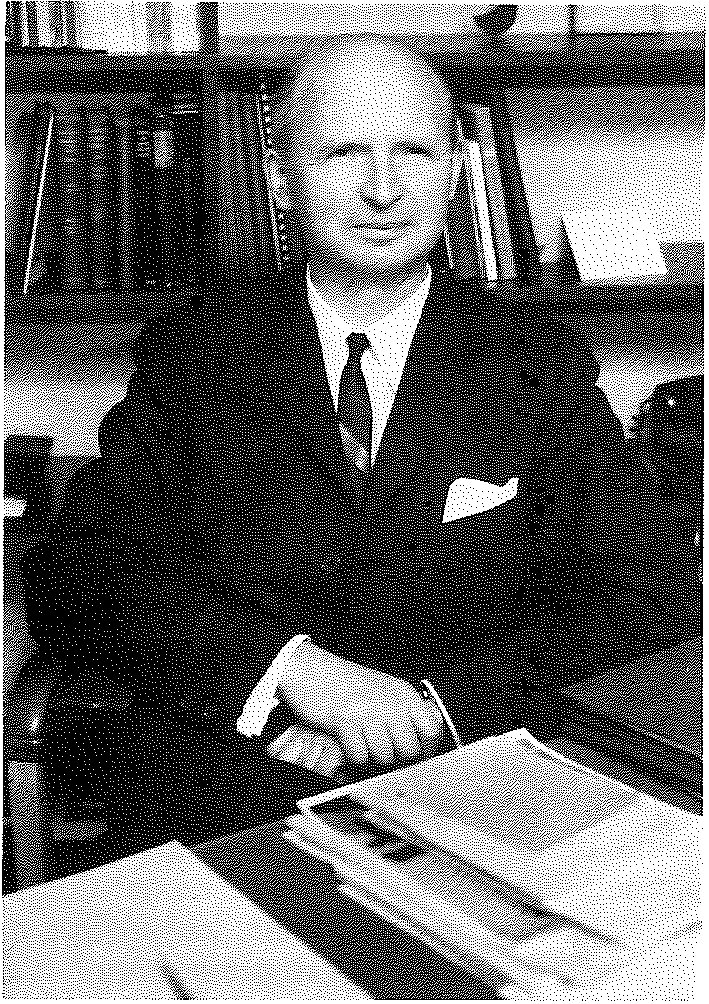
My official travels during the first four years of departmental service never extended beyond note-taking expeditions in advance of 1939, The Royal Visit, and occasional (later regularly) Saturday working sessions at Kingsmere. But in April, 1942, when the SSEA said “Can you be ready to leave for Washington on Sunday afternoon?” the answer was clearly “Yes, Sir!”
I travelled to Montreal aboard Government of Canada Car 100 (panelled in Circassian walnut but without air-conditioning) and overnight to Washington aboard The Washingtonian. Mr. King stayed at The White House; I stayed aboard Car 100, parked in Union Station in outside temperatures that reached 92°F. We had the dubious benefit of live steam pumped through Car 100 to various trains departing from the same platform.
Part of the time I worked at the Canadian Legation as Jean Chapdelaine made his office available. This made no favourable impression on the Hon. Leighton McCarthy, the Minister then, who regarded me with a certain suspicion. In the brief “walking about” time I fitted in, I came on the statue of Edmund Burke, with its inscription … magnanimity in politics is not seldom the truest wisdom.” I mentioned the statue to Mir. King, who asked whether it did not have this inscription, which he quoted correctly.
On the return journey my expanding career nearly came to an abrupt halt. The “running rule” was that if Mr. King had no other business at 11:00 p.m. one said good night and moved forward in the train. This I did, accompanied by the State Department security man who travelled with the party. It chanced that at 11:00 p.m. The Montrealer was gliding to a halt at New Haven. The car immediately ahead of Car 100 was a diner, in darkness. When we reached the head end of the diner, the forward part of the train had moved on, when we retreated to the back end, Car 100 had disappeared. I jumped off the end and then sideways clear of the track, and let out a loud yell. A yardmaster heard me, grasped our problem, dived into a telephone box, and barked two sentences. In a moment a yard diesel emerged from the gloom, we climbed on to the footboard, and were whisked up to where the train was waiting. So was the conductor, gold watch in hand. I said good-night, and hastened aboard; it was several months before I ventured to tell Mr. King of this incident. 1943. But from July onwards Mr. Kings statement in the House of Commons on “functional representation”, the Allied landings in Sicily, the battle of the Coral Sea — the sky began to lighten, and in great secrecy we began to make preparations for the Conference at Quebec code-named “Abraham”. The Prime Minister’s staff travelled disparately by rail, each with a contrived cover-plan designed to serve until the principal visitors (Franklin D. Roosevelt and Winston Churchill) arrived at the meeting place.
We were quartered comfortably, in The Citadel, probably the most impressive monument that still exists to William IV; the cast-iron fireplace panels bearing the Royal Cipher of 1830 had been newly black-leaded to set off whitewashed walls. There was one evening when “junior staffs” were invited to dinner in the Governor General’s quarters; the table had Colonel Henry Osborne at one end, and Colonel Willis-O’Connor at the other. With seven courses and three wines, it gradually dawned on me that this was a deliberate “dry run” to verify if atmosphere and service were “up to scratch”
There was a sunny afternoon when “junior staffs” and junior service personnel were taken for a cruise on the St. Lawrence aboard the CGS Ernest Lapointe. There was some merriment when the veteran captain invited a personable leading Wren to take the wheel, which she did with aplomb.
The day before our return to Ottawa the engine of a CP train bearing many of the press corps lost a tire from a driving wheel and a relief engine had to be provided: this was said to have produced more “hard” news than all of the Conference proceedings. Our own return journey provided one of the best train rides I ever enjoyed at home or abroad. Car 100 was coupled behind an ancient colonist Coach (2786) (to provide braking power) and the nimble tuscan-red 2.4.2 engine 3003. With a clear track this special train ran from Palais Station to Ballantyne Jct in 45 minutes less than the timetable indicated.
The 1944 return to Quebec was somewhat like an old home week; some of the same faces from the U.S.A. and U.K., the same telephone numbers (though the exchange name had become Bosco instead of Victor).
The principal journey in 1945 was to the United Nations Conference on International Organization in San Francisco. The days immediately preceding the departure of most of the Canadian delegation had been saddened and sobered by the death and funeral of President Roosevelt, but on an April afternoon Car 100, plus a 10compartment Pullman (Ridgeville, with the number J200) were hooked on to the afternoon train to Toronto and, at 6:00 p.m. the following day, into the Overland Limited. (The Pullman porter was named Theophilus C. Johnson; Charles Ritchie suggested he was a State Department operative in disguise).
The day in Chicago from early morning until 6:00 p.m. departure was one to put me on my mettle. I was whipping-boy; while Pearson, Robertson and other departmental retainers went to see the Cubs play the Dodgers, I worked aboard Car 100 while it was being moved from one station to another, shared a gargantuan lunch, and accompanied Mr. King on some afternoon visits he had decided to make. (We were driven about by the city passenger agent of Canadian National Railways in his well-run-in Hudson).
The first of these was to Hull House where, in Jane Addams’ time at the turn of the century, he had been head resident. Mr. King climbed up the back stairs to a plain bare room which had been his 50 years earlier. Descending by the main stairway, he came upon a group of high school seniors from South Bend, Indiana. The head resident asked Mr. King whether he would not say a few words to them which, atter a slightly awkward shifting around and mounting up two steps, he did. Out of his line of vision, I took down verbatim what he said, against a day when it might have some useful purpose; it did.
The next stop was at the University of Chicago where, with a somewhat formidable courtesy, he left his card for The Chancellor, who happened that day to be in Washington.
In the open air, a ministerial voice said “I feel a bit faint on my feet; I could do with a stimulant!”
Balancing my imperfect knowledge of Chicago geography against the imperative of making the 6:00 p.m. train, I asked our chauffeur if he could put us down at the Stevens Hotel. Here we marched as boldly as we dared into the Plantation Lounge, and when a soapy-looking waiter emerged, I said “Bring this gentleman a double Scotch!” A faint murmur suggested that a single might have done, but one look from me sent the waiter to the bar (as by protocol one could not quite “drink level” with the Prime Minister, we settled on gingerale for Edouard Handy, vermouth and soda for So far, so good. Mr. King knocked back the double and said “I feel better!” We were accordingly relieved, not least because “the whole armour of God” (the last five words of a broadcast as “Temperance and a Total Wen out of. Be there as, more: ad noe bill and left a tip. Then the following conversation:
Mr. K.: Did you pay the bill? J.A.G.: Yes Mr. K.: Did you leave a tip? J.A.G.: Yes Mr. K.: How much was the total?
J.A.G.: $1.90 Then to my infinite surprise (it was the only time I ever saw it happen), he took out his pigskin note-case, extracted two U.S. dollar bills, handed them to me, and said “keep the change.”
The rest of the journey was without incident; we were met at Oakland by Norman Robertson, who courteously handed out keys for delegation rooms in the St. Francis Hotel, where we were shortly busy at work.
The return journey to Ottawa was not quite what I expected. In San Francisco nearly all of my working time had been taken up with matters arising from the end of hostilities in Europe (I had been present at the opening plenary session of the Conference, and I attended the first morning meeting of the Canadian Delegation as a whole. But as Mr. King evidently disapproved of this, I did not attend any further meetings. I knew that on leaving San Francisco Mr. King would shortly be plunged into a general election campaign, but I had expected I might stay on and pick up some delegation work. In the event, I travelled in Mr. King’s party from San Francisco to Ottawa in the (for me) unlikely guise of security officer. (It is true I carried a copy of the Government Code Book in my locked briefcase; it was also true that at any stopping point the men who represented the railways, telegraphs, express, or other services had no difficulty in “picking me out” for what I was supposed to be.)
In addition to “routine duties” I had some dealings with the press, and with a variety of assorted characters most conveniently described as “hangers-on”.. I had no part with the content of Mr. King’s election-campaign speeches in Vancouver, Edmonton and Prince Albert. In his own constituency the entire travelling party went to the main meeting, where Mr. King spoke for 150 minutes. Between Prince Albert and Winnipeg, at a moment when he supposed his electoral fortunes to be particularly low, Jack Pickersgill and I tried to lighten the gloom by suggesting some items that might enter into the Winnipeg main meeting.
“If you feel so strongly about these things, write me a paragraph I can use” said a Ministerial voice. So it was that Jack drafted a note about the desirability of a “distinctive national flag” “, and out of my typewriter came a note about “the confused and anomalous state” of the law touching nationality,
(The distinctive national flag was finally proclaimed February 15, 1965. The Canadian Citizenship Act passed into law in 1946, and Mr. King was present at a ceremony at the Supreme Court of Canada in 1947 when the first certificates under the new Act were presented.)
The longer journey from Winnipeg to Ottawa was punctuated by an incident at Hornepayne, Ontario, (then a divisional point on the CNR mainline.) The principal of the public school had telegraphed to ask if Mr. King would speak to the pupils while the train was being serviced. Mr. King agreed, and was just working into an account of United Nations brought down to the local community, when a roughshod individual came down the slope, barged through the rows of children, singled out his own two, and brusquely ordered them home.
King, clearly not wishing to have these two “made an example of” before their schoolfellows, said “Please let them stay.” The father then turned on the speaker; Mr. King stood his ground; the intruder retreated and, after a moment, the train moved on. (We gathered what information we could about the heckler; none of it was complimentary.)
More ambitious travel was involved in 1946. The first journey, to the meeting of Commonwealth Prime Ministers in London in May, took us overnight to New York to embark in the Queen Mary. The day in Manhattan was improved by an elegant lunch at the Harvard Club, and we sailed with the tide shortly after dawn. There was some incidental bringing up-to-date of briefing papers (e.g. the situation in India — Lord Halifax, once Viceroy, was on board returning at the conclusion of his embassy to Washington), and a looking-out of other visitors. I was quartered in what I fancy was the gentlemen’s gentleman part of a midships suite. As the main dining saloon was still boarded up, we found it more agreeable to eat in what had been the tourist restaurant. We were met in Southampton, travelled to Waterloo Station by Pullman, and were shortly installed at The Dorchester, complete with Commissionnaire and private telephone exchange. Our ration books we surrendered to the hotel.
Most of the London events were Prime Ministerial, in which I was cast as Private Secretary, without the title. There was a day when the Council of the Borough of Derby, headed by the Mayor and accompanied by the Town Clerk, came to have Mr. King sign the roll of Freemen of the Borough (to which he had been admitted some months earlier.) The previous evening Mr. King had said, reasonably enough, “What shall we talk about?” “Well, (I said Derby County won the F.A. Cup (soccer); it’s as important here as the Stanley Cup in Canada.” “Is that so?” (he said.) But the following morning, after the black ink signature had been sprinkled with powdered chalk, and sherry and beer had been handed around, there was a marvellous opening gambit. “They play football in Derby, don’ they?” Broad smiles and cheerful assent.
There was also the Victory Parade, and in the evening fireworks which the several Prime Ministers viewed from the Terrace of the House of Commons. Mr. King, accompanied by an inspector, Special Branch, Scotland Yard, travelled by arrangement by a special train from Gloucester Road Underground Station to Westminster. It had been intended that the return journey should also be by underground between these stations, but the 11:00 p.m. crowd was so great that Mr. King arrived back at The Dorchester in a panda car of the Metropolitan Police.
To mark Mr. King’s entry into his 20th year of office as Prime Minister (a day or two after he had exceeded the term in office of Sir Robert Walpole 200 years earlier) there was a dinner in the Cabinet Room at 10 Downing Street. In anticipation, knowledgeable bibliophile — the Under- Secretary of State for External Affairs, had found at Hatchard’s a fine three-volume set ofF.S. Oliver’s The Endless Adventure, and this, signed by the five members of the Prime Minister’s party, had been handed over earlier in the day.
On the westward journey in the Queen Mary we had spacious cabins on the sundeck. Elsewhere in the ship were some 2,200 war brides and some children, travelling to Canada and new homes. When we docked at Halifax we managed to hive off the press until Mr. King had received official calls from the Lieutenant-Governor, the Premier of Nova Scotia, and the heads of the armed services. These calls we returned during the morning, and left for Ottawa aboard the Ocean Limited.
The second 1946 journey was to bring us to the Conference on Peace Treaties in Paris. We left Ottawa in early morning, and in early afternoon left Montreal aboard one of three special boat-trains, the first of this description since the end of hostilities. The following late afternoon we came alongside the M.V. Georgic (its silhouette much changed since I had known it in pre-war days; two funnels had become one; main passageways had warped walls because of wartime damage by fire and, indeed, passengers had had to sign statements of recognition that the accommodation was not of usual Cunard-White Star standards.)
Mr. King was quartered in a cabin labelled OC Troops; the Under-Secretary in one marked P(rincipal) M(edical) O(fficer); the Clerk of the Privy Council found himself under OC Naval Draft. In a triangular cabin near the bow were Charles Ritchie, Jean Chapdelaine and myself. We were comfortable enough; we were well fed, and we spent a good many sunny hours on the shelter deck (with the Captain’s permission) studying the draft peace treaties.
(Our concerns were with Italy, Finland, Hungary and Roumania. Bulgaria did not come within Canadian purview because there had never been a declaration of war by Canada. On an afternoon of multiple signing of proclamations of the existence of a state of way in December, 1941, we exhausted the supply at Laurier House of plain wooden penholders. The four fine pens had been sealed in individual envelopes; no fifth penholder being immediately available, no proclamation was issued.)
Before the ship sailed there were a series of “incidents”.. The chief steward called on Mr. King to say he had had a table laid in the Saloon so that he might have a private meal before the main sitting. Mr. King said thank you, he wouldn’t trouble, he’d just go back ashore and have dinner on his private car. We thereupon despatched the nearest corporal to alert the steward on Car 100 in the station yard. Half-an-hour later Mr. King said perhaps it would be pleasant to eat on board the Georgic; by that time the special table had been absorbed into the main evening serving.
Mr. King then said he would go ashore to eat, andl accompanied him. We approached the main dining room of the Nova Scotian Hotel at the instant a head waitress shut the doors and said firmly that the room was closed. There was a suggestion of grumbling over my right shoulder; I found myself asking Mr. King if he would mind sitting down a moment and I would see what could be arranged. I set off for the front desk, talking as I went: “I have the Prime Minister of Canada here and he’s hungry; can you please do something about it?” “I guess we’d better” (said the desk-man, handing me a key.)
By the time we reached the fifth floor a waiter was at the door of the suite. He explained that the main kitchen was closed; anything could be cooked to order, but it would take some time; anything on a “cold” menu which he had could be provided promptly. So while some of my colleagues were elsewhere eating lobster, our evening meal was chicken salad, ice cream and gingerale. In due time we returned aboard the ship.
At Liverpool the Lord Mayor came on board. We travelled in a motorcade to Lime Street Station, remarking at a police sergeant (and at least one pub) on almost every corner, and we were then conveyed to Euston in a Directors’ Coach of the London, Midland and Scottish Railway. Before dark we were again installed at the Dorchester, and we travelled to Paris on the following Sunday.
On some, though not all, of Mr. King’s expeditions from Paris I was of the travelling party. I went to Dieppe for the fourth anniversary of the reconnaissance in force, but not to the Normandy battlefields nor to Berlin. After he had made his main speech in a plenary session of the Conference, Mr. King rather lost interest in most of the remaining proceedings. There were evidences that he was finding it difficult to make up his mind what he should do next; though it is now also apparent that he had decided that he would relinquish the External Affairs portfolio (I had no knowledge of this determination until after we had returned to Ottawa, when indeed I first learned of it in the newspapers.)
The changeable mentality came into play on the day fixed for our departure from Paris. It had first been intended that we should travel by train. The RCAF at Northolt had then sent over a Dakota with the intention that Mr. King’s party — nine in all plus luggage, should be flown to Britain. Mr. King first agreed, then said he would prefer to travel by train. By the time he changed his mind yet again, the Dakota had gone back to Northolt, and we ended up leaving the Gare du Nord and crossing from Calais to Dover. I had already closed my delegation account, so that I ended up borrowing money from the Army driver (to pay extra registration for luggage) and borrowing (on the train) all available French francs to provide a pourboire for the steward.
A final touch to this somewhat unconsidered journey arose on arrival at Victoria Station. The party’s luggage was in one great mound; a senior porter said to me “would you mind, Sir, walking once round and giving a cursory glance; it looks better to the bystanders.” After the cursory glance, and 10 shillings, an Army party took the luggage to The Dorchester.
Once again aboard the Queen Mary, and after we had unpacked in sun-deck cabins, Mr. King told Edouard Handy and me (in a tone which suggested he expected compliance) to exchange cabins with Mr. and Mrs. Frank Salisbury, who were travelling to Canada to be Mr. King’s guests. So we packed up, and moved down two decks. If Mr. King wanted either of us he had to send for us.
I went ashore after midnight to send off last-minute telegrams and to say au revoir to the faithful Scotland Yard inspector who had accompanied us throughout. On this voyage there were again over 2,000 war brides and children; there was a great assemblage to celebrate Queen Juliana’s birthday: Mr. King made a speech, Mr. Salisbury made a speech; Lester Pearson made a still better speech
Towards the end of the stay in Paris Mr. King had kept his distance “from the three seniors” Pearson, Robertson and Heeney. Still learning on the job, I had taken the precaution of requesting a compartment for each of them on the train from Halifax to Montreal, and “the distance” certainly was maintained throughout the journey. I now found myself “promoted” to travel aboard Car 100; this was comfortable, and my meals were provided, but I was, of course, right there.
The arrival at Halifax went smoothly, and we reached Ottawa just before midnight the following day.
This ended my travels with the Secretary of State for External Affairs. Mr. King relinquished that office four days later, and though I remained on his staff at Laurier House, I was, for departmental purposes, answerable to his successor, Rt. Hon. Louis St. Laurent. I remained “on strength” until the following July; my “travels” were confined to Kingsmere and to occasional expeditions within Ottawa itself.
View the original scanned pages →
Originally published in bout de papier, Vol. 4, No. 2 (1986) — Spring/Summer 1986 // Printemps/Été 1986, pp. 7–10. Read the rest of this issue →



