
bout de papier, Vol. 14, No. 4 (1997) — Winter 1997 // Hiver 1997, pp. 30–31
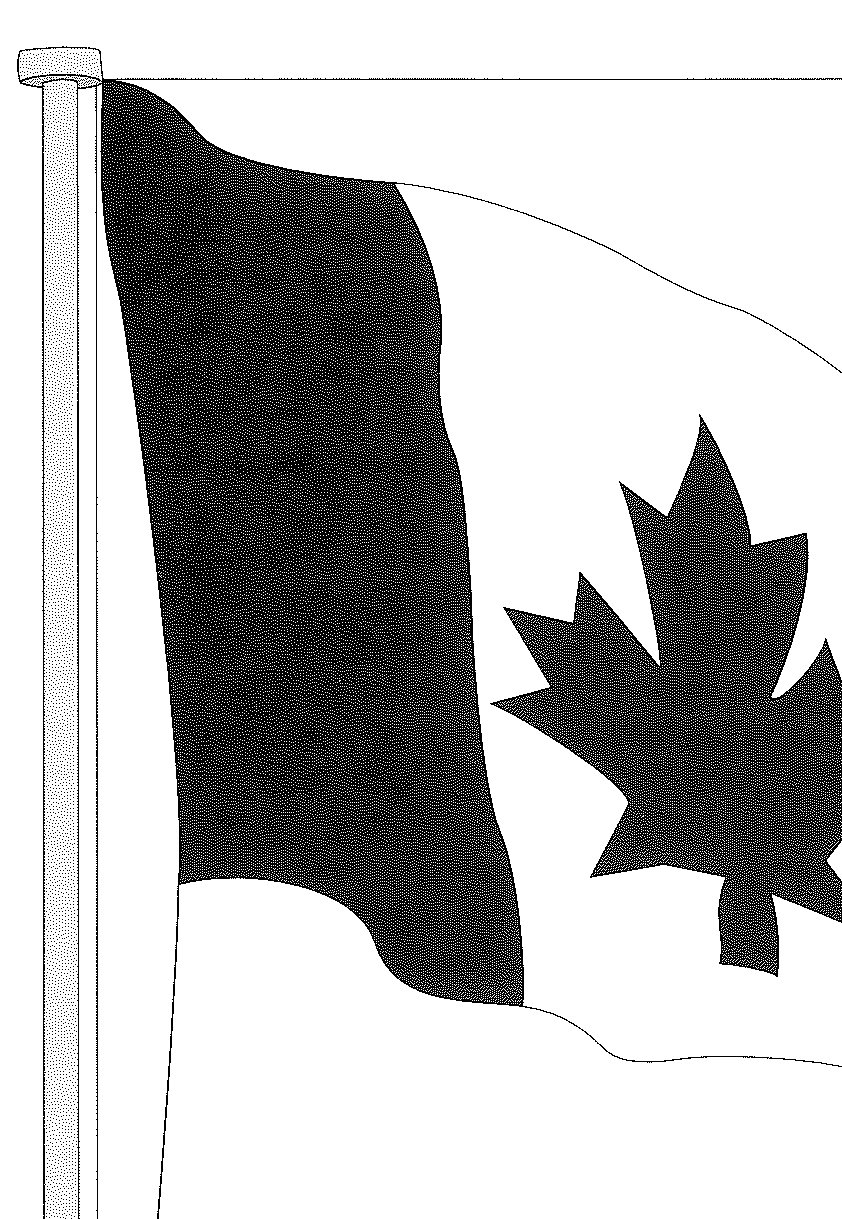
The colourful montage “Showing the Flag” (Summer 1997) brought back memories of several passages-at-arms during 1945 on the subject of a distinctive Canadian flag.
At one stage of hostilities (I think in 1943) the Prime Minister (W.L. Mackenzie King) remarked, in my hearing, that on the day fighting ceased he intended that the Canadian red ensign (with the arms of Canada in the fly) should be hoisted on the Peace Tower in Ottawa. This had been the legal flag of Canada since 1924 when worn abroad; it had been the banner carried by Canadian forces going into action from 1940 onward
At the Quebec conferences of 1943 and 1944 the red ensign had been worn in company with the Stars and Stripes and the Union Jack. In 1943 an engineer officer of the Military District and a work party toiled through one night to erect the required third flagpole.
In San Francisco I gently reminded Mr. King of this intention. He went into action by telephoning to Ottawa to direct that the Canadian ensign should fly from the Peace Tower from May 8 (VE Day) until sundown on the following Sunday (observed as a national Day of Prayer and Thanksgiving). His diary indicates that he felt “annoyed” that I, on instruction, drafting a paragraph about these arrangements, had used the phrase “the Canadian flag”
He must have known (the Diary records) that we have no Canadian flag; that is the whole source of the controversy. It would be putting the Prime
Minister in an appalling position to raise an issue of the kind at this moment…. Having the Canadian Red Ensign fly in this way for an entire week, there is little doubt that once the soldiers begin returning with that flag, it will be accepted as the flag of Canada.
What I had written was “the flag of Canada”. And having reproved Jack Pickersgill for counseling that the Prime Minister would “not think of taking down the flag once it had been put up”- Norman Robertson had raised the same point, rather more gently, earlier in the day — Mr. King rationalized that “I cannot imagine anything that would provoke more bitter controversy and feeling at this time than an endeavour to seize this occasion to force a flag on the Canadian people” ’. [Pickersgill & Forster, The Mackenzie King Record (Toronto 1968) II, 380-381].
In the event the authority to wear the 1 Canadian ensign expired at sundown on the following Sunday; the Department of Public Works reverted to “standing orders” hoisted the Union Jack.
The Prime Minister elaborated still further after talking to Ottawa … “no objection can be taken to flying our own flag at this time… this step will lead to the Red Ensign becoming the national flag of the Dominion”. He added that during the forthcoming general election campaign he would advocate “having a national flag of our own”
Leaving Prince Albert on May 23 after four days of campaigning in his own constituency — where he had not been for four years — the Prime Minister was thoroughly depressed. Over dinner with Jack Pickersgill and me he said he would lose his seat; we tried to rally him and Jack suggested that in his Winnipeg speech on the following day he might mention a distinctive Canadian flag. He drafted a paragraph which Mr. King used in his speech. My contribution to the discussion was a paragraph on “the confused and anomalous state of the law touching nationality” • The sequel was the Citizenship Act of 1946. [cf Pickersgill, ibid, 391]. The Prime Minister also brought in the Union Jack, and later wrote in his diary that he was “not altogether surprised” that his reference to a distinctive Canadian flag “did not meet with too ready a response”. (He might not have grasped that the combination of Victoria Day and an audience largely of members of the Canadian Legion may have created an adversarial atmosphere.) He was frank enough to admit that P[ickersgill, Gibson], T[urnbull] and H[andy] “have all been pressing so strongly… that I felt this was the time [to make a statement advocating “a distinctive Canadian flag”].
There was a sequel five months later when General de Gaulle made a second visit to Ottawa. Mr. King told the General that “the Canadian flag” flying that day at Laurier House represented the first time it had been worn there during the years he had been Prime Minister. The Red Ensign was also flying that day from the Peace Tower in honour of the General’s visit. [One of the most curious of all my “public service” errands was on that day to climb as far as one could climb in the Peace Tower where the Dominion Carillioneur was busily at work, to ask, at the Prime Minister’s direction whether he could play La Marseillese. He said he had no music for it: would Vive La Canadienne do? It rang out loud and clear, but I’m not sure the General noticed.]
The flag was discussed in Cabinet on July 4 (1945); Mr. King “urged strongly that we should press on and get a decision by Parliament” ’. He had no doubt that a Committee [of the House of Commons] would recommend the “Ensign with a gold maple leaf”; and he gave the Chairman (Walter Harris) a painted maple leaf (which he brought from Canada House in London) as a symbol of what he favoured. All but one member approved of a report from a subcommittee. The sequel was a suggestion from Mr. St. Laurent that an order-in-council validating the resolution of the Committee would obviate the need for a debate in the House.
But no-order-in-council followed; the subject, at least from the published parts of the Prime Minister’s diary, disappeared from comment. [Pickersgill & Forster, III, 274-276.]
On February 15, 1965, I presided as President of Brock University at a ceremony in the courtyard of the interim precinct (a converted factory). The Red Ensign was hauled down by the senior ex-combatant of the faculty (former officer RNVR) and handed to the University Archivist. The crisp new flag with the red maple leaf was hoisted by the senior reservist of the support staff (a Chief Petty Officer, Engineering Branch, RCN). I then read out the Queen’s Proclamation. The “flag of Canada” has been worn at the University on every “active” day since.
View the original scanned pages →
Originally published in bout de papier, Vol. 14, No. 4 (1997) — Winter 1997 // Hiver 1997, pp. 30–31. Read the rest of this issue →



