
bout de papier, Vol. 27, No. 2 (2013) — Spring 2013 // Printemps 2013, p. 26
At the time of the “Canadian Caper”, I was an analyst in the Intelligence and Security Liaison Division, responsible for covering Sub-Saharan Africa and the UN family of organizations. Louis Delvoie came into my office (he was not the sort of director who habitually telephoned to summon you into his presence) and shut the door behind him. Did I know, he asked without appearing to doubt it much, about the houseguests in Tehran?
I did, as indeed far too many already did. It was one of my jobs to go through the “pack”, a stack of paper copies of every telegram coming into the Department and distribute them among the analysts according to their regional responsibilities. I had seen the telegrams from Tehran reporting on the arrival of the six US colleagues. So had everyone else who got a copy of the pack.
Louis asked me to set Africa and the UN aside for the time being and work on Operation SAFE HAVEN, as we were calling it. My first job was to get a copy of the Order-in-Council (OIC) authorizing the issuance of Canadian passports to the United States citizens who had taken refuge with the Canadian Embassy in Tehran; that was the wording to the best of my memory — it was certainly that specific.
With the OIC in hand, Louis and I went to see the Director-General of the Central Passport Office, explained the situation and showed him a copy of the OIC. He understood immediately, and was enthusiastic about taking part. He said that he would send a message to several regional passport offices in Canada, asking them to provide passport blanks by overnight courier; this would ensure that we would have a good mix of non-consecutive serial numbers. In the meantime, there was something we had to do: since there had to be a completed application on file for every passport issued, it was up to us to generate the applications, and he gave us a handful of blank forms. On the way back to our offices, it occurred to me to ask Louis whether we would have to pay the $12 fee for each passport, in order to generate a record of payment received; he said that if it came to that he would pay the fees himself. I spent the rest of the day with my door closed, inserting fictitious information into twelve passport application forms.
My next job was to make up cover stories for the contingency in which CIA support would not be available and we would have to extricate the houseguests by ones and twos. I got as far as a one-paragraph outline of each identity. I think I decided that the Lijeks would be owners of a boutique in Vancouver, in Tehran to buy rugs. Before long, the Americans came back to us with the fully-backstopped “Hollywood Option”, and for us enthusiastic amateurs it was a great relief to have the professionals manage the exfiltration. remember meeting Tony Mendez and his colleague, a documents technician, when they came to Ottawa. The latter offered to show me how to age a document: first he held the pages of one of the passports closed, and hacked at the edges with a credit card; then he opened it to the photo page, put it face-down on the floor, and scuffed it back and forth with his foot. He was not happy with the result: “Your carpets are too clean,” he said.
I also had to interview Canadians who had just left Tehran to get a detailed step-by-step account of departure procedures at the airport. It went something like this: “You get out of the car at the departures entrance. You go in the door. What do you see? Do you turn right or left? What is the first counter you come to…and so on.”
One regret: I never did get to speak to John Sheardown, then or since.
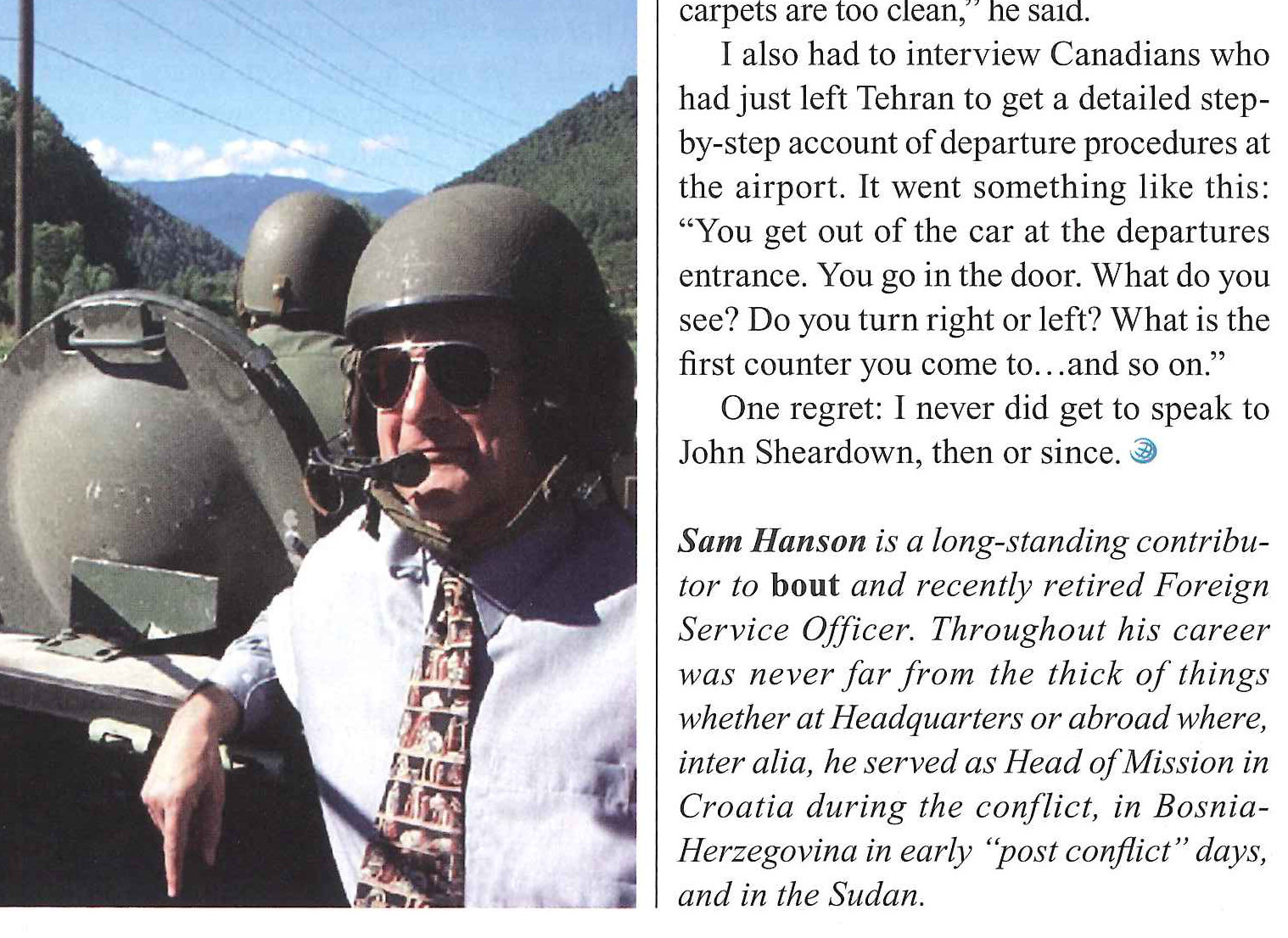
Sam Hanson is a long-standing contributor to bout and recently retired Foreign Service Officer. Throughout his career was never far from the thick of things whether at Headquarters or abroad where, inter alia, he served as Head of Mission in Croatia during the conflict, in Bosnia- Herzegovina in early “post conflict” days, and in the Sudan.
View the original scanned pages →
Originally published in bout de papier, Vol. 27, No. 2 (2013) — Spring 2013 // Printemps 2013, p. 26. Read the rest of this issue →



