
bout de papier, Vol. 14, No. 1 (1997) — Spring 1997 // Printemps 1997, pp. 23–25
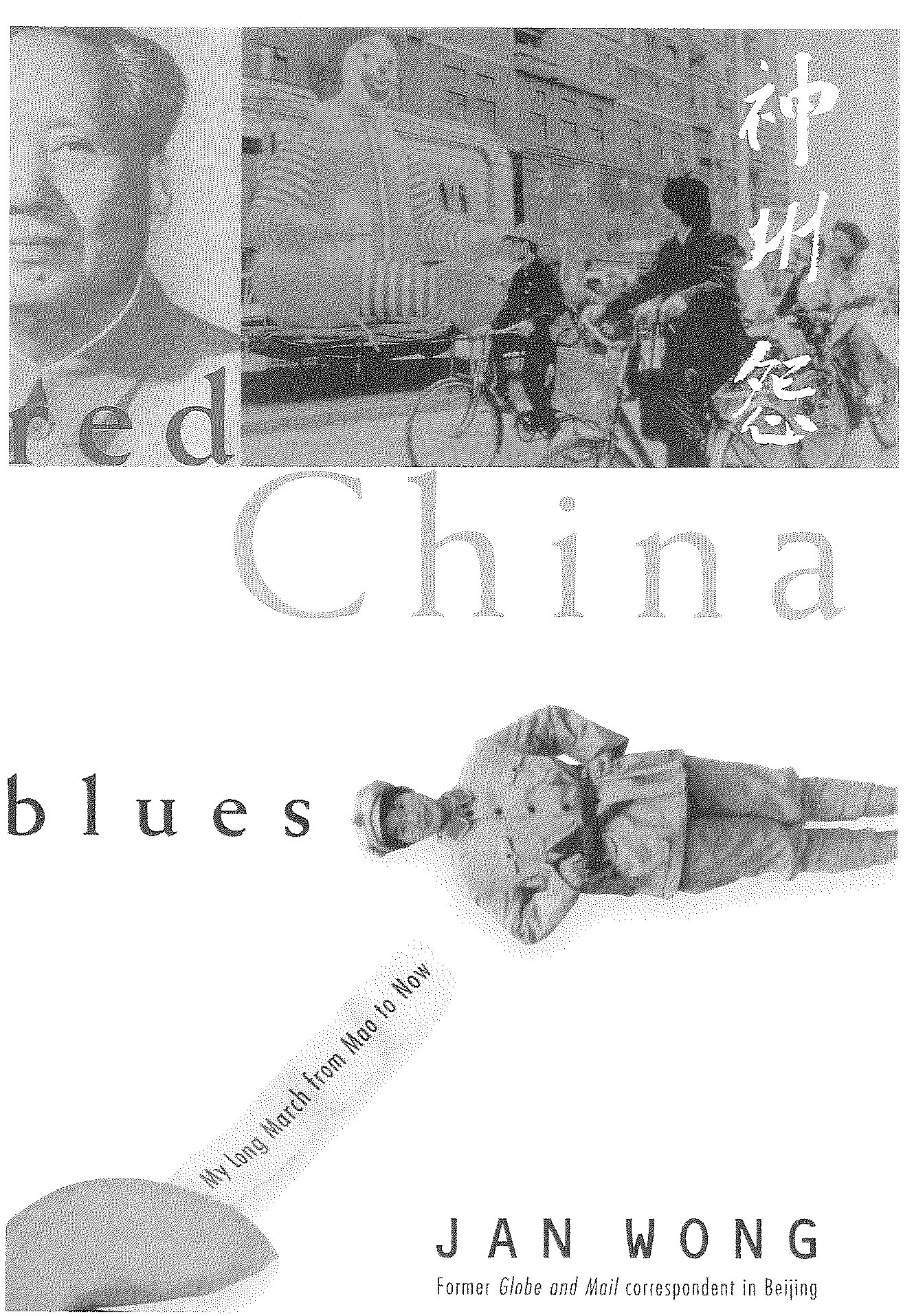
Red China Blues, Doubleday, Toronto, 1996.
405 pp. $32.95
John K. Fairbank, reviewing Edgar Snow’s first book, Journey to the Beginning, describes him as a reporter who avoids the “oversimplicity of the library researcher … and of the columnist who has to know what he thinks in the first place.” As one reads Jan Wong’s engaging account of her attempts to find her place in a China in turmoil, one can’t help but conclude that this reporter knows very well what she thinks but takes great pains to find evidence, or at least selected personal incidents, to substantiate her views. This is not to imply that Red China Blues is mainly a compilation of anecdotes designed (or created) to buttress foregone conclusions; on the contrary, it is a fairly gripping tale in the style of Tintin au Pays des Soviets of a sixties’ product of the North American bourgeoisie working out her rebellion against her own social background.
Jan Wong takes her quest quite a bit further than most of her peers. Rejecting her parents’ credit cards, though not their high placed contacts, she immerses herself in Mao’s China as one of the first Western students to be admitted to Beijing University since the beginning of the Cultural Revolution. Awed and thrilled by the egalitarian poverty surrounding her and the stern discipline to which Chinese students are subjected, she strives to blend in to an extent unprecedented, we are led to believe, in any of her contemporaries coming from the decadent first world. Along with an American colleague of hers equally intent on not missing out on any of the rigours of the world’s most hopeful revolution, she rejects her specially assigned Chinese cook and insists on eating the inedible fare of the students’ canteen. Not content with just going to classes, she and her friend pester everyone in sight until they are granted the privilege of doing hard labour in the countryside and in industrial plants. Striving with all their might to win their revolutionary epaulettes, they even go so far as to snitch on a Chinese classmate seeking information on how to get to America.
Despite a somewhat disingenuous tone in much of this post hoc self-criticism, the first third of the book makes for fascinating reading. It is not just the account of an adventure-seeker portraying the courage and stoicism underlying her naivete, it contains a very believable description of a Chinese university setting in the latter half of the Great Proletarian Cultural Revolution. Though probably not quite up to the pernickety standards of serious sinologists, it has the richness and colour of a top rate David Cronenberg production and will give the average reader the impression of having witnessed first-hand some juicy vignettes of one of the most dismal chapters of the Mao years. For, underlying the snide comments and flippancy that are the stock in trade of Bright Precious (Wong’s literal translation of her given name) is a gift for concise depiction and dramatic imagery that make even fairly bland events seem exciting.
After six years of almost total immersion during which Wong acquired a husband and total fluency in Mandarin, she takes time out in the West to learn journalism, get her newshound credentials and return to China eight years later as correspondent of the Globe and Mail. This is where we reach the book’s centrepiece. Her description of the lead-up to the Tian’anmen Square demonstrations encompasses so many personal, social and political factors that the massacre that follows is even more overwhelming read seven years later than it was when it was first broadcast to the world. The shilly-shallying of the octogenarian leadership, the political tensions and intrigue, the mounting euphoria among the students and the populace portend the tragedy so clearly that we feel trapped in a danse macabre.
In one chapter, “Safeguard your lives” Wong takes us step by blood-filled step through that fateful week-end of June 2-4, 1989. I was one of her many thousands of avid readers and listeners during those terrible days. As I sat in Ottawa staring at a blank CBC-TV screen, hearing Jan Wong’s gunburst-by-gunburst reports from the Beijing hotel, I was aghast at the images she evoked of the carnage as it progressed. In the years that followed, these images would return to haunt me every time I went anywhere near the Gate of Heavenly Peace Square or the Beijing Hotel. Yet the retelling in Red China Blues is even more horrifying. This detailed account, sparsely studded as it is with her own instant reactions of fear, disgust and outrage, leaves one in no doubt about what happened nor about the long-term effects on Wong’s own outlook.
After things had returned to “normal” how could she simply pick up where she’d left off? The average Beijing citizen had, of course, little choice. All the forces of social control were exerting their best normative efforts to make everyone fall into line — in our own politico-speak we would say “put matters behind us”. Since China’s coercive institutions remained largely intact after the massacre, reestablishing order and an apparent nation-wide docility was not too difficult. The work-unit, the neighbourhood committee, military check-points on the lookout for trouble-making students were effective means of ensuring that the “Beijing Spring” quickly left people’s lips. By the time I arrived in Beijing, sixteen months later, one would have thought it had all happened a decade before, judging by the casual way in which questions on the subject were brushed aside. How much more distressing for a foreign observer in the summer or fall of ’89! Could Bright Precious just resume her official contacts with a cheerful “Apart from those few weeks in the spring, how did you enjoy the rest of the warm season, Comrade Vice-Minister?”
Quite understandably, she wasn’t prepared to let matters rest. Nor was she ready to leave major questions unanswered. How many people had actually been killed? How did bereaved family members cope with the young protesters who’d simply disappeared? What was the fate of dissidents or protesters still on the loose? How extensive was the Chinese gulag system and what were conditions within it? All these were questions she sought to explore with ingenuity and courage, though one is left to wonder in some cases at what cost to the individuals themselves? Here one comes to the last third of Red China Blues and, unfortunately, the least convincing.
Wong sets out to reveal in as many ways as possible the dark underside of China today. The revival of such medieval practices as the sale of women and children, drug addiction, prostitution, poverty, malnutrition, congenital cretinism, all these are astutely examined in her articles. But this did not, it seems, satisfy Bright Precious’ visceral need to “get even” with the butchers of Tian’anmen.
Even when reporting on the economic revolution raging in early nineties China, she cannot resist sardonic conclusions or the snide comments that seem to be part of her second nature. To her, henceforth, all aspects of China are morally reprehensible. She maintains that this reflects how thoroughly she has shed her erstwhile rose-coloured glasses. Never again will she be bamboozled by communist propaganda or charismatic revolutionaries. She is at pains throughout the book to demonstrate the careful analysis to which she subjects her past experience and meticulously notes how it affects her present-day reactions. And yet, she seems to be unaware that she has in fact assimilated the most basic premise of the Communist Party of China past and present: to wit, that everything is political. The most humdrum economic act and, indeed, social, artistic, psychological or purely personal motives, have important political consequences. Translated into current Party concerns this means that any positive event is a godsend for reinforcing the regime’s badly damaged legitimacy.
Wong seems to have accepted this as axiomatic and is determined not to contribute wittingly, or otherwise, one shred of respectability to the hardline crowd wielding power from inside Zhongnanhai. Why should she? What she obviously fails to realize is that her approach leaves her incapable of reporting meaningfully on the most staggering social transformation the world has ever seen. With all its flaws and pervasive corruption, the current revolution is changing China more thoroughly than any other since the collapse of the Qing dynasty, some would say since 221 B.C. when the imperial system was first established. But then, she does admit that she belongs to a generation that has “no sense of history” … albeit one that lost its innocence on that night in June. And, presumably, greater perspective and a more practical outlook.
Not, I fear, better moral acumen. At all times suspicious of other people’s motives, she seems remarkably cavalier when it comes to the moral dilemmas she creates for herself. For example, thanks to an invitation from the Canadian Embassy (about a year before I arrived) she is able to accompany CIDA officers to Gansu, one of the poorest provinces, and is thus able to describe the numbing destitution of the population there, their deprivation producing not only endemic diseases but also genetic deformations. She feels utterly depressed, she writes, especially since these conditions might be shared by some 100 million Chinese — the World Bank’s estimate of the number of Chinese living below the poverty line. She blames the growing gap between rich and poor for this state of affairs and, of course, the present leadership. Fair enough, but at no point does she bother to mention the “good news”, sparse as it is, that Canada has aid activities in these forsaken regions, that its negotiations with the Chinese authorities to set up such poverty alleviation projects have impelled them to direct more attention and resources there and have attracted other aid donors as well.
Self-indulgent moral judgements are never far behind Wong’s observations – usually in the context of her previous experience, misdeeds and delusions. Only once does a practical moral urge assail her. In a daring article on bride bartering she manages to interview a loutish, malnourished 25-year old peasant and the hapless wife he had bought seven months earlier. Wong describes in heartbreaking detail this poor woman’s plight, her illiteracy, her banishment from her home more than a thousand miles away, her lack of communication with her husband’s clan who speak a different dialect, above all, her wish to escape her de facto imprisonment.
Quite understandably, Bright Precious felt depressed as she departed, leaving the unfortunate “bride” standing sullen beside her smirking husband. She writes:
“I had the urge to do something useful, like rescuing [her], or paying off her husband [his original investment of $250] and setting her free, instead of merely jotting down notes and taking photographs. It was hard for me to stay detached and objective in the face of so much suffering… I had learned to always take a stack of exercise books and a bag of pencils and a couple of soccer balls along whenever I visited a rural school. But what good would a bit of stationery do? There were so many wretched Villages … so many women trapped … China’s problems seemed vast, daunting, insoluble.”
Thus does the reformed Maoist conscience jump through the horns of a dilemma.
Jan Wong obviously has many inner qualms she seeks to address and she tries to do so in a “let-it-all-hang-out” fashion, but it is hard to understand why she keeps invoking her dual cultural and ethnic heritage and her youthful adventures as exculpation. She makes much of her confession at having ratted on people. She keeps harking back to it as if it bestowed on her some sort of badge of maturity. Yet one can’t quite shake the suspicion that there is guile behind this constant reiteration. Is it in her mind the crucial “hook” which makes this tale more than just a post-hoc account of The Trials and Tribulations of Bright Precious in the Middle Kingdom …
If so, why does she berate herself endlessly for having suspended disbelief for so many years, when throughout the book she implies that all along her critical faculties were fighting back and her natural rebelliousness was asserting itself? Even more perplexing is her litany, towards the end of the book, of the standard type of expatriate complaint about how bloody life abroad can be. After one has lived through China of the 1970s, carping about lead-based paint on the walls of one’s flat seems picayune and pointless. Why try to give the impression that one is no more than a “donut-eating Canadian”, ’, (as she calls her compatriots) suffering culture shock in a country where one can’t buy the right brand of TV dinner?
In a sense, these more trivial aspects demonstrate extremely well the long way China has come in the last twenty years. In spite of her reluctance to admit it, Wong is bewildered by the fact that China is taking a capitalist road before the disappearance of communism. Despite the rampant corruption, new injustices and depraved behaviour such untrammelled espousal of the market system implies, it is producing far-reaching modernization in all aspects of Chinese life. Herein lies the BIG STORY of China today. Almost as an afterthought, Wong devotes the last few pages to this earthshaking phenomenon. Her editors, apparently, had to twist her arm to get it. I’m glad they did. Her chapter Middle Class Kingdom is the most balanced of anything she’s written. It’s a pity she didn’t devote more of the book to it. That is, I suppose, a typical foreign service officer’s reaction. After all, what pleasure can the likes of us derive from accounts of nouveau riche Ferrari collectors or penis extension clinics?
I may have overstated some of the above reservations. China Blues remains a gripping account. Those not familiar with the country will find it fascinating. Old China hands will grit their teeth and admit it casts a spell. Quite fittingly, all will agree that the epilogue is a gem.
View the original scanned pages →
Originally published in bout de papier, Vol. 14, No. 1 (1997) — Spring 1997 // Printemps 1997, pp. 23–25. Read the rest of this issue →



