
bout de papier, Vol. 15, No. 4 (1998-1999) — Winter 1998/99 // Hiver 1998/99, pp. 18–20
It is clear that there are many misconceptions about Haiti. Admittedly, it is not without its difficulties, fully deserving its rating as a hardship post.
It can take about six months to be comfortable (or as comfortable as possible) with the money. The official currency of Haiti is the gourde but almost all prices are quoted in Haitian dollars, one of which is the equivalent to 5 gourdes. The main problem is that the Haitian dollar does not exist, and never has. This phenomenon goes back to a period (from the US occupation – 1915 to 1934
– until a short time before the fall of Jean- Claude Duvalier in 1986) when the exchange rate on the gourde was pegged to 5 gourdes to the US dollar. Thus, a 5-gourde note became known as a dollar, a 10-gourde as two dollars, etc. For the first while after our arrival, every time we went to the supermarket, we had to ask “How the **** many gourdes are in $72.30?” One has to make do with reduced quantities of life’s luxuries. There is electricity about 8 hours per day (which could have been more tolerable if the outages were at consistent, predictable times). I can remember asking a departing colleague how she kept the beer cold. When she said she put it into the freezer, I asked if it didn’t freeze. She said “No problem. There isn’t enough hydro to make ice cubes, let alone put the beer at risk”. This, of course, did not mean one would not get a hydro bill (known locally as ’fiches blackout’). As well, telephones work rather sporadically, often cutting out when it rains. One of the important objectives of everyday life in Haiti is to cultivate a “friend” in Teleco who could actually get your phone repaired in less than six to eight weeks. The Canadians at the Embassy have to rely on VHF radios as the prime means of communication, as did most people in Haiti. Where in Canada you see so many people walking around with cellular phones, in Port-au-Prince one goes everywhere with one’s radio. I still feel sort of naked without mine on my belt. There is one side benefit to this in that one has on-going soap operas since one is able to listen in to everything going on in one’s colleagues’ lives. Getting anywhere is a trial, at all times. The roads are in deplorable condition — sort of like off-roading in Canada, but not as smooth. Traveling to a place like Les Cayes in the southwest, a distance less than that between Ottawa and Montreal, takes five hours. Traffic is extremely chaotic, due to a complete lack of discipline on the part of 18 bout de papier Vol. motorists and to the condition of the vehicles. Cars are constantly breaking down in the middle of the road because of a lack of maintenance (it is important to remember that if the vehicle stops due to a mechanical breakdown or a flat tire (panne caoutchou), it must be in a position to cause maximum traffic tie-up; if it isn’t, one has to push it into such a position). Most vehicles belch black smoke out the back, some so badly that one cannot see the vehicle in front of one, at times forcing one to stop since one cannot see the pedestrians either. Among the worst maintained are the trucks. This can be a little dicey considering that Port-au-Prince is built on a mountain. I recall arriving on the scene of one accident where a dump truck’s brakes had failed at the top of Delmas. It only stopped, about three kilometers further down when it hit another dump truck and overturned. He had bashed about ten vehicles on the way — miraculously there were no major injuries. (Radio Metropole was thrilled since the accident occurred right in front of their building and they were able to give on-the-spot coverage for hours) No-one gives way as it is better to be stuck for half an hour in traffic than to let someone in, an act which might prevent congestion. One can, of course, understand this reticence to let another vehicle pass or turn in front of one, since if one lets another in, one has to wait while at least 15 others go as well and one has trouble getting under way again.
The highways outside the cities are particularly challenging. There are many vehicles which are in such bad state that they cannot go faster than 40 to 50 kph, which can be a little frightening when one comes up behind them on a curve. On the other hand, intercity buses, especially the ones running between the North and the capital, only know one speed – pedal to the metal. I can recall warning the driver of a colleague from Santo Domingo about this. He didn’t believe me until the first one passed. After that, he practically hit the ditch every time he saw one approaching (not necessarily a bad thing since frequently the ditches were in better shape than the roads).
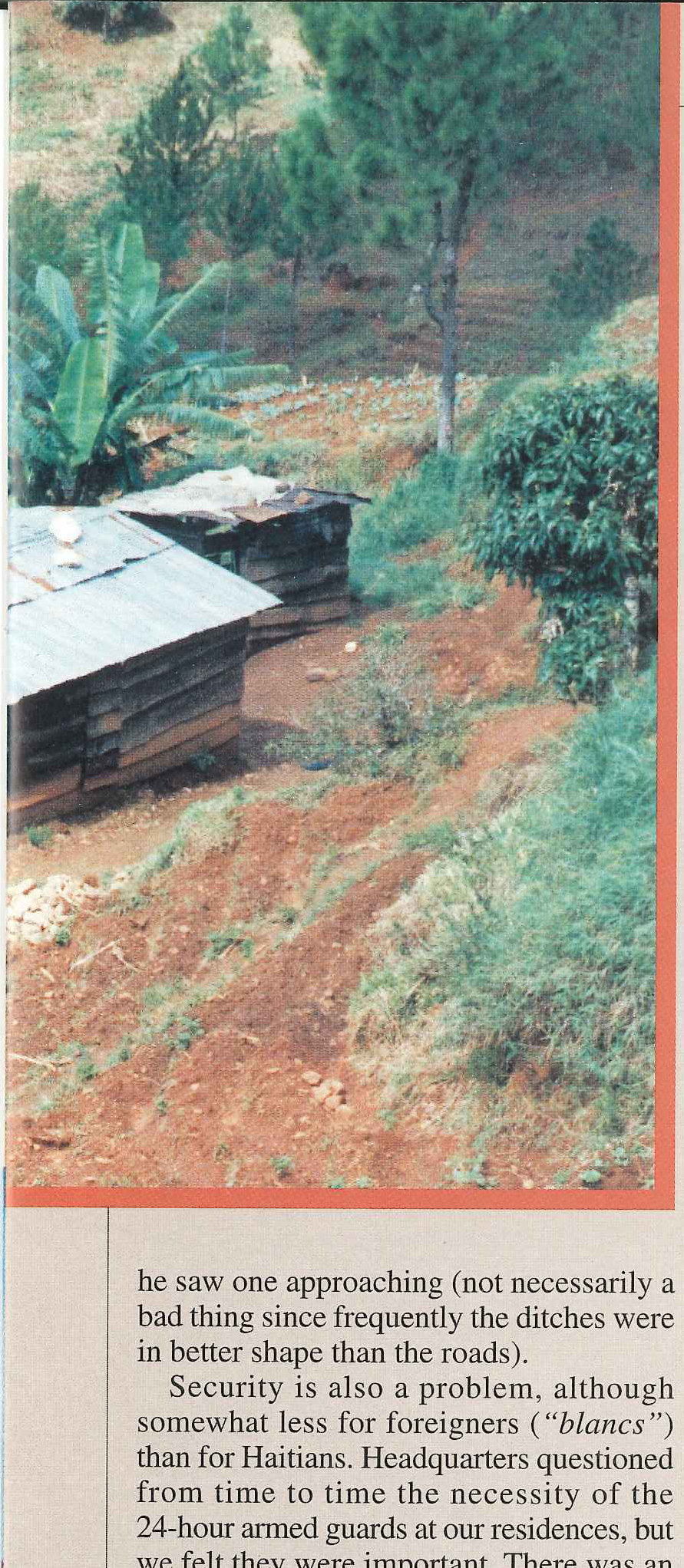
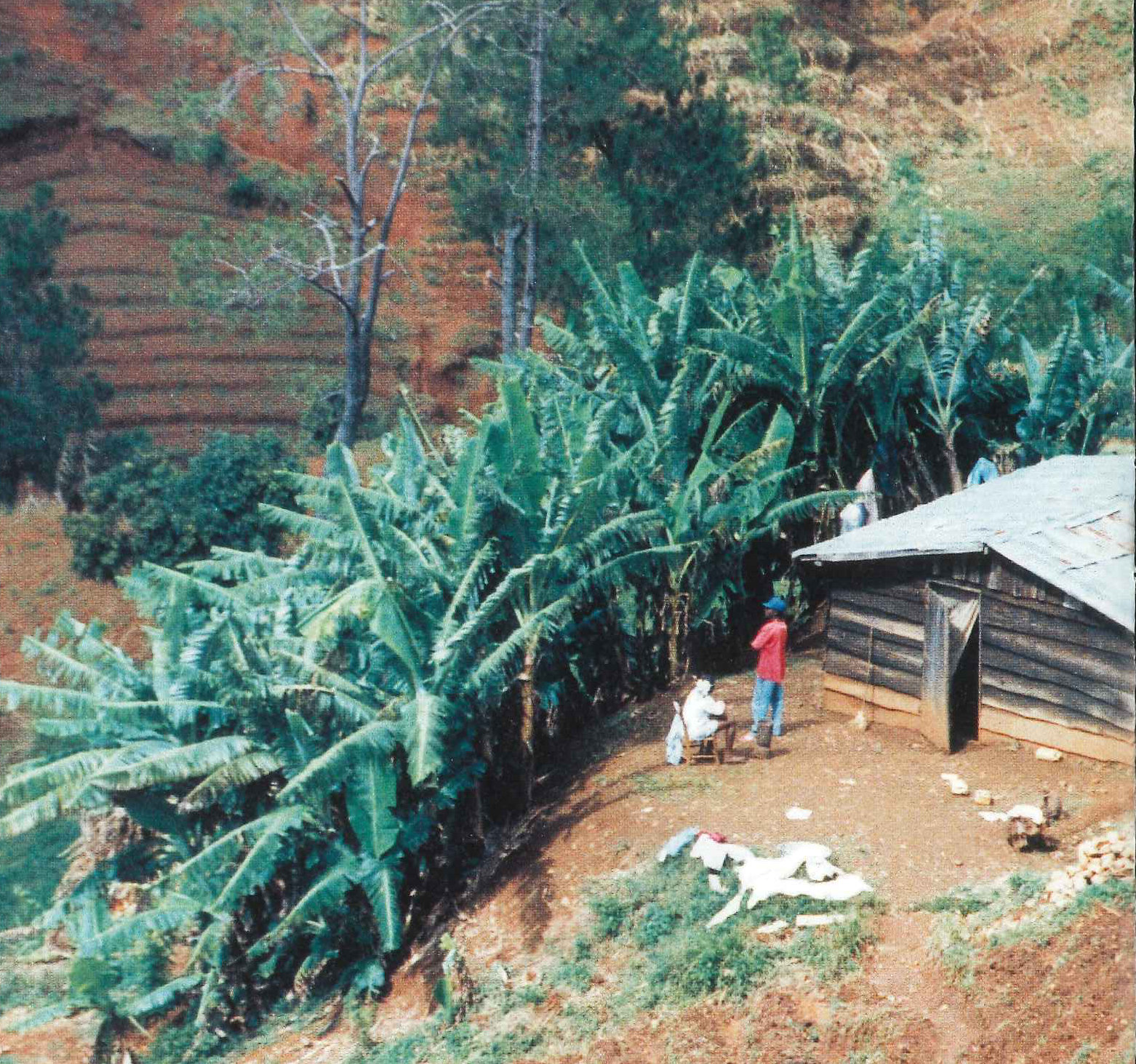
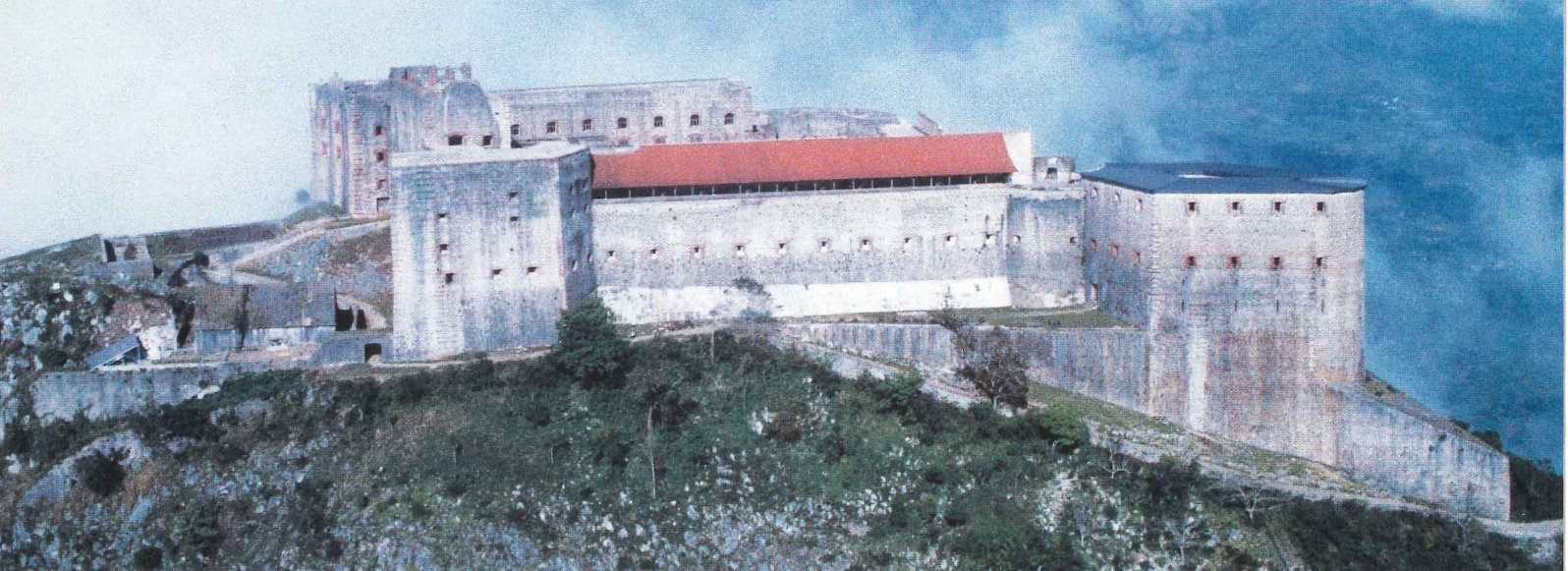
Security is also a problem, although somewhat less for foreigners (“blancs”) than for Haitians. Headquarters questioned from time to time the necessity of the 24-hour armed guards at our residences, but incident at the home of our Head Military we felt they were important. There was an Security Officer, when armed bandits tried to steal his Jeep (with shots being fired on both sides – it was kind of like the Wild West). Several of our local staff were robbed at gunpoint. One always has to have one’s Left: Rural home in mountains above Kenscoff Below: The Citadel near Cap-Haitien car doors locked while driving around. One Sunday, on the way out of town, two colleagues had a car door opened by kids waiting for vehicles to stop in the traffic jam and had some of their things stolen.
One must, however, temper one’s fears of the security situation. While I don’t have any hard statistics, I believe that the crime situation is not really worse than in Canada. A large part of it is that in Haiti, a lot of the people know each other. Therefore, everyone has family/friend/acquaintance who was a victim. The consequence of this is that crime tends to become much more personal, as opposed to mere statistics as it is in Canada, and can appear even worse than it is.
A great deal of the crime is clearly caused by the incredible poverty which pervades the entire country. Despite three years of restored democracy, one could give up hope of ever seeing an advancement. However, there are several communities which are doing a great deal to improve their lots. One such is the rural commune of Vallue, between Grand Goâve and Petit Goâve in the south. The Association de Paysans de Vallue was started by a former CIDA scholar who decided to return to Haiti after his studies in order to do something about the situation in his home area. He has managed to drum up a large number of projects from different sources and implement them with a long-term view. When I attended their tenth anniversary celebrations in January 1997, I was left speechless by their accomplishments. They had disbursed some 3 million Haitian dollars (approx. 1.5 million CDN), of which 500,000 was their own money. Contrary to many, they are obviously prepared to invest in their community. They have been so successful that the rural sections of the two Goâves have joined them (rather than the opposite where larger communities absorb smaller ones).
Despite all the difficulties, Haiti is a marvelous country. The landscape is diverse. One cannot be anywhere in the country without seeing mountains, albeit the majority are denuded of trees. It is almost completely surrounded by the blue sea. (As a side comment, I found it interesting to note that, despite all this water, the vast majority of Haitians cannot swim, explaining why many of my friends liked using my pool with its large shallow end). In the centre and the north, like between Saint-Marc and Gonaives, or the area between the capital and the Dominican border, the countryside is essentially a desert with only cactus and the like growing. In the south, it is extremely lush and green.
While they are difficult to reach because of the condition of the roads, some of the cities outside the capital are quite beautiful, though somewhat seedy due to the lack of funds for repairs. My favourite is Jacmel, in the south, with its multitude of gingerbread structures and its relative cleanliness. In Petit Goâve, about two hours south of Port-au- Prince, there is a hotel, le Relais de l’Empereur, which was once the residence of Emperor Faustin 1er (1860’s) and was frequented up till some 15 years ago by jet-setters like Elizabeth Taylor (guests loved its 3-km long private beach which is accessible only by boat). L’ Arc-à-Haie, a half-hour north of the Capital, is a pretty little town which is known as the site where the Haitian flag was designed after independence in 1804. (According to legend, Jean-Jacques Dessalines tore the white strip out of the French Tricolor and had the blue and red stripes sewn back together). One can also see that Cap-Haitien, the old capital in the north, was very attractive at one time, though it is in very poor shape now due to neglect. The Citadel, built by King Henri Christophe near Cap-Haïtien, is breathtaking and, in my opinion, rightly referred to as one of the wonders of the world. Unlike Sans Souci palace below it, the Citadel has been fairly well restored and, since it is at about 3,000 feet high, the view is spectacular. Of course, getting there is something of an adventure, partly because of the aforementioned roads but also because a portion of the trip has to be made on foot or on the back of a donkey.
Only an hour or so north of Port-au-Prince, one can find very nice beaches on the Côte des Arcadins. All, except the new public beach, are hotel-restaurants where one is not permitted to bring one’s own meal (i.e. no picnics). A half hour longer on Route Nationale #1 brings you to the Club Med, the best beach in this area and where the meals are absolutely great, though expensive. In the North, just outside Cap-Haitien, Cormier Plage is one of the most beautiful beaches in the country (along with Labadie next to it). It is highly recommended as a place to spend a quiet weekend, though one must allow at least three full days since it takes 5 to 6 hours to get there, again because of the roads.
Culturally, Haiti may be the most interesting country in the Caribbean. Prior to going there, I thought of Haitian painting as being only the primitive, brightly-coloured “art naif”, as exemplified by Alexandre Grégoire, Etienne Chavannes and Pierre-Joseph Valcin. However, there are many others as well, such as the Cap-Haitien school which is best exemplified by the likes of Philome Obin and his famous family, the icon-like style of Saincilus Ismaël or Don-Curiace Constant and the more moderns like Tiga or Denise Mangones. As well, there are several different types of sculptures, from the Croix-des-Bouquets school practiced by Gabriel Bien-Aimé and Serge Jolimond, to works by artists such as the wood sculptures of Sanon to the metal masks of Jean-Gérard Merveille, and painted tole works. Art is so captivating that one must be 20 bout de papier Vol. careful to avoid doing what we did, that is, buy enough of it that we now have to build an annex on the house to accommodate it.
Music also forms an important part of Haitian culture. Any weekend, one can go to various clubs in Pétionville and see well-known groups perform. The most popular form is kompa, with its beat to which it is impossible not to dance. A lot of groups, like Sweet Mickey (Michel Martelly) and Koudjay are into this form. I personally don’t care for kompa as I find that, like Dominican merengue, many of the songs sound alike. I admit, however, that I could not sit still when it was playing, especially Martelly’s “Pa manye fenm na kon sa”. My favourite music was “rasin” (“racine” in French) with its heavy beats going back to slavery and its African roots (and with its incredible accompanying visual show). It is best exemplified by groups such as Boukman Eksperians and Alovi Yawe. The thing to do on Thursday nights is to go to the Oloffson Hotel to see RAM (a rasin group though they have strayed into kompa lately — who have a cut on the soundtrack of the movie Philadelphia). However, when I left, they had stiff competition since Sweet Mickey had started playing on Thursdays at Mango’s in the El Rancho Hotel (the latter is arguably the more popular of the two groups). If one is lucky, one gets to hear some great shows if Beethova Obas or Emmeline Michel is in the country (though they were born in Haiti, they both live in the US) and, of course, the biggest phenomenon of 1997 was the appearance of the Fugees in Haiti.
Mizik rasin is very much influenced by the most pervasive element of Haitian culture, vaudou (we know it as voodoo), which has nothing to do with our common misconceptions of black magic and pins in dolls. I got a chance to witness several ceremonies (not of the tourist variety) thanks to a close friend of mine who is very highly placed in the vaudou religion. There are many parallels with Christianity. The loas, or spirits, in most instances have an equivalent saint and many festivals (fet champèt) are sort of joint vaudou/Christian celebrations. For instance, at the July festival in Sceau d’Eau (in the centre of the country, near Mirebalais), the same people who climb the hill to the waterfall and become possessed by one loa or another, are the next day to be found at the Catholic church celebrating the feast of Notre Dame du Mont Carmel. Many of the vaudou rites begin with Christian prayers, such as the rosary.
The work in the Immigration Program brought out a whole bunch of interesting phenomena. Legal documents (birth, death, marriage certificates, etc.) are very easy to obtain, through late declarations of one kind or another. We had one case where a supposed widower had remarried and was being sponsored by his new wife for permanent residence in Canada. In order to confirm that he was eligible to remarry, we asked for the death certificate (admittedly we were not specific that it was his late wife’s we wanted). He brought in his own. These documents were so useless for establishing identity and family relationships, that we had to rely more and more on DNA testing. Despite the criticism we received for imposing the test on the “poor people of Haiti, the fact is that we had the highest failure rate in the world. At one point, 39% of applicants actually taking the test were found not to be related
Shortly after he arrived, a colleague came out of an interview with a perplexed look on his face. When I asked what the problem was, he said his client had left him confused. According to her, she had last seen her husband (the sponsor) in 1989. She had a baby in 1994 and swore it was her husband’s. He had just been exposed to the concept of being ’en perdition’, wherein a pregnancy is suspended for some time and then resumed, a concept in which many people in Haiti really believe. I don’t know if my colleague understands yet.
Despite the hardships and frustrations, Haiti is a country to which I would return anytime. There must be something to the place since most people posted there tend to extend and many have returned for a second posting.
Bill Bottomley joined the Social Affairs Stream in 1992, after many years in
View the original scanned pages →
Originally published in bout de papier, Vol. 15, No. 4 (1998-1999) — Winter 1998/99 // Hiver 1998/99, pp. 18–20. Read the rest of this issue →



