
bout de papier, Vol. 15, No. 4 (1998-1999) — Winter 1998/99 // Hiver 1998/99, p. 16
by Christopher Brown
In August 1998 Julius Nyerere came to town. The former President of the United
Republic of Tanzania has lost none of his lustre although his socialist policies have not stood the test of time. As a statesman, his charisma and integrity have allowed him to fill a leadership role on the world stage, particularly regarding the African peace process.
I first met Mwalimu (“teacher” as he is known) following a posting in Dar-es-Salaam. He stopped in Ottawa in August 1977 to see his esteemed Commonwealth colleague Pierre Trudeau, while en route to Washington, D.C. to meet with Jimmy Carter. He was Tanzania’s founding President and endured much longer than both his fellow East African leaders Jomo Kenyatta and Milton Obote.
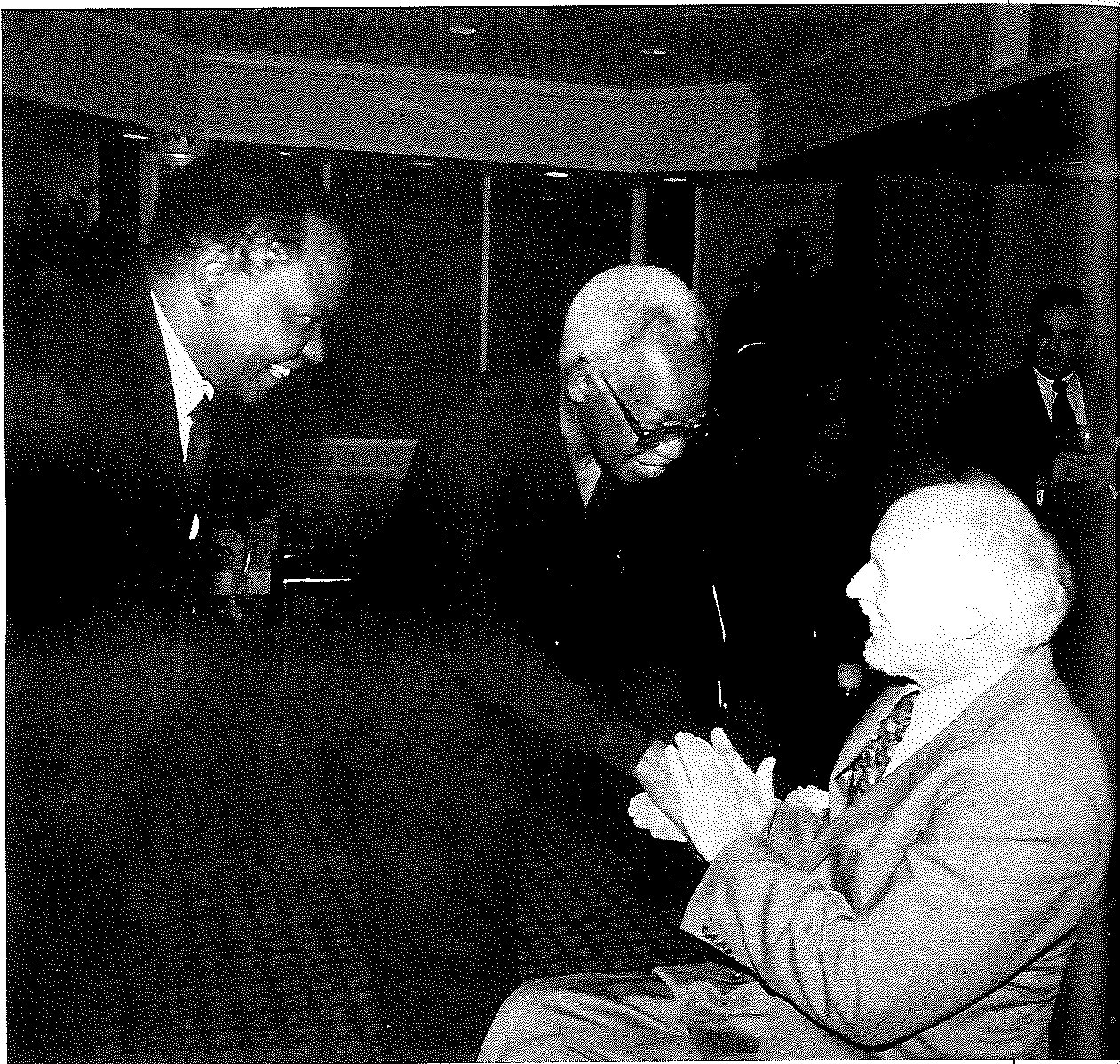
I headed CIDA planning for Tanzania when the East African Community broke up in the mid seventies. Responsibility for the community railways system headquartered in Nairobi devolved to the small regional railway office in Dar-es-Salaam. Canada responded promptly to Tanzania’s call for assistance with a CIDA mission to look at the railways in April 1977. This mission resulted in an approval of $60 million three months later. At the time, along with my director Keith Bezanson, I briefed Nyerere on the CIDA rail- President Nyerere and Chr ways programme Fadhil Mbaga’s (far left) re at 7 Rideau Gate.
CIDA’s sustained commitment for over two decades has trebled in grants to Tanazania’s railways for projects that are due to be completed in two years. Canada stepped in as lead donor at a critical time. No other country nor the World Bank moved quickly to support this project and Canadian assistance has been greatly appreciated by Tanzania. Nyerere was always interested in the potential benefits of rail links and spearheaded the TAZARA link to Kaunda’s isolated Zambia built by the Chinese following Rhodesia’s unilateral declaration of independence.
Many years later in mid-August 1998, Mwalimu visited Ottawa to receive an Honorary Doctorate at the University of Ottawa and to participate as the facilitator of the regional peace talks on Burundi in the round table of prospective donors, which Diane Marleau chaired. Nyerere’s presence brought a special flavour to the meeting. His status as founding President, still revered at home and respected abroad, place him in a very exclusive category.
The Tanzanian High Commissioner, Fadhil Mbaga, hosted a reception in his honour at the Westin Hotel. A grand affair, to which I was pleased to be invited, if only to greet Mwalimu most briefly. I mentioned our previous “rencontre” on the railways two decades ago.
Now Mwalimu is agile but perhaps it was not surprising that having met so many people, he would ask to be seated. my enormous delight, instead of being led away to a seat amongst the other dignitaries, he asked that a chair be brought alongside mine. High Commissioner Mbaga made welcoming remarks to the assembly, extolling the career of Nyerere and the stable democracy Tanzania represents. Meanwhile, Nyerere put his head close to mine to talk about “the spur line to Musoma” he had always wanted to see built.
This man is unique amongst his peers as one of few African state leaders – Mandela will likely be next — to gracefully retire from politics with a smooth democratic succession yet remain a prominent figure in pan-African issues. It was a gesture of Nyerere’s appreciation of Canada’s contribution that Mwalimu still had the time and interest to discuss railway links with a onetime CIDA hand.
If that had been my last day in the Department, it would have been one of my best. Would that all my colleagues have a similar experience.
Now I wonder, what about that Musoma spur?
Christopher Brown joined CIDA in 1971 and was posted in Dar-es-Salaam 1972-75 and Harare 1980-83. He chose the political
View the original scanned pages →
Originally published in bout de papier, Vol. 15, No. 4 (1998-1999) — Winter 1998/99 // Hiver 1998/99, p. 16. Read the rest of this issue →



