
bout de papier, Vol. 27, No. 1 (2012) — Winter 2012 // Hiver 2012, pp. 33–34
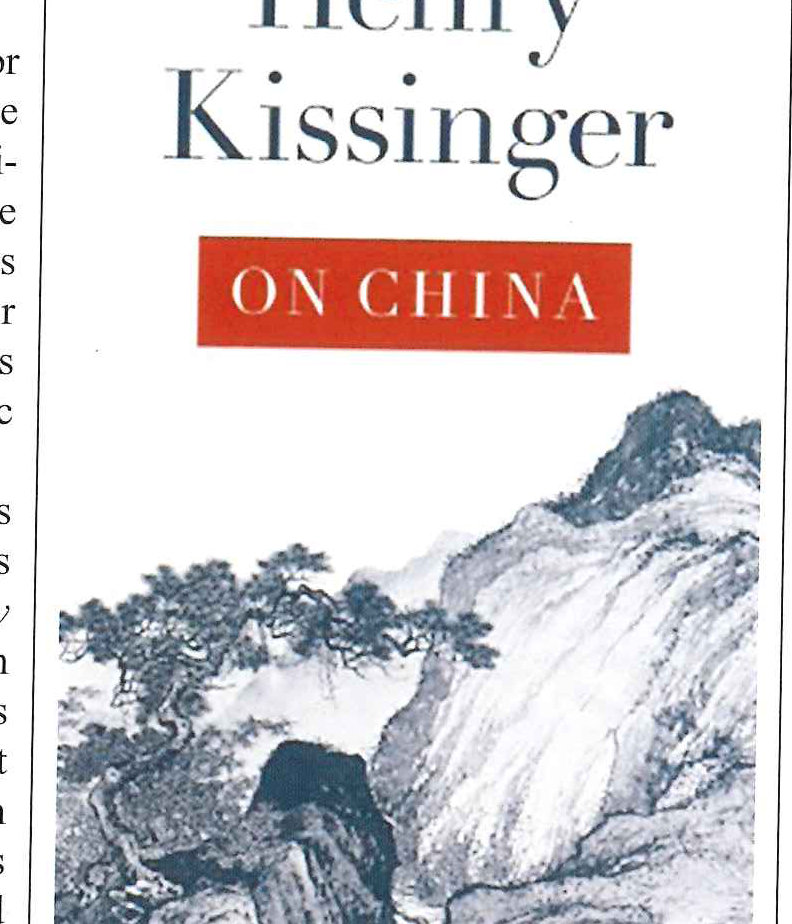
ON CHINA, by Henry Kissinger, Allen
Lane Canada, the Penguin Group, Toronto,
2011, 586 pp.. $38.00
Henry Kissinger needs no introduction. For the past sixty years his has been the voice of foreign policy par excellence, at the perihelion of momentous events that shaped the second half of the 20th century. At 89 his views remain central to many of our major policy conundrums and it is rare that he is not consulted on large issues of public policy both American and beyond.
He has published some sixteen books on foreign policy ranging from 1957’s Nuclear Weapons and Foreign Policy to three volumes of memoirs dealing with his years in public service. His years as National Security Adviser to President Nixon and Secretary of State to both Nixon and President Ford (1968-77) were ones during which the shape of today’s world was initiated and constructed. It is on those achievements that his legacy is based.
Nowhere is his legacy more fundamental to today’s world than his work on China. While he has discussed this work in earlier books, his latest, On China, provides a comprehensive understanding of what was wrought through the events of the subsequent forty years since the late February 1972 surprise arrival in Beijing of the typical American cold warrior. The full impact of that event remains at the centre of one of our world’s most complex issues: the integration of China into the modern world’s international system and its re-emergence as the second largest global economy (and soon to be first). It presents opportunities and dangers that will affect us for the rest of this century. The speed and scope of China’s re-emergence means that we are still in the early days of the global and bilateral adjustments we need to make ( if we are to avoid the deep and dangerous / fissures reminiscent of those that attended “ the end of the Second World War.
Kissinger makes clear that the “re- I emergence” of China is the most accurate p term to describe what happened since the p arrival of European colonial powers along S its coasts in the 18th century and the c collapse of its imperial system in 1912. The A first three chapters provide a tightly written presentation of the major social, political, economic, philosophical and military elements of China before Mao started his destructive war on many of them. As Kissinger makes clear, realpolitik was not first a European technique but rather a central element in how the Middle Kingdom dealt with those on its borders wanting to harm it. His description of the Chinese approach to border issues provides clarity on many aspects of Chinese foreign policy and remains important today as we come to grips with this heaving behemoth.
The end of the Second World War (and the associated close alliance between the United States and the Soviet Union) gave rise to a debate in the United States as to how to deal with a Soviet Union that many westerners now saw as intent on world revolution and domination. Out of that debate, George F. Kennan (a member of the American embassy in Moscow) wrote his “Long Telegram” providing the analytical framework for American policy. The Truman Doctrine, as it became known, proposed “containment” as the guiding principle of American policy towards the Soviet Union. For the next two decades containment remained at the centre of American policy and there were few initiatives suggesting alternative approaches.
Kissinger broke with the containment policy, promoting the idea of détente in order to reduce tensions between the two countries. At the time, in the late 1960s, China’s relationship with the Soviet Union was undergoing considerable stress with thousands of Soviet troops along its borders and regular military clashes. That, and the American policy of détente with the Soviet Union, provided the environment for the reconciliation between the United States and China. The United States was still embroiled in a bitter and unwinnable war in Vietnam, an ostensible close ally of China. However, for China bigger stakes were at play and Vietnam was cast overboard in the larger game of triangular superpower relations.
The three-way relationship between the Soviet Union, China and the United States post-1972 provided the basis for the management of the international system down to the breakup of the Soviet Union in 1992. All three countries played predestined roles, allowing China to make the transition from the revolutionary policies of Mao and Zhou to the boardroom approaches of Deng, Jiang Zemin, Hu Jintao, and soon, Xi Jinping. This predictability in Chinese leadership provided social stability and constancy of policy leading to its extraordinary economic gains.
The most serious exception to China’s steady evolution was the uprising at Tiananmen Square in May 1989. Kissinger quotes the American academic Andrew J. Nathan on the uniqueness of the situation in China (who believed that neither the students nor the regime wanted confrontation): “Through miscommunication and misjudgment, they pushed one another into positions in which options for compromise became less and less available.”
Kissinger describes the international reaction as “stark”, with China an “arbitrary authoritarian state” where “popular aspirations to human rights” were “crushed” while the American relationship “came under attack from across a wide political spectrum.” One side pushed for “confrontation” while another argued that progress on human rights could be better attained through a policy of “engagement.” Since the 1972 visit of President Nixon the philosophical differences and policy vicissitudes of varying American administrations. Through almost two decades the bipartisan approach on the importance of China to the United States ensured stability in both philosophy and policy.
Kissinger’s comments on the matter have currency far beyond the example of China:
He answers his own question by writing that “China would be a major factor in world politics, whatever the immediate outcome of the Tiananmen crisis. .[solating China would usher in a prolonged period of confrontation. ..[and] there were objective limits to American influence on China’s domestic institutions, whether confrontation or engagement was pursued.”
The Harper government in 2006, coming late to the issue, decided it did not like the government of China and engaged in a policy of low-level confrontation. However, three years later experience demonstrated that there were no benefits to confrontation. Unreserved engagement came to the fore. That change seems predictable, as Kissinger aptly notes:
In his final chapter “Does History Repeat Itself?”, Kissinger attempts to provide perspective on the evolution of China from 1949 with its ever increasing political, military and economic power. He makes a comparison to the evolution of North Atlantic states where:
However,
China has land borders with fourteen countries and has engaged militarily with three of them since 1962 (India, Vietnam and the USSR). It has had unresolved disputes, either strategic or marine boundaries, with several others — South Korea, Japan, the Philippines, Cambodia, Thailand, Burma, and Indonesia. There is also Tibet. Despite more than fifty years of effort, Beijing has not been able to obtain legitimacy in the eyes of most Tibetans or the world. It is not necessarily an area of instability but miscalculation, misunderstanding, misjudgement or exploitation could quickly deepen into issues that affect interests far beyond the region.
Kissinger draws a parallel with pre-World War I Europe with its Anglo-German rivalry as “an augury of what may await the United States and China in the twenty-first century.” For example, he writes that “China would try to push American power as far away from its borders as it could, circumscribe the scope of American naval power, and reduce American’s weight in international diplomacy. The United States would try to organize China’s many neighbors into a counterweight to Chinese dominance.”
At this stage, there is some pessimism in Kissinger’s writings on the ability of most countries to deal with large scale political events. He does not see in Asia a sense of an emerging discussion bringing about regional consensus. His policy prescription is for the development of a “Pacific Community” similar to what emerged in the North Atlantic (although that was an initiative aimed at containing the Soviet Union). He sees such a community as inclusive of China and not one by which China is “contained”. All of the countries of the region would be part of it, including India and Australia. Kissinger hopes that future policies and actions by the United States and its regional allies do not result in a standalone China confronting the rest of the region.
There are few signs that such efforts are underway. The recent decision — post publication of this book — to create an “Asian pivot” to existing American foreign policy (with the opening of a military base in Australia and possible reopening of bases in the Philippines) may not augur well as these initiatives are seen by most as being directed at Beijing. Kissinger has little to say on the extraordinary growth of the Chinese economy nor does he weigh the significance of converging economic interests. For the most part, he sees this development as almost a return to the days before the Taiping civil war when China’s economy was larger than that of most of the other countries of the world.
Kissinger closes his book with an observation on a meeting with Premier Zhou Enlai whom he quotes as saying: “This [Nixon’s visit] will shake the world.” He goes on to say: “What a culmination if, forty years later, the United States and China could merge their efforts not to shake the world, but to build 1t”” As with events in the Middle East, “Inshallah.”
Gar Pardy retired from the Foreign Service in 2003 following assignments in India, Kenya, the United States and Central America. He comments on foreign and public policy and can be reached at [email protected].
View the original scanned pages →
Originally published in bout de papier, Vol. 27, No. 1 (2012) — Winter 2012 // Hiver 2012, pp. 33–34. Read the rest of this issue →



