
bout de papier, Vol. 10, No. 2 (1993) — Spring 1993 // Printemps 1993, pp. 16–18
When I came to the East Block in 1938, I had no particular experience in filing nor in record keeping, though I had had a working acquaintance with many consecutive years of despatches, minutes and memoranda of C.O. series in the Public Record Office in London, and in corresponding records in the Public Archives of Canada.
At the Prime Minister’s Office on the main floor at the East Block, I found an efficient file room. The experienced staff could tell in seconds whether the Prime Minister had ever written to a particular individual, how recently, on what subject, and what form of address had been used.
When I was ordered to the top floor of Laurier House, Prime Minister Mackenzie King’s residence, 22 months later, I was confronted by rows of four-ring binders, which had accumulated since the outbreak of war. The contents were mainly despatches and situation reports from missions abroad (there were in May, 1940, only eight including the lately opened offices of High Commissioners in Australia and South Africa). The largest component was the “D Series” from Dominions Office, London.
The great bulk of these papers once read, if read, would not be required again, except perhaps for a retrospective survey. Many of the papers were marked “Secret”; some “Top Secret”; a few “Top Secret and Personal”; and some “star” items, from the British High Commission, marked “decipher yourself,” and usually in handwritten form. We took care that the binder containing such “star” documents was readily accessible and always in the same place.
For “non-serial” items we (Deane Russell and I) made up our own “system.” Some items delivered to us sealed, remained sealed “for the duration” ’ Our argument was that if the subject seemed not to be immediately relevant we would lock it up. This happened with a file labelled Habbakuk (later revealed as Winston Churchill’s idea of floating ice platforms as landing strips for aircraft being ferried overseas. We could guess at the contents; we did not then know about experiments conducted in a high-altitude lake in Banff National Park; nor the confrontation, headed by the-then President of the National Research Council, which informed Churchill that the project was unrealistic and should be abandoned.
There were many miscellaneous files for which we made up our own names. Items resembling Habbakuk, though not sealed, were filed under Planet; for the Quebec Conferences 1943 and 1944 we used the code words Abraham and Octagon, applied from the beginning from Britain. The most celebrated of all files was labelled Hurricane: into it went items that had to be plucked out at a moment’s notice.
The best example of this requirement came on a day when Lord Alexander, Governor General, came to tea at Laurier House. In 1945, on the day before public announcement was being made of this new appointment, Mr. King had sent identical, matter-of-fact messages to Mr. Attlee (UK Prime Minister) and to Mr. Churchill (latterly retired from that office). The former reply was courteous and straightforward; the latter expansive and rather eloquent: in part it said “In Alexander you have one of the most valiant beings alive.” It transpired that the Governor General had not seen this message: when it had first arrived we had (still learning on the job) made four copies of the original format and had tucked them into the Hurricane file. So when Mr. King rang his bell, and a puzzled duty Secretary emerged, rubbing his chin, saying “Mr. King is mumbling something about “a valiant being” we were able to produce a copy on the instant.
Though Mr. King’s Prime Ministerial and much of his official correspondence had no ordinary place in our records (which, technically, were War Records; in the beginning I had the made-up title of Officer-in-Charge of War Records), for our own purposes we kept a restricted file labelled “Belittlers.” Into this went copies of letters or of public statements which Mr. King regarded as derogatory: his rationale frequently was that though it was nothing to him personally it was degrading to the office of Prime Minister. Frequently we thought it might be both: examples, such as an order of divine service which enjoined prayers for “Our great leaders Churchill and Roosevelt” — making no reference to Mackenzie King — qualified as “Belittlers,” and the most aggravated cases as “Damn Belittlers.”
The implied profanity was, so far as I was aware, verbal only. But it could be incisive, not to say vindictive. One day during the Quebec Conference 1943, a Minister in Mr. Churchill’s cabinet “happened along” at 10:30 a.m. with no particular errand in mind. The Brigadier’s quarters in the Citadel had been furnished, inter alia, with a decanter of Scotch; when the visitor left, nearly an hour later, most of the whisky had disappeared, and it was apparent that Mr. King had not shared in it. The imbiber was scarcely out of earshot when an aroused Prime Minister exploded: “These damn people: Canada isn’t a country to them, it’s just a location!”
Over time we had to use some discretion in what we did not show to the Secretary of State for External Affairs — the Ministerial capacity under colour of which I had been seconded to his Office. On the day a signal arrived saying that HMCS Nabob had been torpedoed near Scapa Flow, I held it back until I could confirm that his nephew, Captain H. Nelson Lay, had been in command. Somehow Mr. King discovered the delay — he had a sort of eighth sense about such matters — and he said, not unkindly, that it would have been better to have told him at once. I was able to make some honourable amends later in London in July, 1946 when, at an official luncheon given by Mr. Attlee, I was seated next to Admiral Sir Rhoderick McGrigor, R.N., I happened to mention the Nabob incident; he said that bringing the damaged flat-top carrier back to Scapa Flow was the best piece of seamanship he had ever seen. I wrote a private note about this conversation for Mr. King to put into his family records.
Some of the things we did not show to the Prime Minister were certain “unsolicited” gifts. As an example, during animosities over the conscription controversy in 1944, a disgruntled citizen addressed to Mr. King a pair of heavy woollen socks wrapped in cellophane, evidently intended to suggest “cold feet”. An agent in the Ottawa office of CN Express telephoned to ask was there any way in which he could carry out the obligation to deliver the parcel “without leaving
. I assured him that I would sign the receipt, and request him to return the parcel to the sender, which would be followed by a letter making it clear that unsolicited gifts could not be accepted.
Some gifts of another character were accepted, with a twist. When Colonial Airlines (later absorbed by Eastern) began service from Washington to Ottawa through Reading, PA., the Chamber of Commerce of the Pennsylvania city on the inaugural flight sent to the Prime Minister a panoply of local manufactures. Two of us on instruction had to make a minutely detailed inventory. The largest item, 40 Ibs. of Reading pretzels, were despatched to the Officers’ Mess at RCAF Uplands; a box of cigars to the head gardener at Government House. Dress hosiery went to the Prime Minister’s nieces (we thought they would have been welcomed by the faithful and experienced women secretaries at Laurier House). A dozen crisp white shirts, size 16, were directed to be returned with a request for replacement by size 17; and a motor battery was sent back with a request for a replacement that would fit the PM’s Pontiac station-wagon. Arranging the two-way replacement transportation was a bit of a nuisance; at the end, Deane Russell and I fell heir each to a carton of Smith Brothers cough drops.
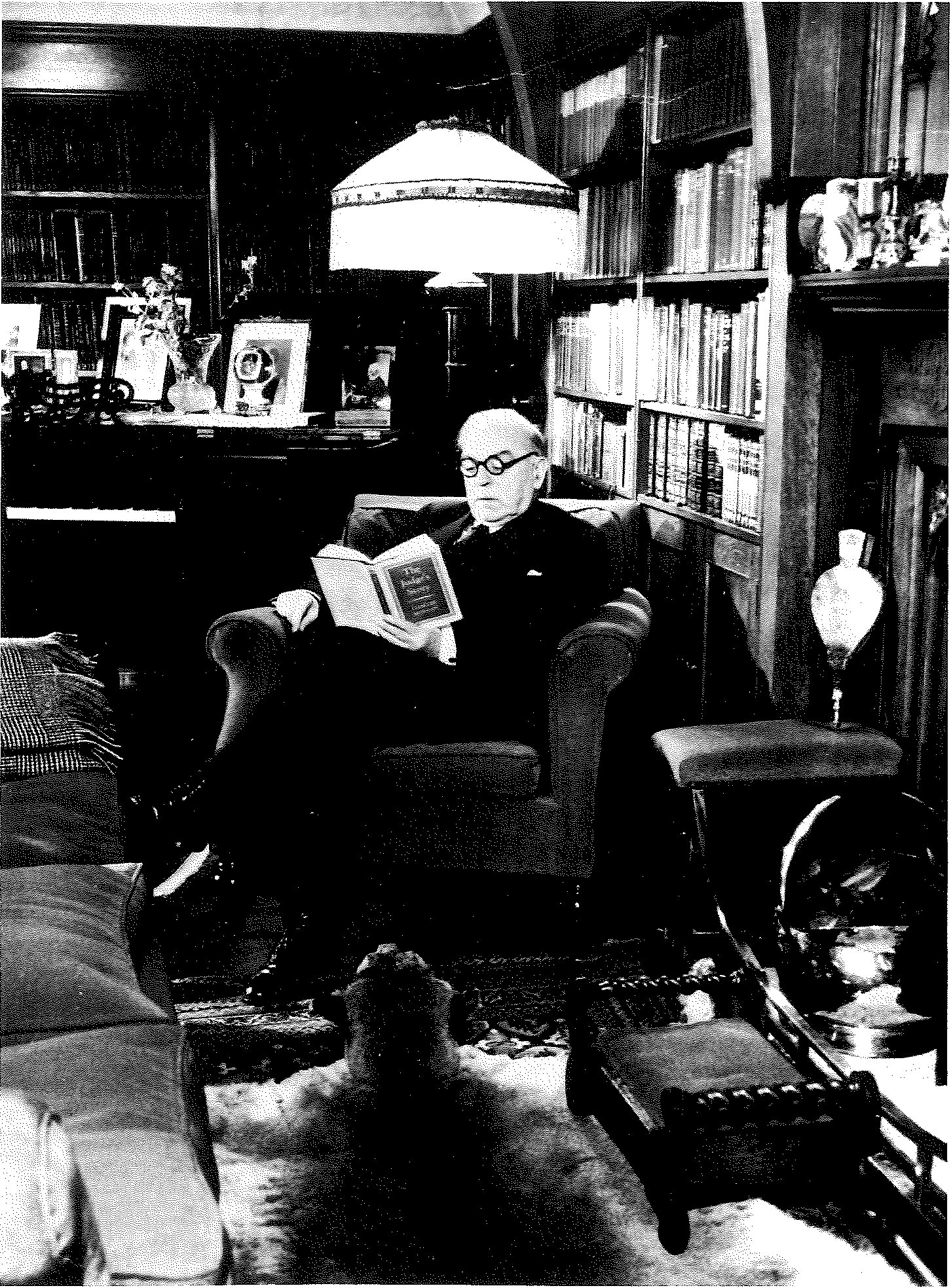
All of this recital will perhaps suggest that timing became the essence of progress. Because the SSEA could not be reasonably expected to read every line of the voluminous incoming despatches, it became routine to prepare summaries of information, a week at a time, day by day if rapid changes had come about. Even then summaries or précis might not be read — or not read during the day or week to which they applied. This circumstance was partly corrected when the House of Commons was in session and Mr. King gave periodic statements on the progress of the war. From mid-1943 until VE Day I made first drafts of nearly all of these statements; latterly the first drafts became the actual texts. Nearly every document sent down under cover of a memorandum from the Under-Secretary at the East Block would be read; but if (as happened) it was tucked away (“squirrelled”, in office vocabulary) a decision sometimes had to await a judicious ferreting out when Mr. King was absent.
The quintessence of timing emerged late on Sunday afternoons — for most of the war Saturday was the working day — when between 6:10 and 6:25 we could get through an accumulation of papers which had piled up and which had been strategically arranged. What we called “The Blunt Pencil at Work” could make operative decisions promptly when it chose. One learned patience, but one also learned strategic acuity.
Our filing arrangements were not proof against the Prime Minister locking up in his red despatch box (given to him at the Imperial Conference in 1923, and the key for which he wore on his watch-chain) documents which would ordinarily have ended up in war records. If he demanded such a document, it was not a viable answer to say he would find it in his red box — that sort of challenge was not on. The sharpest set-to I had had with Mr. King in over seven years of basic day-to-day contacts involved the red box. The document I had never seen, nor had it been in my possession. It had been sent from London to Ottawa while Mr. King was in San Francisco at the UN founding conference. Missing him before his departure for Vancouver to start his general election campaign, it was sent by safe hand of a Sergeant Courier to Portland, where this messenger, correctly, handed the envelope to the Under-Secretary. Mr. King locked the document away in his red box — on journeys of this nature the red morocco was encased in buff canvas — and to my knowledge it never emerged during the remaining months of my assignment. There came a day when he demanded it, in a hectoring attitude, when he came into my tiny cubby-hole in the attic of his house. Something snapped: I said I could not produce a document I had never had. I belaboured a colleague at the East Block to read me a paraphrase of what I thought was the document, and was in the midst of this paraphrasing exercise when the PM came storming back, nearly as angry as I had become. I stamped my foot; he retreated; the urgency of the moment seemed to have passed; and although our relations for two or three days were cool they were correct, and they thereafter resumed the minimum tolerance of cordiality which had become the working rule.
One should add that although a great deal of the material passing through our hands was classified, we never had any real concerns about security. The most sensitive material was locked in a safe; items on open shelves would not have given much information to an enemy interloper, and the ordinary entry door at the street level was guarded by RCMP constables around the clock. (These long-service men were police officers; they were also useful weathervanes of the in-house climate.)
One must confess it was something of a relief when the great bulk of the accumulation of papers of 25 years at Laurier House was bundled off to the Public Archives. If the transition and transfer took place more rapidly than Mr. King thought would have been appropriate, it was nevertheless an important public service. So long as Mr. King lived in the house, there was no hope of any one individual being able to classify and arrange these papers, least of all as preparatory to the PM’s devoting himself to the writing of memoirs which (at age 73) despite repeated rather wishful predictions seemed increasingly unlikely. If a constant work-a-day problem, for people working opposite Mr. King in his library, was somehow to encourage him to make up his mind, it was in my experience something to which he was temperamentally opposed, and over the longer haul there were requirements of everyday public business which one must now agree were more important.
Writing now some 54 years since I first reported at the East Block, and 45 since I took leave on resigning as a Foreign Service Officer in the Department of External Affairs, I do not regret the ripened experience of nine years close to the seat of political power. There were months of no regular hours, extended periods of sustained sticking at the tasks in hand, and considerable deprivations within what once would have been regarded as “a normal family life.” During the pre-war and war years (1938- 1947) there was not a great deal that a citizen could regard as normal. But the country was held together until victory had been assured; and there was some durable satisfaction in having had even a marginal part in the ordering of the nation’s business.
View the original scanned pages →
Originally published in bout de papier, Vol. 10, No. 2 (1993) — Spring 1993 // Printemps 1993, pp. 16–18. Read the rest of this issue →



