
bout de papier, Vol. 24, No. 1 (2008) — Fall/Winter 2008 // Automne/Hiver 2008, pp. 17–19
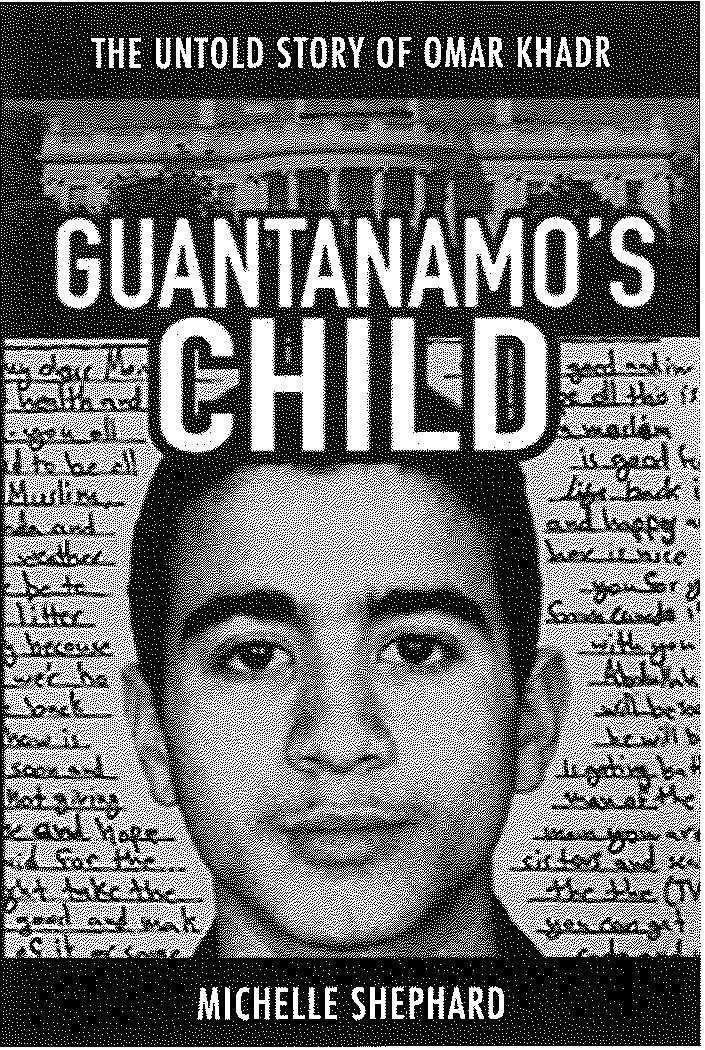
GUANTANAMO’S CHILD: The Untold
Story of Omar Khadr, by Michelle
Shephard, John Wiley & Sons Canada,
Ltd., 270 pp, $29.95.
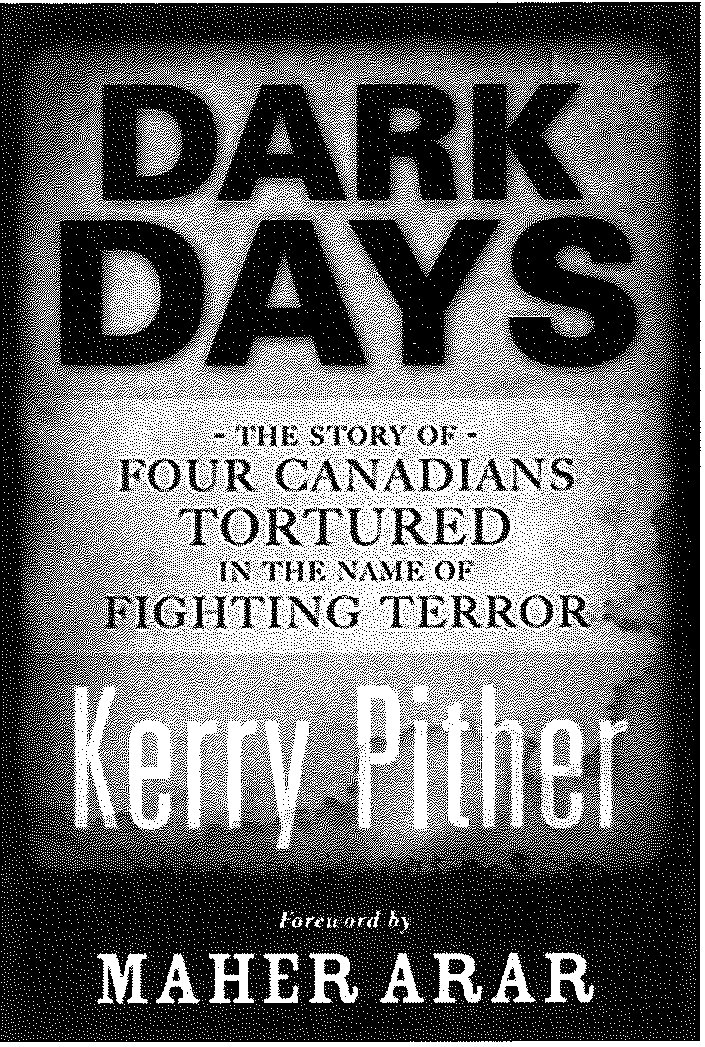
DARK DAYS: The Story of Four
Canadians Tortured in the Name of
Fighting Terror, by Kerry Pither, Penguin
Group, 460 pp, $35.00.
We are now seven years on from the world-changing events of September 11, 2001, and the consequential “war on terror” launched by President George W. Bush and his coterie of over-reaching, hubristic associates. His Administration has shambled to the end of its shameful existence and it will be some time before revisionist historians will put lipstick on that pig. Unfortunately, the countervailing forces of reason, decency and prudence have been slow to emerge and it is only now that some of the inadvertent casualties of that war are being identified.
It was only a few months after 9/11 that some of the elements of the dark side of the war on terror began to appear in the mainstream media. In December 2002, Dana Priest and her colleagues at the Washington Post reported on the phenomenon of extraordinary rendition at the same time that Guantanamo became part of the public lexicon as a place beyond the rule of law.
And it was not many months before the evils and terrors of “Black Prisons” and of Abu Ghraib illustrated the lack of morality and decency within some elements of the American policy and security agencies and armed forces. Except for a few soldiers no one of rank has been held legally or morally accountable for these indelible stains on the “city upon a hill”.
In Canada, with high dudgeon, we have stood aloof from the moral and legal failures of our neighbour. We stumbled into the open-ended war in Afghanistan and, chameleon-like, we sidestepped Iraq. However, time increasingly demonstrates that in the dark side of the war on terror our own hands have stains and these should not be allowed to fade with the passage of time.
These two books, Michelle Shephard’s insightful and unique look into the first family of Canadian terror and Kerry Pither’s authoritative and sad chronicling of the four Canadians who were ensnared in the webs created by our out-of-their-depth and untrained security and police organizations, illustrate the Canadian casualties. The books should stand for some time as examples for those in and out of government of how six decades of “reform” of our security and police organizations have failed. Equally, the books provide stark reminders of how thin the protection is for citizens when the rules of law and reason are dumped or circumscribed in order to give the illusion of security.
Michelle Shephard’s Guantanamo’s Child tells the story of the Khadr family and its troubled journey from Egypt to Canada to Pakistan and ultimately to death in Afghanistan. It is a rare story and despite the media attention going back over a decade, it is only in Ms. Shephard’s superb telling that there is any sense of understanding and comprehension. It is the first book that relies on the cooperation of members of the Khadr family, and particularly the willingness of Omar’s sister, Zaynab, to speak openly and — from my knowledge — honestly of a dysfunctional and migratory clan searching for certainty in an uncertain world. As Ms. Shephard writes, “The Khadr family is endlessly fascinating, infuriating, belligerent, simple, and yet complicated, sometimes naive, sometimes savvy.”
The patriarch was Ahmed Said Khadr, a professional engineer from a reasonably well-off Egyptian family, who against the wishes of his family migrated to Canada. In so many ways there are strong echoes in his life to those of several other Egyptians — particularly Ayman al-Zawahiri, the founder of Islamic Jihad and later deputy to Osama bin Laden, who became a close friend of Ahmed — of his generation who, frustrated with the lack of political and economic change in Egypt, sought change through violence based on their twisted understanding of Islam. (Lawrence Wright’s The Looming Tower: Al-Qaeda and the Road to 9/1] provides an outstanding account of the evolution of al-Zawahiri and the Islamic Jihad of Egypt into Al-Qaeda.)
Mr. Khadr was one of thousands of Egyptians who came to Canada during this period and there were few signs then of the course the rest of his life would take. However, the Soviet invasion of Afghanistan in late 1979 provided a “rallying call for the world’s Muslims” and Ahmed was no exception. For most, the war had little to do with the historical role, irrespective of religion, that Afghans played in central Asia. Rather the war was now “a war against Islam.”
Within a few years (1983) Ahmed made his first visit to Afghanistan and was among the very first of thousands who followed. This, in some ways, was not significantly different from what happened in Spain in the second half of the 1930s. Before long his family was with him in Peshawar and they began their fateful, deadly journey and their close association with Osama bin Laden and Al-Qaeda. It led to the death of Ahmed and one son, the serious wounding of another, the disaffection of yet another, who for a while became.a CIA agent, and the capture of Omar and his imprisonment in Guantanamo.
Lest we forget, these were the years when the Afghan mujahedin were the poster boys of the world in their heroic, bloody struggle against the Soviet invaders. Washington and Riyadh were united in a common, secret struggle and poured billions of dollars into the Afghan resistance — with much of it sticking to Pakistani fingers — and promoted the idea this was jihad at its very finest. (George Crile’s Charlie Wilson’s War tells this story and its blowback of unintended consequences from the perspective of today’s world.)
Ms. Shephard’s focus is Omar, and she provides a sympathetic story of a person caught up in a global maelstrom he did not understand, while being a member of a family that will provide psychologists and sociologists with fertile ground to till for years to come. However, as Ms. Shephard constantly reminds us, this was a child (at the time he was captured by the Americans in 2002, he was 15) who deserves, if not our sympathy, then our understanding and a willingness to apply the moral standards of a just and tolerant society.
Previous governments, both Liberal and Conservative, have escaped serious criticism for their unwillingness to accept responsibility for Omar. Many other governments, ranging from the United Kingdom and Sweden to Saudi Arabia and Yemen, have done so for their citizens with more serious blots. However, there are no signs that the government of Canada has begun serious discussions with the Americans to have him returned to our shores. Canadian governments have hidden behind the sins of the father, the words and dress habits of his mother and sister, and the hilarious idea that there is a justice system at Guantanamo. meantime, as Ms. Shephard ably documents, there is now serious doubt that Omar threw the grenade that led to the death of an American medic. More ominously, he is being judged within a system which “has no rules” and against which the United States Supreme Court has found serious and substantial fault on four separate occasions.
The story of Omar Khadr reflects largely on Canada’s sins of omission. The subjects of Dark Days by Kerry Pither cut more closely to the Canadian bone, and our sins there are ones of commission. These sins are based on ignorance and stupidity by our security and police organizations and the inability either to understand a complex threat or, on the part of the public, even to understand the threat that badly conceived policy represents for all of us.
Ms. Pither begins her account of the harsh treatment of four Canadians at the hands of their own government and media, with the plea that they “have the right to be presumed innocent”. At the end of her book there can be no doubt they are innocent victims of over-zealous, uninformed, ignorant and in some instances malicious police and security organizations.
These organizations were helped by media that were willing to use unverified and inaccurate leaked information and, most troublesome of all, media that were willing to be used for the sake of a “scoop” or to sensationalize. None of the news organizations involved has seen fit to provide an accounting of their misdeeds and mistakes. Ms. Pither’s book details all of these flaws; for that alone her book performs a valuable public service, since it is a sign of our time that societies quickly forget the evils that are perpetrated in their name.
Dark Days tells the stories of Maher Arar (he provides the foreword for the book), Ahmad El Maati, Abdullah Almalki and Muayyed Nureddin. Ms. Pither relies on the four for first-hand accounts but also uses the thousands of pages of testimony and conclusions from the O’Connor Commission of Inquiry to cross reference and to verify. In this she is assiduous in her attention to detail. The book was published in late August and so far there has not been one instance where exception has been taken to her facts or to her conclusions.
The melding of four complex experiences to provide a coherent story is worthy of commendation. At the same time, to create an easy-to-read account of that complexity is rare, especially in a first book. Ms. Pither’s experience with the Arar team (she did press relations for Monia Mazigh from early 2003 onwards) and her penchant for lists and chronologies results in a book that will remain the definitive work on this troublesome and disturbing matter.
Maher Arar is quoted in the book as saying, “in our society, to be labelled with this ‘t-word’ is worse, unfortunately, than a serial killer” and this theme correctly fills the book. Suspicion, underhanded accusation and malicious leaking, not the courts, are the vehicles that were used to darken the reputation of these four men. This inexorably led to their imprisonment in foreign countries and their torture at the hands of some of the world’s most adept torturers. Ms. Pither does not hide from the nastiness or the banality of the violence visited on the four men and, for those who are sceptical of such first-hand accounts, it can be stated with some finality that there is nothing in them that cannot be verified by contemporaneous and third-party accounts.
The shame is not in the telling but in the willingness of Canadian political leaders to rush to erode our rights and protection under law, as they did with the Anti-Terrorism Act of December 2001. These changes were made in the willing blindness not to realize that they would be abused. History has shown that our security and national police have been incapable of meeting new threats to national security. That history demonstrates that first the RCMP and, more recently, CSIS do not have the moral or legal foundations either to police themselves or to adjudicate mistakes, or to provide competent leadership during periods of national crisis.
Kellock-Taschereau, Mackenzie, McDonald, and Morin-Hughes have all tilted at that windmill with less effect than Quixote and Panza. More recently Justice Dennis O’Connor and Dennis Brown have tilted at it as well. While former Supreme Court Justice Iacobucci’s report detailed the tragedy of four Canadians, by mandate he was not asked to look at remedies, a conscious omission by the government. And we are awaiting the wisdom of former Supreme Court Justice Major with respect to Air India.
After 9/11, as with previous periods of national concern, the RCMP developed a passion for the new mission of Sunni-based terrorism, urged on by politicians and the media who should have exhibited greater balance and oversight. Ms. Pither also documents the failure of the RCMP and CSIS three years earlier in dealing with Ahmed Ressam, who was captured by the Americans before he was able to bomb Los Angeles Airport — thus adding to the willingness of police, security officials and national politicians to cut corners and throw kerosene on what was in reality a small Canadian fire.
These two books, in conjunction with the report of Justice Dennis O’Connor, are the only documents which provide Canadians with the opportunity to stand back once again and see the failures of their elected representatives and their willing agents in the RCMP and CSIS. The nature of these failures has remained unchanged in the Canadian body politic since the postwar years when Igor Gouzenko wandered around Ottawa with documents exposing Soviet spying in Canada. Roughly every two decades these failures have been examined and dissected by eminent individuals, but another constant of our body politic has been our inability to create institutions in which we can have some measure of confidence if not trust. Ms. Shephard and Ms. Pither demonstrate once again how much we have failed.
View the original scanned pages →
Originally published in bout de papier, Vol. 24, No. 1 (2008) — Fall/Winter 2008 // Automne/Hiver 2008, pp. 17–19. Read the rest of this issue →



