
bout de papier, Vol. 17, No. 3 (2000) — Fall 2000 // Automne 2000, pp. 34–37
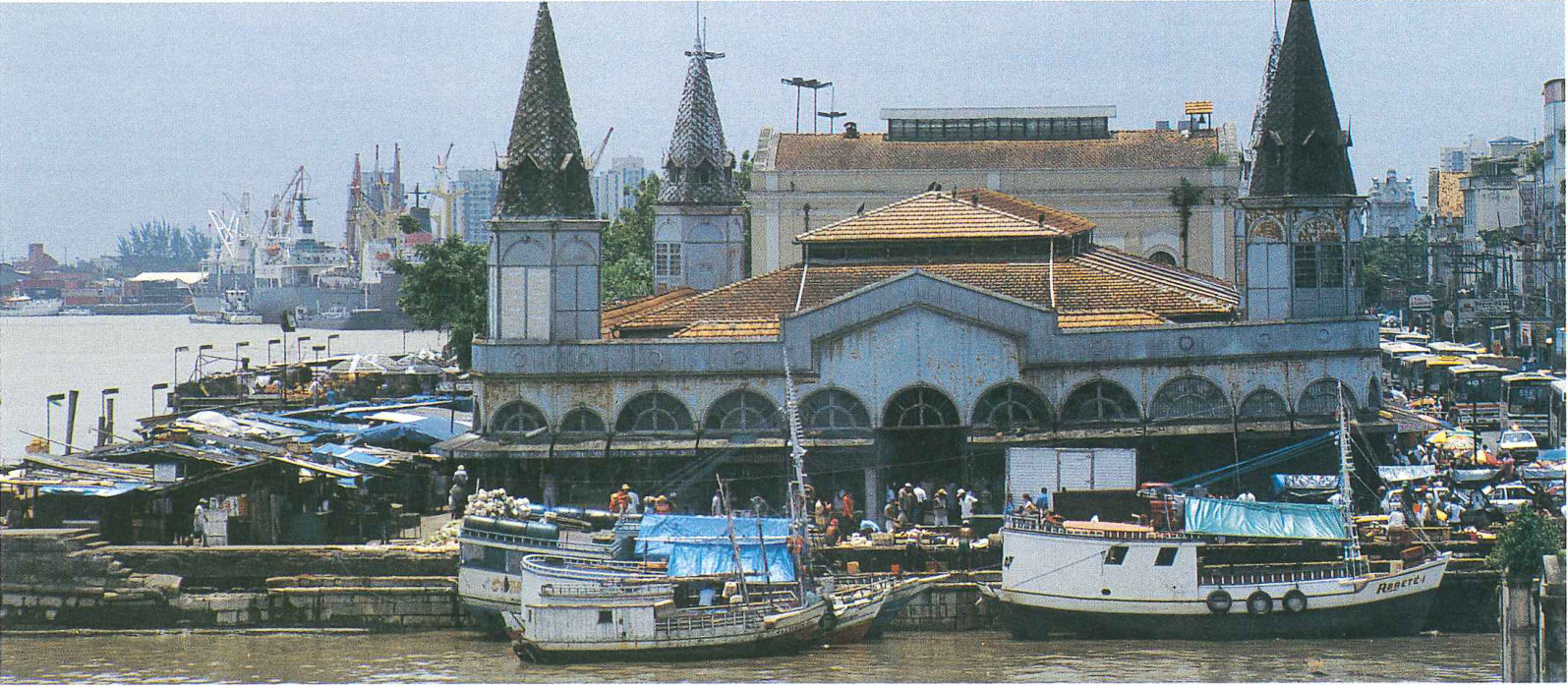
The most popular movie running in the quiet and very hot Brazilian river port of Tabatinga (pronounced Tabachinga) was Chitanic (work it out). I hoped this wasn’t an omen.
Down at the floating wharf the Voyager Three, which Jenny and I would be looking to take us half way down the Amazon River, before we changed boats in Manaus for the second and third legs to Macapa and Belem, in fact looked quite seaworthy. Its three open decks (cargo, passengers’ hammock deck and bar/sundeck) had all quite clearly just been cleaned. Moreover, the fare was a bargain: 1300 km, three nights and three meals a day for C$45. This, we thought, compared quite favourably with the 5095 pounds charged for similarly all-inclusive trips on the Amazon by Abercrombie & Kent (although passengers probably don’t have to supply their own hammocks aboard the Explorer).
Now most people have some mental vision of what rolling down the Amazon must be like. My preconceptions owed much to those wonderful Werner Herzog movies Fitzcarraldo and Aguirre: Wrath of God. In the former, a manic Klaus Kinski hauls a full-sized paddle steamer up the side of a jungle-clad mountain and then down the other, so as to reach lucrative rubber tree territory in the Upper Amazon, while in Aguirre (which is actually set on the Orinoco, but you get the idea) a raftload of equally manic Spanish conquistadors, led by their eponymous captain, slowly go even more mad as they gently drift down to the sea, mocked by howler monkeys, screeching parrots and taciturn but unmistakeably hostile natives with bows and arrows.
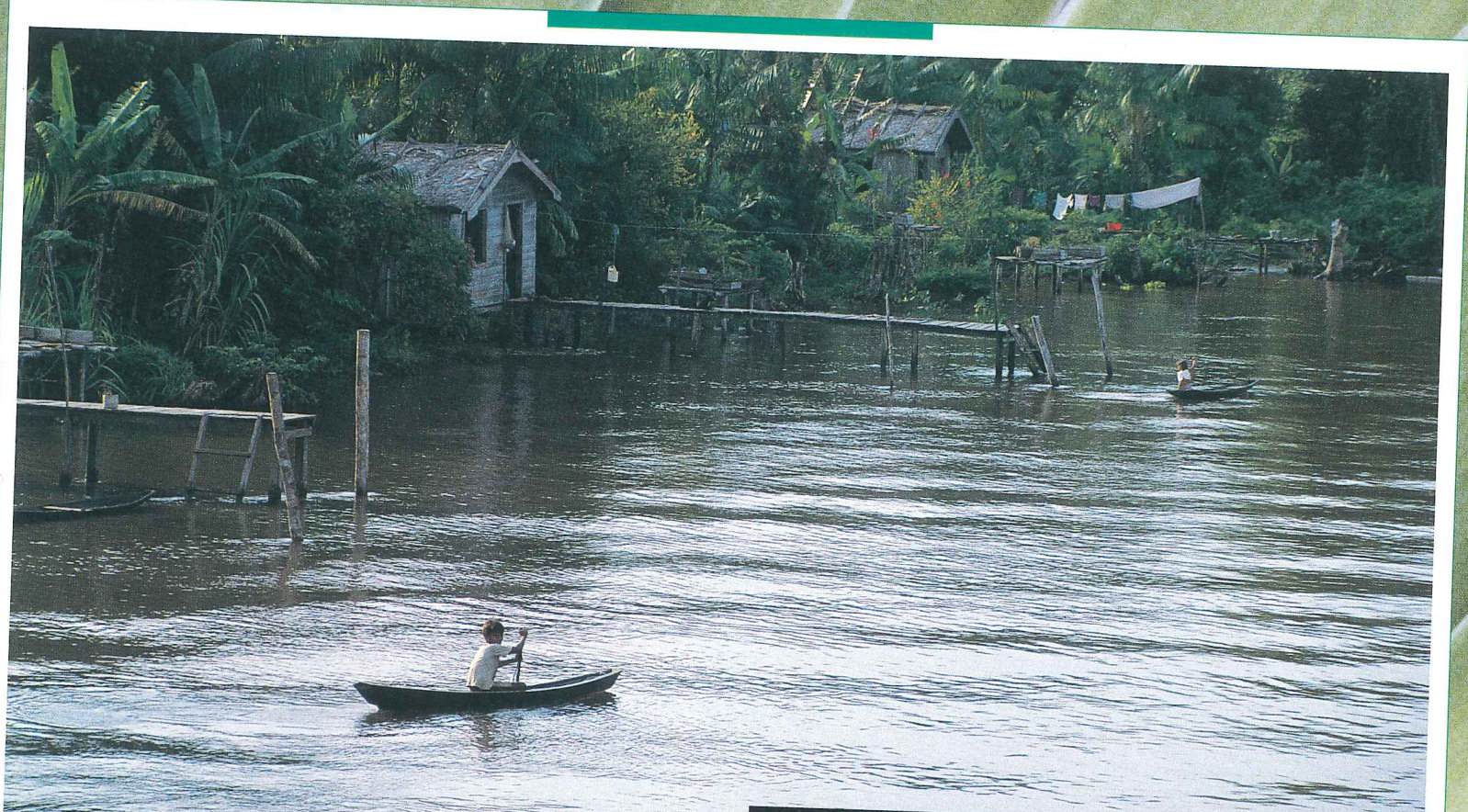
Well it’s not quite like that these days. Our first night out from Tabatinga, one of the crew members did ride shotgun on the stern, but the fear here was piratical FARC guerrilla from Colombia rather than Indians firing curare-tipped darts and, as for the howler monkeys, when sailing downstream one is often as much as 2 km from the bank and well out of their range as well. What we did see were dozens of the inoffensive pink river dolphins that ply the Amazon and Orinoco systems and, at our many port stops, throwing a piece of orange peel into the river could be guaranteed to attract an immediate and dramatic thrashing of piranha.
The joy of rolling down this particular stream is, rather, in the journey itself — in the midnight stops at tiny unlit riverside settlements, in sipping huge, cold Antartida beers at sunset on the top deck, with Brazilian country music or the theme from Top Gun pounding out over the treetops, in reading all of Vikram Seth’s 1349 page A Suitable Boy while swinging in your hammock and, above all, in the observation of your varied fellow passengers.
There were, for example, Humbert and his Lolita — not their real names, of course — whom we encountered in Belem, before starting upriver again. Humbert was in his early thirties and was from the poverty and drought-stricken region in northeastern Brazil known as the Sertao. He had loaded all his worldly possessions on board and was headed, eventually, up the Rio Negro to make his fortune. These possessions included his beautiful, newly-wed but apparently mute wife, who never wore anything but inappropriate clinging dark-velvet mini-dresses and who must have been closer to twelve than sixteen. She and Humbert spent most of the voyage in a passionate clinch in their single hammock. When he briefly came up for air one evening, Humbert did confess that his Lolita was “a bit overawed by it all.”
Then there was The Man With The Car. Loading The Car at Santarem, by means of two planks angled at 45 degrees down from the wharf to the open lower deck, while the boat moved up, down and sideways had been a thrilling experience: more than once it looked as though the poor Toyota was going to end up on the bottom of the river. But a car is a great status symbol in most Amazon riverside communities, the more so because it is of very little practical use in a country where there are no roads to speak of. The Man with the Car knew it. Three times a day he would process down to the lower deck with a crowd of ever larger sycophants, there to turn the engine over and play a song or two on the car’s tape deck:
“You mustn’t let a day go by without running the engine,”
he would say gravely, to approving nods.
The Man With The Car, who also led the top-deck poker games and was very macho, would have nothing to do with The Gay Guy, an athletic black man of about eighteen, who spent his days mincing around the boat dressed only in a brief tanga, a tape-deck on one shoulder playing Sambas. Whenever we stopped, The Gay Guy would put on an impromptu Lambada and Limbo show on the roof of the bridge for the communities that had usually assembled to witness our arrival. The Gay Guy’s companion was a grizzled American who appeared to be in his late seventies and who rarely stepped out of his oven-like cabin; but on the last day of our trip The American did strike up a friendship with another of the boat’s characters, the tea-cosy clad and jewellery-making Rasta Man. This only led the Gay Guy to pout for an afternoon.
Then there were The Soccer Fans. Mostly they wore the black and red hooped shirts of Flamengo, one of Rio’s top teams, but there were still a few behind-the-times Fans with Ronaldo’s Number Nine shirt, in Brazilian gold and green. Ronaldo, following his disappointing performance in the 1998 World Cup in France, had fallen out of favour, it seemed, although I learned from The Fans that he had been bribed by the French to fake his epileptic fits.
The Soccer Fans attempted to monopolise the TV on the passenger deck, but periodically fights would break out with the Soap Opera (Telenovela) Fans. Every time our boat went around a bend (and there are more than one or two in the 3000 km of river we traversed) someone would have to go up to the top deck and, by means of shouts over the rail, coordinate adjustments of the satellite dish with the TV watchers below in such a way that the signal was regained: this was the chance for the Soap Opera Fans to have their way.
Mealtimes were usually an excuse for lively discussions, as well. Food was plentiful, if monotonous — rice, chicken and beans, sprinkled with manioc flour. But table manners tended toward the uncouth and on two legs of our four-leg journey the crew wisely decreed that the men should eat apart from the women and children: otherwise, the latter would surely have starved. Usually, there were two tables that sat fifteen apiece. With up to four hundred passengers on board, this meant that you invariably had to eat with three or four people at your back waiting to seize your seat as soon as you made as much as a sign of putting your fork down.
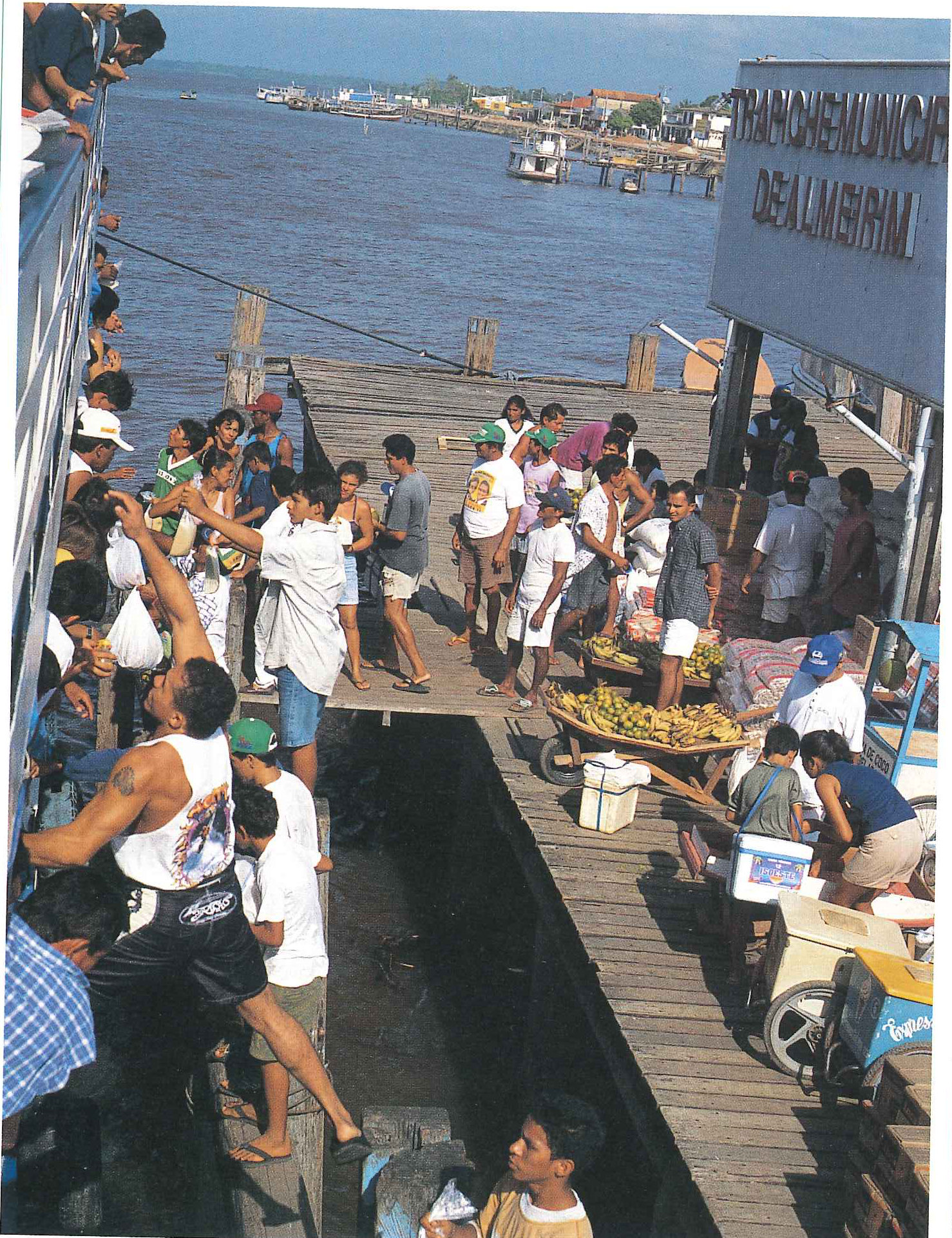
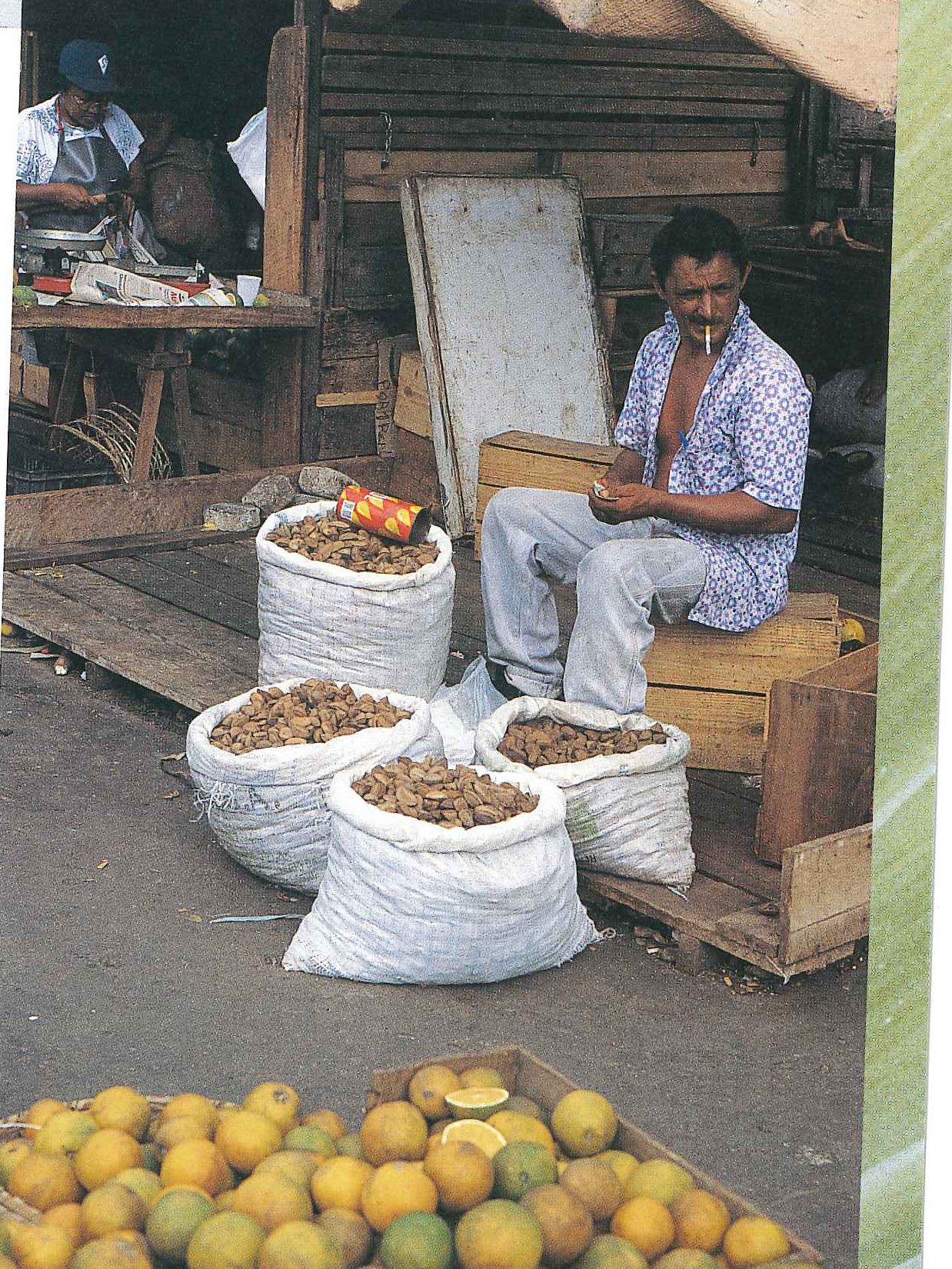
Every few hours for the eight days it took us to reach Belem and the three days back up to Santarem, there would be stops. Hundreds of cases of frozen chicken and pallet-loads of beer would be offloaded (all by hand) while tons of bananas and other produce came on. On the Voyager Three we were only about fifty passengers, which meant we had plenty of room to sling our hammocks, but on two subsequent legs the load was four to five hundred (I had a suspicion no passenger list was kept). On these occasions, our vessels would have furnished a good location for an academic researching the conditions aboard eighteenth-century slavers in the Bight of Africa. But things weren’t just crowded. We had to sleep immediately over hatch covers that led into the very depths of the vessel. At every stop these covers would come off and human chains would be set up immediately beneath us; it’s remarkable what you can learn to sleep through.
Only twice were we actually woken. The first time, it was because the engines suddenly stopped. With no lack of passengers and crew members shouting advice, one of the cooks was lowered over the stern with a flashlight, which unsurprisingly went out as soon as he tried to dive underwater with it. For an hour, he banged away at the propeller shaft with a large wrench as we drifted in the stream; it seemed to do the trick and on we went, the boy in the bows periodically sweeping the river ahead with his searchlight to look for further deadheads.
On the second occasion, it was 2 a.m. and a customs launch had come out to intercept our vessel; we must have been passing from one Brazilian state to another. Blinking as the overhead lights were put on, I made out a very officious uniformed personage unmistakeably coming our way and apparently ignoring all the other passengers, most of whom I knew for a fact (because they had told me) to be involved in smuggling.
But I was ready. Even as the officer was moving his swagger stick to prod our baggage and was opening his mouth to roust us out, I was proffering my warm, limp but unmistakeably red passport.
“Diplomatico,” I said apologetically.
Perhaps if Captain Aguirre and his men, aboard their ill-fated raft, had been so equipped they would have had a happier trip downstream.
View the original scanned pages →
Originally published in bout de papier, Vol. 17, No. 3 (2000) — Fall 2000 // Automne 2000, pp. 34–37. Read the rest of this issue →



