bout de papier, Vol. 17, No. 3 (2000) — Fall 2000 // Automne 2000, pp. 29–33
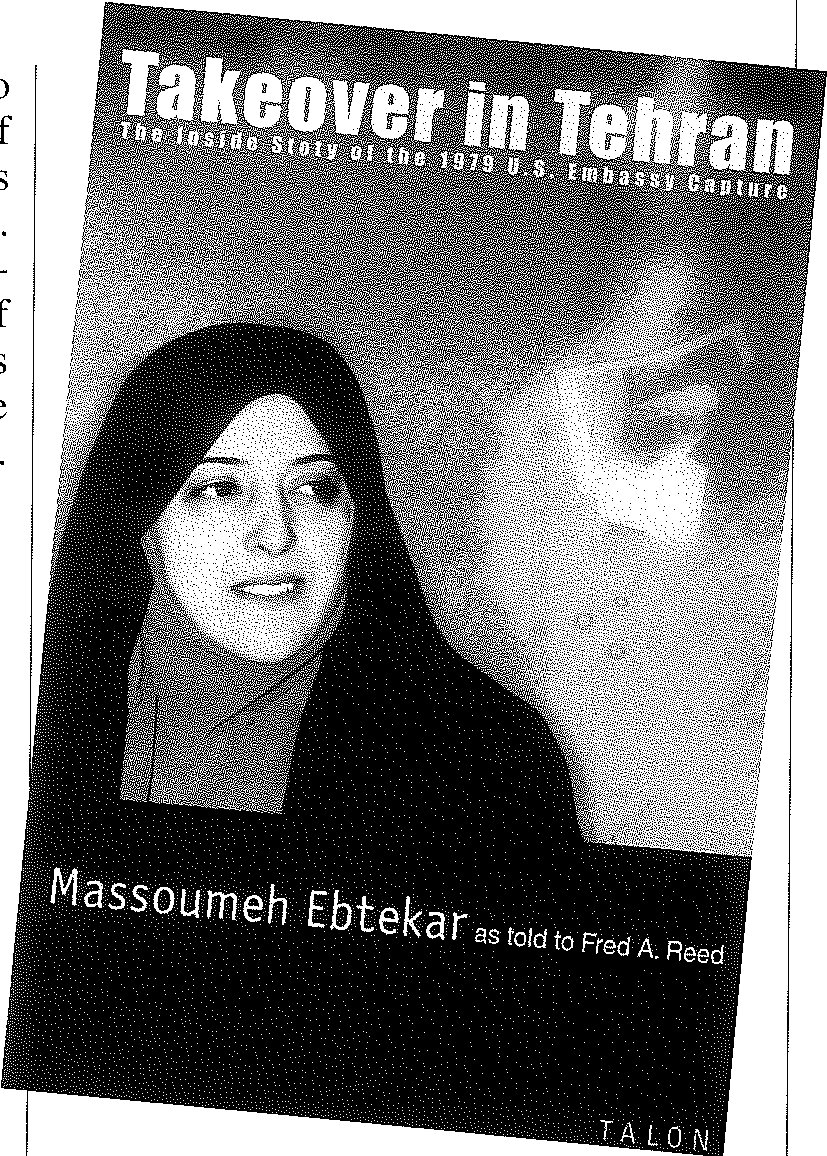
Editor’s Note: Fred A. Reed is a Governor General’s Award winning translator and international journalist. The following excerpt is from his latest book, Takeover in Tehran:The Inside Story of the 1979 U.S. Embassy Capture published by Talonbooks (2000, 224 pp., $18.95). It is the first-ever insider account of the American Embassy takeover in 1979 as told by Massoumeh Ebtekar to Mr. Reed. Other books by Mr. Reed include Persian Postcards: Iran after Khomeini and Salonica Terminus: Travels into the Balkan Nightmare, and Anatolia Junction.
Massoumeh Ebtekar, then a freshman at Tehran Polytechnic Institute, was an active participant in the political movement that planned, organized and carried out the capture of the United States Embassy in Tehran on November 4, 1979. Its impact was to shatter relations between the United States and Iran, and propel Iranian religious radicals, under the leadership of Ayatollah Ruhollah Khomeini, to the fore as the country’s dominant political force. Takeover in Tehran tells the story of this group of students, their supporters, the Iranian revolutionaries, and the 61 — and ultimately 52 — American hostages, and how they became caught up in events that mushroomed into a major international issue and ultimately eluded their control.
This book promises to become one of the keys to confronting a troubled and controversial past, both in Iran and in the United States. Massoumeh Ebtekar, like several of her fellow students, has gone on to hold positions of responsibility in Islamic Iran. She is currently vice president in charge of the Department of the Environment, a close political advisor to president Seyyed Mohammad Khatami, and one of the founders of the Islamic Iran Participation Front (IPF). This was the broad coalition that won more than 70 percent of the votes in the Majlis (parliamentary) elections of February 18, 2000 which pried control of the country’s legislative branch from the country’s ultraconservative political faction.
Ms. Ebtekar’s generation, which came to precocious maturity during the first days of the Islamic Revolution, is now, twenty years later, emerging as Iran’s new political elite. Mohammad-Reza Khatami, the British-trained nephrologist, younger brother of President Khatami and IIPF leader, was among the student activists who seized the embassy on that fateful November 4, 1979.
On a more sombre note, so was Sa’id Hajjirian, wounded in a failed assassination attempt by a Revolutionary Guard Corps intelligence operative loyal to the defeated clerical faction, as he was arriving to attend a Tehran City Council meeting several days after the election. Mr. Hajjirian is generally regarded as the architect of the strategy that led the reform coalition to victory, and was formerly a high-ranking official in the Information Ministry, a position that had given him privileged access to the inner workings of the Islamic state’s intelligence apparatus, and to detailed files on all leading figures of the regime.
Another former student who has gone on to win a reputation as a combatant for Iran’s emerging civil society is Abbas Abdi, the investigative journalist whose reports exposed the direct involvement of the security services in the brutal “chain murders” of secular nationalist opposition politicians in November, 1978. Mr. Abdi’s hard-hitting, chillingly documented reports appeared several months later in the radical daily Salaam, published by Hojjatoleslam Mousavi Khoeiniha, who twenty years earlier had acted as spiritual and political advisor to the occupying students. Mr. Abdi was subsequently imprisoned, and Salaam shut down by Iran’s clerical-dominated judiciary system in June, 1999.
The emergence of the one-time student militants as reform activists committed to an Islamic civil society, democratic pluralism and cultural dialogue has been seen by some as a paradox. Others interpret their rise to prominence as a ruse perpetrated by a putative monolithic Shi’a clerical establishment. Still others see it as an implicit disavowal by the one-time students of the errors and excesses of their past. If nothing else, this apparent paradox calls into question conventional views of the hostage crisis itself, and about the society created by the massive, inchoate upheaval known as the Islamic Revolution.
For twenty years, the prevailing “globalized” version of the embassy capture has cast the students as, at best, well-intentioned but naive young people manipulated by a Machiavellian hierocracy, and at worst, as irresponsible extremists. They are seen not as initiators of events, but as agents of the mollahs.
“It now seems certain,” writes James Bill in his authoritative account of US-Iran relations, “that the militants had plans to move on the American Embassy in Tehran long before November 4 and that they put their plans into action when anti-American rhetoric and feeling began to peak in the first three days of that month.”
Ms. Ebtekar’s account of the events leading up to the seizure of the embassy supplies some of the key detail lacking in Bill’s rather sweeping assessment. In fact, several student groups, of widely varying political allegiances, had been contemplating such action, and had even invaded the embassy grounds for brief periods prior to November 4. The Islamic students were, she demonstrates, the first to act, a decision persuasively explained by widespread indignation at a specific action by the United States: the Carter administration’s decision to admit the ailing Mohammad Reza Pahlavi, Shah of Iran, to American soil on “humanitarian grounds” less than two weeks previously.
Sa’id Amir Arjomand, an author hostile to the clerical regime, sets the events of November, 1979, against an almost exclusively Iranian political background. “Following the taking of hostages by an Islamic student group at the American Embassy on November 4, 1979, the Bazargan government fell, and the clerical coup d’état took place, in the form of a direct takeover of the state by the clergy-dominated Revolutionary Council.”
Well before then, by August of that year, argues Arjomand, the clerical party had already shown its true colors, by clamping down on press liberties which had flourished in the months immediately following the fall of the shah’s dictatorship. It also began, he says, to attack organizations like the National Democratic Party, the Marxist-oriented Feda’iyan, the Mujahiddeen Khalk Organization (MKO) and the Tudeh (Communist) Party. All of these political factions, however, continued to function throughout the embassy occupation. Moreover, as Massoumeh Ebtekar’s account makes clear, each one sought to profit from the extraordinary popularity of the students’ initiative among ordinary Iranians by both endorsing it, and seeking to join it.
That the clerical party maneuvered cleverly, aggressively and often brutally in pursuit of its declared aims — to undo a century of Western influence in Iran and to establish an Islamic state as conceived by Ayatollah Ruhollah Khomeini — is beyond dispute. To posit it as the sole architect of events strains the imagination. Iranians of almost all social backgrounds could have been forgiven for seeing in the American handling of the fall of the shah in 1979 a potential replay of the events of 1953.
It was then that the government of Mohammad Mossadegh, which had nationalized the Iranian oil industry, to the dismay of Great Britain and the United States, had been overthrown by a coup directly organized and financed by the CIA, as part of which the New York Times was handed the responsibility of destroying the late Dr. Mossadegh’s character by depicting him as under Soviet influence. Confirmation of the fact by US Secretary of State Madeleine Albright in March, 2000, forty-seven years later, offered cold comfort to Iran, which had been strong-armed into a quarter-century of tyranny at the hands of the Pahlavi regime.
Secretary Albright’s admission was accompanied by a major Times article purporting to reveal hitherto unknown details of the coup that overthrew Dr. Mossadegh. The information was drawn from a “secret history” allegedly written by Dr. Donald N. Wilbur, an expert in Persian architecture who is described as one of the leading planners. Wilbur was, however, no expert in analyzing the behavior of those whom he was charged to influence, referring to the “recognized incapacity of Iranians to plan or act together in a thoroughly logical manner.”
That the Times would obtain this previously classified material only hours after Ms. Albright’s near-admission of American guilt can be viewed as coincidence only by the credulous. Best described as politically motivated spin, the document details the agency’s “limited success” in using the American press in the months leading up to the American-planned military coup. It avoids, however, using the words “no success,” and quotes the now-deceased Times reporter in Tehran, Kennett Love, as admitting to being “responsible, in an impromptu sort of way, for speeding the final victory of the royalists,” all the while being fed information by a CIA operative masquerading as the American Embassy’s press officer.
In fact, it is generally accepted in Tehran that Love was on the agency payroll, and that his reports were instrumental in preparing American public opinion for the impending coup.
The thesis that the students were manipulated by the clerical party in 1979 fails on another, more serious count. It is predicated upon an assumption of inability on the part of the unaffiliated Islamic students who captured the embassy to draw conclusions from their own social, political and ideological environment, and from their country’s recent history, and then to act independently on those conclusions. At the same time, it hastens to confer a spurious legitimacy on the myriad other ideologically driven groups struggling for public support and recognition in the flood tide of revolutionary upheaval, suggesting that because of their pro-West, secular, liberal or Marxist credentials, their grasp of events was somehow more firm or enlightened. However, this book confirms, in its eye-witness account of the Iranian public’s response to the takeover, the immense popularity enjoyed by the students. Their assesment of public awareness had been acute and it had been accurate. No serious account of those politically-charged events has ever concluded anything less.
Jean-Pierre Digard, Bernard Hourcade and Yann Richard, in their comprehensive overview of Iran in the twentieth century argue that “the existence, within its ranks, of a ’third-worldist, leftist’ trend at loggerheads with the traditionalist, ’right wing clergy, reminds us of how mistaken it would be to reduce the Islamic Republic to some kind of medieval theocracy or caliphate, and to what extent it continues to be marked by the popular revolution upon which it is based.” [My translation]
Seen from such a perspective, the students can be understood as articulate representatives of the “third worldist” trend that has always existed within the Islamic Republic, though until recently in a minority position. Ms. Ebtekar’s narrative provides ample evidence of their original and ongoing commitment to the democratic ideals that are now gaining currency in Iran, 20 years later, under the deft guidance of President Khatami. Certainly they could not have been accused of complacency then. Judging by their actions, the political activists, journalists and public figures they have become cannot be so accused today.
Far from an accident, the ascendancy of the student “radicals” as reformers committed to a program of civil society within an Islamic framework, reflects the maturing of one of the two dominant aspects of the Islamic Revolution: its democratic structures and high degree of representativity. The other of these two aspects is the theocratic structure that derives its legitimacy from the doctrine of the Velayat-e Faqih (Rule of the Jurisprudent), propounded to accommodate the extraordinary personality of Ayatollah Khomeini.
Inescapably, the process of reappraisal that is accompanying the emergence of an Islamic civil society in Iran has also focused new, critical attention on the past. Once beyond all criticism, even the Khomeini legacy is itself being questioned. Such articles of faith as obligatory hijab (modest Islamic dress, taken to include head covering) are being challenged by outspoken women. The role of the country’s leadership in the eight-year war against Iraq is being submitted to close reexamination. The battle for reinterpretation that is part and parcel of any process of political renewal has been joined, and Massoumeh Ebtekar’s account can be taken as a part of that ongoing engagement.
In keeping with the new spirit of frankness at large in Iranian society, some voices — notably that of dissident philosopher Abdolkarim Soroush — argue that the embassy capture, occupation and hostage taking should be seen as a mistake. The former students who are today assuming positions of influence in society are, in his view, best understood to be striving, through positive, non-violent political action, to expiate past wrongs. It would seem indisputable that awareness of the excesses that occurred during the first years of the Islamic Revolution would attempt to work itself out in many ways. Active or near-overt forms of self-examination, regret or even repentance cannot be ruled out, and may well extend to Dr. Soroush himself, one of the principal architects of Iran’s “cultural revolution” of 1980-1981, which closed the universities, dismissed professors on ideological grounds, and recast curricula along strict Islamic lines.
The Iran-Iraq war, which began while the students still held the embassy, was a human catastrophe for which those who prolonged it, due in part to the acquisition, via Israel, of sophisticated American weapons systems, may eventually be called to account. Shortly after the end of hostilities, Ayatollah Hossein-Ali Montazeri, then successor-designate to Khomeini, declared: “We must realize that we have voiced slogans, many of which have contributed to our isolation in the world; slogans for which there were wiser ways, but we closed our eyes and ears and cried: ’It is as we say!’, and later found out we were wrong. We must understand our mistakes and admit our errors before God and the nation.”
A few days after making this statement, Montazeri was stripped of his title, and is still being held under house arrest in Qom. But he has retained and even increased his influence among devout Iranians as a religious authority.
A powerful factor motivating the students’ action, argues Ms. Ebtekar, was the slanted if not hostile coverage of events in Iran by the international, and primarily the American, media establishment. In their determination to explain the wrongs committed in and against Iran by a succession of United States governments and intelligence agencies, the students sought to address the American people directly. The capture of the embassy and the sequestering of its diplomatic and intelligence staff would give them, they believed, both an ideal platform and the necessary leverage to do so. It was here, if anywhere, that they could have been criticized for naiveté.
Though transnational ownership of the mainstream press and radio-television outlets of the early seventies was less concentrated than it is today, American media shared the same characteristics then as now. These included unwavering fealty to a well-defined “national interest” and systematic denigration of any views or information that might challenge a centrally originated and agreed-upon version of facts, persons and events. This the Iranian students were to certify. The description of their doing so is one of the most touching and eloquent parts of Ms. Ebtekar’s book.
The US government had learned a bitter lesson in Vietnam. This was the conflict that was alleged to have been “lost” as a result of allowing American print and electronic journalists access to the front lines which later proved damaging to the political and military objectives of the United States. A study of television coverage of the war, however, revealed that the media could not have been held responsible for the American people’s disaffection with their country’s political and military objectives in the region. Nearly half of all broadcast information dealt with the operations of the American ground and air forces; official statements by Washington and the US puppet government in Saigon accounted for another 12%. The “enemy” viewpoint was reflected in less than 3% of coverage.
Never again would Washington and the media owners make the same mistake. Even three percent was too much. Television coverage may have been unable to conceal the clouds of tear gas wafting across the White House lawn when Shah Mohammad-Reza Pahlavi visited the American capital in 1977 at the invitation of President James Carter, nor the tears it brought to the eyes of the visiting royalty and their hosts. But two years later, when the Muslim students seized the American Embassy to protest the admission of the shah to the United States, they would first be portrayed as wild-eyed fanatics and fundamentalists, then dismissed outright, and their ideas and ideals ridiculed.
That the primary spokesperson for the students was an articulate young woman with fluent English named “Mary” – author Massoumeh Ebtekar — would prove no obstacle to Betty Mahmoody’s tendentious and inventive Not Without My Daughter later becoming the accepted Western description of the plight of all Iranian women.
As the Gulf War, and the NATO aerial campaign against Serbia over Kosovo in support of Albanian separatist guerrillas were to confirm, the lessons of the role of the media in Vietnam have since been applied with cybernetic precision. Outrages have been manufactured to shape public opinion; claims of genocide in the tens of thousands have fallen lightly from the lips of State Department spokespersons. CNN retained the services of active-duty United States Army psychological warfare specialists to buttress the battlefront reporting of Christiane Amanpour, the spouse of State Department spokesman James Rubin.
On another, less controversial, level this story is one of youthful audacity leavened by humor and anecdote, related in a way that throws new, revealing light on the ideas and the powerful belief that motivated the student rebels. Massoumeh Ebtekar depicts the American hostages, their would-be Iranian rescuers among the moderate political forces, the students’ friends, families, and all those who attempted to use and manipulate them for political ends, in new depth and perspective. In this book we have an articulate, detailed account of a “third world” crisis not from the point of view of Washington, but from that of the “third world.”
Massoumeh Ebtekar presents a fast flowing, day-by-day, blow by blow account of the planning of the embassy seizure, introduces us to several of the key student leaders, and takes us behind the scenes into the complex world of religious and political conflict that raged in the aftermath of the Islamic Revolution, the flood tide of popular frustration and resentment that swept away the imperial regime, then brought down Iran’s first post-revolutionary government, clearing the way for what long seemed unrestricted rule by Iran’s traditional Shi’ite clergy, the ulama.
Hers is also an account that wears its heart on its sleeve. We meet young men and women like the narrator, moved by a powerful combination of offended national pride and religious dedication, as they experience a situation of growing complexity. We encounter people who, as the occupation draws on, are overtaken by forces beyond their control, and that will ultimately take control of them. Finally, the “October Surprise,” having sealed Jimmy Carter’s political doom, would lead to the negotiated release of the hostages on the day of Ronald Reagan’s inauguration. We gain insight into the complexities of Islamic Iran, into the power of Ayatollah Khomeini to shape and guide events, and into his complex and ambiguous legacy of theocratic absolutism and grass-roots democracy.
Islamic Iran, in all its contradictions, has always been anything but dull or predictable. Massoumeh Ebtekar’s narrative — and subsequent career – shows why.
The story of this book is almost as convoluted as that of the US Embassy takeover. I was first introduced to Ms. Ebtekar in 1996 by a mutual friend. She was at the time publisher of Farzaneh, an Islamic women’s journal, and was pursuing a scientific career while rearing two children. Her efforts to interest English-language publishers in her story had been unsuccessful. Some, including reputable houses, had dismissed the project as a fabrication. Others responded with indifference, polite lack of interest and some with overt hostility. Such a book would be “contrary to our interests,” they argued.
It was not until I proposed the enterprise to my publisher, the Vancouver-based Canadian independent Talonbooks, that it began to take on life as a book. I met Ms. Ebtekar in Tehran on several occasions, during which she clarified several aspects of her story and answered a long list of questions. Subsequent question and answer sessions took place in her offices at the Department of the Environment on Villa Avenue in the heart of the Iranian capital. This book is the fruit of those hours of discussion.
View the original scanned pages →
Originally published in bout de papier, Vol. 17, No. 3 (2000) — Fall 2000 // Automne 2000, pp. 29–33. Read the rest of this issue →