
bout de papier, Vol. 15, No. 4 (1998-1999) — Winter 1998/99 // Hiver 1998/99, pp. 12–15
The October 24-25 weekend:
The Canadian delegation to the XXIV Meeting of the Inter-American Drug Abuse Control Commission (CICAD) and the Third Meeting of the Intergovernmental Working Group on the Multilateral Evaluation Mechanism (MEM) arrives in Tegucigalpa, Honduras. There are four of us: David Duinker from DFAIT, Michel (aka Mitch) Perron from the Office of the Solicitor General, Diane Jacovella from Health Canada, and myself from the Canadian Mission to the Organization of American States (OAS). Deputy Solicitor General Jean Fournier, who was to head our delegation, is required to stay in Canada at the last moment, and the role passes to me. We have a delegation meeting to finalize preparations for the week ahead.
Business out of the way, we avail ourselves of the generous offer extended by Neil Mussell, the CIDA officer who runs the Office of the Canadian Embassy in Tegucigalpa, to see the city and some of the nearby countryside. Neil’s tour is accompanied by a detailed briefing on Honduras. Diane notes that the local vegetation is not as verdant as one would expect for a tropical country. There are few flowers. We learn that Tegucigalpa, high in the mountains, gets little rain. Indeed, the afternoon shower that ends our tour brings welcome freshness to the dry terrain. We are told that in contrast, San Pedro Sula, the country’s business hub located Monday, October 26:
Our Honduran hosts, including the staff of the Hotel Maya, have overlooked no detail in ensuring that we have excellent working conditions for our meetings. Their efforts, the preparatory work of the OAS Secretariat and the shared goals of the attending delegations in fighting the drug problem in the hemisphere — all lead to rapid progress in the meetings. On two evenings, the Honduran authorities provide hospitality events. The first is a reception on Monday at the historic city hall hosted by the Mayor of Tegucigalpa, Cesar Castellanos. A large man with an equally large presence, he is widely pointed out to us by Hondurans and by members of the media and the local diplomatic community as the man who is expected to become the next President of Honduras. We listen to his speech. We mill about, exchanging ideas with other delegations, networking, trying to concoct solutions to some of the more difficult items coming up on the agenda. There is a sense of movement on an issue which for many years had seen little progress. It is raining as we return to the hotel.
Tuesday, October 27 – Thursday, October 29:
It now rains on and off every day. Dampness permeates the air. There are news reports that Hurricane Mitch, the fourth most powerful hurricane ever recorded, has hit the Honduran news photo depicting a farmer walking in brackish water up to his neck, clutching a live chicken over his head. Nothing else remains of his possessions or livelihood. San Pedro Sula is under water. On the margins of our meetings, there are expressions of relief that the CICAD and MEM meetings had been moved to Tegucigalpa. This was pure chance. The active business community had long pre-booked all available conference and hotel facilities in San Pedro Sula. We are cocooned. We are sheltered from Hurricane Mitch by our inland position and the high mountains that surround Tegucigalpa. Secure in our fortress, life goes on. By late Thursday, we complete all of our work, eliminating the need for holding the closing session on Friday morning as had originally been planned.
At the accelerated closing session on Thursday, our Honduran hosts thank the delegations for their expressions of empathy over the tragedy that has hit the Honduran coast and ask that we convey to our capitals the growing need for assistance. Neil Mussell is not at this session where he had hoped to join us. He is coordinating with other local missions and with CIDA. We reaffirm to our hosts that Canada is already considering how it might assist most effectively.
A handful of delegates pick up the few remaining seats on earlier flights out of Tegucigalpa. They disappear into the rain. Within our delegation, we discuss reporting and follow-up. We prepare to leave midday on Friday. With all of the rain that keeps falling, David cannot shake off his premonition of an impending disaster. He draws parallels to last January’s ice storm in Canada, recalling his similar sense of a situation going wrong in slow motion. As the heavens continue to open up and spill out their contents, he grows increasingly pessimistic, stating categorically that Mother Nature is once again refusing to cooperate.
Friday, October 30:
The steady showers have become a thick downpour. Clouds descend, obscuring the peaks that surround Tegucigalpa. Flying, into or out of what is already one of the most geographically difficult airports in Central America, is now impossible.
There are gunshots close to the hotel. We are warned to be careful when crossing the street to the American Airlines office to re-book our tickets for Saturday. Some prisoners were being moved from the nearby penitentiary which was flooded by the rains and they had escaped. We focus on the gunshots. The word “flooded” is peripheral to our concerns.
Late in the evening, there is word that Hurricane Mitch, which has been downgraded to a tropical storm, has begun to move inland after days of hovering near the coast. The storm’s centre is expected to come within 70 kilometres of Tegucigalpa. Hotel staff systematically secure the windows in all the rooms. We are told to stay in the hotel. Having been cooped up all week, we don’t listen and walk around the corner to have supper in another hotel, just for a change of scenery. Mitch Perron endures the growing number of jokes related to the name he shares with the storm. Over dinner, the wind and the rain increase. We run back to our hotel, arriving drenched despite the plastic garbage bags that some of us are wearing over our clothes. The night brings restlessness. There is pounding rain. Electrical power dies and the hotel’s generators kick in.
Saturday, October 31:
Daylight brings a continuing downpour and a massive cloud that remains firmly nestled among the mountains surrounding Tegucigalpa. Again, flights are cancelled. Colleagues talk of missing Halloween with their children. These are the final moments in our surreal existence, disconnected from the tragedy that we are not yet aware is all around us.
Across the street, all the airline offices are closed. Staff has not turned up. The streets have become streams. Hotel staff, too, is missing. Public transportation on which many depend has ceased. David, whose room overlooks a small stream running through parkland is among the first aware of the magnitude of the damage. The stream has turned into a raging river of mud, flooding the park and the adjacent housing, and crashing against the wall that stands between it and our hotel.
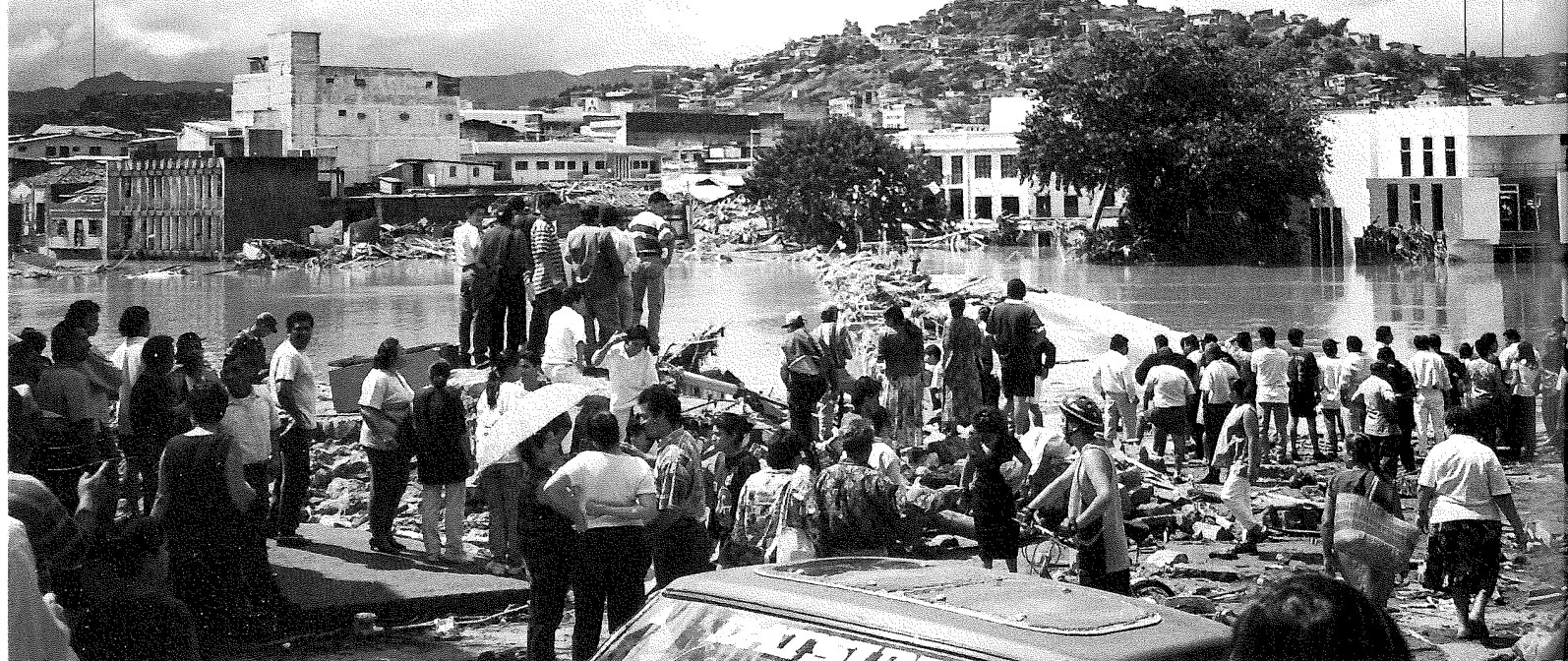
Unable to re-book our flights, David and I phone Neil. He agrees to bring us into his office so that we can try to sort out our travel arrangements. We drive off into the rain with him. On the way to the office, we join him as he surveys the damage in preparation for an afternoon meeting of assistance coordinators. The view of the Choluteca River astounds us. It is no longer a pretty ribbon of water meandering under picturesque bridges. It is an angry torrent of mud that has swollen up and swallowed large chunks of the city which had stood on both its banks. We stop and watch. All but one of the many bridges is gone — only one which will still connect our side of the city with the airport. Large pieces of debris are floating downstream at breakneck speed. One piece can still be identified as a washing machine. We continue but we cannot go very far. Each road out of Tegucigalpa is destroyed by muddy landslides.
Bit by bit, the story of the horror of the previous night emerges. Expecting some flooding in this city that had never experienced any, officials had evacuated one block along either side of the river. Between 1:00 and 4:00 in the morning, as people slept. landslides blocked the river causing it to rise rapidly as much as four to six blocks on either side. Homes with entire families suddenly vanished into the swirling water.
Early estimates on Saturday are that about 1000 people have died in Tegucigalpa alone. The city is cut off from surrounding towns and villages and there is no way of knowing how those fared. We drive by the stadium where now thousands of homeless survivors are finding shelter from the rain that continues to pour relentlessly. We stand among the throngs of Tegucigalpans who have lined up along the river to stare at it in shock and helpless silence.
Tropical storm Mitch stops moving, planting itself firmly over the city. Estimates on the news are that Tegucigalpa received a meter of rain on Friday. Another meter of rain empties over the city on Saturday. The lobby of a nearby hotel is flooded. We chat with members of the now skeletal staff in the two hotels where delegations and OAS Secretariat members are staying. Most staff are relieved that their families are safe although some of their homes have suffered damage. They are the lucky ones on higher ground who had escaped the landslides that dot the city. One maid is less fortunate. Unable to find transportation at the end of her shift on Friday, she has spent the night at the hotel. In the morning, she learns that her home and most of her family, including three young children, have disappeared. Her own escape from death does not console her.
The mayor who had hosted us just a few days earlier emerges as a hero. Local media coverage shows him tirelessly urging calm, organizing relief efforts, offering hope that the city will not long remain isolated from much-needed outside help. By the end of the day, we stare in disbelief at the television sets carrying the local news. Mayor Cesar Castellanos is dead. The helicopter he had taken out to survey the worst-hit areas has crashed. The city, already in mourning, is stunned.
Sunday, November 1:
The sun is out. Michel and Diane leave on the early morning TACA flight after paying $1000 each for new tickets. The flight is full, we are told. About sixty of us, including members of various delegations and OAS Secretariat staff are left behind. American Airlines and Continental Airlines refuse to fly or to let us transfer our tickets to another airline. We don’t understand. There isn’t a cloud in the sky. They should be flying in emergency supplies and relief workers. We are told that they will fly on Monday. Back at the hotel, we flip through CNN and other US channels. There is nothing about Tegucigalpa. Again, we don’t understand
Once more, we clean up our own rooms, make our own beds, have the limited breakfast service offered by the hotel which is both rationing its food and short on staff. Daniel, the Maya Hotel’s coordinator who from the start ensures that we receive full information on the unfolding situation and how it might affect us, issues a strong warning in writing. Roving gangs are roaming the city, plundering shops and offices, stealing the last valuables held by homeless survivors, and attacking passersby who look as if they might be carrying money or jewelry.
In the lobby, I meet David as he returns to the hotel. He was part of a group that had walked to the river and looked at the growing damage as the water receded. He grimly describes his experience, including his walk through the remains of the jail whose walls had collapsed under the pressure of the water. His shoes are caked with muck.
I join him and some American delegates for another walk in the afternoon. I take nothing with me — no jewelry, no purse, no wallet, not even the inexpensive waterproof watch bought to weather the monsoons on a posting many years ago. Who would want this, I ask myself. I feel ridiculous taking such extreme precautions. Later, I see one of the women from the OAS Secretariat with a gash on her skin left when a gang of thieves had torn her necklace from her.
In the bright sunlight in which we walk, no detail escapes us. Rubbish is strewn everywhere, deposited by receding water. Electrical poles and wires lie dead in the streets. Much of the city is without electricity. The stench of raw sewage is overwhelming. People everywhere are working, cleaning up, their clothes slimy with mud. Others sit exhausted on wet mattresses in the street, despondency in their eyes. Pumps are pouring streams of water out from houses on slightly higher ground. Below, homes, office buildings, stores and car dealerships are still under water. Fifty years worth of infrastructure has vanished. We stand at the remaining end of a former bridge. The river current is still much too fast. Heading into a nearby street, we are passed by three running soldiers with raised machine guns. One touches my arm lightly to get my attention. “Cuidado”, he pleads, Spanish for be careful. As he runs ahead, I suggest to my companions that we turn back. I barely finish speaking when we hear shooting.
Back at the hotel, some of us decide to head out to the American Embassy School where early relief efforts are being organized. David and I make boxes there for a while. These will be filled with food prepared by volunteers in our hotel kitchen. Bottles of potable water, clothing and blankets and will be delivered to shelters set up around the city and at the stadium. By the time we return to the hotel, it is raining again.
Our situation is becoming precarious. All security guards at the hotel, in abundance during our meetings, are gone. They have joined the relief effort. Our own security is no longer guaranteed. There is shooting again just outside the door of the lobby. As night falls, the sound of gunfire reaches our hotel with growing frequency.
The approximately sixty of us that remain have become a burden to the beleaguered Honduran authorities who keep apologizing for the crisis that surrounds us and making every effort to extend ever-gracious hospitality to us. We are embarrassed by our helplessness. We learn that American Airlines and Continental Airlines have now cancelled all flights until Thursday. Except for the local Honduran news stations, Tegucigalpa continues to be non-existent on any of the cable stations. We are convinced that the world does not care. We are enraged. We promise each other to make every effort if and when we finally do get out to tell the world about the human tragedy here and to persuade a seemingly uncaring world to help.
We feel guilty for using up diminishing resources. Safe water at the hotel cannot be guaranteed for more than another 24-48 hours. We had just witnessed thousands outside the hotel who already had none. We eat sparingly, knowing that the city is running out of food and wondering which meal might be our last. Gasoline is rationed for relief efforts. An Exxon representative whom David and I meet confirms that the city will run out of gasoline altogether within the next day or two. With all roads into Tegucigalpa destroyed by massive landslides, there is no hope of gasoline or other supplies coming into the city by land. Our prospects for transportation to the airport thus grow dimmer as time goes by. The late evening news reports that three soldiers were killed in a shootout with a gang of looters on the airport road
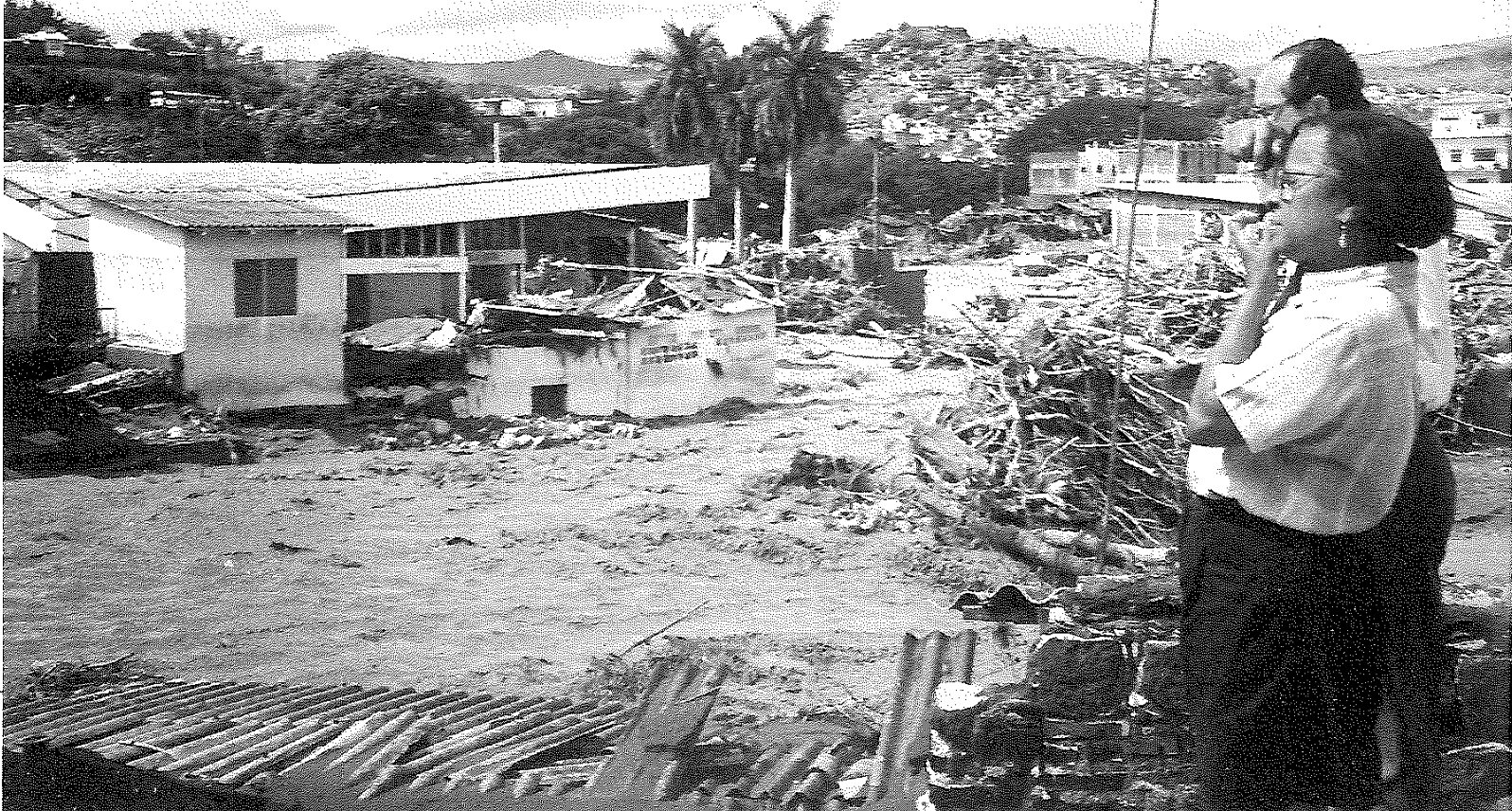
The local news further reports that the morgue has been flooded and that holding retrieved bodies for identification has become a health hazard. We recall the stench of raw sewage encountered on our walk that afternoon and know full well that it is only a matter of days before disease adds to the city’s misery.
It is late, very late, when we learn that we are leaving the next morning. David Beall, Executive Secretary of CICAD, and Carlos Sosa Coello, a senior Honduran official who has been one of the key organizers of the meetings in Tegucigalpa, gather together our group to announce the arrangements they have successfully won for us. TACA Airlines will be sending two special planes for us in the morning from El Salvador. American Airlines and Continental Airlines, under substantial pressure, conceded that we could transfer our existing tickets to TACA. We are touched. Mitch has affected so many Central American countries and yet it is precisely those countries, at a time when they themselves need help, that come to our rescue through The Airline of Central America (TACA).
Monday, November 2:
It is 5:00 a.m. and still dark when we head for the airport in a small convoy that we hope will afford us security from ever-roving gangs. By the time we have our boarding passes in our hand, the sun is shining in a perfectly clear blue sky. Rumours abound that airlines other than TACA had left us stranded because they were too cheap to fly into Tegucigalpa without incoming passengers.
Our last moments in Tegucigalpa again bring home never-failing Honduran hospitality. Knowing that our early departure from the hotel left us without breakfast, Daniel brings pastries and thermoses of coffee and juice from the hotel to the waiting lounge. We are sorry to leave him behind
The flight is quiet. We are painfully aware that we are the fortunate outsiders who can leave. The images of the Hondurans who remain behind do not fade, even when we close our eyes to sleep.
Tuesday, November 3:
Ambassador Lionel Hurst of Antigua and Barbuda, as the senior-most diplomat from an OAS mission who had been part of our group in Tegucigalpa until the very end, delivers an impassioned speech at the OAS Committee on Hemispheric Security, This is the first OAS meeting upon our return and, as agreed, he speaks for all of us in drawing attention to conditions in Tegucigalpa. The OAS Office of Public Information is mobilized into action. The Ambassador of Honduras, touched by expressions of concern over her country, delivers a plea for assistance. The voices grow louder. The news begins to spread.
In Ottawa, David Duinker arrives just in time for a meeting on coordinating Canadian assistance. Neil Mussell’s reports have hit a responsive chord. David delivers a briefing that helps focus that response further.
Aftermath:
Upon my return to Washington, I contact bout de papier as part of the promise all of us had made to broadcast the plight of Honduras. However, within a few days, the world is finally seeing television images of what we had witnessed firsthand. The magnitude of the disaster in Central America, including in Tegucigalpa, becomes known. Relief begins to pour in — but these efforts are now part of other people’s stories.
I wonder about the continuing usefulness of writing an article. Then, on November
19, the postcard I had sent home from Tegucigalpa arrives. I am touched by the fact that its arrival signals the obvious effort of Hondurans to return to the normal routine of daily life after the devastation of Mitch. I am also stung by a sharp awareness that much of what is pictured in the postcard is no more. I write this article no longer to get a story out, but rather so that months from now, when it appears in print, it may in some small way keep us from forgetting those whose valiant struggle to rebuild after Mitch will go on for a long, long time.
View the original scanned pages →
Originally published in bout de papier, Vol. 15, No. 4 (1998-1999) — Winter 1998/99 // Hiver 1998/99, pp. 12–15. Read the rest of this issue →



