bout de papier, Vol. 11, No. 2 (1994) — Summer 1994 // Été 1994, pp. 27–29
As Canada reviews its foreign policy, Peter MacArthur, who is on an exchange assignment in Australia, believes we can draw lessons from Australia
Have you ever wondered what it would service? Imagined how you might operate in another country’s bureaucracy? Thought how you would fare representing a foreign government at a multilateral negotiations which include Canada at the table?
Over the past two years I made this mental leap as Canadian Exchange Officer in the Australian Department of Foreign Affairs and Trade (DFAT). My assignments included their OECD and G-7 Section when Australia chaired the annual OECD Ministerial Meeting, their Japan Section, shortly after the July 1993 elections and introduction of political/economic reforms by the Hosokawa Government, and in research teams in the East Asia Analytical Unit to prepare major studies on India, China and Japan. I had to learn much and more quickly, establish trust and credibility in an organization that was as new to me as I was to it, and perform my duties not only as a DFAT officer but as a representative of the Canadian foreign service. This meant adapting to the different foreign and trade policy objectives and to the different management style and operating procedures in DFAT’s destreamed environment.
I was conscious of a gradual progression from “guest” to “team member,” and at some point starting to talk about “our” interests instead of “your” or “Australia’s” interests. The characteristic Australian friendliness and hospitality eased the shift. In the workplace, the morning and afternoon appearance in the corridors of a tea/coffee and biscuit trolley vies with the cappuccino available in the basement cafeteria. Busy work units find time to establish “cake rosters” to celebrate special occasions on a rotating basis each week and jump at any opportunity to lunch together and talk shop.
An exchange officer feels the additional responsibility for one’s work and decisions as a foreign guest who is representing Canada in the workplace. Traditionally, and for good practical reasons, the exchange officer and High Commission operate at arm’s length in order to maintain discretion in the treatment of sensitive issues and confidences.
As Canada reviews its foreign policy and considers public sector retorms against a backdrop of continued budgetary austerity in the 1990s, I believe we can draw some useful lessons from the Australian experience.
The Revolution Down-Under
Many Canadians may not fully understand or appreciate the revolutionary changes which have occurred in Australian politics, economy and diplomacy. Australia, this “continent for a nation”. ’, is rapidly strengthening its own national identify, beginning to enjoy economic recovery and opening up to the world, particularly to nearby Asia. I found an Australia in the full flight of an economic revolution, re-embracing won against a GST proposal and relentlessly charting a future in an economically dynamic Asia, its natural region in a post- Cold War world. I worked in a Department led by three Ministers (Foreign Affairs, Trade and Aid), the first two sat in a Senate chamber elected on the basis of compulsory voting, proportional representation and a complex system of party preferences.
The structural adjustment and microeconomic reforms which Australia began to pursue in the early 1980s were beginning to deliver economic recovery, buttressed by more buoyant consumer and business confidence. Major improvements in labour relations and domestic competitiveness coupled with relatively comfortable public finances and the right policy settings were leading to low inflation growth and enhanced exports.
During my assignment Australia also came to terms with native title for its indigenous peoples following the decision of the High Court in the Mabo case. This reconciliation, more than two centuries after Europeans first discovered “terra nullis,” is part of the fostering of a stronger national identity which may include Australia’s possible referendum decision to become a Republic within the Commonwealth by the time Sydney hosts the Olympics in 2000.
Australia was also increasingly asserting itself on the regional stage through the Asia Pacific Economic Forum, the ASEAN Regional Forum and the South Pacific Forum. The country’s economy is as big as all of the six ASEAN markets combined. The links are close. Australia is one of two countries (China is the other) to have regular Ministerial Committee Meetings with Japan.
Sharing time zones with Tokyo, Beijing and Taipei, Australian business news focuses more on the Hang Seng and Nikkei indexes than the Dow Jones stockmarket reports. Australia’s little known Christmas Island, situated in the Indian Ocean, is only one hour’s flying time from Jakarta while its Northern Territory shares maritime boundaries with the Indonesian archipelago and former colonial territory of Papua New Guinea. Australia’s navy is helping to protect some of the world’s most commercially important sea lanes linking Asia to North America and Europe.
Unlike Canada, Australia was bombed by the Japanese in World War II. Today Japan is by far Australia’s major trading partner, buying one quarter of her exports, now including rice, and providing over 600,000 tourists per year. Having once fought beside the Americans in the jungles of Viet Nam, Australia is today a leading business partner to the Vietnamese. It has actively contributed to the Cambodian peace effort with the largest UNTAC peacekeeping contingent.
A Benchmark for Middle Power Diplomacy?
In the world of foreign and trade ministries, as in the case of global multinational corporations, there may be a case for utilizing the concept of “best practice” and comparative “benchmarking” to measure and improve Departmental performance. If Canada’s DFAT were to undertake such an analysis, we might well start with our Commonwealth cousins in the southern hemisphere.
Australia and Canada fit the same category as active and diplomatically well equipped middle powers with similar interests to pursue and protect. We are among the civil service leaders in the streamlining and simplification of client services, i.e. making performance still count in an era of diminishing resources. Australia followed the 1982 Canadian decision to integrate trade and foreign policy when a similar amalgamation took place in 1987. Both Departments have thus gained a merger of economic and political expertise and crossfertilisation, enabling considerable strengths in advancing APEC, the Uruguay Round and other key trade issues in the 1990s. The new challenge facing the two Departments is how to effectively bring together management and policy skills at all levels of the 28 bout de papier Vol. organizanon w acmeve mgner pruuuvuvny and enhanced return on investment for maximum impact.
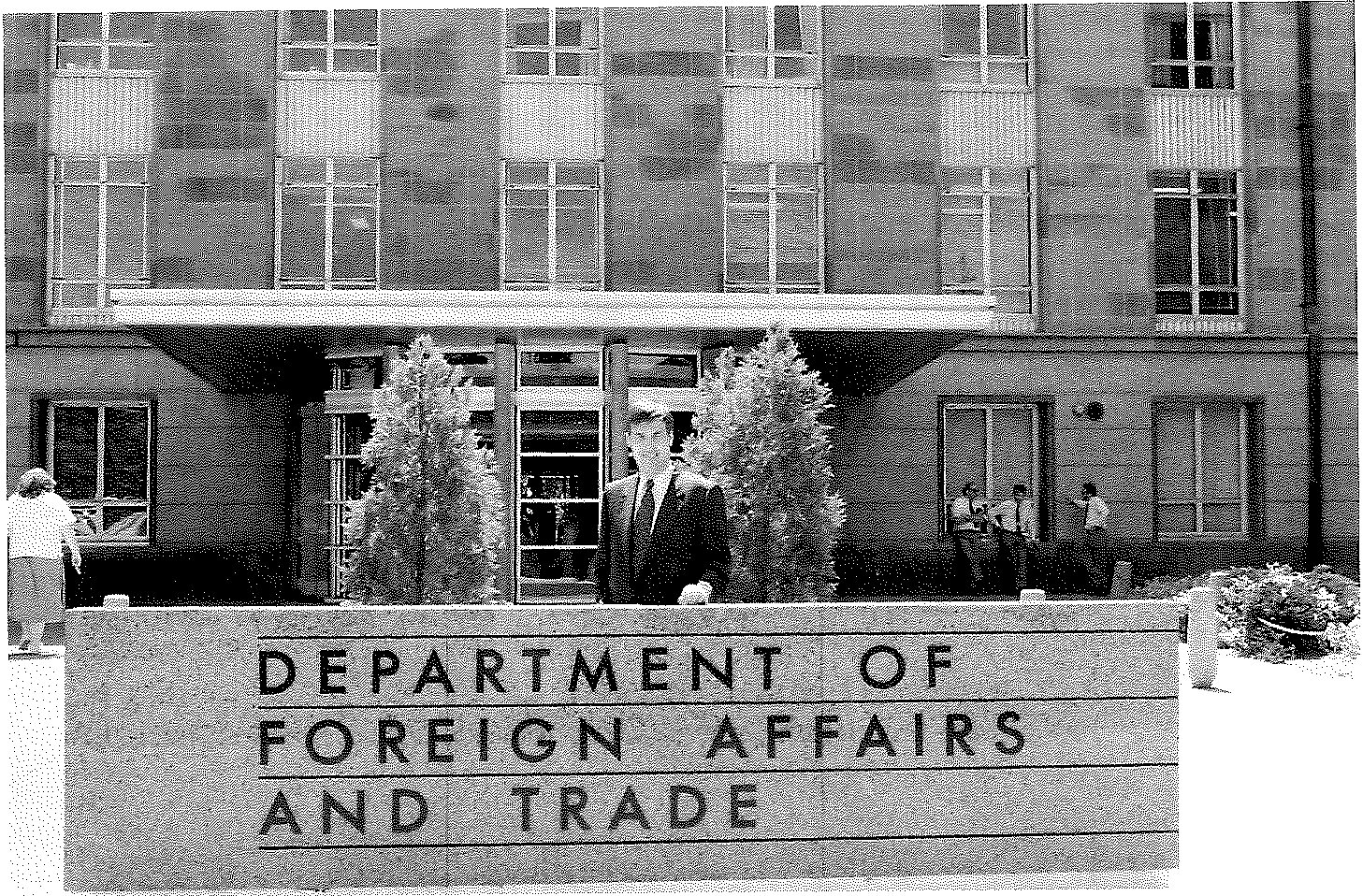
DFAT is perhaps as much influenced by British traditions and style as DFAT is by American ways of dealing in information and running government policy. One example is the Australian retention of good prose over the Canadian telegraphic style in the drafting of telegrams. Another small example is the attention paid by Australian diplomats to the preparation of official records of conversation following any substantive visits or talks. Apart from that, Australian diplomats carry out many of the same tasks as their Canadian counterparts: international conferences, official talks, ministerial correspondence, ministerial visits, briefing books, ministerial submissions, cabinet submissions, policy papers and protocol.
Smaller and More Focussed
The Australian DFAT is smaller and more focussed than the DFAIT in Canada. It retains functions such as consular services, public and cultural affairs and (since 1987) trade policy. The Passport Office remains an integral part of the Department but operates in separate offices on a fee for service basis. The Australian Trade Commission (known as Austrade), the approximate equivalent of our Trade Commissioner Service, has been part of the ministerial portfolio since 1991 but functions as a separate corporate entity. Austrade earns 10 percent of its budget from cost recovery on trade development services.
Despite being accountable to the Minister for Foreign Trade, Austrade’s headquarters were moved from Canberra to Sydney and senior management was decentralized throughout major world markets in 1991-92. This dramatic shift followed a report prepared by the McKinsey consulting firm which recommended a reorganization in response to widespread political and business criticism. The jury is still out on whether Australia would also gain from a complete integration of its trade policy and trade development function along Canadian lines.
The DFAT is about half the size of the DFAIT in staff numbers and operating budgets which do not include specific trade and investment promotion. The Australian Department, which is increasingly keen to diversify into broad strategic trade development, is staffed by 3755 employees, divided 1253 in Canberra, 769 overseas, 275 in state offices and 1458 LES deployed abroad.
The DFAT operates 82 missions in 72 countries but these numbers will continue to be fluid as bigger posts are cut or closed and smaller posts are opened. Washington is the DFAT’s biggest mission while Nauru in the South Pacific is considered its smallest post. Australian posts are fewer and highly concentrated in Asia and the South Pacific. Austrade has also been reducing or re-deploying Australian positions abroad. In 1991-92 Austrade closed Vancouver, San Francisco, Chicago and Miami in order to open Hanoi, Guangzhou and Surabaya.
Doing More with Less
Both Canada and Australia are seeking to do more with less. As in Ottawa, Canberra public servants are having to meet greater demands with less resources and incentives for adaptation, innovation and reform. both capitals questions such as “where can we make a difference?” and “how can we do this better?” are being asked.
The DFAT has for several years been surrendering 1.25 percent of its running budget as an efficiency dividend and, like Canada, has closed or reduced posts. The DFAT receives an appropriation of about A$500 million, of which $367 million comprises operating costs (about two thirds of which is spent abroad.) Australian Ministers are currently seeking Cabinet approval of a major proposal to rehabilitate the DFAT’s global network with additional resources, particularly in the Asian region.
Management in the DFAT is actively seeking to keep the Department relevant to the interests of its main client base. Their approach to downsizing, productivity enhancements, information technology, training, decentralized management, financial reforms and other innovations include the introduction of accrual accounting and program budgeting, a three year forward-looking corporate plan, workplace enterprise bargaining, expanded business liaison with some cost recovery, a clampdown on fraud, streamlined administrative procedures, a focus on new technologies (such as the Australian Diplomatic Communications Network-ADCNET — which parallels our SIGNET) and better management of human resources (including a massive commitment to Asian language and other training such as a new scholarship fund).
DFAT management believes that while its policy agenda is looking good, the Department needs to improve the quality of management, managers and admınıstrative systems in order to create pools of talent which will facilitate future successions to the most senior levels. The challenge, like that of the Canadian service, is how to make use of the high proportion (by wider public service standards) of Executive level officers and a large pool of experienced and talented staff at lower levels of the organization.
The DFAT believes that there is excessive micro-management by senior staff. many managers are bogged down in the detail of policy that is just as well undertaken by large reserves of staff and spend too little time leading, planning, assessing, appraising and coaching more junior officers. Among DFAT’s efforts to improve career satisfaction are proposals to employ more spouses as locally engaged staff (LES) at overseas missions, Leave Without Pay, permanent part-time work, more reciprocity agreements on spousal employment (Australia is less advanced than Canada) and more higher level specialist positions in both Canberra and posts. The bottom line is to take measures which retain the loyalty and enthusiasm of officers who have reached their limit in the promotions cycle.
The Department is being called upon to institute continuous improvement training and multi-skilling, prioritize constantly, adopt new technology, cut costs, introduce user pay principle and “say no” to some demands. The introduction of the ADCNET computer communications system is replacing A-based communicator and clerical staff at posts.
This shift is being assisted by a determined LES localisation program where local staff, including expatriates, replace A-based officers in more and more posts, particularly high cost locations. DFAT planners forecast a future of more numerous, smaller posts, many staffed by only one Australian officer to provide administrative and quality control oversight, program leadership, representation and negotiation skills. Much of the analysis and post administration will be left to LES through a participative work design which will require more precise post directives and mandates and clearer job descriptions.
One innovation for middle power diplomacy faced with reduced resources may be sharing our resources. Canada and Australia already have consular sharing agreements for about 26 countries, common diplomatic bag facilities in certain countries, cooperate in the CANZ Forum in support of each other’s candidates and positions in international organizations and enjoy a tradition of personnel exchanges. In 1993 Canada and Australia commenced direct electronic cable exchange and began to implement a policy of co-locating missions abroad, beginning with Phnom Penh and Bridgetown, to achieve financial economies and greater efficiencies.
Relevance in the 1990s
How do the Australians expect to remain relevant and survive the 1990s? In 1993 DFAT decided to enunciate and develop a clear corporate aim: “Winning a future for Australia in the world.” DFAT recognizes : that dramatic global changes mean that it will have to fight skilfully for Australia’s future and win at all levels. The aim is to win access to (and engage) governments, international organizations and the worldwide business community. A fundamental change in how DEAT approaches the world strategically is taking shape. The Department is shifting from the traditional “maintaining good bilateral relations” posture to managing bilateral relations primarily in terms of building leverage to achieve specific bilateral and multilateral goals which are of highest priority to Australia.
Canberra is more methodical in painting a big broad brush picture before ruthlessly selecting administrative targets for follow-through.
The saying that “small is beautiful” rang true for me in Canberra where a smaller Department is more methodical in painting a big broad brush picture before ruthlessly selecting program and administrative targets for follow-through and completion, including evaluation.
On balance, in comparison with DFAIT, there are many more strengths than weaknesses in my personal view. Among approaches we can learn from are a more tightly focussed Departmental mission, greater outreach to the community through published material based on cost recovery, streamlined and more forward-looking corporate services, greater openness to analysis provided by think tanks, revolutionary ideas in labour relations and productivity enhancement and better internal communications.
View the original scanned pages →
Originally published in bout de papier, Vol. 11, No. 2 (1994) — Summer 1994 // Été 1994, pp. 27–29. Read the rest of this issue →