
bout de papier, Vol. 13, No. 3 (1996) — Fall 1996 // Automne 1996, pp. 15–18
In retrospect, what was most surprising was that it hadn’t been done before.
No Canadian ambassador had ever made an official visit to the State of Alaska.
“Alaska” — the name conjures up images of fiords, glaciers, huskies and gold. Any visit holds great allure but we had good cause when the 1994 U.S. mid-term elections vaulted the three members of the Alaskan delegation into leading positions in Congress.
Overnight, issues which have bedeviled Canada-Alaska relations for years, like Pacific salmon and development in the Arctic Refuge, took on greater importance. A diplomatic foray was very much in order.
Bernie Gagosz, Consul General in Seattle, sold the idea of a high profile visit to Ambassador Raymond and Kay Chrétien.
He then put together a voyage which drew more upon the fabled diplomacy of the 19th century than the twentieth.
The first leg was secured through a call to the Commander Pacific Squadron, Royal Canadian Navy. The timing of our trip neatly matched the patrol and port call schedule of the helicopter destroyer, HMCS Annapolis.
But a great idea in January caused some anxious moments in July. The mid-summer headlines were full of another Canada- US conflict over salmon.
BC fishermen were livid when Alaska shrugged off its Canada-US Treaty obligations to help rebuild stocks of chinook, “king” salmon. Tempers flared the week before our departure when BC fishers blockaded the Ketchikan-Prince Rupert ferry for three hours. Alaskan affront turned to fury when Brian Tobin quipped to the media that if he had the time off, he would have been out there in his boat too.
The Prince Rupert affair caused panic among diplomatic planners. Dare we proceed with the destrover? Would Alaskan fishers assault the boat? (Is the sky falling?) The department’s pathological inclination to fret and second-guess raged around us.
But the Ambassador quickly dispelled the panic. It was ludicrous, he said, to worry about being provocative with our closest military ally…and even sillier to think that the Alaskans would be the slightest bit intimidated. After a few phone calls, the destroyer was back on.
In Esquimalt, Captain Robertson and crew welcomed us aboard the Annapolis to begin one of the most memorable voyages in my foreign service career. Far from a cruise ship, especially for anyone over 5’6” the Annapolis is still an impressive vessel. The crew had her polished and preening in our honour.
First impressions always stay with you. One was the number of women on board. Maybe it was all those WWII movies that had misled me but today’s navy is firmly co-ed, and quite comfortably so, we were told.
Another thing that struck me was the age of the crew. War has always been designed by the old for the young, but to see so many barely out of their teens brought the point home. Whatever one might conclude from a walk through NDHQ, the sharp end of our armed forces is made up largely of kids.
Finally, I was amazed by the work/sleep routines on board, especially for officers. There seemed no pattern to the schedule of my cabin-mate who worked twelve hours, slept two, worked six, slept five, and so on. His schedule had me stumbling around in a pitch-black cabin no matter what time of day.
The three-day voyage took us through spectacular shoreline, cavorting whales, and crystal clear nights. Navigating through the straits conjured up images of Bering, Cook, Vancouver and all the others who explored these waters and made sense of the maze of islands along the North American coast.
Our destination was Juneau, named after the gold-prospecting uncle of one of our own foreign service colleagues. Like Ottawa, Juneau derives most of its energies from government and tourism. It also holds the distinction of being the only North American capital which cannot be reached by road.
The morning of our arrival revealed a small city at the top of a narrow channel, the buildings burrowed deep into the foot of mist-shrouded Mount Juneau. The guidebooks suggest that it enjoys a reputation as the San Francisco of the North but that morning Juneau seemed to me more aptly called America’s Shangri-la.
As we steamed into the channel, everyone was on deck in full regalia. Whatever our delusions, there were no bands or flag-waving children on the dock. At mid-morning, Juneau seemed ominously deserted.
Right on schedule, the ship manoeuvred toward the fuelling jetty where we were to disembark and then proceed immediately to meet the Governor. But plans for an auspicious arrival went aground when the captain of an Alaskan fishing boat at the dock looked us over and decided to take his sweet time fuelling his boat. We were left to tread water ingloriously in the harbour.
As the time for meeting the Governor approached, the Captain directed the crew to prepare emergency transport to shore. The seamen released a zodiac — a motorized rubber raft — into the water, unfurled a rope ladder over the side and stood back. Our three intrepid diplomats cast nervous glances over the ship’s side at the raft rocking twenty feet below.
As the junior officer, I was designated to show how (or if) it could be done. Scrambling warily down a swaying ladder in a suit, groping for footing on slippery three-inch slats, is a test well suited to FS recruitment (or better yet to the PSC tests for prospective EX’s).
Fortunately, one by one, we all made it. As our dinghy roared away from the ship, we could see the Alaska media on the dock, telephoto lenses at the ready. I said a silent prayer for having avoided the embarrassment for ourselves and Canada if any of us had stumbled and fallen into the harbour.
The meetings with the Governor went very well, the destroyer generating several goodnatured jokes. On salmon, the Ambassador and Governor agreed to tone down the rhetoric and get our negotiators back to the table.
The press conference afterward will be best remembered as the time the Ambassador, pressed by the Alaskan media on Minister Tobin’s description of Alaskans as greedy scofflaws, said “I would not be a good diplomat if I were to comment on the style of my Minister.”
The Alaskans made that the highlight of their reportage, causing some teeth-grinding in Ottawa but the Ambassador was philosophical: such are the risks of sparring with an adversarial media.
After a very successful reception on board the Annapolis, the crew repaired to the Red Dog Saloon for a ceremonial toast and hoisting onto the wall of one of the ship’s life-rings. Look for it when you visit Alaska’s modest and delightful capital.
The following morning we took a small aircraft up the Lynn Canal to Skagway, staging ground for the historic Yukon Gold Rush. Skagway is one of the key tourist destinations for the 400,000 passengers who take the famous Alaska cruises from Vancouver.
After a rushed lunch with the Mayor, we boarded the famous White Pass and Yukon Railroad. The narrow-gauge track follows the route taken on foot by tens of thousands of stampeders in the winter of 1897-98. It took almost two hours to travel the twenty miles up to White Pass which sits 2,900 feet (885m) above Skagway.
Our trip led past spectacular forests and sheer cliffs on the leeside of the mountains; but at the mountain pass/watershed marking the border between Alaska and British Columbia, the land became remarkably barren and wind-scarred. We disembarked in Fraser, BC, and drove the remaining eighty miles to Whitehorse.
Meetings the following morning with the Yukon Government Cabinet helped ground our understanding of the Arctic Refuge/ Porcupine Caribou Herd issue, one of Canada’s major differences with Alaska. Oil development in the Arctic Refuge threatens the caribou upon which 5000 Canadian Gwich’in depend.
We were fortunate once again that Canadian Air Force training requirements enabled us to hitch rides into more remote areas of the Yukon and Alaska. In Dawson, we had excellent meetings with the Porcupine Caribou Herd Management Board which had convened from across the Yukon and NWT for our benefit.
Our next stop was Old Crow, 100 miles north of the Arctic Circle. Accessible for all practical purposes only by air, the town is located beside the Porcupine River which, of course, gave the caribou herd its name.
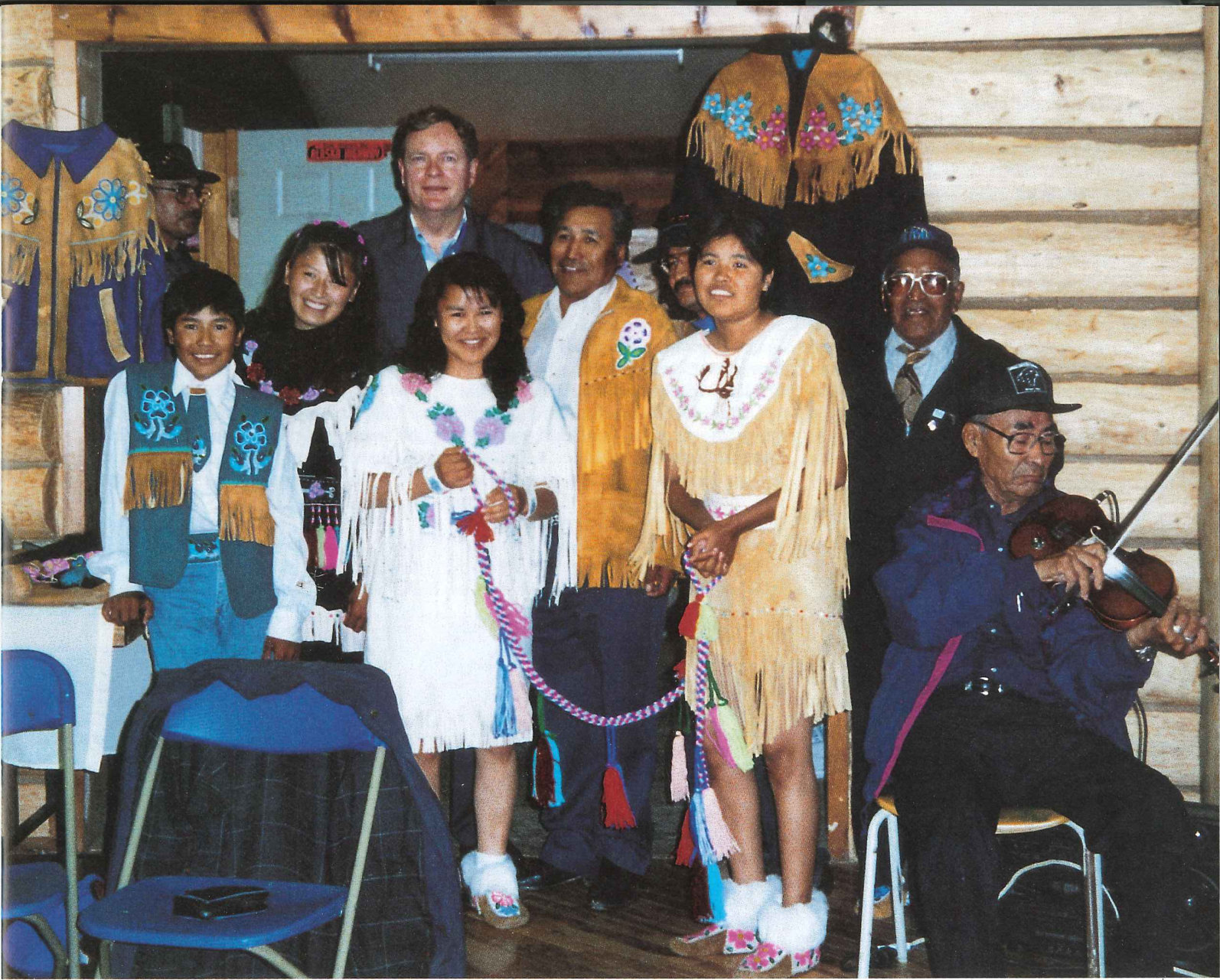
A small village of about 250, Old Crow is sited on the migratory route of the caribou and exudes the neatness and civic pride of a small-town anywhere in Canada.
Once off the plane, the Ambassador jumped on the back of an ATV and roared off toward the community centre where Chief Robert Bruce and the entire village were waiting. The rest of us were left to walk or jump onto the back of a pick-up.
As I walked into the village, two buildings stuck in my mind. The Anglican missionary chapel from the turn of the century was still in good repair, even beside its much newer and larger successor. The RCMP station, / located on a small hillock, stood out as a cold and aloof brick building among the simple wooden bungalows along Old Crow’s gravelled main street.
The Gwich’in are called the “Caribou people of the Lakes,” their culture and economic life rooted in the lifecycle of the caribou. We arrived in mid-July, shortly after the caribou would have had their young in distant Alaska.
I had already dealt extensively with the Gwich’in and so knew the messages for our delegation. What struck me most, however, was how the Gwich’in dependency on caribou was revealed in more subtle ways.
In private moments, young and old spoke excitedly about the return of the caribou. Everyone said “any time now” the caribou would appear, tens of thousands of them migrating past or even through their village. But “anytime” could mean tomorrow or in three months. On those terms, time is much more fluid and nature more unpredictable than the precise calculations we southerners build our lives around.
The wait was expressed in terms of hope and fear — a mixture of childlike excitement and an unspoken terror that this year the caribou might not come. That anxiety goes a long way to explain why the Gwich’in feel so strongly about permanent protection for the sacred birthing places of the Arctic Refuge.
The entire village greeted us in the new community centre where they had prepared a feast of caribou: meat-balled, stewed, roasted, dried, and souped. The visit concluded with the Ambassador and Mrs. Chrétien escorted onto the floor to perform and be honoured in a ceremonial dance.
On the way to the airport, Chief Bruce told the Ambassador how much he and the village appreciated the visit. “We have invited so many people to visit Old Crow but no one ever comes. And you came without even being invited!”
Our next stop took us back to Alaska and the town of Barrow. The northernmost town in the US, Barrow was the place where Will Rogers, cowboy-aphorist, died in a plane crash in 1935. An ancient base for Inupiat whale and seal hunts, Barrow is now flourishing thanks to the wealth of Prudhoe Bay.
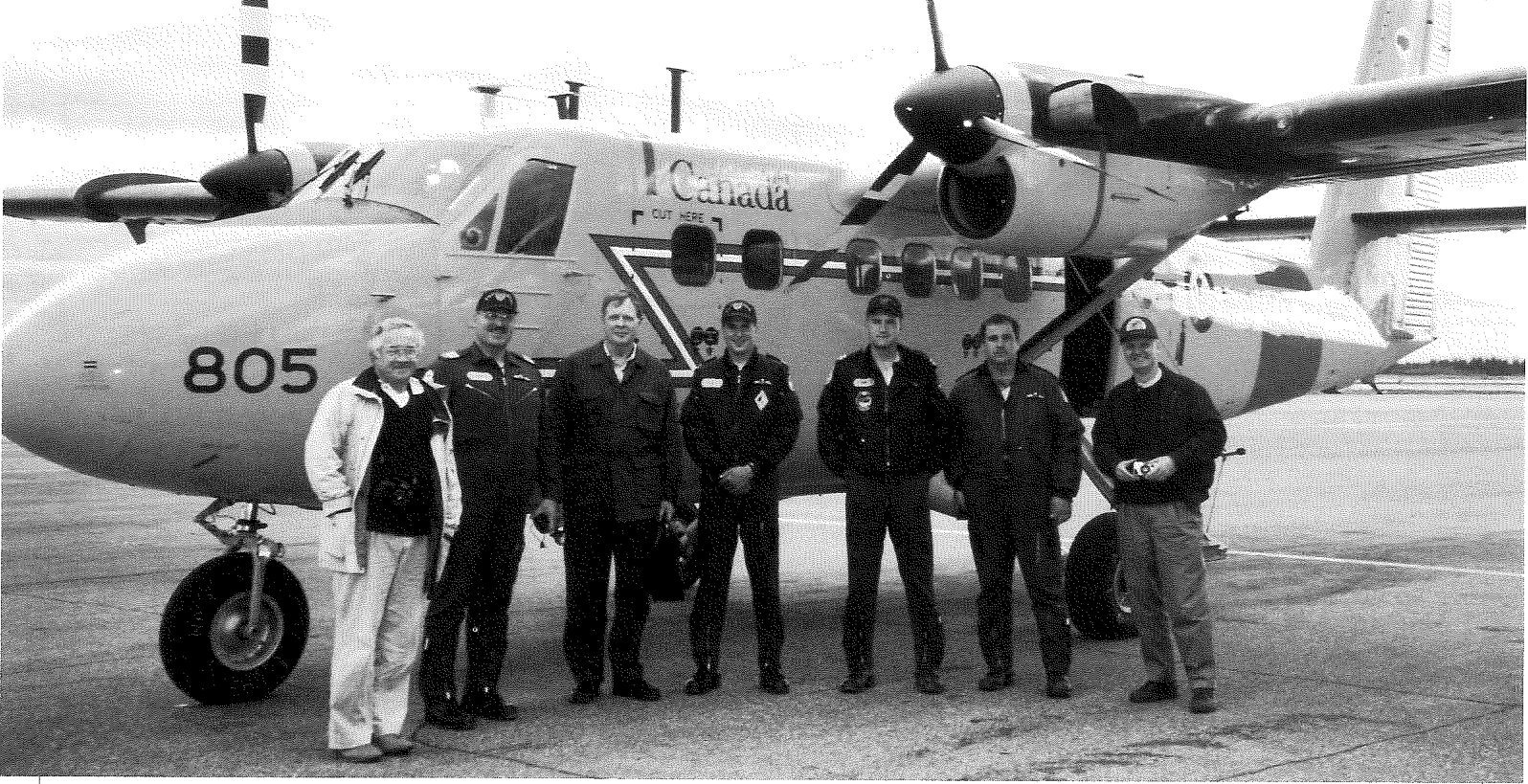
Arriving at midnight, we stepped out into late-afternoon daylight of the Arctic summer. We checked into the “Top of the World Hotel,” which proudly claims beachfront property on the Arctic Ocean. Our rooms were outfitted to meet the needs of the typical visitor: heavy duty drapes, industrial heater, and no closet— presumably because occupants were never there long enough to bother changing.
A city of about 2000, Barrow seems caught between its past and present. Homesites are surrounded by every motorized vehicle known to man, with pride of place going to the four-wheeled ATV. But hanging over these vehicle are racks of meat drying on the northern variation of the household clothes line.
Southern visitors are usually struck by the “junk yards” around northern homes. But we shouldn’t be smug, considering these homes have no basements and garages, without which our own homes would look a tad more unkempt.
It was an The following morning we met our hosts with Arctic Power, a “grass-roots” organization lobbying to open the Arctic Refuge to oil and gas exploration. The group was formed to give the development cause a populist veneer to counter anti-development environmental groups.
Arctic Power had us scheduled for the same tour designed to win over allies in Congress for the forthcoming legislative debate in the fall. First stop was Kaktovik, the Inupiat community which lay along the coast of the Arctic Refuge, to hear the pro-development views of village leaders.
We arrived at mid-day. Looking very much like a movie set from “Ice Station Zebra,” Kaktovik has a year-round population of about 150. It seemed like a place where people from the south came to make big money and people from the north stayed as long as people from the south paid them to. Over lunch, we asked town councillors how many townspeople worked for the oil industry. After all, Prudhoe had been operating for almost thirty years. The men pondered, hesitated and then remembered that the son of someone who used to live there was now working as an accountant with an oil company in Fairbanks. It was an embarrassing admission of the slim local employment benefits of oil development in the north!
On the way back to Barrow, we flew over the Refuge, hoping to get a glimpse of some caribou. Unfortunately, they had already left the birthing fields and had begun the migration back to the Yukon.
We saw a few stray animals which our hosts from Arctic Power said showed that man, beast and industry can happily co-exist. It seemed a stretch to extrapolate the contentment of 160,000 on the presence of two, but when billions of dollars are at stake, you can hardly blame them for trying.
While the dedication of our hosts was unquestioned, Arctic Power seemed to have some way to go before they could match the fervour of their ENGO adversaries, but then again, it’s hard to get mystical about an oil well.
Our last stop was Anchorage, Alaska’s largest city and the economic centre of the state. The city lies at the foot of Cook Inlet, named after the explorer who mistakenly thought the inlet was the mouth of a great river into North America.
We spent the weekend reflecting on what we had learned in both the Yukon and Alaska. The Ambassador re-worked his speech to capture impressions and conclusions from the trip, especially his time with the Gwich’in.
Throughout the visit, we were received with the utmost hospitality. Alaska prides itself in being “America’s Last Frontier” and there was a palpable sense of ’anything is possible.’ But there was also a strong sense of wonder and respect for the environment; there are as many people in Alaska seeking the wealth of nature as are there to find more traditional fortunes.
I was struck by some common threads linking the Yukon and Alaska. Alaska is facing the decline of Prudhoe Bay oil, the source of 85% of state revenues; the Yukon Government is struggling with declining federal payments which account for two-thirds of territorial revenues. Both are looking for the freedom to develop resources on their own terms.
But each also must balance classical development objectives with the interests of the native communities and the need to protect the fragile northern environment. Finding that balance will be very difficult, especially when southern compatriots look over northern shoulders and insist on being part of the process.
The trip was a priceless way to discover the human dimensions of the policies we are asked to advance and defend at post. It is not often in our profession when the abstract becomes real; but for ten days in the summer of 1995, I had one of those rare opportunities.
View the original scanned pages →
Originally published in bout de papier, Vol. 13, No. 3 (1996) — Fall 1996 // Automne 1996, pp. 15–18. Read the rest of this issue →



