
bout de papier, Vol. 28, No. 4 (2015) — Spring 2015 // Printemps 2015, pp. 32–34
Don’t Tell the Newfoundlanders: The True Story
of Newfoundland’s Confederation with Canada
reviewed by Gar Pardy
DON’T TELL THE NEWFOUND- from the rocks; and then British naval
LANDERS: THE TRUE STORY OF officers with an excess of rum, lash and a
NEWFOUNDLAND’S CONFE- DERATION WITH CANADA, by Greg Malone, 2012, Viking Canada Edition [2014], Toronto, 314 pp., $22.00.
Sixty-five years ago this spring Newfoundlanders ended their nearly half-millennium of convoluted and unique constitutional history by voting narrowly to become the tenth province of Canada. In many ways this constitutional history did not differ materially from other parts of the British Empire except in its final denouement.
There is a weak historical consensus that the Island was “discovered” in June 1497 by an itinerant Genoese sailor in the employ of Henry VII. John Cabot or Giovanni Caboto, claimed this “new founde land” for England. Less than a century later a foppish and frequently penurious nobleman, Sir Humfrey Gilbert, accompanied by minstrels, Morris dancers and a Hungarian poet sailed into St. John’s harbour in August 1583 and re-iterated English ownership. Gilbert’s ship along with all hands sank before it made it back to England. Nevertheless, through the magic of faux historians, we have Gilbert’s last words before he sank beneath the North Atlantic. Echoing the sentiments of thousands of Newfoundlanders ever since, Gilbert is “recorded” as shouting “Courage, my lads! We are as near to Heaven by sea as by land.” The accompanying Hungarian poet, Stephanus Parmenius, drowned earlier during the voyage but not before he left us with the unofficial motto of the Island Piscium inexhausta copia or in the vernacular, Fish Without End.
As with most of the bits and bobs of empire managed from London, Newfoundland experienced the full range of British colonial administrative mechanisms. First were the “Fishing Admirals” — government by the first-arrived ship captain in a port each spring; next came several Proprietary Governors who had visions of cotton and other crops emerging buggery were put in charge.
It was 1832 before the Island had its first elected assembly along with an executive council run by a governor out of London which as a group simply added to the abundance of fog. In 1855 there was “responsible” government, seven years after it occurred in Canada (then roughly Ontario and Quebec) and Nova Scotia. In 1907, Newfoundland along with New Zealand was granted Dominion status by London. Party politics emerged largely reflecting the religious differences between southern Ireland Catholics and west England Protestants. Fish dominated and its world price determined standards of living. It was a harsh mercantile system where money stayed with the merchants on land and the dangerous work was done by fishermen on the stormy waters of the North Atlantic.
The cost of an oversized contribution, both in men and money, from the Island to the First World War coupled with the earlier disastrous decision to build a railway (from fish stage to fish stage) lumbered the Island with an oversized debt. The 1929 global economic crash was fatal creating near fiscal bankruptcy conditions. The British were not doing much better and any help from the Mother Country was conditional on the surrender of responsible government and direct control of finances by London. The elected Newfoundland Assembly agreed and from 1933 onwards there was government by a secretive commission consisting of four British, two Newfoundlanders and one Canadian all appointed by London.
This 1933 decision by the Newfoundland legislature to temporarily yield its status as an independent country was a unique one in the history of the world. It is the major theme in Greg Malone’s book, Don’t Tell The Newfoundlanders. Malone is a well-known Newfoundland actor having helped develop the television series CODCO and appearing in the Republic of Doyle. He has been an occasional politician having lost as the NDP candidate in a 2000 Newfoundland Assembly by-election. More recently he has been associated with Elizabeth May and the Green Party.
The Joey Smallwood version of Confederation has dominated post-1949 history. While there have been occasional weak assaults on its basic tenet that the process was a democratic one, the overall success of the venture has dampened interest in any background story. One such assault was the 1992 movie The Secret Nation starring Mary Walsh, Cathy Jones and Rick Mercer. Ms. Walsh, a graduate student in history at McGill, returns home looking for information on the referendum conspiracy that led to the 1949 union. Needless to say, while a good movie, it was seen by fewer people than live on Funk Island.
Mr. Malone’s book is the first serious attempt to put a measure of investigative scholarship into the issue. His interest in the matter was triggered by St. John’s lawyer James Halley who from his student days at Dalhousie Law School in 1949 harboured doubts on the Smallwood version of events and over the years assembled “a large collection of research materials relating to Newfoundland’s federation with Canada.” Malone also pays tribute to the work of Paul Bridle who between 1974 and 1984 produced three volumes of Documents on Relations Between Canada and Newfoundland. In over 3,500 pages Bridle details Canadian activities between 1935 and 1949 that led to Newfoundland becoming the tenth province. His interest and involvement in the matter goes back to 1944 when he was assigned to the Canadian High Commission in St. John’s which had been opened the year before. Needless to say the sheer scope of Bridle’s work ensures it is even less read than those who saw The Secret Nation.
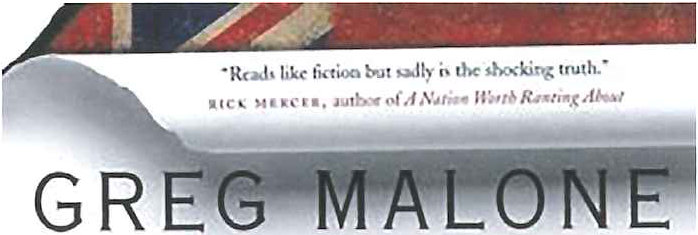
Malone’s central thesis is that the British controlled and dominated unelected Commission of Government in St. John’s manipulated the 1948 referendums to create the majority decision to become the tenth province of Canada. Malone states this was contrary to the 1933 understanding that post-Commission decisions on the future of Newfoundland were to be made by an elected Newfoundland government. “The constitutional arrangements whereby confederation between Canada and Newfoundland was effected were extraordinary, dubious and as controversial in London and Ottawa as they were in St. John’s.” Neither Canada nor Britain wanted to use the British North America Act which had provisions for additional provinces, instead “Canada preferred to negotiate with Britain while Newfoundland was temporarily under British control.”
The British sidestepped its decision to have an elected Newfoundland assembly make final decisions on the constitutional future of the Island. The British Newfoundland Act of 1933 promised that “as soon as the Island’s difficulties are overcome and the country is again self-supporting, responsible government, on request from the people of Newfoundland, would be restored.”
Instead the British decided there would be an elected National Convention in Newfoundland that would “consider and discuss” the future constitutional status. As Malone makes clear this was a dramatic change from the original proposal that would allow the National Convention to “discuss and determine” the future for the Island. In making the change the British retained the right to override any and all recommendations made by the National Convention. This it did when the Convention at the end of its work in January 1948 voted for two options to be decided in a referendum — retain Commission of Government or return to Responsible Government as it existed prior to 1933.
Smallwood and his allies in the Convention had pushed to include Confederation with Canada as a referendum option but were defeated 29 to 16. After the vote and dissolution of the Convention Smallwood mounted a vigorous campaign directed at London to have Confederation included as an option in the June 1948 referendum. The British first consulted with Canada and in March 1948 ordered that confederation with Canada be included as a third option in the planned referendum. A fourth option — economic union with the United States — was promoted by a group of St. John’s merchants but never had much traction and was not included in the referendum.
Once Atlee replaced Churchill as Prime Minister in 1945, the British secretly created conditions that would not see a return to Responsible Government even though the main condition in the 1933 Newfoundland Act for its return was met —“financial difficulties overcome,” probably in the fear that American interests would come to dominate on the Island. A National Convention delegation to London in 1947 had trouble even finding a hotel and led the London Daily Express to comment “How cold, graceless, ungenerous and chuckleheaded is the attitude of the Government towards Newfoundlanders. …” Once the British decided that it wanted confederation then there was little room to maneuver for those who promoted a return to Responsible Government. Lord Beaverbrook, formerly one of Churchill’s most able ministers in charge of aircraft production during the early days of the war and now out of government, charged that “our rulers spoke for Britain with the voice of a shark lawyer.”
The role Canada played in the years leading up to the 1948 referendum was one of caution so as not to be seen as fueling the possibility of another Newfoundland rejection of confederation. Norman Robertson even went so far as to caution the Canadian High Commissioner in St. John’s, Scott Macdonald, that “All correspondence on our Newfoundland policy should be marked ‘Confidential’ since… it may be difficult to prevent correspondence, which might conceivably be embarrassing, from becoming public unless it is given a security marking.”
The British visited Ottawa in September 1945 and, as described by Prime Minister Mackenzie King, for the purpose of “very confidential and informal discussions on matters relating to Newfoundland.” Mackenzie King went on to say in a message to Scott Macdonald in St. John’s “Ostensibly [the] mission would be for other purposes, and therefore this information is for you alone.” Peter Clutterbuck from the Colonial Office headed the British delegation and in a separate note prior to the visit noted that “You should know that we have been careful not to give Newfoundland Government any inkling of [his] impending visit or its object.”
Reporting on his discussions in Ottawa Clutterbuck noted that earlier “the Canadians had themselves been giving a good deal of thought to the Newfoundland problem and had certain ideas which they were anxious to discuss with us before conclusions as to future policy were reached.” To his surprise, Clutterbuck wrote that “the initial reaction of the Canadian officials to this approach was almost entirely negative.” Clutterbuck with the presentation of this Canadian view simply stated that “who would be surprised if Newfoundlanders began to think seriously of turning to the United States?” This “entirely negative” view was typical of Mackenzie King’s approach on all large issues but with C.D. Howe pushing hard for the inclusion of Newfoundland the hard Canadian interest was never far from the centre of the discussions.
Clutterbuck when on to note the mention of American interest quickly turned the discussions around. “At this stage the Canadian officials became more helpful…” In his report Clutterbuck then wrote the Canadians asked what the British government’s reaction would be if “the Canadian Government were to indicate to us that they would welcome a recommendation by the proposed National Convention in favour of Newfoundland joining up with Canada.” With his reply Clutterbuck set the stage for eventual confederation: “I said that any such invitation would be warmly received by my Government; it had always been felt… that union with Canada was the Island’s natural destiny.”
Malone goes on to write “Newfoundland’s fate was sealed. Canada had the dollars — it was the buyer and would set the terms. Britain was the vendor and would deliver the goods — Newfoundland.” Three months after these discussions Clutterbuck was knighted and appointed British High Commissioner in Ottawa to “preside over the final transfer of power.”
Nevertheless the June and July 1948 votes were near run things. The results of the June 3 vote as reported from St. John’s by Paul Bridle were:
Commission of Government for a period of five years 21,944 Confederation with Canada 63,110 Responsible Government as it existed in 1933 69,230
The results did not provide a majority for any of the three options so the British scheduled a second vote for July 22, 1948 to decide on the two leading ones — confederation and/or responsible government. Bridle in his reporting noted that the appeal of the “proposal [for] responsible government should endeavour to negotiate economic union with the United States.” He went on to comment that Chesley Crosbie’s “sincerity appears to be so taken for granted” and that a “substantial body of people” were willing to accept his views and “give him a chance.” Mr. Crosbie was the leader of the economic union with the United States political grouping and, of course, the father of John Crosbie who has enriched Canadian politics with the same level of sincerity.
The second vote on July 22, 1948 was decisive but not overwhelmingly so. Confederation received almost 78,000 votes while responsible government received just over 71,000. Confederation won with 52 per cent of the vote cast; 150,000 Newfoundlanders voted out of a possible electorate of 176,000. The total was about 5,000 less than those who voted on June 3.
In ending his documented account of how Canada and Britain conspired to ensure confederation was the final outcome of the postwar constitutional process in Newfoundland, Malone deals with the largely underground belief of many that the British rigged the results of the second referendum. (This was the main theme of the 1992 movie The Secret Nation.) This has been an ongoing controversy since the referendum and Malone presents the largely circumstantial evidence — the tallying of the votes in the governor’s office, the destruction of most of the ballots shortly after the one and only counting, no poll-by-poll compilation, no recount despite the narrowness of the results, elliptical statements by those involved — with some completeness. He concludes “From London to St. John’s there were many who cried foul about Newfoundland’s entry into Confederation, but none of them could hold raw power to account. However the very very nasty taste, as one British MP put it, has never gone away.”
The double dealing of the British and the Canadians and their common perfidy is well summed up by Malone’s title Don’t Tell the Newfoundlanders. The history of Newfoundland’s rejection of Confederation on three earlier occasions was known and as the results from the 1948 votes demonstrated remained a strong force in the land. The British wanted out and were prepared to manipulate arrangements to achieve that end. Ottawa, despite the suggested reluctance of Mackenzie King reflecting his personal operating characteristic, wanted Newfoundland for a variety of geopolitical and economic reasons but realized that overt action on its part would make this even more difficult to achieve. Smallwood served Canadian and British interests but it was his own personal commitment to union with Canada as much as outside manipulation that led to Confederation in 1949.
Greg Malone tells the story of confederation with the accuracy of the historian with an exhaustive documentary record. It is a compelling account. No one argued that the British were more than normally perfidious in the postwar period and that Canada was prepared to play the game as the prize in Canadian terms was an immense one. But what is missing from the account are details of the larger game Britain was playing.
Central to the Newfoundland issue was the condition of Britain in the immediate postwar period. It had just emerged from a war that was a close run thing; millions died and its infrastructure was in ruins, its economy was non-existent and central banks everywhere were not generous in offering financial assistance. Equally the Empire was not only fading it was disappearing. In 1947 the Subcontinent was partitioned; India and Pakistan along with Burma and Ceylon emerged as independent countries and in less than a decade the forces for decolonization of the Empire in Africa and elsewhere was well underway.
In all of this Britain played a short game of divesture of places and matters of marginal value. The 300,000 Newfoundlanders in this game were very small potatoes and appeal to their contribution to the wars of Empire found little resonance in London. The detailing of British perfidy as Mr. Malone has done provides a valuable account of the death of what for many of us was a “home, in the place where the Irish mystics dreamed of going.” That home lives on for many even though many Newfoundlanders live in it as a poetic abstraction. Camelots still have a role to play.
Gar Pardy was born on the Rock just as the War started and was one of the 300,000 Newfoundlanders who became Canadians as a result of the post war constitutional changes. He is retired from the Canadian Foreign Service and comments on foreign and domestic issues from Ottawa.
View the original scanned pages →
Originally published in bout de papier, Vol. 28, No. 4 (2015) — Spring 2015 // Printemps 2015, pp. 32–34. Read the rest of this issue →



