
bout de papier, Vol. 7, No. 4 (1990), pp. 35–36
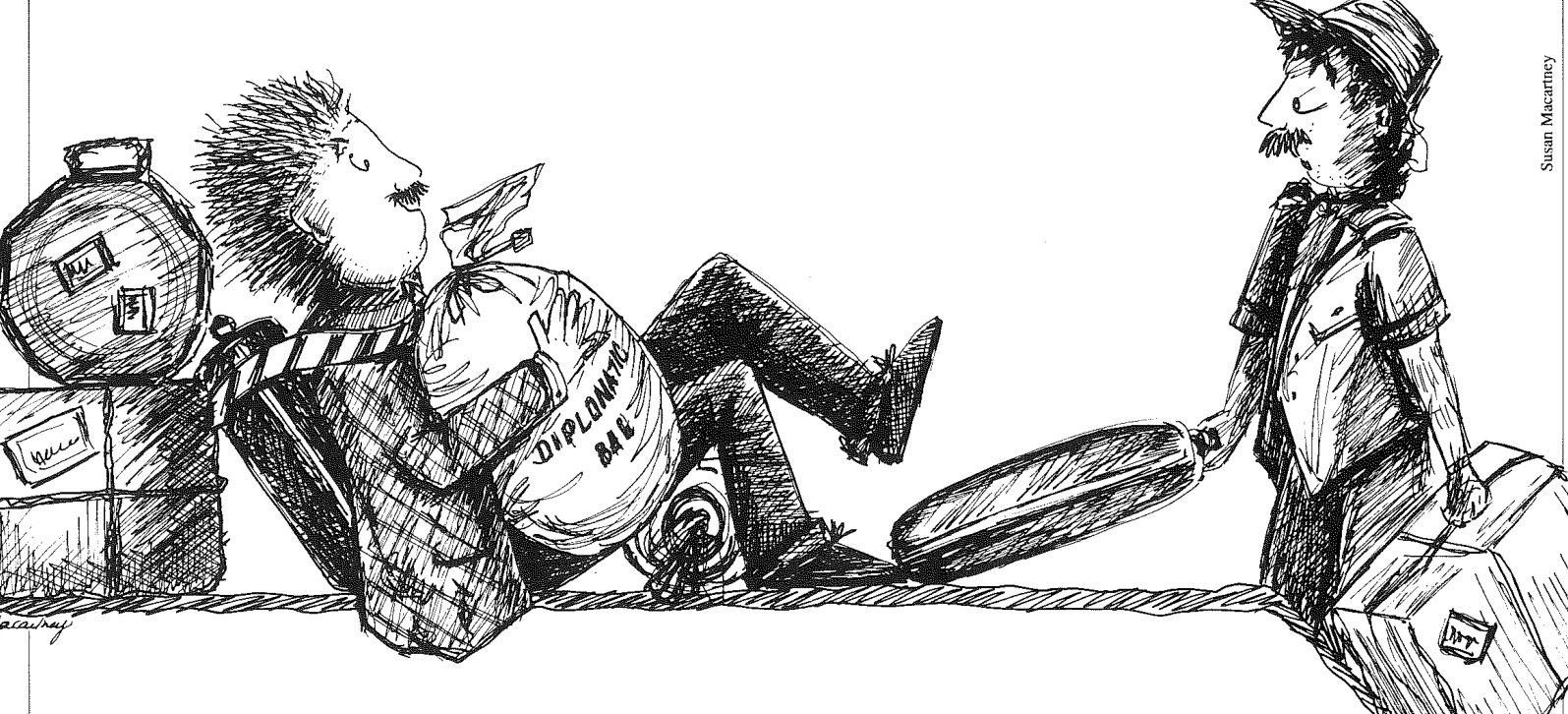
Three years in Chile during the most volatile era of the “protestas” of the mid-1980s produced a wealth of memorable experiences … of demonstrations, strikes, funerals and a major earthquake, larger, but thankfully less lethal than the ones which were to hit Mexico and San Francisco years later. Some of the experiences were the usual abnormalities of life abroad … like my courier run to the airport one weekday night. An overzealous official, ignoring the niceties of international conventions, insisted that the outgoing classified bags could not be escorted to the tarmac; they had to use the baggage conveyors, like normal luggage. Unable to reconcile his rules and the requirements of Canadian security (and gratuities being out of the question), the full rigour of Canadian diplomatic training came immediately into play. The diplomatic bags and I took the conveyor together, a most memorable foray through the bowels of the airport, where, at the end of the line, an astounded attendant happily conducted me to the waiting incoming airplane.
My fondest memory of the public affairs program — such as it was in a country where we were quite deliberately keeping a “low profile” — was an interview with Santiago’s largest radio station. Asked the inevitable question about Canada’s climate, I tried to suggest that Canadians were, despite the warm people. Instead of the word “caluroso” (warm), however, I used the adjective “caliente” (hot), and thereby explained to about one million Santiago listeners that Canadians survived our winters because we were essentially horny. The interviewer and our locally-engaged public affairs officer nearly fell off their stools in laughter. It was not the last time that the subtleties and sexual innuendoes of the Spanish language would come to the fore in slightly embarrassing circumstances.
It was Jesus Poblete, however, who provided me with one of my most compelling memories, and who, at the same time, taught me something of the differences between the First and the Third Worlds in the medical field. A chronic back problem of many years standing had suddenly begun to recur after about a year in Chile. A new and disturbing pain in the centre of my back was so sharp that I could barely sit. Appointments with the best internationally-trained specialists in Santiago, at reputedly the finest private clinic in Chile, left me with precious little relief. His diagnosis, that I was fat, lazy and out of shape, was probably right. But his prescription — shots of cortisone, exercise and rest — gave me little faith in the healing power of modern medicine and no respite from my daily agonies. A Chilean friend to whom my woes were being recounted asked if I was prepared for some- No appointment was necessary because Jesus Poblete ran a combination auto mechanics shop and chiropractic clinic. I arrived as he was wiping the grease from his most recent surgery, on one of the Santiago taxis that are held together by chicken wire and chewing gum. A friendly, gregarious man of about sixty years of age, with the weathered face of typical campesino, he greeted me with a firm handshake, his huge, calloused hands silent evidence of a long life spent at manual labours. He invited me into his house, where his wife pointed to an examining table and asked me to disrobe.
I began to describe the symptoms, but Poblete waved me off. In the rough joual of Chilean working-class Spanish, where the middle syllables disappear and the endings are swallowed, he told me that he knew about backs — all there was to know about backs. He would form his own conclusions.
I was surprised by the gentleness and precision of his touch. As I lay stiffly on the table, he ran his fingers down my back, from cranium to lumbar, once quickly, then a second time more carefully and pointedly, then a third time, as if for confirmation. Allowing me a moment’s recovery, he then told me the life history of my back, its three major problem areas, and what he proposed to do about each of them. Two of the areas in my neck and lower back were minor problems, at least for now, although the lower back was ominous for the future. The sharp pain in the centre of my back, however, was far more serious. Grabbing arms and legs firmly, twisting me into a variety of postures, he produced a number of familiar noises from my neck and lower back, somewhat reminiscent of my last chiropractic appointment prior to leaving for Chile. But the best he saved for last.
Poblete asked me to relax. The next part of the treatment, for the serious problem, would take some time. As he began to massage an ointment into my back, something smelling like a deep-heat rub, I shifted my head, opened my eyes, and recoiled in horror. His wife was plugging an electric steam iron into the nearest electrical outlet. After a few minutes he tested the heat. Yes, it gave off steam when he spat on it. He then threw a towel over my back and proceeded to iron it, from top to bottom. I could feel the heat pour through the towel into my back, almost right through my body, but without a sensation of burning. He passed over my body slowly three or four times, and I began to relax as the heat took hold and my anxieties eased. Within a few minutes, the first treatment was over. The sharp pain in my back was already substantially better.
I went twice more to the home of Jesus Poblete, paying him the total grand fee of some ten dollars Canadian (non-reimbursable, needless to say, from GSMIP). The routine was the same. I asked about golf, tennis or squash, not revealing that I had been advised against all three by my medical specialist with a European graduate degree. Poblete’s reply: Yes, do anything I wanted … the more the better … seven days per week. I tried golf the next day. Within a week, my back was sore, but bearable. By the end of second visit, the pain had nearly gone. Within a month, following my third visit, I was virtually back to normal. Amazed at the speed and completeness of my cure, I asked Poblete as I left his care the secrete of his skill. He smiled broadly and proudly, slapping me gently on the arm: “I know backs. I know everything there is to know about backs.”
He was right. Five years have passed since I visited Jesus Poblete, mechanic-cum-back specialist. The lower back problem which he predicted would arrive indeed made its unwelcome appearance. But the middle back problem which he ironed out of existence has never recurred. bout de papier Vol.
There were two worlds in Chile. One was the world of imported cars, imported music and imported medicine — a clinic designed in California, staffed with foreign-educated doctors, fitted with Laura Ashley accessories and controlled by Japanese computers and international credit cards. To an exceptional and perhaps unhealthy degree (no pun intended), this was also the world of the diplomatic community. The other world was Jesus Poblete’s, of home-made medicines, herbal teas, traditional treatments and education the hard way. Perhaps my experience was an isolated case, a chance encounter that would be dangerous to recommend to others. But this much remains. Nothing in three years in Chile brought home to me more forcefully the dangers of excessive pride, of believing that modernity, technology and progress had all the answers, of neglecting the values and accomplishments in the societies to which we were accredited. He may have lacked the pedigree, education and social skills which might have made him wealthy in any other circumstances. But Jesus Poblete knew about backs.
View the original scanned pages →
Originally published in bout de papier, Vol. 7, No. 4 (1990), pp. 35–36. Read the rest of this issue →



