
bout de papier, Vol. 7, No. 4 (1990), pp. 29–31
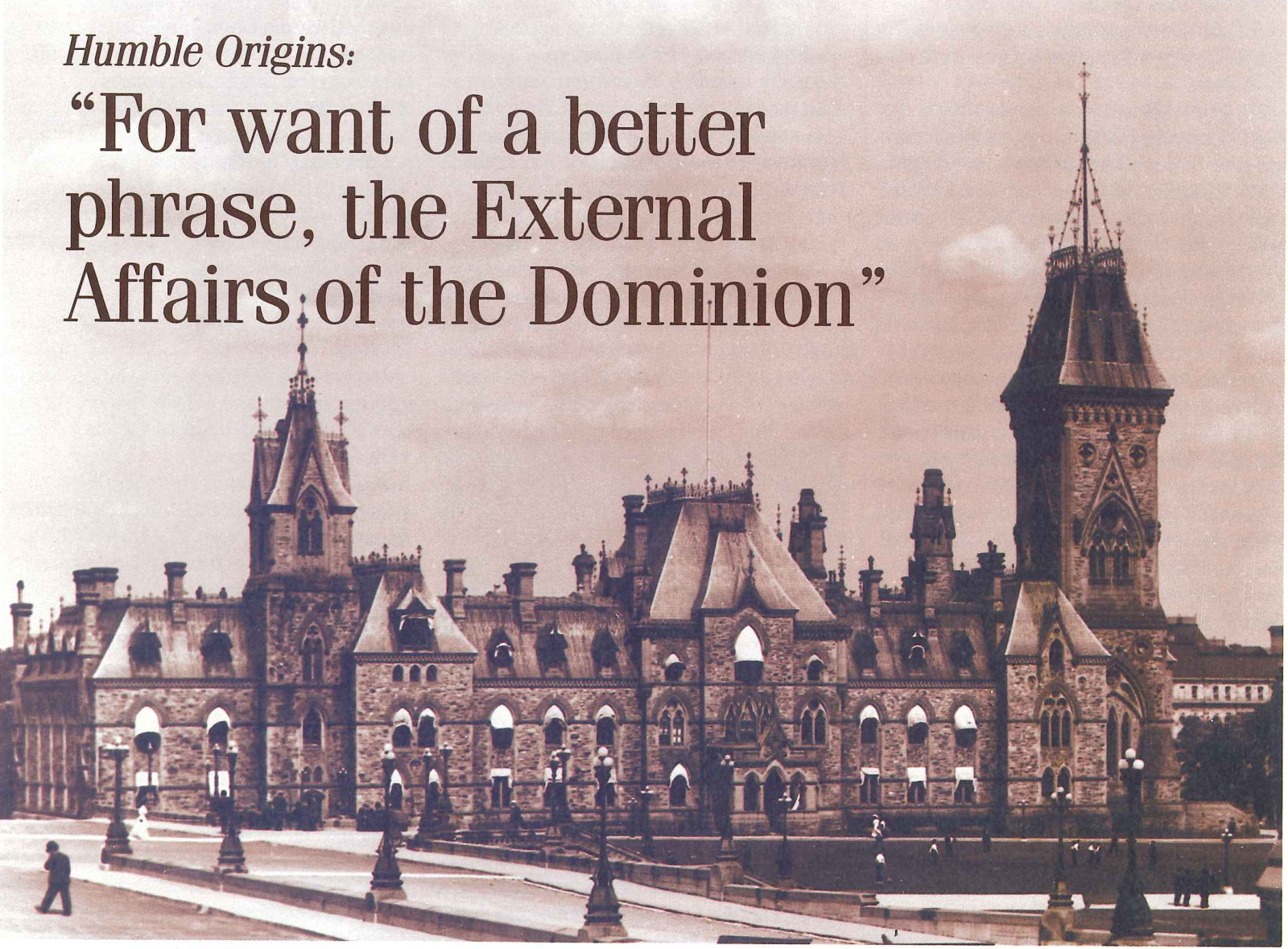
G iven the central position within the Government of Canada that the Department of External Affairs has occupied for most of its eighty-year history and the prominent international role played by so many of its diplomats, it seems hard to believe that it had to be gerrymandered into existence as little more than an archival post office.
In the early years of this century, Prime Minister Laurier was trying to hold a noncommittal stance on imperial relations so as to avoid the politically charged atmosphere of conflicting imperial and nationalist sentiments. While this prevailing political environment explains much about the nature of the department, it does not account for the timing of its emergence, which was dictated more by administrative problems.
Within the Canadian civil service, Joseph Pope, the person who had the most experience in dealing with foreign affairs had become thoroughly frustrated by the confusion that prevailed in the ad hoc system of the day. Since he had become Under-Secretary of State in 1896, his duties included passport work, naturalization of aliens, citizenship, extradition of criminals, the recognition of foreign consuls, and preparation of answers to parliamentary questions on external matters. He had also participated in many diplomatic missions and negotiations including the Bering Sea arbitration discussions, the Joint High Commission, the British- Canadian delegation to the Alaska Boundary Tribunal, and the Pelagic Sealing Conference. Pope was, in Governor General Earl Grey’s view, “the non-official Foreign Office of the Canadian Government.” Out of necessity, then, Pope was trying to be the unofficial keeper of whatever Canadian records these international negotiations required. In this capacity, his intolerance of innate confusion and muddle finally drove him to effect a change in the system. He, for one, was fed up with trying belatedly to collect documentation dispersed over several departments. Besides the frustrations caused by delays in the retrieval of records, it became downright embarrassing when he had to beg the British archives for copies of records because no one in Canada knew where to find the originals.
In 1907, Pope wrote to the Royal Commission on the Civil Service a lengthy memorandum in which he pointed out the need “of establishing a more systematic mode of dealing with what I may term, for want of a better phrase, the external affairs of the Dominion. “ For the benefit of the Commissioners, Pope carefully outlined the cumbersome procedure for handling international affairs:
The Colonial Minister addresses a despatch to the Governor General; that despatch is forwarded by command of His Excellency to the Privy Council, which means with us the Cabinet. The Privy Council refers it to the Minister at the head of the department to which it relates, who causes to be prepared a reply in the form of a report to the Privy Council… This Minute, when approved by the Governor General, is forwarded to England. If it is an important despatch, the policy of the Government in regard to the principle involved is, no doubt, discussed and agreed to in Council; but the terms of the report are almost invariably left to the department to which the despatch was originally referred. bout de papier Vol.
Under this mode of dealing with official correspondence there is no uniformity of system or continuity of plan.
As Pope himself admitted outside the Royal Commission hearings, the procedure had even more substantial flaws. As time permitted, Laurier, who was also President of the Privy Council, would read out before the assembled Cabinet Ministers a few lines of even the most routine dispatches, which in 1908 numbered 1,596, until some clue to their contents was ascertained and they were directed to the appropriate minister. Everything depended upon his memory when months or years later subsequent dispatches on the same subject came to be distributed. Since no records were kept of where things went, it often took a Colonial Office reminder to get a civil servant scurrying along the trail of the unanswered dispatch. And since more than one department might be concerned with a particular issue, both knowledge and records tended to be dispersed among officials who individually did not know how to respond. The upshot of this system of conducting correspondence, based on haphazard files, was an undue reliance on the memory of a few officials.
In his memorandum to the Commissioners, the ever-meticulous Pope also pointed out his concern that “in Downing Street, Canadian dispatches are noted for diversity rather than for elegance of style.” Pope recommended that all dispatches should be referred to one department, whose staff would be trained in the study of diplomatic questions and the conduct of correspondence. If a new department could not be created, then this work should be done under the aegis of the Secretary of State, who would then preside over a department dealing with both internal and external affairs. It was a worthwhile suggestion, but it received little consideration from a Commission whose main concern was patronage in the public service.
Fortunately for Pope, others outside the Commission, who had to work in this whirlpool of policy-making, shared his dissatisfaction with the prevailing confusion and he soon acquired powerful allies within the Cabinet. Pope also gained the strong backing of two very forceful personalities, Governor General Grey, and the British Ambassador in Washington, James Bryce. Neither was inclined to let obstacles stand in the way of effecting an Anglo-American accord.
Determined to play a first-hand role in the diplomatic manoeuvrings of the period, in 1908 the Governor General made the creation of a Department of External Affairs his personal concern. Grey complained to the colonial secretary in March 1908.
30 bout de papier Vol.
“There is no Department, no official through whose hands all matters dealing with External Affairs must go. Consequently, there is no record, no continuity, no method, no consistency. I have represented all this to Laurier, who agrees with every word I say. He regrets that he did not, when he came into office I years ago, create a department. Well it is not too late now. Do it now, I urge.”
The Colonial Secretary to whom Grey was complaining had his own reasons for wanting to effect a more orderly channel of communication with Canada. The Colonial Conference of 1907 had called for the establishment of a permanent imperial secretariat for handling correspondence related to future conferences. It was set up, and after a visit to Ottawa from an official of that secretariat, in April 1908, Laurier established in the Privy Council Office an additional position for William MacKenzie, a Liberal Party stalwart and member of the press gallery, who was appointed to keep track of such correspondence. Pope was not impressed. “This is carrying out my scheme in a fashion though not exactly in the way I intended,” he ruminated. “I should not have thought that MacKenzie’s training as a newspaperman was such as to fit him for the duties of a diplomatist, but the press of the country (and indeed, Sir Wilfred Laurier) seem to think differently.” Pope refused to include the improperly trained MacKenzie in his plans. Though MacKenzie remained in the Privy Council Office as a docketeer and registrar of diplomatic correspondence, he may not have been as ill-suited as Pope thought for on two occasions he was sent by Laurier’s successor on important missions to Washington.
Whatever his merits might have been, MacKenzie could not single-handedly have met the expectations of those clamouring for a full-fledged department. Bryce, who in February 1908 had discussed the situation with Laurier and Grey, continued to be thwarted in his attempts to carry on negotiations with the Americans. The loss of time involved in “this constant breaking the chain of negotiations and then trying to rivet the sundered links afresh… is so great that really nothing seems so urgent as to create at once the needed department,” he told Grey. However, the Colonial Secretary had some misgivings about the creation of a department which could detract from Britain’s paramountcy in foreign relations.
Grey hastily assured the Colonial Secretary that everyone in the Cabinet agreed that something had to be done and there need be no concern about independence from the British Foreign Office because that staunch defender of the imperial connection, the Minister of Finance, W.S. Fielding, had agreed to find the money for the additional salaries. In September 1908, Cabinet agreed to establish a Department of External Affairs with Pope as its head.
As early as January 1908, Pope had begun drafting a bill that would establish the department, although he did not actually submit a draft to Laurier until February 1909. Between then and the time of its introduction into Parliament a number of changes were made, the most important being the placing of the new department under the Secretary of State rather than the Prime Minister. In doing so, Laurier had been influenced by the Minister of Justice, Allen Aylesworth, who did not want to risk arousing opposition over the creation of another separate department with its own budget.
On March 4, 1909, Secretary of State Charles Murphy moved the resolution in the House of Commons calling for the creation of a Department of External Affairs. The debate that followed was couched almost exclusively in terms of the administrative role of the Department, since the Opposition’s criticism focused on the need for better organization rather than new machinery. Much to Laurier’s relief, on the verge of a horrendous political wrangle over a Canadian navy, no one spotlighted the political or constitutional significance and the Government deliberately downplayed the significance of its action.
The Government’s assurances that no constitutional change was intended was warmly greeted by the imperially conscious Opposition. But in so doing, they missed the significance of the wording of the bill’s third clause which gave to the Secretary of State “the conduct and management of international or intercolonial negotiations so far as they may appertain to the Government of Canada. “ In the context of the imperialist-nationalist debate within Canada, this clause could well have been viewed as a means of developing and conducting an autonomous Canadian foreign policy, but surprisingly even an avid imperialist like Sir George Foster did not seize on this implication. Fortunately for Laurier, the debate centred on the functioning of the bureaucratic machinery and not on more esoteric concepts such as the control of foreign policy or imperial relations. Although the Department was not in fact to function as a true foreign office for some time to come, Laurier ensured through this third clause that the legislative authority to do so would be in place when the time did come.
To make his point, Laurier cited the increasing volume of questions concerned with external matters and the inability of the Cabinet to deal with them properly. Working from the Colonial and Foreign Office models, Laurier pointed out that they had officers who were trained to keep up-to-date on questions that might arise “so that, in a moment, the ministers may know where they are.” “We have,” he continued, “attained such development as a nation that in order to deal with these matters, we must have a department for the purpose. It is not intended it shall be a very numerous department, a very heavy department; I think the officers at present in the service can do the necessary work.”
Leading off the debate for the Opposition was Robert Borden who wondered why external matters could not simply be handled by the Department of the Secretary of State itself. In spite of the arguments advanced by Laurier and Murphy, Borden remained convinced that the proposed department “will amount to nothing.” Everything depended upon the organization and that was where Sir George Foster, the former Minister of Trade and Commerce, who had created the Trade Commissioner Service, raised some perceptive points in the House. Foster observed that Cabinet Ministers, including the Prime Minister himself, could not divest themselves of the responsibility of screening all incoming dispatches because some were so confidential in nature that they should be seen only by the Prime Minister, or a few trusted colleagues. Laurier doubted this. The nub of Foster’s argument, however, was the relations between the new department and those departments which had, and would continue to have, specific international issues as their responsibility. Here the crucial issue was the drafting of replies to dispatches by trained officials of the new department. In Foster’s view, this function properly belonged to the responsible minister who “is the man who has to determine the policy and is the man who has to lay down the tenor of the dispatch and submit it to his colleagues.” “You may bring from that bureau (External Affairs),” he warned, “all that your new-fledged diplomats may pen on paper, but the minister whose department is chiefly affected will say ’I do not agree with some parts of it, I will have to think it over’ and then your merry-go-round starts again.” If External Affairs was to do the drafting then, he went on,
“you must have a replica of every department of the government in the Department of the Secretary of State (i.e., External Affairs), men who are as able as the ministers of the departments are, men who are just as well up in their history as the ministers of the departments; consequently you are to have, if you are going to have an effective service, a very costly and numerous service … I believe that difficulties and practical difficulties will be encountered in that respect which I doubt if the right honourable gentleman has thoroughly weighed.”
Foster’s observations about “just one more circumlocution office” were lost on the Government, but the problem he raised would be around to haunt many a Secretary of State for External Affairs who in years to come would attempt to manage a multitude of issues affecting other departments.
The debate lasted less than two hours. On the surface what had been accomplished was the mere hiving-off of a section of the Department of the Secretary of State that would now look after external rather than home affairs. Murphy and Laurier had succeeded in steering the debate away from controversial imperial concerns and onto the safer subject of administrative efficiency. In this last respect, the Liberal spokesmen had, it seemed, not given much thought to the means whereby they were seeking to accomplish their reform of an inadequate system, while an equally inept Conservative Opposition never seemed to grasp the significance of the Prime Minister’s defence of the separate department as a means of placing Canada among the nations of the world. While not everyone on the Conservative side would have objected to this, it was at least worthy of discussion. The creation reflected the ambiguities that prevailed in the Canadian political scene. Laurier had skilfully manoeuvred the department onto the scene through the back door. None of the politicians really understood how it would function. Nor was it really in the interests of the Foreign Office, except that the Anglo-American accord demanded the efficiencies in communication that a department could introduce if properly managed It was all so typical of Canada’s administrative and political development of that era. The Government had not forgotten the hullabaloo created when they had last tried to introduce a new department of government. It was not yet the bureaucratic age. Ministers could still manage things themselves.
Such a lacklustre debate in Parliament did not stir much interest in the country at large. My survey of twenty-one of the country’s largest daily newspapers reveals only seven editorial comments. The Winnipeg Tribune was the most blunt in its opposition, claiming that there were already too many departments in Ottawa and too many “idle men” working in them. The two Ottawa papers followed the same theme, with the Journal reluctantly accepting the new department as a clerical body as long as the responsibility for handling foreign correspondence remained with the Prime Minister and it was “not made the excuse for the creation of a new portfolio and corresponding set of sinecures.” The Citizen wanted for an under-secretary, a “ ’jurist of repute’ who will go up against the cavalry screen of diplomacy and make Canadian claims look like something.”
The watchdog of imperial interests in the country, the Toronto Mail and Empire, was happy to confirm that the creation was not a step towards Canadian nationhood. In marked contrast, the Montreal Daily Star and the Regina Morning Leader supported it as a step towards nationhood.
“It is only a question of time in any case until we shall have to get not only a department but a Minister to deal with it,” argued the Daily Star.
That would take another few years and a change of Government. In the days immediately following the debate the political and public focus had turned to naval armaments and the new department was soon all but forgotten except by the Governor General, who had to sign the act, and by the fifty-four-year-old Pope, who had to shape the new creation. On May 19, 1909, royal assent was given to the act which brought the Department of External Affairs into being on June 1, 1909. It wasn’t much of a beginning, but then no one wanted to blow the cover off an archival post office for diplomatic records responsible to the Secretary of State.
View the original scanned pages →
Originally published in bout de papier, Vol. 7, No. 4 (1990), pp. 29–31. Read the rest of this issue →



