
bout de papier, Vol. 13, No. 3 (1996) — Fall 1996 // Automne 1996, pp. 47–48
When Liebnitz entered the conference room, he was greeted by the Head of the Service, MacBannock, and by Chief Inspector de Toombs. Said MacBannock, “The security office has asked for our help on a tricky international case, Liebnitz, and one that’s right up your alley.” De Toombs nodded and smiled. “It’s a referral from the police in Nuevo Tango, the capital of Piazzola. They’re had an unusual murder-theft.” “So fill me in,” replied Liebnitz.
De Toombs began without ceremony: “The stolen object is a cubical gold reliquary, about 20 cm on a side, containing a preserved human heart. The reliquary is quite modern and is plain except for the name TAILOR AZELEAS-WONG engraved on the side. It was stolen a few weeks ago from the Convent of the Maculate Giraffe in Nuevo Tango. The abbess won it in a poker game in Toronto about twenty years ago, and the police believe that the one who arranged the theft is the Canadian from whom she won it — a man whose first and last names are acronyms of the two words inscribed on the reliquary. So they contacted us.”
“The Nuevo Tango police have also established that the reliquary was stolen between 3:00 pm and 4:00 pm precisely,” he went on, “and that entry was gained through the Cafe Norton, which backs onto the convent building. The connection between the cafe and the convent is through an abandoned sewer that runs under both the cafe storeroom (where there is a trap-door) and a vestry near the chapel where the reliquary is held. The police say that it would take about 20 minutes to get from the cafe to the convent and back.”
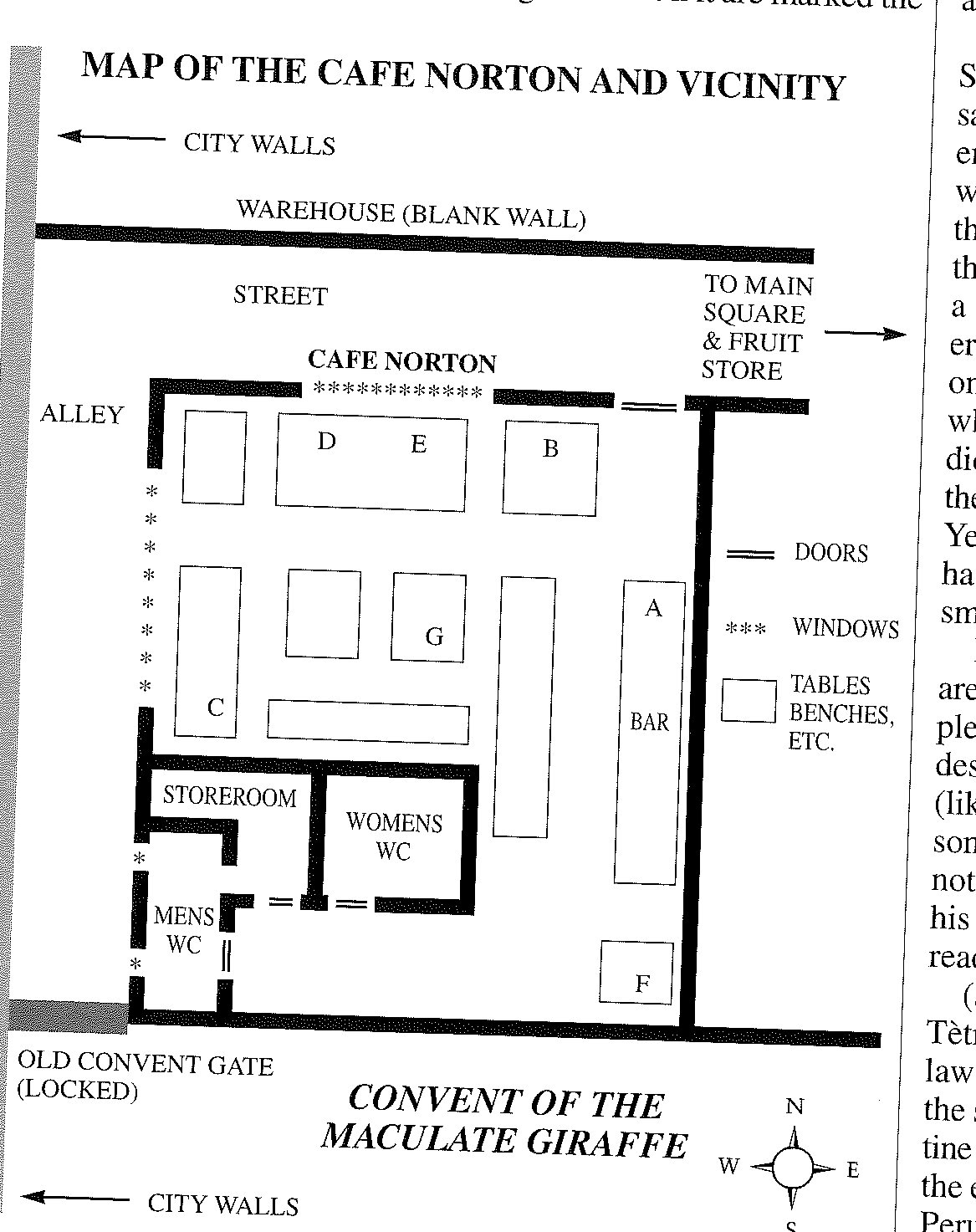
De Toombs passed Liebnitz a piece of paper. “This gives a sketch of the cafe and the surrounding streets. On it are marked the storeroom, which is between the two washrooms down a short corridor in the back. The two washroom doors are marked with the usual astrological symbols, while the storeroom door has a saxophone. The map also shows the seating places for the seven people who were there over the period in question, marked A to G. Position G is where a poet called J Alfred Stearns was sitting until just after 3:00 pm. He isn’t a suspect for either the theft or the murder, since he was out of the cafe and back in his hotel by 3:15 pm. He doesn’t remember much of the place, but he did make some notes.”
The inspector continued: “The murder victim himself was a private eye named Sweeney, who was sitting at position F. This means he could see the back corridor and the door to the storeroom — and that he was the only one there who could always do so. He’d been sitting at that table for almost a week from the time the cafe opened to the time it closed. Apparently, he got wind of the planned theft and was hoping to cash in by finding out who was behind it. So the murder and theft might be connected.”
“What killed him was poison, one that would first make him groggy and then kill him suddenly, all in 20 minutes. He fell out of his chair dead at 4:00 pm. We know that he must have taken the poison in a cup of coffee, since there was nothing else but that and the poison in his stomach and he took no medication. There was no poison in the coffee cup in front of him when he died, in the coffee spilled on the table or in the expresso machine. Sweeney did leave one possible clue doodled on the table: a little circle with an arrow sticking out one side, followed by a question mark.”
“The murderer must be one of the five people in the room with Sweeney,” de Toombs concluded. “So must the thief — either the same person or another. There is no way that anyone else could have entered the cafe without being noticed: there is no back door; the window in the front is in constant view by the staff and customers; the windows on the side of the main room are heavily shuttered; the windows in the washroom might be just big enough to admit a child but the dust is not disturbed on the sills; and the old sewers don’t connect with anything but the cafe and the convent. With one exception, all the suspects were still in the cafe at 4:00 pm when both the murder and the theft became known. The police did a thorough search of both the cafe and the four who were still there, and found nothing — they are sure the reliquary is not there. Yet they are also sure, from the grapevine, that one of the five still has it and is only waiting for the hue and cry to die down before smuggling it out of the country.”
He then passed the ace logician another piece of paper. “These are Stearns’ notes, made while Sweeney was still alive. The people described are Sweeney and the five suspects: Stearns did not describe himself. Stearns also tells us that the attributes he gives
(like “dressed in brown” or “eats grapes”) are unique to that person, a sort of memory trick he uses. Where it is clear, I have added notes giving the map positions of the places he mentions. All of his statements are accurate.” Amid the absinthe stains, the notes read as follows:
(a) The man behind the bar [position A] is surnamed Cazador Têtrico. (b) Two of the people are surnamed Rossignol, being in-laws of the same gender. (c) The Mexican dressed in brown and the singer are the two sitting nearest the west wall. (d) The Argentine watches Raquel as she eats grapes. (e) The waiter, who sits near the expresso machine [position B] is Juan, surnamed Sirio. (f) The Peruvian woman, Esmeralda, sits at the same table as the French dancer. (g) From where they each sit, Sr Parca y Cuervo and Eduardo the ape-necked Chilean cannot see each other. (h) Diego the painter watches the woman wearing the Spanish cape. (i) The Spaniard has heavy eyes; Julio reads Eliot. (j) Sweeney the detective sits against the back wall [position F].
“The other thing we have,” continues de Toombs when Liebnitz looks up, “is a list of five statements made by each of the suspects. Recordings of these statements were analyzed by the Nuevo Tango forensics people, and we know that each suspect made exactly one statement containing a lie; the statements that do not contain lies are completely accurate. You will note that Piazzolans are fanatics about accurate time. Unfortunately, the fax from Piazzola cuts off just where it is about to specify the lies, and the annual pisco festival has put the entire country out of order for at least a week.” So saying he handed the ace logician a final sheet of paper with the following notes: JUAN: (1) I went to Sweeney’s table only three time during that hour, each time to bring him coffee: once right at 3:00, once at 3:25 and once at 3:50. He paid me separately each time — didn’t want to run a tab. (2) Diego went over to Sweeney’s table at 3:20, sat down for five minutes and tried to talk to him, but Sweeney brushed him off and Diego went back to his table just after I brought Sweeney’s second coffee. After that they ignored each other (3) The woman in the Spanish cape went over to talk to Sweeney at 3:30. She tried to sit on his lap, knocked over his coffee cup and fell on the floor. (4) At the same time I served Sweeney’s third cup, I also took coffee to the man in brown at his table, just as Raquel came out of the back corridor. (5) I never left the room except once to go to the bathroom.
ESMERALDA: (1) I never went down the back corridor at all. (2) The dancer went to the bathroom at 3:30 and was back by 3:35. (3) A few weeks ago, the painter and Sweeney had a fight over taking me to a lambada party. I went with Sweeney. (4) The Spaniard went down the back corridor at 3:40. (5) Neither Raquel nor the Argentine went up to Sweeney’s table while I was in the room. DIEGO: (1) I never met Sweeney before today and had no reason to kill him. (2) I only left my seat twice during that hour — once to try and talk to Sweeney and once (at 3:40) to go to the bathroom. (3) I got back from the bathroom at 3:45, just as the singer swept out the front door. She didn’t come back. She wasn’t carrying anything like the reliquary you describe, and with an outfit that tight, she wasn’t hiding it either. (4) As the singer went by the front window a few seconds later, I looked around for the dancer, but she wasn’t in the room. (5) Just then, as I was on my way back to my table, I heard Sweeney order a fresh cup of coffee. He sounded wasted. JULIO: (1) I never touched or saw the reliquary you describe, or any package that could hold it. (2) Sr Sirio was out of the cafe from 3:10 to 3:20 buying fruit. (3) I never left my position except for a trip to the bathroom, from 3:15 to 3:20. (4) Between 3:25 and 3:30, Esmeralda and the dancer had a big screaming match over something. (5) When Sweeney’s coffee got spilled, Juan was busy with other customers, so Esmeralda got Sweeney a fresh cup from the espresso machine.
RAQUEL: (1) I left the room only the once. That was just when Esmeralda went over to talk to Sweeney. (2) Julio went down the back corridor at 3:15 for maybe five minutes, and I saw him step outside for a few minutes just at 3:50 to talk to someone — I couldn’t see who. (3) No-one else went out after that. (4) The Mexican went down the back corridor at 3:40 and got back at 4:00, just as Sweeney fell over dead. (5) I never went near the barkeeper or the bar, the whole time.
De Toombs concluded gloomily, “As you can see, it’s a complicated mess. I’d really like to help my colleagues in Nuevo Tango, but what can we do, Ludwig?” Replied the ace logician, “Well, from Stearns’ notes I can tell you where Sweeney and the five suspects sat. Using that information and a bit of logic, we should be able to work out which statements are lies. The statements that are true should then tell us who could have stolen the reliquary and murdered Sweeney (I will assume that it wasn’t suicide or some sort of grizzly accident). I can even make a good guess as to which of the suspects has the heart now”
Which Liebnitz proceeded to do, to MacBannock’s amazement and de Toombs’ satisfaction. Can you duplicate his feat by (a) describing the six people in the room: seating locations, first and surnames, nationalities, professions and attributes; (b) indicating which statements are lies; (c) naming the murderer, the thief and the one most likely to have the reliquary now? As a bonus (but not necessary for a solution), can you also name the one who arranged the theft to get the heart back, based on the anagram?
View the original scanned pages →
Originally published in bout de papier, Vol. 13, No. 3 (1996) — Fall 1996 // Automne 1996, pp. 47–48. Read the rest of this issue →



