
bout de papier, Vol. 13, No. 3 (1996) — Fall 1996 // Automne 1996, pp. 32–35
When the Right Honourable Roland Michener was about to go to India as High Commissioner he asked me, because he temporarily occupied an office next to mine, for advice on how to conduct himself as a Head of Mission (HOM) at a Canadian foreign service post. In retrospect I believe I neglected to give him one of the most important pieces of advice that anyone can receive going to this kind of assignment, namely, to make a friend of and to depend on your driver. By all accounts he did so anyway.
The driver will meet the Head of Mission within minutes of arrival at the post, will also be at the Residence home each day and take him or her to and from the office, will be with the HOM on official calls and local travels, and will be the last person seen as the HOM leaves the post years later. For most Heads of Mission the working day is not over until sometimes three or four official functions are attended in the evening. So there will be a series of long and arduous days for the Head of Mission and for the driver. It is not surprising therefore that over the months and years an HOM may spend in constant contact with his or her driver, they should get to know each other very well indeed.
The driver comes under many pressures. Anyone who has driven a North American car in a country which drives on the other side of the road will realize the difficulties this creates. But imagine having to do this month after month and year after year, in crowded Third World urban and rural conditions. The roads in a Third World country, or in an old world capital, are congested, often narrow, and full of dangers. To undertake a difficult mountain journey in Asia without being able to naturally and easily see round the corners is to say the least a major handicap. There is the added problem of spare parts and maintenance. For many years efforts were made to use Canadian-built cars in countries where there were no spare parts available anywhere nor any experienced service facilities. Somehow the drivers the Canadian missions managed to recruit, learned how to carry with them the tools and equipment which helped them to deal with at least some mechanical problems in a completely hostile environment. They became skilled at preventive maintenance and experts in finding and obtaining help no matter where they were.
Most HOM’s drivers develop a fine tuned antenna for the likelihood of difficulty. Often they are able to see the signs of disquiet in a community and anticipate which roads in which districts will be safe. These problems are of course compounded when an HOM is required to travel outside the capital city or even to visit countries of double accreditation.
In recent years there has continued to be danger for many Canadian HOMs abroad. A disgruntled employee who has been fired may become unbalanced. There could be grievances directed against the Ambassador as a representative of Canadian policy. There have been instances of planned attacks, whether of terrorist or other origins, directed at the Canadian HOM. When these conditions arise, and sometimes they continue for long periods and are completely unpredictable, a major burden falls on the HOM driver. From time to time, specially protected vehicles are needed and armed guards and a protective convoy provided. HOM drivers cope with these challenges.
There is also the fact that in most Third World and most First World countries the HOM is often required to be on the roads at time of very heavy traffic. By definition there are many cases involving hasty trips to the airport or attendance at major functions involving huge crowds and complicated arrangements. The drivers with whom I have had experience developed techniques for dealing with such conditions.
In Karachi in the early 50s I was once, in an emergency, driving myself to the airport when an elderly tribesman walked from a hidden entrance directly into the side of my car. I stopped at once to help him and a large crowd gathered and there was a general discussion about what to do with the injured man. A guide was found and I drove him with this guide to the nearest hospital. Throughout this particular episode I gave no thought to any potential difficulty for myself or the car and communication worked very well in spite of my limited knowledge of the local language. There are, however, circumstances in which foreign drivers are advised not to stop if there is an accident, but to drive on and report as soon as possible to some official authority (if they can find one). This is perhaps one of the main reasons why a Canadian HOM does not generally drive himself or herself in most of the countries of the Third World. You do not know whether the herd of goats on the road ahead will get off the road at the sound of your horn. You do not know how quickly the bullock driver will bring his cart to the side of the road to enable you to get past him in conditions of relative safety. You do not know whether people will get out of the way when your car approaches them.
The drivers of course have to have a considerable degree of language skills. They often work for HOMs who do not have skills in the foreign languages required by their several countries of accreditation. Quite often they are loaned to a visiting Canadian minister and will have to deal with people completely unfamiliar with the local scene. There will be a running series of requests for information of a tourist nature which the driver will be obliged to fulfill, and sometimes the visitors will require help in carrying out their own personal programme. When one of our drivers retired recently, it was noted that he had driven for five Canadian Prime Ministers.
To have a driver is a strange thing for a Canadian. I doubt if anyone, except the occasional wealthy appointee from outside the service or a Minister, ever had his own driver in Canada. The fact is that in most Third World countries an HOM could not function without professional driving assistance. It would simply occupy too much of his day to deal with the maintenance of his official vehicle, to plan attendance at official functions, and to cope with the daily wear and tear and long hours required to meet the demands of the job. The difficulties of parking alone can severely restrict an HOM’s ability to cover the ground he should cover in the performance of his duties. I have never served as HOM at large Western European capitals or in Washington, but I did observe very closely the function of the HOM driver at the Permanent Mission to the UN in New York from 1956-60. The difficulties of operating a vehicle in Manhattan are directly comparable to those faced in Malaysia, Pakistan and India.
Over the years, in the course of their work, the HOM drivers have become members of the official Canadian family. From the HOM down, there is now concern with assisting the locally-engaged employees with their health, financial or family problems. In return, drivers are typically quick to recognize when their reaction and abilities are affected by age or illness and when they can no longer function under the pressures applicable to a HOM driver’s position.
Drivers I have known
Reidar Granerod — Oslo
An official letter, sent in support of Reidar’s application for housing in 1946 soon after he joined the Canadian Embassy, reads:
…Prior to the Canadian Minister’s acquisition of his present residence, Granerod slept on the floor of a friend’s room. He has now been forced to exchange this for the doubtful improvement of accommodation on the floor of the Canadian Minister’s basement room… this is an untenable situation for both the chauffeur and the Canadian Minister ….
A recollection of Reidar’s background has been provided by a former Canadian Ambassador who writes in 1994 as follows:
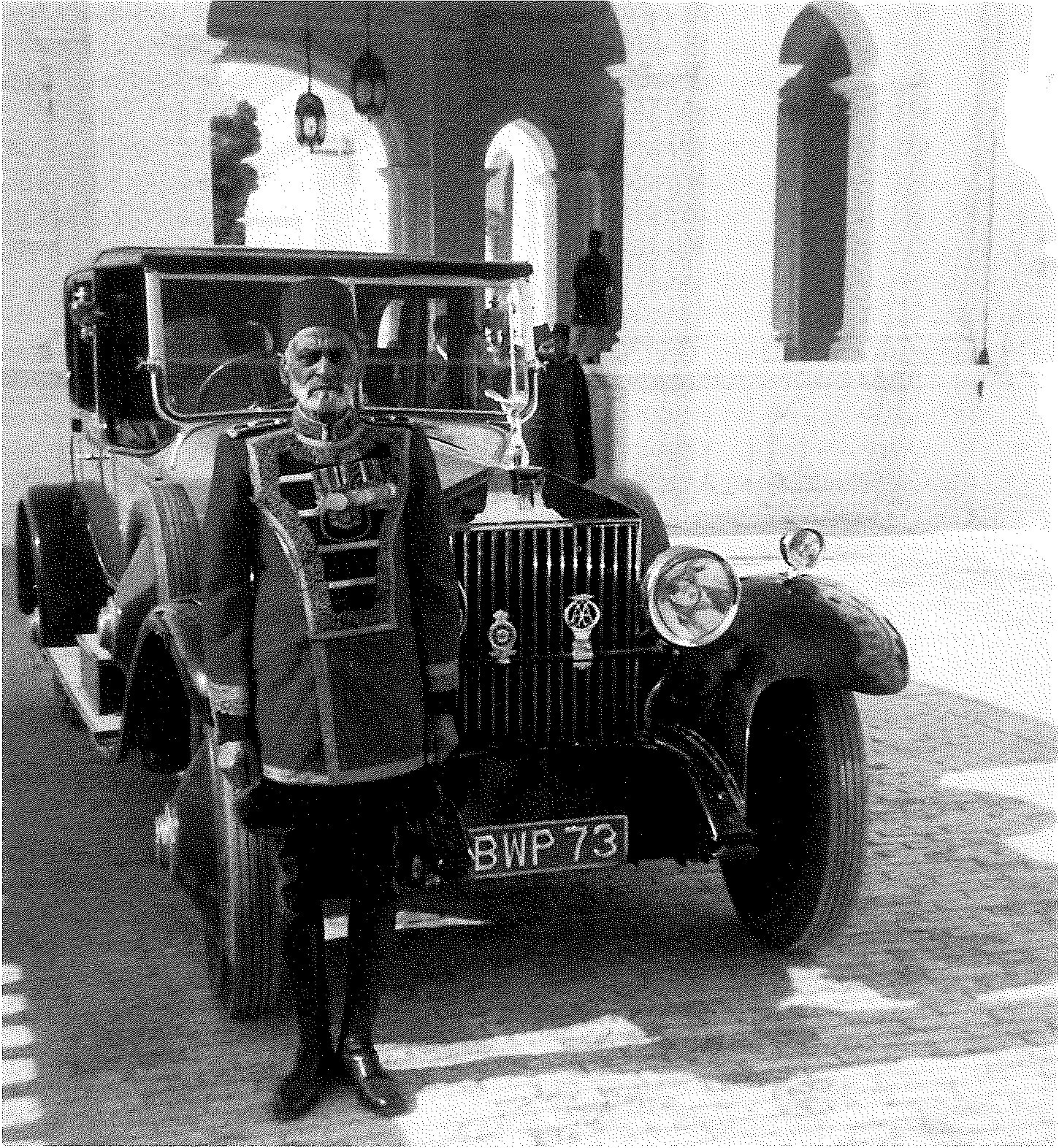
I believe Reidar came from Sandefjord, the former whaling port. In any event, as a young man he went to sea with the whaling fleet, mostly to Antarctic waters. When the Germans invaded Norway in 1940 Reidar was in England, having been put ashore to recover from an accident at sea. With the arrival of the Norwegian Royal Family, Reidar was employed as a driver for Prince Olav in a 1942 Packard. When I was in Oslo (1981-84) this same car was still used to fetch newly arrived Ambassadors for the presentation of credentials at the Palace where Olav was then King. Somewhere I have a slide showing him at our residence standing proudly beside the car he used to pilot around wartime London.
Reidar exceeded the rigorous Nordic standards of punctuality and with a fine sense of traffic and weather always instructed one when to be ready to depart for a public function, and was invariably alert to bring up the car for a quick or timely getaway, regardless of how many others had the same thought. Over time I gained the impression that Reidar seemed to have acquired the status of Dean of the Diplomatic Corps Drivers.
There will be many others who could testify to Reidar’s service over the years. He looked after, and was a friend of all the HOMs he served including R.A. MacKay, Louis Couillard and myself as a Chargé.
Abdul Hamid bin Ali — Kuala Lumpur
My first long-term involvement with an HOM driver was in Kuala Lumpur from 1967-71. I was accredited to Malaysia as well as to Singapore and to Burma. Malaysia involved a good deal of travel outside the national capital because there was a requirement, if time permitted, to visit the sultans of the Malay States. It was also necessary very frequently to take the official vehicle from Kuala Lumpur to Singapore, since there was only one vehicle in Singapore and it was more than fully occupied supporting a small but active mission. Thus we drove sometimes once or twice a month from Kuala Lumpur to Singapore. Hamid was required to have as good a knowledge of conditions in Singapore as he had in respect of his home country.
We got to know Hamid and his family, and while he was a collaborator in the full sense of the word, he was also a reserved and private person. He made very great efforts, which we were able to help, to ensure that his children got the best possible education. Sometime after we had left the post his health required major and urgent treatment. One of my successors’ wives recognized the problem and made certain that Hamid was properly cared for.
At the time of Hamid’s retirement after thirty-five years of service, it was said of him:
Hamid’s engaging smile and the fact that he was easy to be seen in a crowd by his windmill-like motions with his arms, made it easy to spot him and get away early from major functions.
There will be a great many people who will remember Hamid and his service with affection. He died in September 1995.
Mohammad Said — Karachi
When I went as a green Third Secretary succeeding Geoffrey Murray in Karachi in 1952, Said was already employed at the post as an HOM driver. We all recognized his skills and his friendly cooperation with many members of the post. As the wheels of the Canadian Foreign Service turned, I came back to Pakistan in 1972 as Ambassador (after Pakistan left the Commonwealth). Said was one of the most experienced and most admired members of the Canadian mission’s staff in Islamabad. He retired in 1985 and has remained active, living with his son who is an employee of the Pakistan National Assembly in Islamabad.
Possibly the most difficult of the assignments he undertook on our behalf was to drive us on frequent official visits to Afghanistan. Between 1972-74 that country was going through one of the comparatively tranquil periods of its history, and as a result we were able to visit possible projects and support Canadian interests through the country. Air services to Kabul were complicated; we frequently had to drive through the Khyber Pass and then make our way to Kabul and elsewhere. Said came from the frontier and had sufficient Pushtu to be able to assist us when we, as was often the case, got into difficulties of one kind or another in the countryside.
Perhaps Said’s main qualities were calmness and steadiness under pressure. Hour after hour we would drive the tortuous bends of the road up to Kabul; he proved steady and capable in unusual and trying conditions on very bad road in Afghanistan and in remote parts of Pakistan. He was invariably good company. One of the problems for a western official in Pakistan was how to find some form of rest stop particularly when there were ladies in the party. In South Asia everyone suffers from dysentery from mild to serious in one form or another, almost all the time, but Said seemed able to negotiate rest stop facilities for us with out-of-the-way official Pakistani houses.
Sunny Jacob — New Delhi
Sunny Jacob was first employed privately by one of the High Commission officers and then joined the Canadian High Commission in New Delhi in 1955. He drove a great variety of vehicles and assisted a large number of Canadians who served at the mission. When I arrived in India in 1979 Sunny Jacob had been the HOM driver for three years.
On one monsoon assignment between Be Candian hign, Commission in New
Delhi wrote that Sunny:
… never once lost his patience or his “cool” although we were driving through the flooded areas of Madhya Pradesh which meant crossing at least twenty causeways that were under several feet of water, and driving in the mud for about five hours one night trying to find a way of crossing a flooded river.
Sunny lived up to his name: his disposition was agreeable no matter what the difficulties. He was also an effective planner when it came to High Commissioner’s travels. We made so many trips with distinguished visitors to Agra that Sunny developed a system for stopping at rest houses on the way there and back. It was amazing how he was able to master the intricacies of Indian cities which he could only have visited once or twice before.
Sunny Jacob suffered one of the most ironic of accidents. After many years of driving in the conditions of Delhi and Northern India, he took his family and himself for a holiday in Nepal. He rented a vehicle and driver and on the journey out of Katmandu in June 1988 there was a collision with a bus; the vehicle he was in went over the side of a cliff. Sunny’s wife was killed and his daughter and himself injured. Sunny recovered but was not able to continue as an HOM driver and finally retired from the service on February 10, 1993. Sunny’s friends in the Canadian Foreign Service were grieved at his loss and many of us contributed when he received his 35 year long service medallion and was feted on his retirement.
There are many who could write about drivers at Canadian missions around the world but all of them would I think join me in expressing gratitude for the service of those who look after us so well. The official responsibilities abroad continue and cannot be discharged without the help and friendship of the locally-engaged drivers. We have come to depend more and more on locally engaged staff as the number of Canadians serving in the Foreign Service overseas is reduced. There will be many histories like those I have recalled involving devoted employees on consular, immigration, commercial administrative and other tasks at Canadian Missions. They work hard and long for the Canadian government. In turn, they will want to be reassured about the strength and vitality of Canadian society.
View the original scanned pages →
Originally published in bout de papier, Vol. 13, No. 3 (1996) — Fall 1996 // Automne 1996, pp. 32–35. Read the rest of this issue →



