
bout de papier, Vol. 13, No. 3 (1996) — Fall 1996 // Automne 1996, pp. 24–27
If you believe that our Foreign Service is not what it used to be, (and sense positive alarm that anyone should study the role of the Political/Economic officer), I offer as a corrective a report by Flavius Priscus, a Roman diplomat, of a mission to the court of Attila the Hun in AD 448.
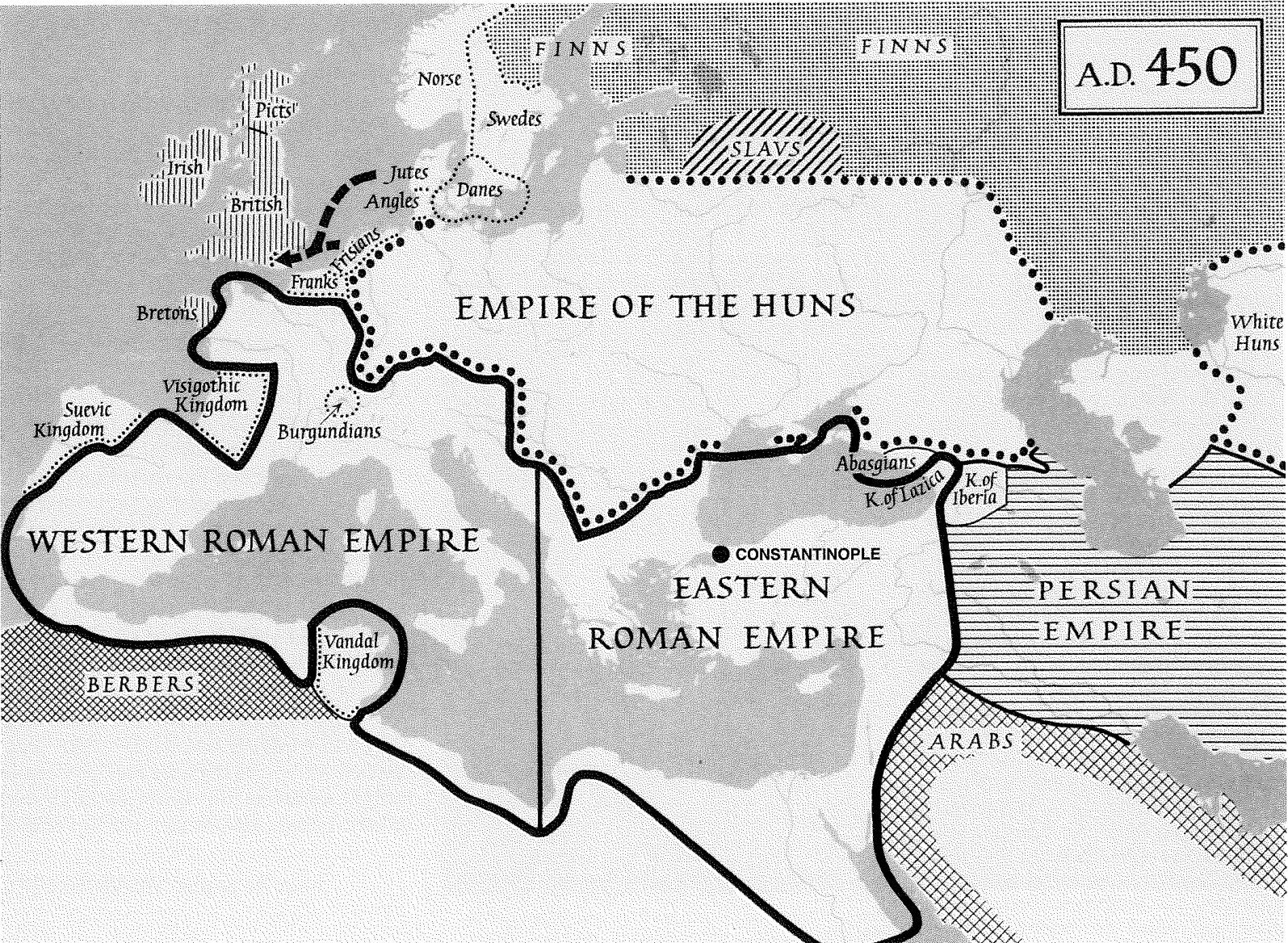
Priscus’ world, like our own, was undergoing major changes. In AD 395, the Roman Empire was partitioned between the two sons of Theodosius I. The West remained under the political and religious control of Rome, the East was ruled from Constantinople. It is no coincidence that the line of partition between the two halves of the Empire closely corresponds with the present border between Bosnia and Serbia. Constitutionally the Roman Empire remained a single entity. In practice, the richer and more secure Greek-speaking East Roman Empire or “Byzantine Empire” drifted away from the rapidly declining West.
Byzantine diplomacy has a not undeserved reputation for cunning and duplicity. Its practitioners, however, saw their calling as realpolitik, making the most effective use of scarce resources. War is an expensive and uncertain business: policy goals can often be achieved more certainly and cheaply by dissimulation, subsidies and subversion. Priscus’ mission to Attila is a good illustration of this approach.
An essential difference between late antique and modern diplomacy is that in those days there were no permanent missions. Embassies were just that, a specific mission sent from one ruler to another to convey a message or conduct negotiations. Often this involved a series of missions back and forth. With no fax, no telex and no SIGNET it was not a rapid process, but delay in itself could be an important objective.
In the mid 5th century AD the main threat to Roman security was the Huns, who had appeared on the Empire’s borders in 375. A new and fearsome people of uncertain origins — but probably of mixed Turkic and Uralic provenance — they had burst across the Volga, subjugating or driving into Roman territory the Goths and Alans. At first the Huns were more a valued source of mercenaries to the Romans than a threat, but in the mid-430s they became much more dangerous, when Rugila (and, after his overthrow, the brothers Attila and Bleda) brought all the Hunnish groups and their vassals under one control. In 444, Attila had Bleda killed and was sole ruler until his own sudden death in 453. The seat of Attila’s power lay on what is now the Hungarian plain, but his control extended down the Danube and over most of Central Europe and Ukraine.
We know surprisingly little about Attila himself; even his real name is unknown. In Gothic, the lingua franca of Hunland, Attila means “Little Father”, like Russian peasants’ nickname for the Czar. Priscus tells us that he was short, broad chested, with a flat nose, swarthy complexion and a sparse, grey-sprinkled beard. Unlike most steppe nobles his dress was clean but austere, without the usual gold ornamentation on his clothes, boots and weapons. He ate off wooden plates while his courtiers dined off gold. Other charismatic dictators such as Napoleon, Hitler and Stalin have dressed more plainly than their senior generals and civil servants. Attila’s manner was equally austere. He was aloof from his fellow tribesmen’s boisterous amusements, his manner was businesslike and, as circumstances required, he could be gracious or in a ferocious rage. In terms of family life, Attila was a serial polygamist, accumulating wives to cement alliances. He was fond of his numerous children.
Attila’s realm was multi-ethnic, an amalgam of Huns, east Germans, such as the Goths, and Alans and Sarmatians who spoke an Iranian dialect. There were not a few Romans: Pannonians from the middle Danube provinces overrun by the Huns; advisors from the Western Empire, who helped run Attila’s fledgling civil service and some who found Hunland a welcome tax haven.
Attila’s foreign policy objectives were simple: extort the maximum possible protection money from the Romans and ensure they met their payments. Over the course of 10 years Attila’s demands increased sixfold from the 350 lbs of gold (the annual salary of a Roman general, under which fiction it had been paid to his predecessor) to 2,100 lbs. While a ton of gold per year
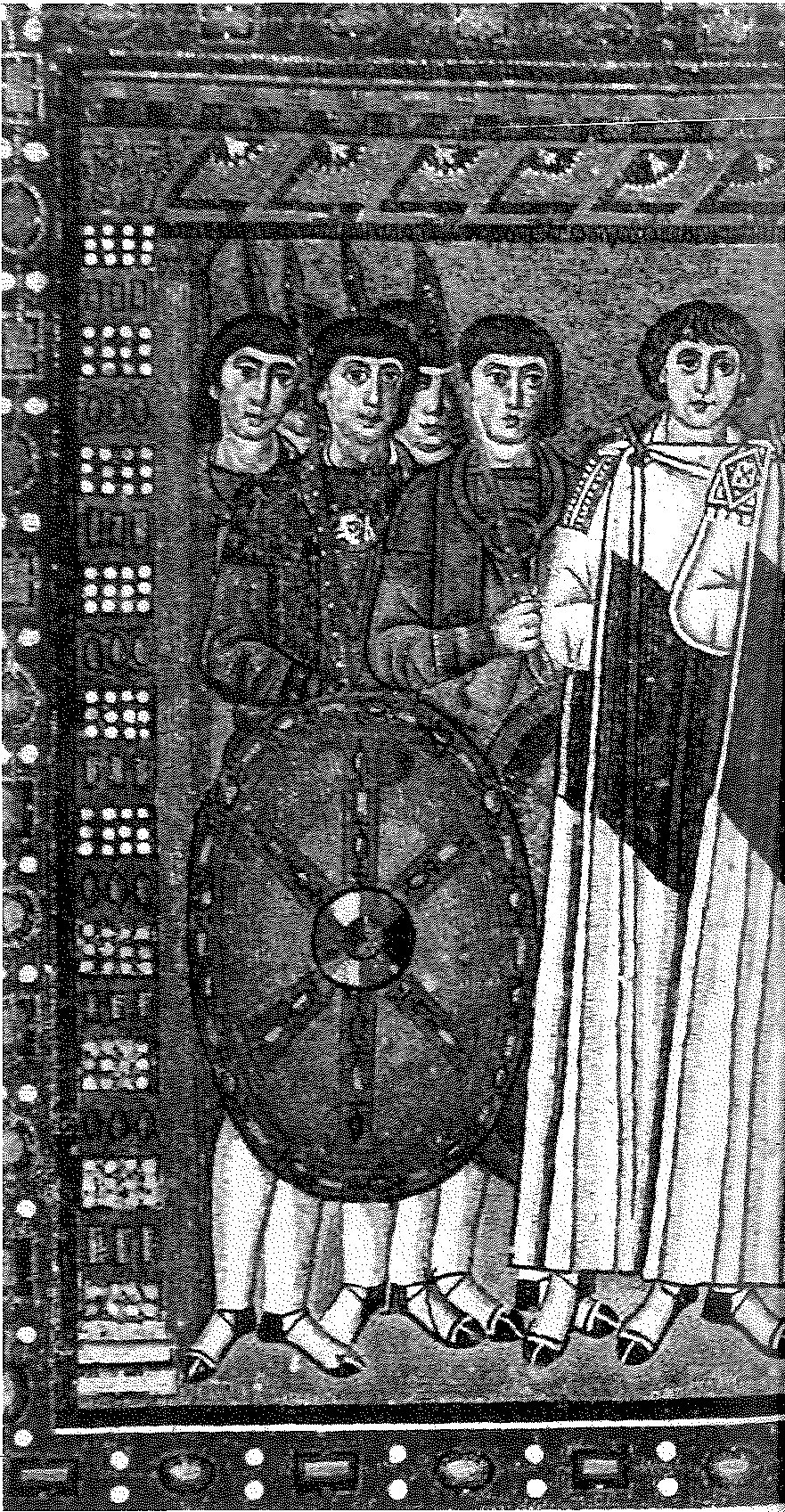
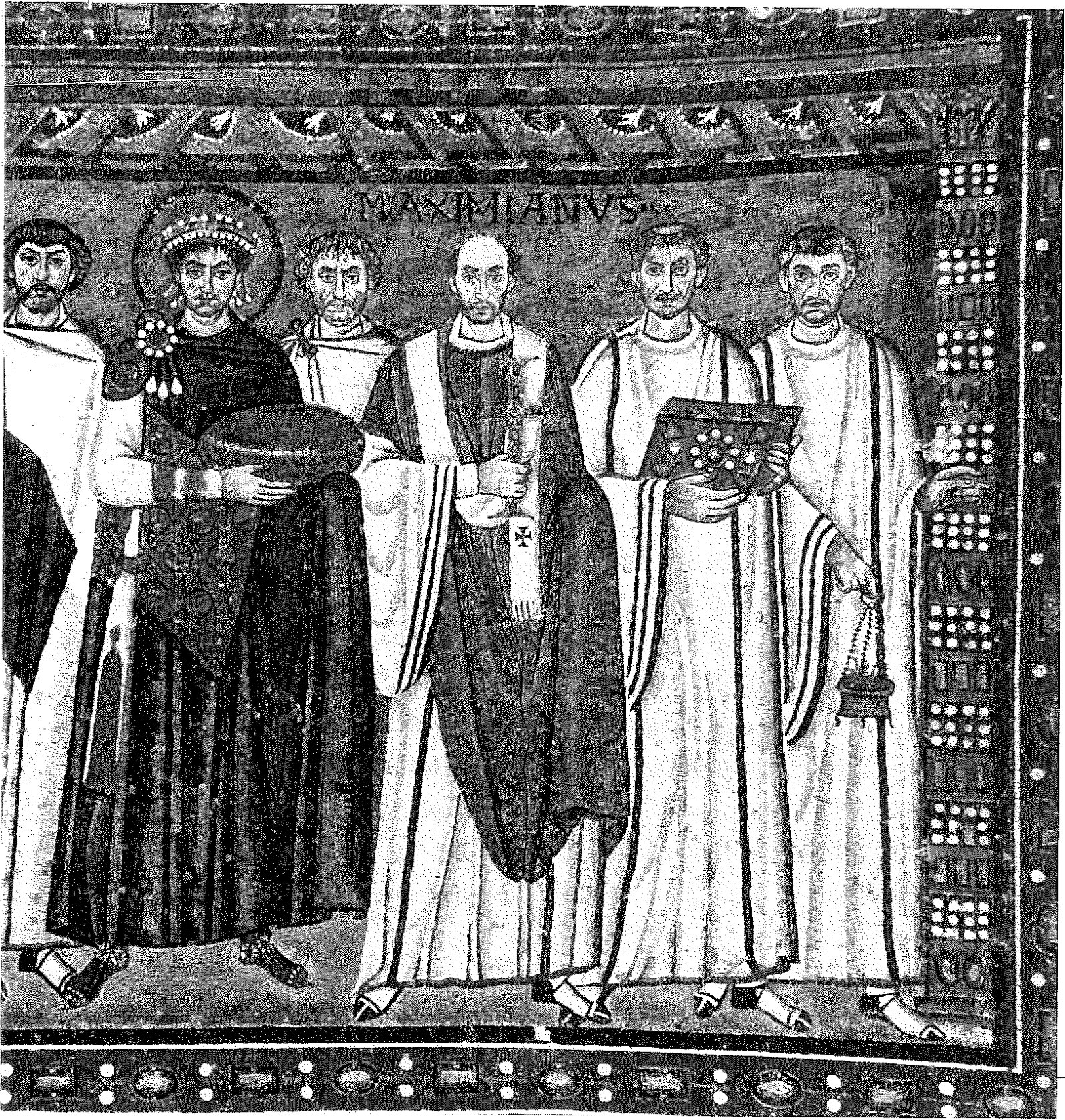
The Emperor Justinian with his retinue. seems an immense sum, many Roman senators made as much or more and, besides, its collection was by no means assured. Rome regarded its payments to barbarians as many modern states regard their UN dues — to be paid only when absolutely forced to do so. Attila also insisted that any escaped POWs who reached Roman soil be handed back or have their ransom paid. Justifiably nervous that the Romans might use them to foment trouble at home, he was also insistent that any Hun subject who sought asylum on Roman soil should be handed back.
Priscus’ mission stemmed from Attila’s claims that the Eastern Empire was not living up to the terms of the Peace Treaty of AD 447. Concluded following a series of devastating Hun attacks on the Balkans, in retaliation for the alleged pillage of Hunnish burial mounds by the bishop of Margus, the treaty required the Romans to pay 6,000 lbs in arrears and evacuate a 100 km deep strip along the lower Danube. This Security Zone was intended partially to cripple the Roman frontier defences, partially to deny easy access to Roman territory by fugitive Huns. As well the treaty also required the return of fugitives and escaped POWs.
With the treaty signed and the Huns departed, the Romans promptly began to ignore its terms. In 448, Attila sent a senior courtier, Edecho, along with his Latin Secretary Orestes to demand the Romans send a high-level delegation back to Attila’s capital to negotiate a new settlement. The Romans balked at sending the cabinet-level negotiators the Huns sought and instead selected a respected general, Maximinus, who asked Priscus to accompany him as an assistant. Meanwhile, some alternative diplomatic machinery went into action.
While waiting for the Roman delegation to assemble, Attila’s messenger Edecho was given a palace tour by Chrysaphius, the Empress’ Chamberlain. Edecho was duly impressed by the splendour he was shown.
He professed great interest when Chrysaphius suggested that he too could live in such style, were only the problem of Attila to be resolved. Edecho was an intimate of Attila, and often served as officer in charge of his bodyguard. Edecho asked for 50 lbs of gold up front to subvert Attila’s bodyguard. Its delivery would require care and discretion. Attila, concerned about such possible conflicts of interest, always quizzed returning envoys about gifts they had received, and checked their baggage to ensure they told the truth. Chrysaphius’ arrangement with Edecho was known only to the official Roman interpreter Vigilas, who was charged with ensuring Edecho got his gold. Maximinus and Priscus set forth with Edecho to Hunland unaware of this plot.
The two delegations travelled together. Relations became somewhat strained by Vigilas’ less than diplomatic behaviour. Edecho’s wounded feelings were soothed with gifts but Orestes’ suspicions were aroused. At Naissus (Nish in Serbia) on the edge of the Security Zone, they met the local Roman commander who handed over 5 of 17 fugitives requested by Attila. Priscus paints a grim picture of Naissus, ravaged by the Huns the year before. The delegations then proceeded to the Danube to be ferried across in dug-out canoes. The boatmen told them they had recently ferried a large band of Huns to the Roman side allegedly to prepare a hunting party for Attila. The Roman envoys suspected that they were actually part of a Hun military build-up should negotiations fail.
Once over in Hunland, the Romans were told to wait while Edecho went to advise Attila of their arrival. The next day they were taken to Attila’s camp where the Hunnish leaders suddenly began to interrogate them about “the real reason” for their mission. Scottas, one of Attila’s nobles, demanded that the Romans tell him what their bottom-line position was. The Romans refused, on the grounds that they had been instructed to deal directly with Attila. For the next couple of days, the Huns toyed with the Roman delegation: sending them off, then summoning them back once they had packed up and were on their way, then ordering them off again. Priscus decided it was time that he try to sort things out. With the help of Rusticius, a Roman expatriate who was a sort of resident fixer for visiting delegations, he sought out Scottas. His message was quite simple, Priscus would make it well worth Scottas’ while if the Romans could see Attila. This seems to have the desired effect. Soon after, the Romans were summoned to see Attila.
Attila was not in a happy mood. Maximinus and Priscus were still unaware of the plot to kill him, but Attila was all too aware of it, Edecho having decided to forego his gold and tell Attila after all! Attila told the Romans he would not receive any delegations until all Hun fugitives had been returned. When Vigilas protested, Attila became very angry and told him that but for his diplomatic immunity, he would have had him impaled or fed to the birds. Attila then had a list of all unaccounted for fugitives read out. He ordered Vigilas to return to Constantinople with the message that the Romans could either deliver up the fugitives or consider themselves at war with the Huns.
That tirade over, Attila became quite gracious to Maximinus and received his presents and official letters. For the next several weeks, while awaiting Vigilas’ return, the Romans followed Attila’s entourage as it meandered around the Hungarian plain, eventually arriving at Attila’s wooden capital. They were hospitably treated throughout, but they were accredited to a nomadic horde: there were no five star hotels and they had to camp out. Only when they reached Attila’s capital were they given anything resembling four walls. In the course of their peregrinations they met up with a West Roman delegation, come to appease Attila’s wrath over the conduct of one of its citizens, an officer who had been on loan to the Huns and who had absconded with some church plate that Attila felt was his rightful booty. The perpetrator was now dead, crucified by the Huns, but he had pawned the gold at a Roman bank and Attila was demanding the extradition of the Bank’s manager!
Priscus was meanwhile busily lobbying senior Hun opinion makers, including several of Attila’s wives (who were very partial to pepper and silks and other oriental luxuries) and Onegesias, one of Attila’s senior marshals. Onegesias got quite huffy when Priscus suggested that he would be well rewarded if he looked favourably at the Roman position in the next round of talks. He did however arrange another audience with Attila, and ensured the Romans were invited to his feasts. The audience made little progress. The Huns had concluded that Maximinus was not empowered to offer more than he had been instructed to. He was told to return to Constantinople, with a Hun delegation, to demand the Romans send a Ministerial level delegation. Several names were suggested; Maximinus objected that so naming them would discredit them in the Emperor’s eyes but Attila insisted. Attila’s Latin secretariat prepared letters for the delegations to deliver. Some side business was conducted. The Romans secured the release of some high ranking captives and the Huns requested that a wife of suitable rank and wealth be found for a favoured West Roman exchange officer. The departing Romans were given gifts of furs and horses, the Hun equivalent of a silver tray or Inuit sculpture.
On their return journey, the Romans were shown some examples of Hun justice at work. A spy, apprehended near the Danube was impaled. Two slaves who had killed a Hun were crucified. The accompanying Hun delegation became increasingly surly and once back in Roman territory took back their gift-horses. They met Vigilas coming the other way, back from Constantinople, but missed the denouement at Attila’s court.
Vigilas, unaware that Edecho had welched on their deal, not only had his 50 lbs of gold for Edecho, but had brought his son as well. Once in Attila’s capital he tried to dispense his gold to Attila’s bodyguard, but immediately fell afoul of an order from Attila that Roman delegations must confine their expenditures to basic necessities. The KGB could not have done it better. Compromised, Vigilas was confronted by Attila, who threatened to kill his son unless he revealed all. Vigilas did, putting the blame on Chrysaphius. Attila now wanted Chrysaphius’ head. He agreed to spare Vigilas’ life, but demanded an extra 50 lbs of gold from him.
In the end Chrysaphius’ life was spared. The Romans agreed to send the two senior negotiators Attila had requested. They succeeded in mollifying his demands, and even secured the return of the Security Zone to Roman control, on the understanding that no more Hun fugitives would be granted asylum. These terms seem very mild, but Attila’s attention was turning to the West.
The quarrel over the absconded church plate escalated into full scale war. For the next few years the Huns were preoccupied with futile attacks on the Western Empire. The year after that Attila was dead, carried off by a stroke on yet another of his marriage beds. His many sons fell to quarrelling over their inheritance, the Huns’ German subjects rebelled and the Hunnish realm collapsed. The Romans refortified the Danube line and returned to their tried and true ways of playing off one barbarian tribe against another.
At first sight Priscus’ mission does not seem to be a resounding success, but its main objective was damage control, stalling for time. The endless shuttling back and forth put off the day the Romans would actually have to meet Attila’s demands in full. By sending an insufficiently senior envoy, the Romans injected several more months of delay into the process. In all, while in itself it accomplished little, the mission was a success.
Priscus himself showed superior initiative, perseverance and performance under pressure. He demonstrated good advocacy skills, used his hospitality allowance well and showed a high degree of cross-cultural sensitivity. His reporting, if long winded, shows he was a sensitive observer with good analytical skills. Vigilas’ appraisal would have been less than fully satisfactory. He showed major weaknesses in judgement, discretion and interpersonal relations. While he showed considerable initiative, it was the wrong kind. The lack of serious retribution for the plot to assassinate Attila seems surprising, perhaps it was so amateurish that Attila never took it seriously.
View the original scanned pages →
Originally published in bout de papier, Vol. 13, No. 3 (1996) — Fall 1996 // Automne 1996, pp. 24–27. Read the rest of this issue →



