
bout de papier, Vol. 15, No. 4 (1998-1999) — Winter 1998/99 // Hiver 1998/99, pp. 46–48
In the last year of the millennium, diplomats awoke to the existence of a vast plot against them. Years of dire personal experience and high-profile disaster — the Pineapple and Fungus Soup or Second Xian Incident (1982), the Chocolate-covered Chitlins Affair (Little Rock, 1989), the “Edible Granite” Pandemic of 1995/6 — should have set off warning bells. But the penny didn’t drop until the Foreign Minister of a certain G-8 power toppled lifeless into his bowl of comidamuerte (Iguana Soufflé with Puréed Raw Sea Urchin) at a local cultures festival while visiting a supposedly friendly country. Then it became clear that diplomats worldwide were being targeted for death through forced ingestion (how could one refuse without displaying either abject cowardice or total lack of savoir faire) of so-called regional specialties — “food” so absurdly concocted and insidiously destructive as to leave the local citizenry gasping at the thought that visiting dignitaries could believe anyone ate that stuff, and visiting dignitaries gasping at the fact that they had just done so.
In sheer self-protection, foreign ministries mandated their arms controllers to down tools on such distinctly secondary areas as nuclear, biological and chemical weapons and sit down with assembled chefs de protocol to conclude an international ban on this new threat to global security. So was born the conference on Simultaneous Trans- Regional Abolition of Terminally Egregious and Gratuitously Inedible Cuisine. The Centre was chosen to provide security for this STRATEGIC conference, under the onsite control of Felix Africa and Inspector Wa. But their best efforts could not prevent regional cuisine from claiming another victim before the conference concluded. Given the baffling nature of the crime, LDC Liebnitz was called to the scene.
Felix conducted the ace logician to a small private dining room off the main conference hall. “It was an unusual meal,” he eagerly explained. “Negotiators have been deadlocked for a week over three technical definitions: ’ghastly’, ’odious’ and “stomach-churning’. The main obstacle was an NGO delegate, Sergei O’Tomsk of the Brotherhood for Organic Warfare and Extemporaneous Lawlessness, a movement closely associated with regional cuisine. This working dinner, hosted by O’Tomsk for six progressive delegates, was to resolve the situation. O’Tomsk insisted that the meal be entirely regional cuisine. Knowing that the Brotherhood specialized in assassination through enhanced food toxins, the guests insisted on giving themselves a sporting chance through access to antidotes. The usual saw-off took place.”
«The table was set with seven dishes of food, each containing two helpings only. On a sideboard were 14 unmarked glasses, two doses of each of seven powerful antidotes. The meal progressed as follows. At exactly 7:00pm, each diner (including O’Tomsk) bolted down one helping chosen from each of two different dishes out of the seven. At 7:05pm, the waiter served each of the diners one of the glasses and at 7:10pm, the waiter served a second glass to each diner. The list of toxins and antidotes was known, but only the waiter knew which toxin was in which dish and which antidote was in which glasses. In any event, by 7:20pm, O’Tomsk was dead.”
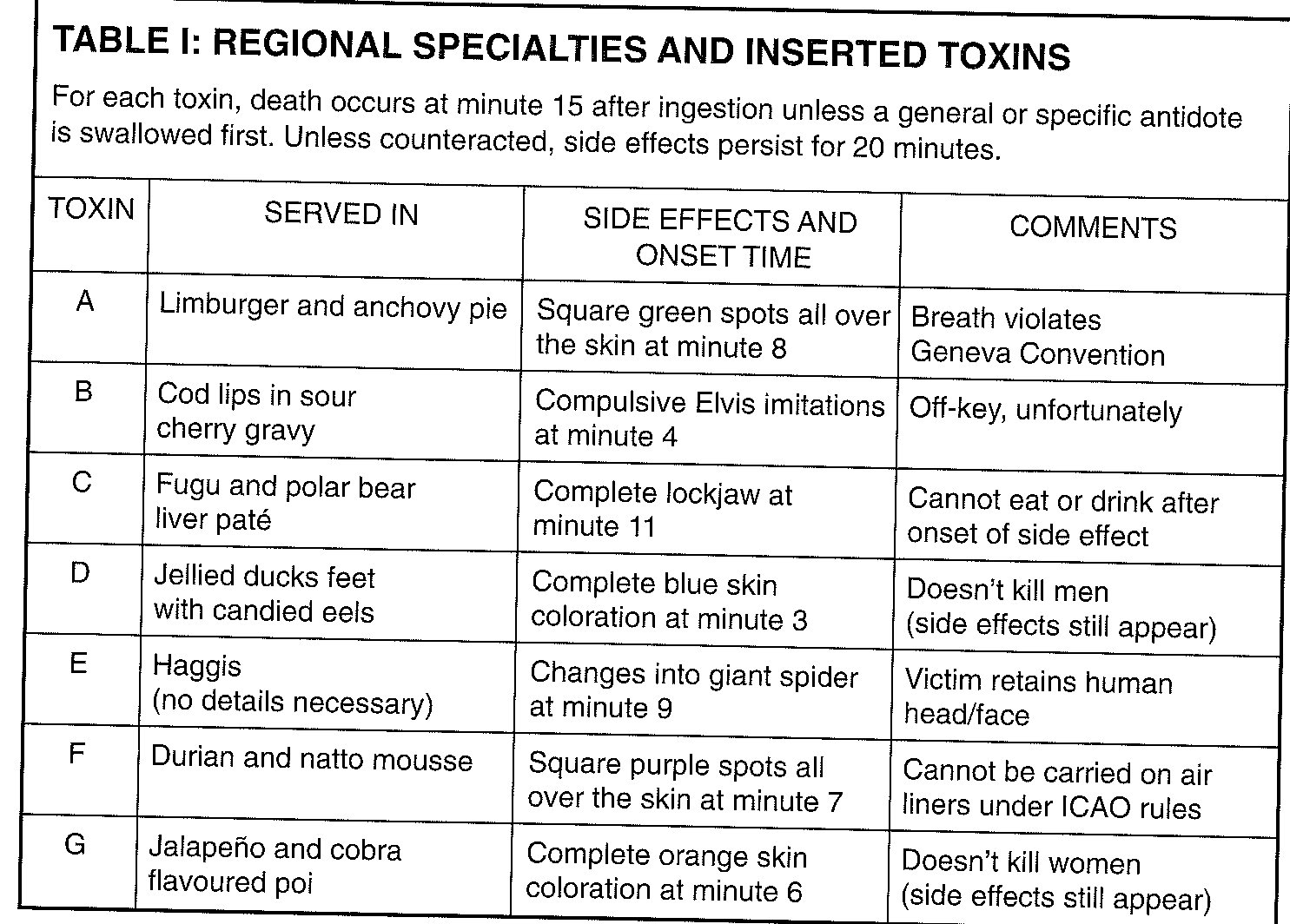
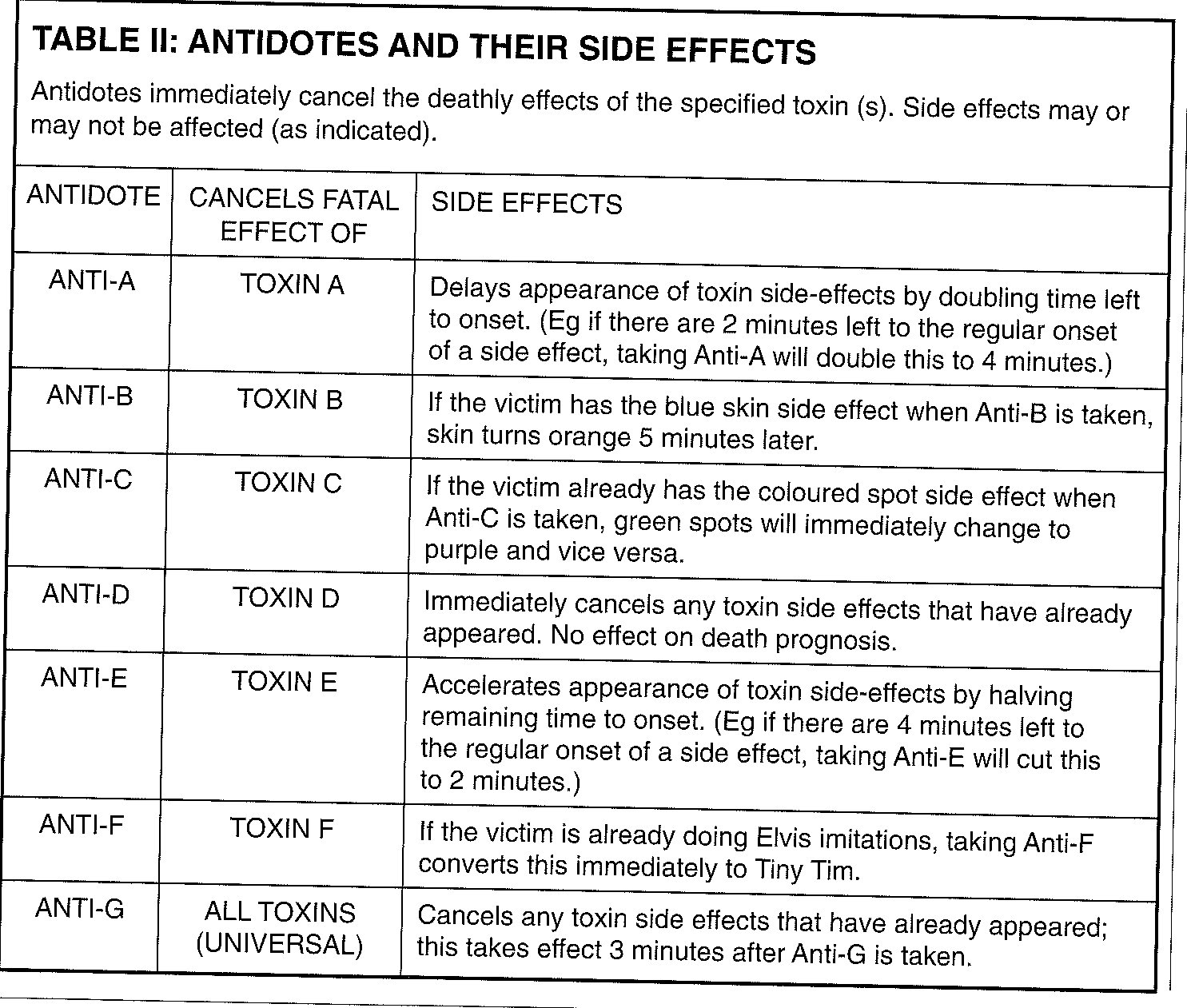
Felix concluded by presenting Liebnitz. with two charts (Tables I and II) which provided details of the toxins, antidotes and respective side-effects. Inspector Wa then urgently took up the tale. “As part of the arrangements for dinner, security cameras were set up. Given Program Review, there was only enough money for 5-second clips every three minutes starting 30 seconds after initial ingestion. By agreement, the images were distorted to obscure identities, but side-effects of the toxins and antidotes were clear and are all noted.” So saying, he handed Liebnitz this summary:
#1 (starts at 7:03:30): two figures with blue skin, five normal.
#2 (7:06:30): one figure with blue skin, one figure with purple spots, two figures with orange skin (including a Tiny Tim impersonator), one Elvis impersonator, two normal #3 (7:09:30): two giant spiders (one doing an Elvis impersonation), one figure with blue skin, one figure with purple spots and clear lockjaw, one Tiny Tim impersonator with orange skin, one figure with orange skin and purple spots, one normal #4 (7:12:30): one Elvis-impersonating spider and one Tiny Tim impersonator with orange skin (in a duet of “Tip-toe Through the Tulips in My Blue Suede Shoes”), one spider swinging from the chandelier, three figures with green spots (including one with blue skin and one with orange skin), one figure with purple spots and clear lockjaw #5 (7:15:30): one Elvis-impersonating spider (singing “Hound Dog”), three figures with green spots (including two with orange skin), one figure (sprawled motionless across the table) with purple spots and the rictus of advanced lockjaw, two normals.
After a few minutes, the Inspector pressed on. “What O’Tomsk didn’t know was that each of the guests had lost a close friend or relative to one of BOWEL’s infamous slime-mould pirogues. The six were Mr Crispin Hallows-Barking (UK), Mrs Roberta McKenzie (Canada), Sr Habañero Picante (Argentina), Mr C. Oscar Yee (China), Mr Max-Johann Gödel (South Africa) and Ms Mariko Mitsuhama (Japan). The waiter, Igor, admits he was hired by one of the guests to kill O’Tomsk with his own regional cuisine, but refuses to say which guest or just how the murder was done. The guests have all provided hints as to which one hired Igor, but the hints are contradictory, as you can see from the following compendium of testimony.” With that, Wa gleefully scaled another sheet onto the growing pile in front of Liebnitz:
McKenzie: (1) I did not hire the killer. (2) The hirer is a man. (3) The hirer is from a Eurasian state. (4) I am the orange-skinned Tiny Tim impersonator in video 2. Mitsuhama: (1) I didn’t hire the killer. (2) The hirer is from an Asian state. (3) The hirer is from an APEC state. (4) I’m the one with green-spotted orange skin in video 4. Gödel: (1) I did not hire the killer. (2) The hirer is a woman. (3) The hirer is from a state in the Americas. (4) I am the non-singing spider in video 4.
Picante: (1) I did not hire the killer. (2) The hirer is from an African state. (3) The hirer is from a G-8 state. (4) I am the only normal person in video 3 Hallows-Barking: (1) I didn’t hire the killer. (2) The hirer is from a Southern Hemisphere state. (3) The hirer is not from a Commonwealth state. (4) I’m the spider Elvis in video 3.
Yee: (1) I did not hire the killer. (2) The hirer is from a Northern Hemisphere state. (3) The hirer is from a European state. (4) I am the blue-faced person in video 2. Igor: (1) O’Tomsk told me ahead of time what he would eat. (2) He also said that he had a dose of universal antidote in his suit, which he would slip into his 7:10 round. (3) One guest paid me to kill O’Tomsk, so I used the antidotes in the glasses to do so. (4) In the 7:05 round, I gave the same antidote to O’Tomsk as to the Englishman.
“Using our new voice-stress veracity evaluator” Africa interjected, “we analyzed the original recordings of the 28 statements on the compendium and found that no guest was completely truthful. There were exactly six lies in the testimony, the rest being true statements. But the evaluator doesn’t tell us which are which.”
Finally, the two expositors ran out of breath simultaneously. Taking advantage of the pause, Liebnitz smiled. “I’m glad to see you have done so much work on the case, but I also see your problem — you have too much information in too many formats. Still, I think we can sort it out. We need answers to two questions. First, who hired the loyal Igor to kill O’Tomsk? That can be worked out from the testimony and from the results of the veracity evaluator. The second question — how O’Tomsk was killed — is a bit more complicated, but not impossible. Using the two tables, we can work out the sequence of dishes and antidotes necessary to produce the results on the videos — including the fact that everyone but the host survived Then we’ll use the statements from the testimony to link the figures on the videos to specific diners. From that we should be able to determine just what killed O’Tomsk.”
Good as his word, Liebnitz was soon able to provide answers to the two questions. Although the hirer was covered by diplomatic immunity (to say nothing of a general approval of Sergei’s death by regional cuisine), the STRATEGIC conference was able to move forward As the security team passed the door to the conference hall, they heard a Slavic delegate formally registering the ingredients of another ghastly delicacy, a pemmican composed of pounded insects, currants and tree bark: “Weevil berry yew!” Felix wondered briefly why the portly, balding delegate was pounding the podium with a shoe as he bout de papier Vol. spoke, but shrugged and put it down to diplomatic tradition.
Can you duplicate the ace logician’s feat by naming the hirer and the means by which O’Tomsk was killed? bout de papier will present a book prize to two winners, one for the answer to each question (so part-answers have a chance). Winners will be decided by drawing from a box containing all correct entries received by April 30, 1999.
Belated season’s greetings from one and all. Liebnitz was visited on Christmas Eve by Marley’s ghost, who offered him a hit of ganja and views on the future of reggae. The Rajah and Ranee of Suwani (aka Dryan Tweedie and Mabel Stanley) held a vast New Years’ party to announce both the birth of their first child and plans for bringing New Wave Rock to the sultanate. Felix and Inspector Wa set up housekeeping together. Chief MacBannoch spent a week lost in the highland village of Dramboggle (which has a population of five but three distilleries). Rialto Sleazewagon and Papa Jack Paridy schemed on. And freelance prestidigitator A Aalto put his feet up with Mrs Aalto and shared warmth against the icy winds.
View the original scanned pages →
Originally published in bout de papier, Vol. 15, No. 4 (1998-1999) — Winter 1998/99 // Hiver 1998/99, pp. 46–48. Read the rest of this issue →



