bout de papier, Vol. 15, No. 4 (1998-1999) — Winter 1998/99 // Hiver 1998/99, pp. 23–25
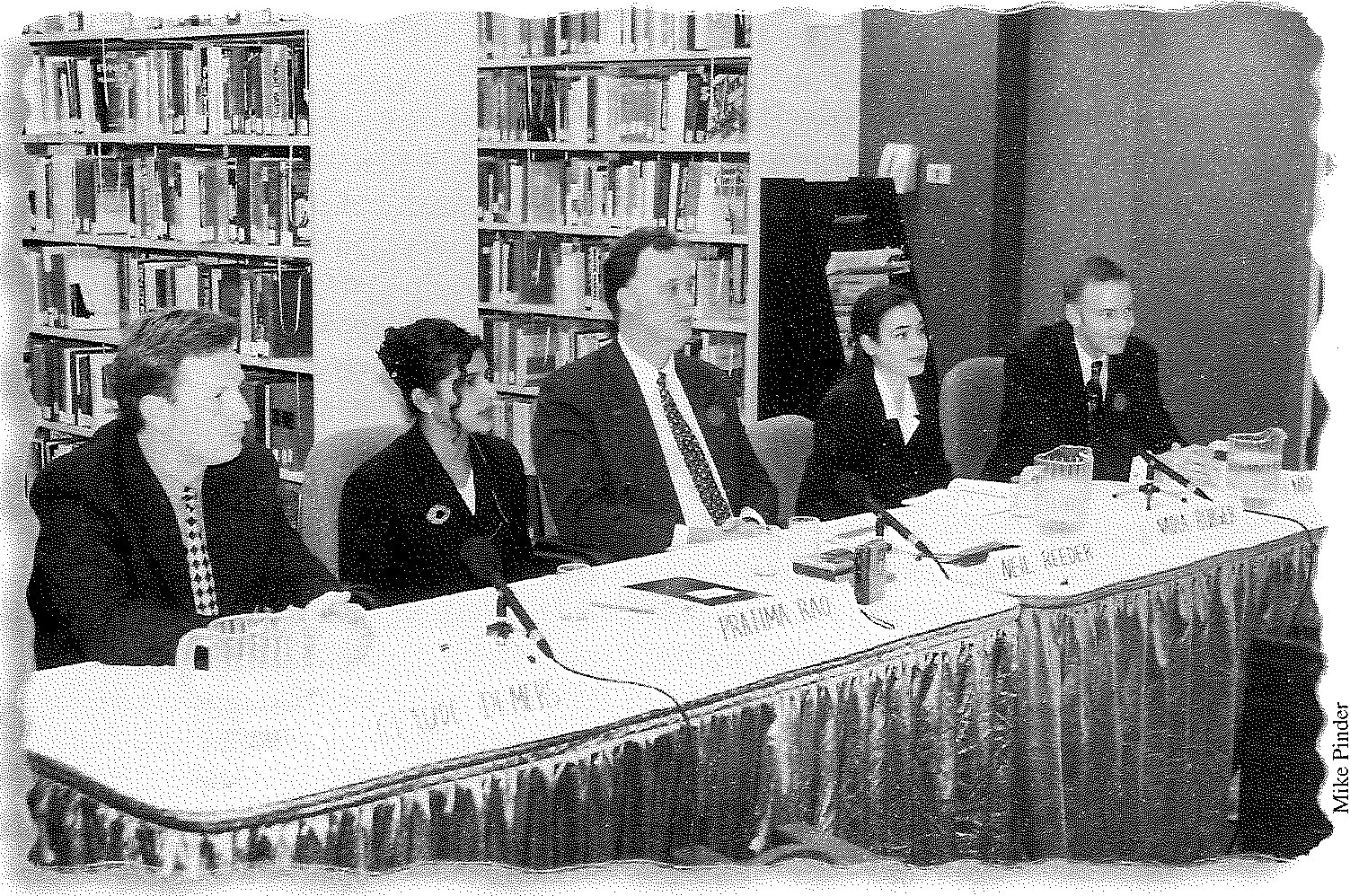
On November 2, DFAIT held its first Open House to celebrate the 25th anniversary of the Lester B. Pearson Building. This event was meant to increase public awareness of the work and accomplishments of DFAIT and to make the Department more open and accessible to the public. As part of the Open House, a roundtable discussion for media was organized featuring newly-recruited FS and former Heads of Mission, who had the opportunity to discuss their experiences with DFAIT.
Following is a summary of the discussions at the roundtable featuring newly-recruited FS. Panelists included Nadia Burger (CPP), Claude Demers (BCM), Pratima Rao (JLOA) and Mark Scullion (TSME). The moderator was Neil Reeder, Director of BCM and bout de papier editor. In our next issue, we will feature a summary of the discussions among the former Heads of Mission.
Moderator: Let me first ask each FS panelist to introduce themselves before we take questions.
Nadia Burger: Bonjour, mon nom est Nadia Burger. J’ai intégré le Service extérieur depuis juin et je travaille présentement à la direction de la planification des politiques. Mon intérêt et ma passion envers les affaires internationales remontent à mes premières années à l’université. J’ai fait un BAC en science politique à l’Université McGill et une maîtrise en relations internationales à l’Institut des hautes études internationales à Genève. Ensuite, j’ai mis la théorie en pratique en travaillant à contrat dans la section des affaires publiques de l’Ambassade du Canada à Hanoi de 1995 à 1997. J’ai tellement aimé mon travail que je suis revenue au Canada et j’ai continué au ministère dans la direction des stratégies de communication, toujours à contrat, de 1997 à 1998. A ce moment, j’étais convaincue de vouloir faire une carrière dans le service extérieur du Canada. Et me voilà!
Mark Scullion: I was a so-called “young entrepreneur” before coming to the Department. Along with my business partners, my parents, I co-founded and managed a country inn in the Upper Pontiac region of the Outaouais. Prior to that, I completed an MBA in International Business at McGill with a semester spent studying International Marketing at Thamassat University in Bangkok. In the early ’90s, I acted as the Coordinator of International Relations for the City of Itabashi, Tokyo. My undergraduate degree is in International Relations and Japanese Studies from Trinity College, Toronto. I am now working in the Export Services for Small and Medium-sized Enterprises Division, working to promote the international trade efforts of SMEs. I’m working specifically with young entrepreneurs, helping them to gain a “leg up” in the world of international business.
Pratima Rao: My name is Pratima Rao, and I work in the Legal Division. I have a B.A (in economics), and a law degree from the University of Alberta — where I also started a Masters in international relations, which I am completing here at Carleton University.
In terms of work with Foreign Affairs I have had one temporary posting — last year in New York at the United Nations during the General Assembly. Previously I worked in what was formerly the Energy and Nuclear Affairs Division. Before going to the UN I did French training with the Department. I also had the opportunity to go on a cross-Canada tour as part of our professional training.
Before I started in Foreign Affairs I was a researcher and writer in the Faculty of Law at the University of Alberta, and prior to that I was a social planner with the Edmonton Social Planning Council. Previously I had worked in bond trading and commodities trading at a large brokerage firm in Vancouver.
So I have a rather mixed background: economics, sociology, law, and political science — and I think Foreign Affairs is a place where all of those educational as well as employment experiences potentially can be brought together.
Claude Demers: Bonjour, mon nom est Claude Demers. Je suis originaire de Trois- Rivières. Après avoir complété des études en droit civil et en common law à l’université McGill, j’ai pratiqué le droit commercial et corporatif à Montréal pendant quelques années. Suite à cette expérience j’ai décidé de réorienter ma carrière. J’ai donc complété une maîtrise en relations internationales à l’Université Columbia à New York, après quoi je me suis joint au service extérieur, au mois d’août dernier. Je travaille présentement au Service des relations avec les média. C’est un domaine tout nouveau pour moi et je m’y plais beaucoup.
Moderator: I will now ask the panel to comment briefly on their experiences in the FS selection process — the whole examination process — which is quite unique to the Foreign Service, and then they might touch upon their interests in terms of their first postings and what kind of career aspirations they have.
Nadia Burger: Oui, merci. Je pense que le processus de sélection pour le service extérieur n’est pas un processus facile en termes de temps et d’énergie. On doit beaucoup s’impliquer à plusieurs niveaux.
Il faut passer un examen de connaissances générales, ensuite une entrevue, des examens médicaux, et obtenir une cote de sécurité. Mais c’est un processus qui en vaut la peine à comparer à ce qu’on peut en retirer comme carrière. Je conseillerais fortement à tous les gens qui ont un intérêt envers les affaires étrangères de aussi tenter leur chance.
En termes d’aspirations, il m’est difficile d’être précise à ce stade. Je viens d’intégrer le service extérieur depuis juin et j’ai plusieurs intérêts, peut-être même trop. Quant à ma première affectation officielle à l’étranger, je crois que je serai plus en mesure de vous donner des détails dans quelques mois, après avoir réfléchi plus longuement à cette question.
: Mark Scullion: Oui, comme Nadia dit, c’est un processus assez long et assez dur. I wrote the Foreign Service exam at the Canadian Consulate in Boston. I happened to be there one weekend to attend a Career Forum for Japanese companies looking to hire Japanese-speaking North American
* graduates. It was a much smaller environment at the Consulate in which to write s the exam — maybe that had something to do with my success. We were put
* through an extensive series of written exams, interviews, medical checks, language tests, and security clearances over the better part of a year. There isn’t a lot of feedback from the Department throughout this exercise, so often you’re left wondering whether or not to look a bit closer at the private sector.
In terms of my opportunities within the Department, I am quite happy being involved with the trade efforts of SMEs. It is a relatively new division and receives a good deal of attention from the Minister. We’re a team of six in the division and work very well together. It’s rather satisfying helping small businesses acquire the necessary direction in terms of exporting their products or services abroad.
My expertise, however, is really within the sphere of Japan. My ability to speak Japanese quite fluently no doubt helped my attempts at becoming a Foreign Service officer. I hope to eventually be posted to Japan, to work either at the Embassy or one of the Consulates promoting trade to that country.
Pratima Rao: I agree with the other two when they say the process was long and hard, but I think that I knew at the time. I wrote the FS exam twice in fact. The first time I wrote it, I wasn’t really sure what it would entail. Coming from the West, you’re not really sure of what foreign affairs really does. After having done okay on the exam the first time, but not having had an interview, I wrote it again, and I was successful. I had the seeds planted in my head that this is what I wanted to do after I learned about the scope and nature of the job.
In terms of future aspirations, I mentioned that I was at the UN last year, I think I would someday like to work at another multilateral post. I think that if I go on a posting next year, Canada will still be part of the Security Council and it would be a very interesting time to be at the UN.
Currently, I am articling with the Department too, so there are opportunities to work in international law and get called to the bar in Ontario — something which I hadn’t done before.
Claude Demers: Well, the selection process was pretty much the same for me. I wrote the exam in New York, and I spent quite a bit of time preparing for it. It is a protracted process and it is highly selective so you are very nervous at times because there are not that many outlets for people to work as diplomats. You basically have to work for Foreign Affairs, so if that is what you are really gunning for it makes you very nervous to have to wait this long.
As for any future plans, mon intérêt premier est pour l’Europe, ma maîtrise ayant porté sur la politique européenne. Je m’intéresse également aux grands dossiers de commerce international. J’aimerais éventuellement pouvoir combiner ma formation et mon expérience en droit avec mon intérêt pour les relations internationales et le commerce international — ça pourrait se faire, par exemple, dans le cadre de négociations de traités commerciaux.
Q. Mr. Scullion, what was the other job that you were looking for in Boston?
Mark Scullion: I interviewed with companies such as Goldman Sachs Japan, Ernst & Young, and Anderson Consulting. I suppose, though, that my heart was set on a career with the Foreign Service.
Q. Was this a second choice?
Mark Scullion: Oh there was no second choice, there was no question in my mind where I wanted to go. Et voilà, here I am. I consider myself very fortunate that things worked out as I had hoped they would.
Q. Has it become a requirement to work overseas and try to get in the Foreign Service that way?
Moderator: No, I would say not, but that kind of experience is obviously an asset. The cutoff point remains the ability to get through the examination process and also to have the basic requirements which are now, I understand, a hard language, masters level degree and such.
In the old days for people like myself or our colleagues from the previous panel, the benchmarks were a little different than they are now.
You will notice if you look at the diplomatic appointments over the last five or ten years, often you will have heads of mission who have BAs for example.
Nowadays the entry level qualification is the masters level. Obviously the experience overseas helps, but primarily the recruitment process is driven by benchmarks such as the exam, the interviews and that sort of thing.
Nadia Burger: Seeking experience overseas is also a good way to find out if you would really enjoy a career in the Foreign Service. It helps you identify if you want to live abroad, if you enjoy being in an environment where living conditions are more difficult than what you are used to, and so on. So it is very useful in that sense.
Q. Can I pose the question that was put the earlier panel about morale? Do you find the morale low? Do you find there are problems there? There has been quite a lot in the Ottawa Citizen about Ms Galtieri and the case that she has brought. That doesn’t concern you so much as expenses abroad and things like that but I mean it gives a general image outside that things are rather, you know, faltering here. Do you find that?
Claude Demers: Well morale among the recruits is still very high, but we are aware of the various reports in the press and amongst older colleagues about the situation and the rate of attrition.
All I can say is that as far as I am concerned, this is what I was really aiming for. I may find some aspects of the job less pleasurable than others, but you have to look at the whole package; there are no other jobs today, very few other jobs today, that offer the chance to represent your country abroad and live in foreign countries and participate in international politics.
Q. One of the complaints that I had heard was because of budget cuts there had been downsizing in clerical jobs and that Foreign Service officers were doing more of this work than they used to do.
Is that a matter of concern or not?
Mark Scullion: Well, of course, we didn’t have Microsoft office and JetForm, you know 10, 15 years ago so it is much easier I think today for those of us to get certain jobs done with fewer human resources. I mean there is that to be considered. I don’t know that any of us are overly burdened with tasks that we might otherwise have someone else do.
That is just part of the new reality of the workplace.
Moderator: I think e-mail, for example, has greatly facilitated the work that we do. It has just eliminated paper and drudgery and that kind of work is just done electronically. It has basically become an e-mail culture in the Department and that saves a lot of time and energy. We can communicate with Kinshasa in the space of three or four seconds without the telegram that used to be typed up manually: our colleagues will recall those days. We are far beyond that now and it has made transmission of information, our stock in trade, much easier.
Q. I guess to follow the question is whether the officers who were typing did that themselves or did somebody else do it?
A. We do our own.
Q. My question is you all have other opportunities in terms of financial remuneration. So you have no qualms coming into the Department at the salary that you are coming with, contrary to the reports.
Nadia Burger: As Claude has mentioned before, I think doing a job we have a passion for is the best salary we can have. Of course, we need to earn money to be able to function these days, but we are very lucky to do a job that we enjoy. In my opinion, that is a great consideration when it comes to making life and career choices.
Claude Demers: I mean let’s not pretend that we wouldn’t like to make more money. I think we would all like to make more money. But I think that we are looking at more than just the money. As far as I am concerned this was a career move and I could be somewhere else. It was definitely something that I wanted as a job, and as for the rest, well there are things that I have to live with and I gladly do so because I am allowed to do something I like.
Moderator: I might just add that there is now an accelerated management trainee program which will allow mobility for the new recruits. Within five years they will go to the second grade in the Foreign Service automatically.
That has been one way through the human resources policy of the Department that we allow for a faster transition to better pay and broader pay scales, which the new recruits will now benefit from. It is something that will address some of those concerns.
Q. I have a question for Miss Rao — not to pick on you, but the taxpayers may argue with your articling position here. They are going to teach you another language also from what I gathered. What guarantee is there that you are not going to move on?
Pratima Rao: There is no guarantee that I won’t move on in the future, but since I have been here, the experience has been one where I have learned a language, have had the opportunity to work with amazing people at the UN, and have had the chance to work on interesting international legal issues. The whole experience has been very value-added for me and I have been enriched by it. I don’t see that changing since I believe I can learn and grow with foreign affairs. Until such time as I don’t find myself being enriched by the process, I don’t think I could comment on whether it is a temporary or permanent career.
Moderator: You see we want the best people we can get, but also make them even better and part of that is second language training, French language training for people who work overseas, and if we can provide opportunities for lawyers in this department all the better.
Our previous panel (former HOMs) had several lawyers. Obviously the nuts and bolts of international relations come down to things like the international criminal court, Law of the Sea, those kinds of issues we deal with which are vital. So obviously a legal fraternity in foreign affairs is very important to the bigger picture.
Q. In your process of going through recruitment, were there mentors? Was there anyone to turn to? Was there anything? Would you have preferred to have a certain mentor to help you along the system?
Claude Demers: There is a wealth of information out there that is available for applicants to consult and learn about and then prepare for the exams. It is highly selective, so you have to do it on your own and put in the hours and prepare for it. As for a mentor, there were people that we could speak to to know what stage of the process we were at.
Yes, there were people we could call and find out about where we were, and how things stood, more or less and that is to be expected, I guess, from the Department.
Unidentified speaker: I could add one thing. I think in the exam process, I mean you can improve by having maybe written the exam once and then doing it again. But really, I think what distinguishes the people that get hired or not is the interview process, and it is really hard to gauge to know what they are looking for other than being polite, being responsive, flexible, showing adaptability, these sorts of generic, general qualifications and characteristics of a person, but I think there are some people that have written and done the exam and maybe been interviewed three or four times and they haven’t been hired because maybe there is something fundamentally that they haven’t achieved or obtained in their interview process.
I mean other people can go through the first time. So it’s really hard to tell what they are looking for in the interviewing panel.
Moderator: I should say it is a sign of the times that we still had 5,000 people write the Foreign Service exam this year to recruit
60. And another sign of the times is that there are companies where you can be trained and primed and prompted for the exam process — firms that give seminars before the exam is written to help people prepare, a bit like the LSAT for the law school entrance process. It is quite interesting to see how there is an industry being set up to get people ready to write the Foreign Service exam.
View the original scanned pages / Voir les pages numérisées →
Originally published in / Publié à l’origine dans bout de papier, Vol. 15, No. 4 (1998-1999) — Winter 1998/99 // Hiver 1998/99, pp. 23–25. Read the rest of this issue / Lire le reste de ce numéro →