
bout de papier, Vol. 15, No. 4 (1998-1999) — Winter 1998/99 // Hiver 1998/99, pp. 5–6
In the early 1980s as a junior political officer I was posted to Bangkok, Thailand. The Southeast Asian wars had ended less than a decade earlier, although the horrors of the Cambodian genocide were still vivid. Cold War geostrategists had imposed a realpolitik interpretation of the Vietnamese intervention which required the effective rehabilitation the Khmer Rouge under the veneer of an opposition “democratic” coalition. The historical setting was extraordinary, and rendered my perceptions of the culture, landscapes and people all the more poignant.
I had a few days of overlap with my predecessor, and on the first day after arriving was taken by he and our locally-engaged consular assistant to visit the former capital of Ayuthaya, sacked by Burmese in the 18th century and lying in a splendid state of ruin about 50 km up the Chao Prhya river from Bangkok. En route to the site I was struck by the density of the traffic, the congestion and the air pollution. I recall with particular clarity my amazement and shock to discover that the major intersections in Bangkok had been transformed into places of commerce, with children cleaning windshields for a few baht and hawking snacks, garlands, and newspapers. In some neighbourhoods, the kids, too, were for sale.
As we cleared the sprawling suburbs, I remember thinking about the hazards of trying to make a meagre living among the careening cars, trucks, busses and, especially, the noxious fumes. Wasn’t it fortunate, I mused, that standards of public health and social service in Canada were such that I would never see Canadian children working the streets. This could never happen to us.
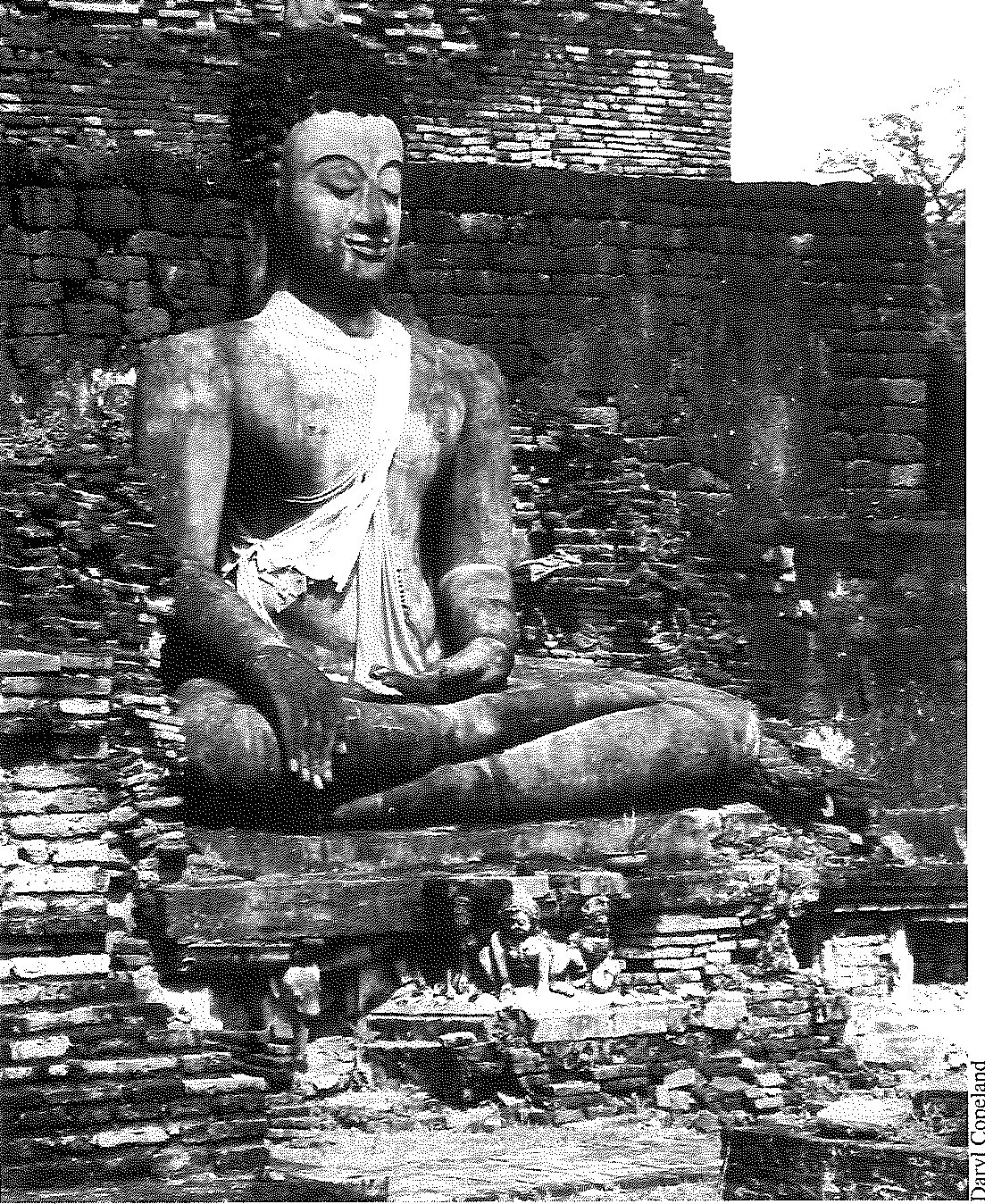
In about an hour we arrived at the first stop, a magnificent temple featuring a giant reclining Buddha. To my surprise, our Thai colleague stopped at a vendor’s stall along the path and came back with a small bird in a bamboo cage. She walked to the riverbank, opened the gate of the cage and freed the bird. I thought this curious, enquired, and was provided a brief explanation of the significance in Buddhist religious practice of making merit.
A few moments later a tall, slightly scruffy looking male visitor, perhaps German or Dutch, who had been watching the proceedings from a distance approached the vendor and also bought a caged bird An obvious novice, slightly awkward, he seemed to want to be accepted, and to do the right thing. But after a few tries, he was still fumbling, somewhat clumsily, with the clasp, beginning to draw a crowd, trying hard but never quite managing to get the cage open. The episode was beginning to take on the qualities of a minor spectacle.
Losing patience, in embarrassed desperation he tried to force the latch, but instead of opening the door, the entire edifice burst apart, and was in a moment transformed into a splinter cloud of bamboo shards. I noticed, with some relief, that the bird had escaped. But to my astonishment, it circled in a wide arc and then flew back to the vendor. It was promptly returned to the larger cage for resale.
And the hapless foreign visitor was charged extra for breakage.
Hmmm…
On that sun-drenched, frangipani-scented, saffron-tinged morning, the importance of symbols, gestures, context and dimensions of experience came into slightly sharper relief. I began to realize that I was in a very different, and, in all respects, very distant place, where everything was not as it seemed, and where much occurred at levels other than the obvious. It was dawning on me that there was going to be a distinction between living somewhere and just passing through. Whatever fragments of insight I had picked up in several years of backpack travel, not to mention anything I may have absorbed while pursuing international studies, I could conclude only that I was not yet equipped, personally or professionally, to function effectively.
In the intervening 15 years I have had many occasions to reflect back on that day. Not long ago, in a speech dealing with Canada’s attempts to promote civil society in the Asia Pacific, I tried to use the story about freeing the bird as a parable. I still don’t know if it works. Among the several possible messages, it occurs to me that the act of interpretation is just as much a creative as an analytic process, and that the search for meaning, real or symbolic, is not only difficult, and tortuous, but unending.
But not all issues are quite so amorphous. Let’s take the young Thai street merchants, for example. For me, that image resonates deeply, especially in face of the subsequent fraying of the social fabric of this country. In the decade and a half which have elapsed, Canadians have borne witness to changes which have brought third world lifestyles not only to our doorstep, but right into the house.
In fairness, it might be a bit of a stretch to suggest a parallel between the appearance of “squeegee kids” at intersections in cities across this country and the children working intersections all over the economic south. But the similarity is close enough to be chilling. And I think that these kinds of developments are even more telling if situated in a larger, and in many ways grimmer picture.
It is difficult to avoid drawing a causal link between Canada’s burgeoning population of street people — on the roads, huddled over hot air gratings, under bridges and in abandoned buildings — and the programme-cutting drive to international competitiveness which has lately so dominated the economic and political landscape. Broken windows and peeling paint in public schools, line-ups in hospital emergency wards, the receding scope and level of public services, the deepening poverty and inequity amid plenty, these are in my view the expressions of globalization’s domestic toll.
Another manifestation of this phenomenon was the politically expedient decision, initiated about ten years ago, to declare war on the public service. The suspension of collective bargaining, freezing of wages, rolling back of benefits, and massive layoffs made little contribution to reducing the deficit, but had disastrous consequences for the quality of public administration, once a pillar of Canadian nationality. No amount of La Releve PR, and certainly not insulting tokens like bureaucrat appreciation week can compensate for the damage done. The public service is still reeling, and consequences for Canadians of the entire ill-conceived and mismanaged episode, not to mention the impact of government withdrawal from many of its traditional functions and responsibilities, will be felt for generations.
Meanwhile, in the press and electronic media the language of received wisdom dominates. Earnest calls for a “level economic playing field”, cheerleading for “competitiveness” and “policy reform” odes to “deregulation” and “adjustment” and glowing tributes to the inevitability of “policy harmonization” are inescapable. What strikes me about them all is the extent to which, when pushed just a little, each reduces to code for the lowest common denominator. Talk of incorporating minimum social, labour and environmental standards into international trade agreements notwithstanding, in the global economy of the late 20th century there is no floor. As the costs of interdependence skyrocket — melting markets, freefalling currencies, financial and institutional collapse — the bloom is off.
All macro indicators suggest that the Canadian economy continues to outperform much of the rest of the G7, and the UNDP has repeatedly found our quality of life, as expressed in the human development index, unsurpassed. Be this as it may, what I see are more rich, many more poor, a very stretched middle, and an increasingly stressed environment. The latest ranking was based on bout de papier Vol. figures for 1995, the year of the federal budget which changed everything but didn’t really start to bite until the following year. Some key indicators have already reversed direction; I fully expect that the coveted first place ranking will be lost.
How much slippage might be anticipated? Given that polarization is growing both within and between states, I wonder if it is an unreasonable question whether or not this country’s place in the higher range of the new international division of labour is really so secure. Is the recent decision, in the face of a challenge under the terms of the NAFTA, to drop the ban on a potentially hazardous fuel additive, MMT, a portent of what is in store for national health and social policy? What is to be made of the large scale retreat from environmental regulation? As any Argentine, or Burmese, or Sri Lankan will attest, even in the once most favoured places things can and do go terribly wrong.
For diplomats, the nub of the issue is just what, if anything, Canadian foreign policy might do to avert that kind of fate. Are the present objectives, strategies and tools of Canadian foreign policy appropriate to the global challenge? Do soft power and niche diplomacy suit our national capacities and interests? What kind of contribution constitutes the real value added of the foreign service? Might a continuing and rigorous study of the best practices and worst pitfalls of comparative public policy, rather than conventional diplomacy, better serve Canadian requirements?
To return to the problem of ascribing meaning and the anecdote about the caged bird, perhaps the best, and maybe the only derivative lesson is that analysis is difficult. But getting a better handle on some of the more consequential political and economic implications of Canada’s changing place in the world — a handle which won’t break off during heavy lifting — is nonetheless essential. bout’s contributors and readership represent a considerable reservoir of expertise and experience. Ideas, anyone? a
View the original scanned pages →
Originally published in bout de papier, Vol. 15, No. 4 (1998-1999) — Winter 1998/99 // Hiver 1998/99, pp. 5–6. Read the rest of this issue →



