
bout de papier, Vol. 15, No. 3 (1998) — Fall 1998 // Automne 1998, pp. 7–9
Canada’s longest-serving Prime Minister, W.L. Mackenzie King, retired from that office on 15 November 1948. As we approach the fiftieth anniversary of that change in this country’s political leadership, Dr. Gibson recalls that a favourite diversionary tactic for Mr. King in dealing with troublesome correspondence was a direction: “write this gentleman a letter that will ease his mind … tell him it will take some little time to work this out….
When I came to the Department of External Affairs in July 1938, I was unaware that it had been determined that the Third Secretary reporting nearest to that date was to spend six months in the Prime Minister’s Office (Mr. Mackenzie King was also, until September 1946, Secretary of State for External Affairs). It was intended that the secondment should be on rotation, in the event I didn’t rotate, the six months stretched into nine years. With the exception of occasional days, and of four weeks when the Prime Minister was on vacation in 1947, after I had decided to return to academic pursuits), my departmental experience was formally on secondment in what was described in wartime parlance as a “reserved occupation.”
In some jurisdictions I would have been rated as Private Secretary to the Secretary of State for External Affairs. But that designation was not employed then, partly because Mr. King didn’t believe in titles that he didn’t want to. Once, during the meetings of Commonwealth Prime Ministers in London in 1946, I served as Private Secretary and was so recognized in the directory for the conference. The Prime Minister was certainly satisfied with my work, saying at the end of that mission that he had never been better served on any journey abroad. But his aversion to the specific title was unaffected. Later that year, at the Conference on Peace Treaties in Paris, I was identified as an Adviser to the Delegation. Meanwhile, Protocol listed me as External Affairs Liaison Officer, which was convenient and correct.
My duties were also shaped by the Prime Minister’s needs and preferences. For the first 22 months at the East Block, I was a sort of knowledgeable generalist. I began with “short notes” — office jargon for preparation for nearly every public, and many private, occasions in which the Prime Minister was involved (whether the notes were used or not was a secondary consideration). I was excused from concern for functions organized by the National Liberal Federation. I dealt with non-routine correspondence; with “messages” of various kinds — anniversaries, tragedies, congratulations, condolences, and many occasions with some flavour of history. Until there was a full-time officer whose first language was French, I dealt with most of the correspondence sent in French; we could at need deal with German, Italian and Spanish; Polish and Syllabic Cree, to take two examples, were diverted to the Bureau of Translation. Because I began as the junior new boy, I was also for several months the first line of reception for delegations bearing myriad requests.
For five months in advance of the Royal Visit of King George VI and Queen Elizabeth in 1939, much of my time was spent working on “detail” for the Prime Minister as official host and Minister in Attendance, a responsibility he took very seriously. In the lead-up to the Royal Visit, I got to know many Members of Parliament: a common opening gambit was “young man, if the Royal Train doesn’t stop in my constituency, I can’t expect to be re-elected next time.” From the outbreak of the war in September 1939 I was involved in night duty, usually to I p.m., and this continued throughout the remainder of my employment except when the Prime Minister was absent from the country. Between autumn 1940 and autumn 1944 I had no regular vacation; when I resigned in 1947, I had 14 weeks’ leave entitlement for those Sundays and statutory holidays when I had been on duty.
In mid-May 1940, on a Thursday, I was instructed to rejoin the Department proper. This was cancelled Friday; on Monday following I was ordered to report to the Prime Minister at Laurier House, which had been his home and chief working-place since 1921. I was shortly installed in a small room (I fancy it had been a maid’s bedroom → “backstairs” and only yards away from Mr King’s library). It was furnished with a desk, telephone, an aged Underwood not on any office inventory, a safe (so-called) and a floor-to-ceiling range of steel shelving.
When I reported there, my duties were not precisely specified, apart from the requirement to “be useful” to the Prime Minister. The uncertainty was perhaps owing to questions in Mr. King’s own mind. Until I had worked into a position of some “everyday trust” — which took more than two years – Mr. King nourished a sense that I wasn’t “measuring up,” the worst, and lowest, verbal expression of that doubt being his comment that I did not know “how I was standing in my own light”. At Laurier House, Mr. King was assisted by Edouard Handy, confidential secretary, who took personal dictation from the Prime Minister (specifically his diary), travelled with him at home and abroad, accompanied him to the cinema and dealt with “non-policy” correspondence. Three long-serving secretary-stenographers (Miss L.F. Zavitske, Miss Florence Moore, Miss Margaret Conniffe) – two of whom were in regular attendance — did the typing and most of the filing. Deane Russell, seconded from the Fisheries Department, an experienced shorthand writer, would deputize if Handy were absent (some matters Mr. King would not dictate to a woman); he was mainly my assistant in classifying the mounting volume of “War Records”
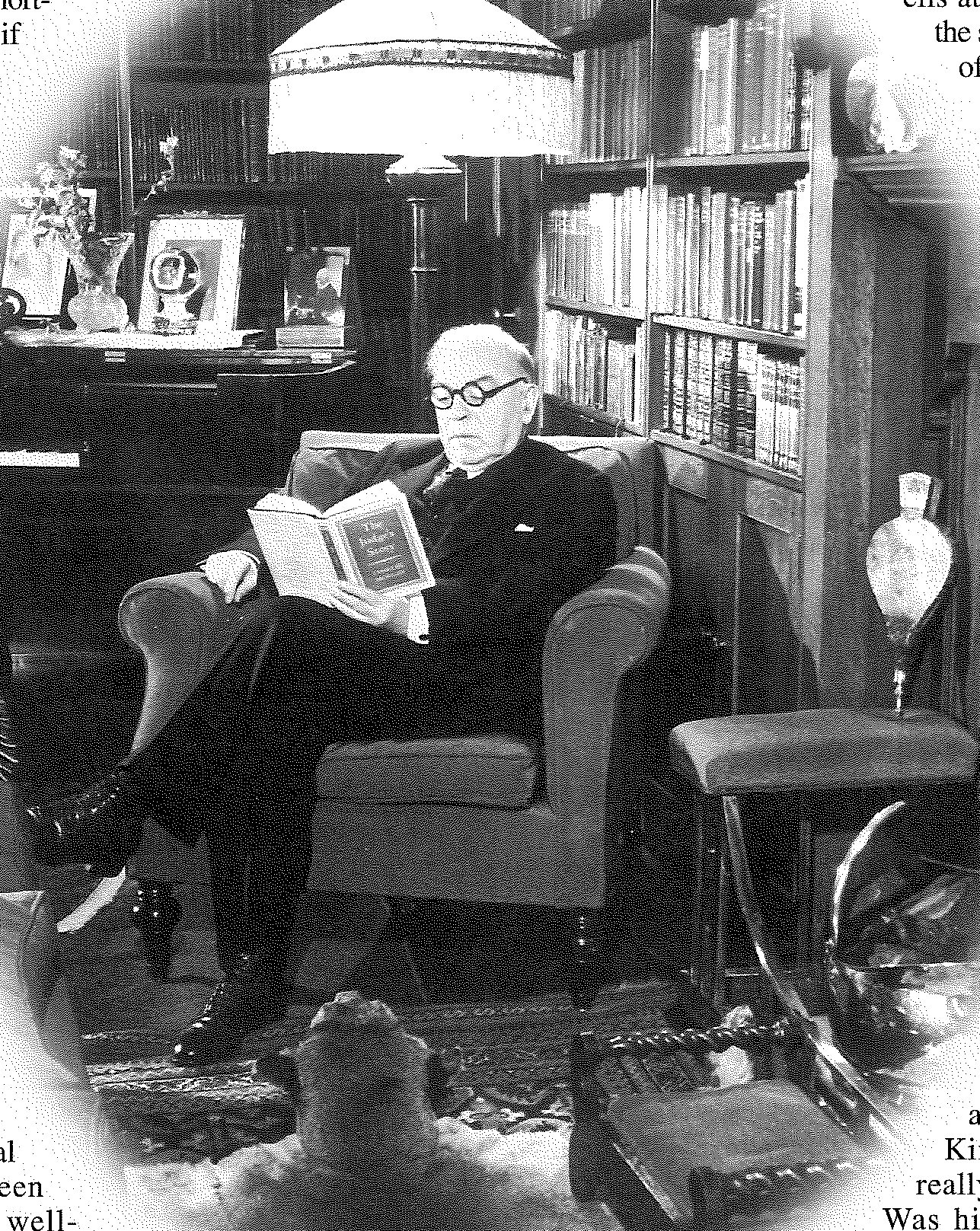
With the uninspiring title of “Officer i/c War Records,” it took me three weeks to wade through the documentation which had accumulated since September 1939; and the daily flow increased, particularly after France and the Netherlands were overrun by Nazi forces, and Winston Churchill’s leadership of the British government and the Allied cause became more pronounced. I made one excursion into the basement where Prime Ministerial files of many years had been amassed. Several perhaps well-meaning attempts had been made to introduce some semblance of order. I frankly gave up; other demands seemed more important and I concluded that it was less and less likely that Mr. King ever would tackle the writing of memoirs to which, he said, he intended to devote his efforts after “retirement.” I counted it a fortunate circumstance that, almost at the end of my Laurier House engagement, a senior office messenger (Roger Frankham, later Custodian), and Russell’s replacement (M.J. Deacey) took advantage of Mr. King’s absence from Ottawa to have green curtains fitted to the basement shelves – literally as a cover, in the interests of tidiness — and they packed up the entire archive for delivery to the Public Archives.
In the East Block, I had become accustomed to the drafting of “short notes.” I was now faced with the recurring, sometimes wearying tasks, of full texts, for national broadcasts and periodic statements about the progress of hostilities and the mounting contributions to the total war effort. Even if drafts were supplied from sources outside the Prime Minister’s Office, these texts were likely to be revised, sometimes as often as seven times. In this effort, Jack Pickersgill was sometimes engaged alone; occasionally, I was a solo reviser; most frequently both of us toiled side by side in the library of Laurier House opposite Mr. King.
On a few occasions we worked in the spacious Centre Block Office, very rarely in the East Block itself. The dedicated working time increasingly became Saturday afternoon, from 2 to 7 p.m., with tea, toast and ginger snaps, at four o’clock.
One became accustomed to the Prime Minister, opposite, a wisp of hair over his forehead, reading glasses at the tip of his nose, sometimes whistling softly between his teeth, short blunt pencils at the ready. Depending on the season, jacket might be cast off, waistcoat unbuttoned remove it his pocketwatch/pen knife had to be set aside, and his grandfather’s personal seal unthreaded through a vertical buttonhole); in extreme cases starched collar and tie removed. I spent one hot July working evening opposite the Prime Minister reduced to his undershirt, he vaguely resembling a put-upon teddy-bear. Mr. King had an unlisted telephone which would ring occasionally. Answering it himself, if it were a wrong number; he would say, with mockcourtesy, “why no, this is the county jail!”
It might reasonably be asked “what was Mackenzie
King actually like? Really aloof from the people?
Was his political judgment as shrewd as winning six out of seven general elections would suggest? Was he as ruthless as the mute testimony of castoff figures along the political highway seems to prove? Was he an intensely lonely figure, with few genuine friends?’
The exacting canons of biography are not automatically applicable in attempting to answer these questions. By one standard Mackenzie King emerges with a curious luminosity: in Bruce Hutchison’s description a rather maddening individual, with the “bouncing, cautious gate of one walking on invisible eggs,” the worldling “who had built his own monument to be remembered in this world, when all his hope lay in another.” It was not as though Mackenzie King was the automatic, foreordained leader of what emerged as a steady progression towards the stature and, subsequently, the substance of nationhood, represented at home by social and economic planning for a post-war universe; and abroad partly by functional representation espoused, reasonably enough, by Canada the Middle Power and (within his lifetime) the Middle- Aged Power.
Personally, Mackenzie King added very little to the overarching idea of nationhood, and this despite a Canadian Citizenship Act and some tentative gestures towards a distinctive Canadian flag. He was capable of showing a certain contempt – both artful and refined – for the niceties of convention and protocol as well as constitutional propriety. He could, at need, be grossly ignorant of the essentials of the common law: the people were always there — people who might be hungry or frustrated or pushed about, and it was not an effective answer to open the floodgates of oratory, nor to quote from his tome, Industry and Humanity, whose mentality and language were the product of thinking done more than 40 years earlier. It may be doubted whether it was statesmanlike for King to make such a show of resorting to judicial supremacy removed altogether from Canada (the Judicial Committee of the Privy Council in London) in order to have the late-in-the-day social legislation of the previous government declared ultra vires. Something needed to be done for people, but until 1945 Mr. King was rarely in a hurry: there were some curious contradictions between King the social reformer and King the pale-eyed householder fretting over his annual coal bill.
Any assessment of a long-serving Prime Minister (and Secretary of State for External Affairs for all but his last 26 months in office) is almost inevitably subjective, recollecting and recreating the mood of many individual moments rather than cataloguing considered judgments. The years when I worked across the table were times of war and reconstruction. They were years in which Mr. King led his party to victory in two general elections; years in which he tried to keep the country united, and in some sense succeeded; years in which the stature of Canada as “a world power of major rank” was sensibly enhanced. But they were years also in which Mr. King grew old – passing from the 60s to the 70s —and with age the loneliness of the man did not decrease. One contrasts outward self-assurance, inward loneliness; mercurial here, pedestrian there; capable of calculated venom yet also rare generosity, very much at the centre of politics, but well removed from any visceral awareness of Canada as a cultural entity.
There was, amid the grumbling that he was never well served by those working on his immediate staff, the curious blending of the reflective and the ruthless, of the intuitive and the rational, of the peaks of aspiration and achievement and the valleys of frustration and disappointment. He had to live with the ever-present loneliness; with the white heat of intensity from which decisions sometimes emerged, and, only infrequently, the compensations of ordinary livelihood.
And yet, considering, for example, the years 1937 to 1946, confronting all the problems of a major war in which Canada fought as an arsenal, aerodrome, shipyard and granary for Britain and other Allied powers, one may still ask if any man, or combination of men, could have dealt with these searching problems so well and in a way so generally acceptable to the majority of the people of Canada. If in the end the Prime Minister supposed that the overall direction of the war effort was what Canadians of that generation wanted, for the time being he may well have been right.
I recall my last two encounters with Mr. King, both of them after he had given up public office. On the first of these I went down to Laurier House to tea to report on a visit I had lately made to the Institut Pasteur in Paris. I had been the bearer of a letter, signed by Mr. King, announcing a gift of $15,000 from the Canadian Council for Reconstruction through UNESCO to enable the Institute to replace some of its precision equipment which had been destroyed or stolen during the Nazi occupation. For tea that day Kingsmere honey was added, along with much (if rather one-sided) reminiscent talk about the mission of the conciliators who were, as he resolutely believed, the truly great men.
The second occasion was when I walked with him from Laurier House the few blocks to the Netherlands Embassy, where he was to receive the first of 5,000 copies of a booklet by school children in the Netherlands in recognition of gifts of school supplies from school children in Canada. This he did very graciously and made a graceful little speech. On the way back his chief concern was with the coal bill at Laurier House — did I think repointing the bricks would make any difference? On this somewhat technical matter I was unable to be of much assistance, but I thought there was something a trifle sad about the small, rather cramped figure with the mincing steps, disappearing through his own front door.
There are some surviving ironies. Mr. King had deep-rooted suspicions about concerted attempts at a centralization of Empire-Commonwealth initiatives and concerns in Downing Street. He was able to become socially amenable in London society, professing affection and support for the Royal family while cordially distrusting the “courtier” mentality and behaviour. He was in consequence never averse to trusting his own judgment in the face of advice from “professionals,” however well-intended. He railed from time to time against honours or awards creating precedence. Along the way he “solicited and received His Majesty’s permission to discontinue using the initials CMG after his name,” but he could not decline the Order of Merit, conferred by the King in the Prime Minister’s last full year in office. There seemed to be an ultimate irony when the insignia — he was at his death the only Canadian member of the Order – was placed on his casket in the lying-in-state in the Parliament Buildings.
View the original scanned pages →
Originally published in bout de papier, Vol. 15, No. 3 (1998) — Fall 1998 // Automne 1998, pp. 7–9. Read the rest of this issue →



