
bout de papier, Vol. 17, No. 1 (2000) — Spring 2000 // Printemps 2000, pp. 22–25
T The founding President of Tanzania, Julius Kambarage Nyerere, died on October 14, 1999. His memory has occasioned this article. Since the days of early missionary activity in the region, including that of the White Fathers, who ran the school Nyerere attended, and later through CUSO involvement, which began shortly after independence, Canadians and Tanzanians have built strong bonds. As President, Julius Nyerere welcomed Shirley Baker, the regional CUSO coordinator, to State House in 1969; Canadian High Commissioner Karl Johansen (1980-84), who had been born in East Africa and served until 1968 as a senior civil servant in Tanzania, was also an esteemed friend of the country. Tanzania’s current President, Benjamin Mkapa served as High Commissioner to Canada in 1983. I offer this article as a tribute to Mwalimu Julius Nyerere, a leader who deserves abiding respect and honour.
As High Commissioner Fadhil Mbaga remarked to me, “Mwalimu Nyerere’s visit to Canada in August 1998 was a farewell to his Canadian friends.” When Julius Nyerere visited Canada in 1998 as keynote speaker at the Roundtable on Peace Negotiations in Burundi, of which he was the facilitator, and to receive an Honorary Doctorate from the University of Ottawa, I had the opportunity to reflect on Canada’s twenty-year involvement as the major donor with the Tanzania Railway Corporation, the TRC.
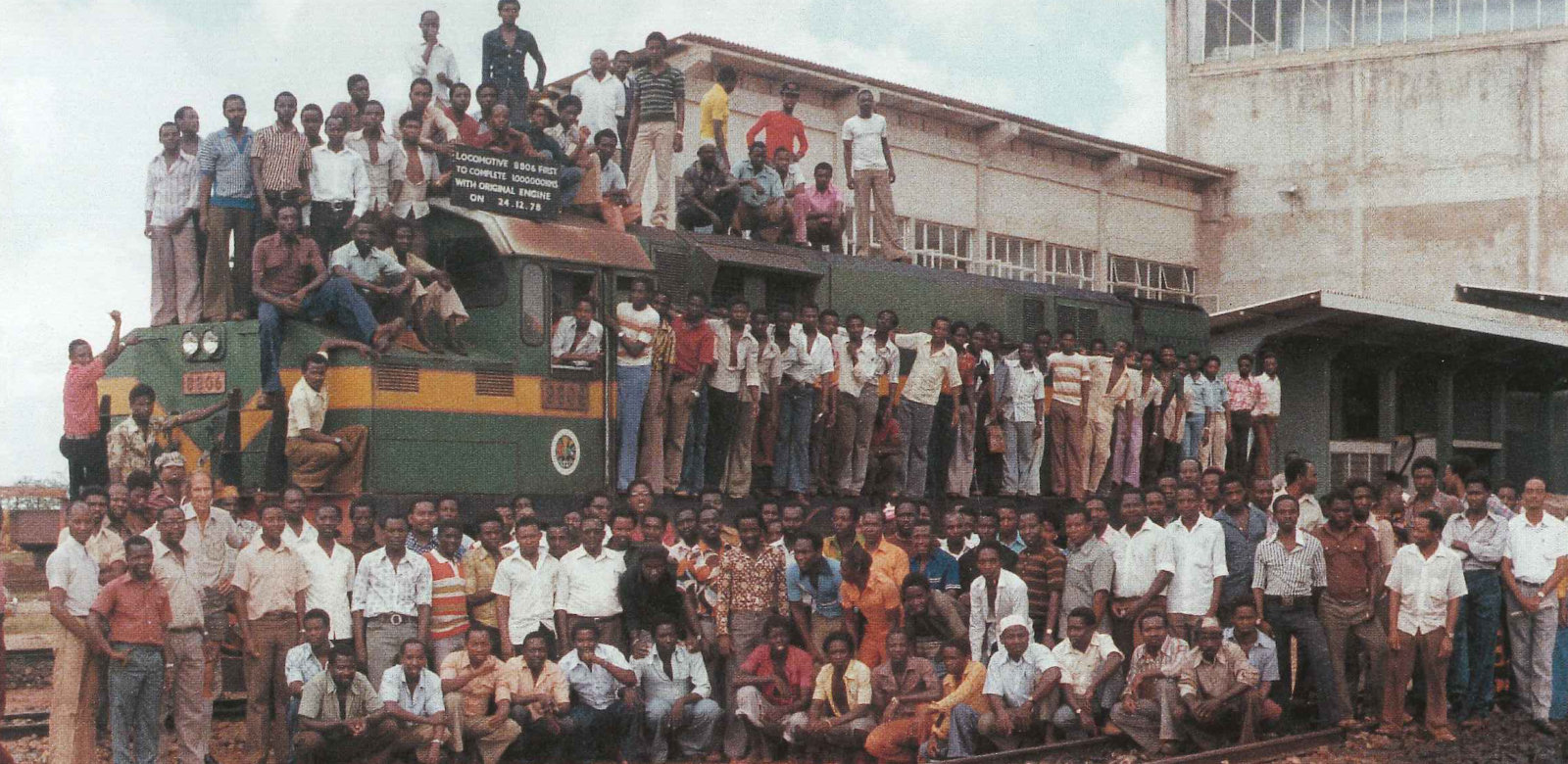
This project has been one of the largest and longest of CIDA’s involvements in a sustained development program. In fact, Canadian involvement in the railways began before 1977 with assistance to the East African Railways Corporation. In 1970, 35 locomotives were provided to EARC under a CIDA loan. Canadian assistance to EARC had benefited the three East African Community members, Kenya, Tanzania and Uganda. The demise of the East African Community in 1976 led to the breakup of the EARC. The regional office in Dar es Salaam, EAR(T), which shortly after became TRC, took full responsibility for the railways in Tanzania. The situation required the expansion of the regional railway workshop in Morogoro and investment in upgrading the railway infrastructure. The World Bank decided it could not respond separately to the individual country requirements of the former EARC as the assets were distributed to the regional offices. Therefore, Tanzania sought assistance from a willing donor country.
Why Canada, one may ask. One reason was that Canada had a proven capability in the railway sector at home and abroad as well as considerable profile through a well-established CIDA program. In addition, Canada had responded with military assistance to train the Tanzania Peoples’ Defence Force in 1965 following the attempted coup d’état in Zanzibar in 1964. And thirdly, the friendship of President Julius Kambarage Nyerere and Prime Minister Pierre Elliot Trudeau encouraged TRC to look to Canada for assistance.
High Commissioner Robert McLaren put the challenge to CIDA in 1977. My experience as the CIDA senior planning officer who had previously been Second Secretary (Development) in the Canadian High Commission in Dar es Salaam from 1972 to 1975 enabled me to grasp and assess the situation outlined in the well-documented TRC request. To look at the railway sector needs in Tanzania, a planning mission was set up comprising Keith Bezanson, who led the mission and was the chief planning officer in the Africa division, Jim Kritsch, the project officer, and myself as the planning officer. Technical backup came from two railway consultants, Bill Jackson and Leslie McGregor, both of whom had long careers with Canadian National Railways, combined with international experience.
From the outset we noted that the railway central line from Dar es Salaam through to Kigoma served a vital role both for Tanzania and in the region for the Congo-DRC, Rwanda and Burundi. These states depended on the railways for the import and export of goods, and for regional development.
Our meetings in April 1977 with General Manager Janguo, and the dedicated team of railway officials including Juma Leweno, chief mechanical engineer, E. Makoi, his successor as chief mechanical engineer, N. Kitemari, manager finance and planning, R. Ottini, district mechanical engineer, and M. Kabipe, in charge of the railway workshops in Morogoro, were interspersed with trips around Dar es Salaam and Morogoro to identify the areas where Canada could assist the TRC. It would take massive investment. TRC’s development plan for 1977-82 budgeted Tanzanian shillings 1,440,945,000, equivalent to $171,541,190 in 1977 Canadian dollars. The TRC railway plan included capital investment for the track bed and track renewal, repair of railway bridges, locomotive and rolling stock requirements, signalling and telecommunications equipment and the railway workshop facilities. The plan was well developed. It outlined each component we selected to undertake and provided sufficient information to justify Canadian/CIDA involvement. Clearly, it was beyond Canadian capacity to respond to all the requirements. However, we were in a good position to make a significant intervention and that is what we did.
We were careful to inform TRC that we could not meet all their needs and that other donors would be welcome. However, with the hands of the World Bank tied, Canada was definitely stepping into the role of lead donor. We consulted with World Bank officials in Washington, D.C. before proceeding to put financing in place and gained their full support. I maintained contact with the consultants as I developed the railway project proposal to be sure that both the facts and the arguments were watertight.
The project was expeditiously handled, from the program proposal for a planning mission in mid-March, to the final approval in early August. President Nyerere’s intended unofficial visit to see Prime Minister Trudeau, en route to meet President Jimmy Carter in Washington, D.C., added incentive to develop the project as promptly as possible, which Don Jamieson, Secretary of State for External Affairs responsible for development assistance, endorsed. The railway program needed the approval of Treasury Board, given its size of $60 million, and we were able to obtain TB approval prior to Nyerere’s visit in August. Despite the compressed time period, the project included a full technical and financial assessment. All seven components were costed and kept within their budgets.
The railway program was deemed to be one of the best interventions CIDA has made in response to an obvious need. Since we viewed this as the first stage of an intervention that would have a twenty-year horizon, we insisted on including a sector study to establish priorities over that time frame. We broke new ground with untied Canadian financing for construction of the workshop, which had been awarded by TRC on an open tender to a Brazilian construction contractor, under supervision of a German consulting firm. The untied finance was approved both for the mechanical equipment sourced from Europe and for local costs. The workshop was essential to repair and service Canadian and other locomotives. Except for overhead cranes, the equipment required was not manufactured in Canada. Likewise the railway track ties (sleeper component) were sourced from India. We justified the 20 per cent untied portion as the appropriate investment required to ensure the railway would be viable. The steel rails, the telecommunications equipment, the quarrying equipment, 15 additional locomotives and spare parts, the consulting services for managerial backup and the technical assistance for instructors at the training centre in Tabora and most of the training attachments of TRC personnel, were goods and services that were available and sourced in Canada. (In addition, 205 railway wagons made in the Maritimes had just been provided under a separate $12 million grant by CIDA to TRC.)
At the outset we put a Canadian railway advisor into TRC headquarters to monitor CIDA’s investment and consult with TRC’s management. This position was filled by Joe Broadbent who had been General Manager of BC Rail in British Columbia. He did an excellent job, which was necessary to build mutual confidence as the railway program was launched. The subsequent stages of the railway program included a large grant in 1983 and other component specific grants in later years. These grants sustained the CIDA railway program over 23 years from the initial 1977 involvement with TRC – and 30 years from the first commitment to EARC.
It is not surprising that there have been many problems with the CIDA projects implemented under the railway program. Since the mid-80s other donors have reengaged to provide assistance to TRC. This has made the process more complicated and it has been difficult for TR to comply with the conditions imposed by the various donors. Over the past decade there has been increased evidence of donor fatigue. Calls for TRC privatization, with a view to making it function more efficiently, seem to have prevailed. TRC will lease out the use of track to competing interests.
CIDA is due to complete its involvement with TRC within a short time, marking the end of an undertaking which represents an investment of some $175 million since 1970. The nature of CIDA projects has changed; CIDA no longer supports the large infrastructure projects that were a significant thrust of the development program in the late 60s and 70s when the TRC program was initiated
The commitment CIDA made to TRC for more than twenty years has been one of the beacons of Canada’s contribution to development in Tanzania. Each of the three Presidents, consecutive Tanzanian High Commissioners and Tanzanian government officials have on many occasions said that it is the sort of development they would want to see CIDA continue. That CIDA can no longer do so is the result of changing priorities in budget allocations that must be respected. However, as the TRC is privatized, we should ensure the CIDA departure is graceful. We should also do everything we can to foster the continued involvement of the private sector and maintain the Canada-Tanzania bond forged through the railway program.
It is worth noting the CIDA staff who have been involved at various times during the life of the project — a few served in both Ottawa and Dar es Salaam, and I apologize if any others have been overlooked. At headquarters: Chris Brown, Jim Krisch, Kevin Smith, Irene Mathias, George Saibel, Susan Ross, Steve Hallihan, Jo-Anne Doherty, Rod Haney, Norman Willoughby, Jan Sheltinga, David Cross, Melanie Alton, Micheline Kingsbury, Roy Weston, Alan Wheatley, Lew Hayashi, Jorge Acosta, Roy Waddington, Mike Vigrass, Edmond Carpentier and long-time consultant Geoffrey Allsebrook. The diplomatic field staff in Dar es Salaam have included Robert Calderisi, Emil Baran, Paul Hitchfeld, Ron Audette, Alan Culham, Rod Haney, Jack Adams, John Lobsinger (a former PAFSO president 1987- 88), Wayne McKee, Bruce Wilson, Adrian Poplawski and Bill Mitchell. Joe Broadbent, Mike Vigras, Bill Jackson and Ray Rowe were railway project field co-ordinators. Gord Alliston, Andre Gravelle, Ron Maughan and Roy Waddington were other railway specialists that assisted the project. The railway program has spanned the tenure of eight High Commissioners and many more CIDA directors and country program managers who have each contributed to the role it has played in Canada-Tanzania relations.
I would add that Canada has an excellent friend in the recently departed High Commissioner Fadhil Mbaga. In 1998, High Commissioner Mbaga and I visited Joe Broadbent, resident at an elderly persons home, to express the abiding appreciation for his role in the Canadian effort to respond to Tanzanian railway requirements. Mr. Mbaga has worked diligently to enhance the Tanzania-Canada relationship, as did High Commissioner Chief Lukumbuzya when the TRC railway project was inaugurated in 1977. Tanzanians at TRC should be proud of their dedicated work, just as Canadians are rightfully proud of their association with the Tanzania railway program.
View the original scanned pages →
Originally published in bout de papier, Vol. 17, No. 1 (2000) — Spring 2000 // Printemps 2000, pp. 22–25. Read the rest of this issue →



