
bout de papier, Vol. 10, No. 4 (1993) — Fall/Winter 1993 // Automne/Hiver 1993, pp. 10–13
Story and photo by James R. Trottier
Invoking the spirit of our age and the realities of our time which calls upon the peoples of the world and all States Members of the United Nations to rededicate themselves to the global task of promoting and protecting all human rights and fundamental freedoms so as to secure full and universal enjoyment of these rights.”
Vienna Declaration, World Conference on Human Rights, Vienna, Austria, June 1993
The World Conference on Human Rights took place in Vienna from June 14 to June 25, 1993. This was only the second such gathering, the first having been held in Tehran in 1968. The Vienna Conference was probably the largest human rights conference ever. Amidst much concern about what might emerge, the Conference achieved consensus on a final document — the Vienna Declaration — which reinforces and advances the cause of human rights.
It had been a long march from the inception of the Conference in a resolution of the UN General Assembly in December 1989 to the Vienna Declaration. Begun in the heady period of the dissolution of the East Bloc as a celebration of human rights, the process had verged perilously close in the intervening years to challenging the concept of universality contained in the Universal Declaration of Human Rights.
The Lead-Up
The lead-up to Vienna had not been auspicious. Three preparatory committees, meeting in the two preceding years, had failed to agree on the agenda for the Conference let alone a draft final document. The agenda was finally resolved by the UN General Assembly in December 1992. The fourth preparatory committee meeting in April 1993 then turned its attention to drafting a final document but failed to reach an agreement. A draft final document containing 55 pages of bracketed (disputed) paragraphs was sent forward to the World Conference. The Vienna Conference faced what appeared to many as an impossible task.
In addition, three regional conferences in San Jose, Tunis and Bangkok had each come out with declarations. These had been forwarded to the preparatory committee and then to the Vienna Conference. The Bangkok Declaration in particular cast doubt on the concept of the universality of human rights, giving priority to “regional peculiarities and various historical, cultural and religious backgrounds”. The Bangkok Declaration also rejected the concept of development assistance being conditional upon the human rights records of countries concerned.
The Setting: NGOs and Governments
This set the stage for the Vienna Conference, held in a conference centre adjacent to the UN Headquarters. The Conference was preceded by a Senior Officials Meeting June 9th to June 14th. This meeting decided how the Conference would go about its work. The Conference itself consisted of the Plenary where Government Ministers and NGO representatives made prepared statements, the key Drafting Committee where the final document would be hammered out, the Main Committee which provided states and NGOs with another opportunity to address specific agenda items, and the Credentials Committee.
The Conference was preceded by a three-day Non-Governmental Organizations (NGO) forum. During the Conference itself there were a series of NGO-organized meetings. All these events occurred on a separate floor of the Conference building. Thousands of NGO representatives of some 1,400 international, regional and local NGOs from around the world met to discuss issues of concern to them. Barred from the all important Drafting Committee, NGO representatives made their views known to delegates through written proposals and formal statements. They also issued a feisty daily newspaper — Terra Viva — containing no holds barred opinions about countries and issues. In a journalistic coup of sorts, Terra Viva obtained and published the briefing notes of the American Delegation, apparently after an (albeit short) internal debate about the questionable ethics of doing so. Other delegations took note and ensured their own documents were kept secured
NGO representatives were present at the entrance when delegates arrived for meetings, thus ensuring that government representatives were aware of NGO issues. The dramatic displays at the entrance included a mock execution in an electric chair, indigenous people in traditional garb, NGO representatives in white masks symbolizing repression and dozens of people passing out literature of various sorts. On the walls of the floor where the NGOs met were vivid displays of human rights abuses, many the result of activities of the governments meeting in the same building — an irony not lost on many. During the statement to the plenary of Myanmar’s Foreign Minister U Ohn Gyaw, opponents of Myanmar’s regime filled the gallery reserved for NGO representatives and created a surreal atmosphere by donning masks of Nobel prize-winning political detainee Aung San Suu Kyi.
Not surprisingly, in a forum involving so many people, feeling passionate about one cause or another, there were controversies. In one of the most unfortunate incidents, former US President Jimmy Carter, invited to speak to the NGO forum in recognition of his long interest in human rights issues, faced — with impressive dignity — a jeering mob protesting his presence, much to the chagrin of many of the NGO representatives present. After an address by the Cuban Foreign Minister, Roberto Robaina Gonzalez, scuffles broke out between pro- and anti- Castro demonstrators. The Dalai Lama’s planned address to an NGO meeting was first cancelled and then, after protests by Canada and several other states, reinstated; the spiritual leader received a hero’s welcome.
Some NGOs resented what they characterized as an Upstairs/Downstairs atmosphere. Their discussions were held on the lower floor while government representatives met behind closed doors in the airier upper floors. This sense of grievance was compounded by some early attempts — soon abandoned — to restrict NGO access to even the corridors and facilities on other floors. Dissatisfied with the leadership of the NGO forum and what some perceived as the leadership’s too accommodating stance with Conference organizers, NGOs staged a sort of auto-coup and established a new co-ordinating body.
Some parties showed up uninvited and unwanted. Most notorious was the infamous Shining Path group from Peru. It had to be forcibly ejected from the NGO forum. Other NGOs were mysteriously disinvited after having received invitations to attend; there again the Canadian and other delegations protested the exclusions. Some states sent so-called “false-flag” NGOs which became known as GANGOS — Government-appointed Non- Governmental Organizations — more interested in defending particular governments’ human rights records than in exposing violations.
These controversies aside (and, after all, NGOs are expected to challenge the status quo), the NGO events were a great success and an eloquent proof of the concern felt by people throughout the world about human rights. This was particularly true of women’s rights. Among the most dramatic events of the NGO forum were the hearings by the Women’s Tribunal. The Tribunal heard horrendous stories of abuse from 33 women from all regions of the world
Much of the activity on women’s rights was aimed to win recognition that women’s rights are human rights and that the rights of women should be considered as a key integral aspect of the work of all UN human rights bodies. Canada advanced and supported these positions. The Canadian Delegation was particularly keen to ensure that claims about cultural and religious traditions were not used as excuses to deny the human rights of women. That the women’s rights positions were put forward forcefully by women from every region belied the claim of a vocal minority of states that this issue was the concern only of a few countries and ensured success at Vienna.
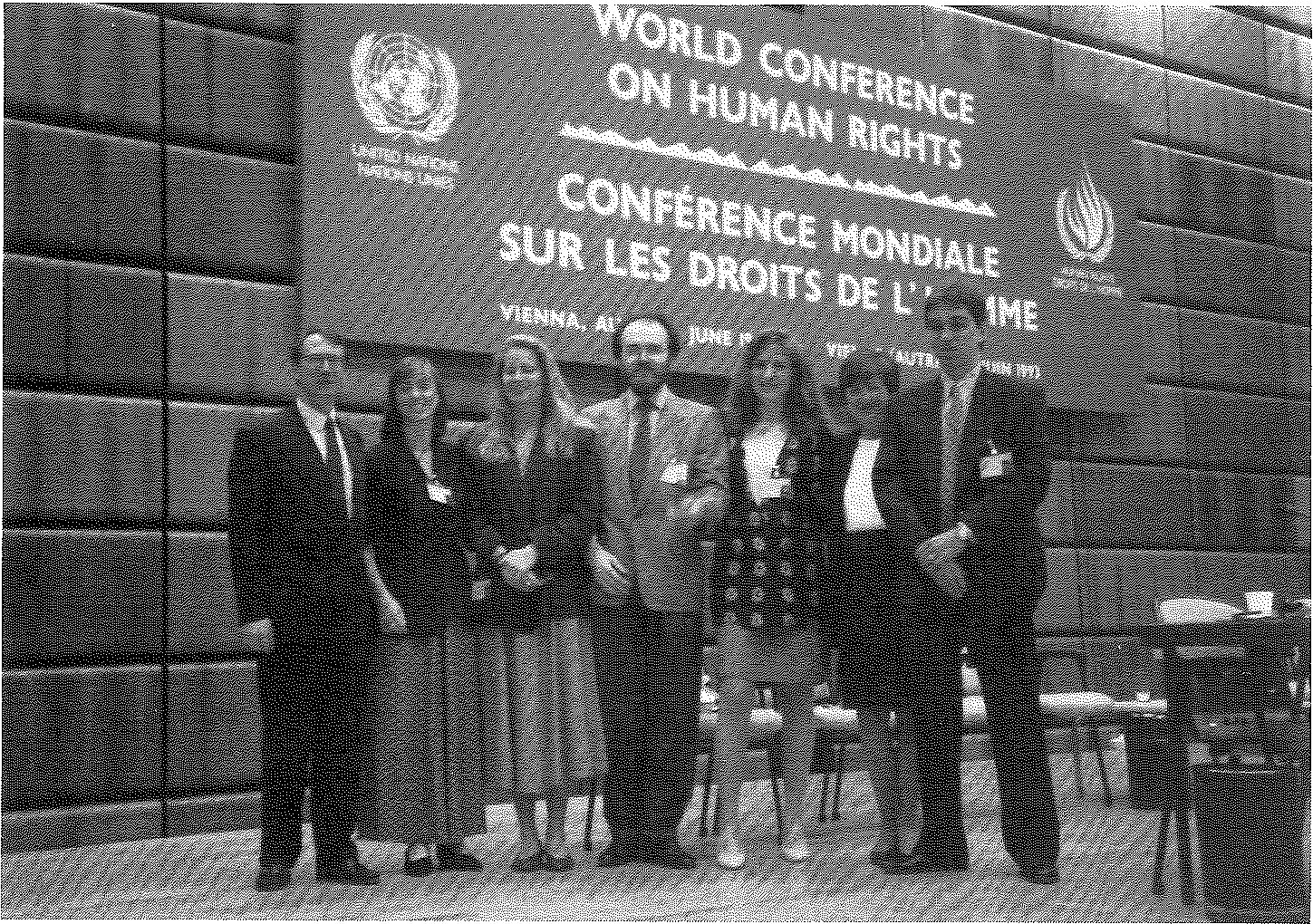
As all this activity unfolded in the NGO forum, statements continued in the Plenary and the Main Committee. The Conference, opened by UN Secretary-General Boutros Boutros-Ghali, provided a forum for dozens of foreign ministers and other notables including Jimmy Carter, former Philippines President Corazon Aquino and Nobel Prize winner Rigoberta Menchu. Most states were represented by their foreign ministers. Perhaps more importantly, the Conference provided an opportunity for human rights activists — who speak for those without a voice — to express their concerns.
The Negotiations
Simultaneous to the activities in the NGO forum and the plenary, official delegations negotiated the final document in the Drafting Committee and in its spin-off Task Force, both chaired in an exceptional manner by senior members of the Brazilian delegation. These negotiations were crucial to the shape of the final document which would be cited for years to come as the definitive view of states concerning human rights. A good solid document could be used to bolster human rights; conversely a weak document or one containing serious deficiencies would undermine this effort.
Many NGOs, media and some delegates assumed no agreement was possible and expected the worst from the negotiations. The concerns of NGOs deepened when they were barred from the Drafting Committee.
The Canadian Delegation, which had argued for the inclusion of NGOs in the Drafting Committee and had funded many NGOs to attend the Conference, made a public commitment to inform NGOs of the discussions through regular briefings and NGO representation on our delegation. Similar briefings were carried out by the United States and the Netherlands. The Canadian Delegation also organized meetings between NGO representatives and members of the WEOG (Western European and Other States Group) and the Eastern European Group. Knowing there would be scrutiny of their positions lessened the recalcitrance of some states in negotiations.
To the surprise of many of the 5,000 people attending the Conference, states agreed by consensus on a final document. The Vienna Declaration reaffirmed fundamental principles of human rights and set out elements of an action plan. The Declaration was a considerable achievement for a Conference which had been pronounced dead before arrival of several occasions.
The determination of many states to advance the protection of human rights, skillful negotiations, mobilization of support from states in every region to the defence of human rights, and failure of hardline states to obtain general support for their positions contributed to the positive outcome. Contrary to many news reports, the division in the period leading up to the Conference had not been between North and South but between those states which believed that rights belonged to people and those who thought that they belonged to the state.
The exceptionally skillful chairing of the Drafting Committee by Ambassador Gilberto Vergne Saboia of Brazil was also a crucial factor in the success of the Conference. At the end of the Conference, in a revealing comment in response to the well-deserved tributes, Ambassador Saboia noted dryly that he and his able deputy were two officers of the Brazilian Foreign Ministry with a particular interest in human rights and that they had gathered around them a cadre of younger officers with similar interests.
The Drafting Committee composed of virtually the entire UN membership discussed the draft document paragraph by paragraph. The negotiations stretched late into the night of many days, including weekends and, on one memorable occasion, until sunrise. The Drafting Committee’s work had two parts. It first considered the principles in the draft document while an open-ended Task Force of the Committee considered the draft plan of action. The Task Force laboured away in a jammed room with partial translation services and forwarded its proposals to the Drafting Committee. The Task Force left the most contentious issues to the Drafting Committee.
Ambassador Saboia, who was in the chair for every minute, was tireless. He ran the meetings with a skillful and formidable blend of authority, toughness, originality, patience and flexibility — a combination of qualities crucial to getting through the draft document. He generally refused to allow amendments to the relatively few but significant paragraphs — on women, children etc. — which had been agreed upon at the preparatory committee. He allowed delegations to make interventions of no more than two minutes on each paragraph in dispute and generally restricted discussions on most paragraphs to no more than an hour. If delegations proposed new wording, subsequent intervenors were asked to address the new proposals as well as the earlier wording. This put a premium on delegations’ preparations, flexibility, attention spans, ability to focus and originality — a challenge any time but particularly in the 16th hour of a day’s discussion.
When the Chair decided that later speakers were merely reiterating points already made, he cut off discussion. He either put forward what he believed to be consensus language or sent delegations representing various viewpoints out of the room to reach consensus on the points at issue. Meanwhile he would move on to another paragraph.
More often than not, the small negotiating groups were able to reach agreements which were then agreed to in the Drafting Committee. Having reached agreement, delegations which had been on opposite sides of an issue in the smaller negotiating committees were in no mood to see their work undone by delegations which had not taken part. They made common cause in rebuffing proposals for amendments from the floor.
The Chair helped this process along by pressuring delegations to reach consensus and gavelling through paragraphs very swiftly, so quickly in fact that some delegations were not able to register their disapproval in time to block consensus. When delegations protested about his rulings, the Chair merely noted that delegations could take the matter up in plenary. Ambassador Saboia deftly overruled delegations from all regions thus preempting charges of favouritism. When the final document did come to the plenary floor, it was accepted without objections.
Decisions on the rights of women, minorities and indigenous and the right to development were greeted with spontaneous applause. The most moving and exciting moment came towards the end of the Drafting Committee’s work. After prolonged and exhausting discussions about the proposed High Commissioner for Human Rights, the gridlock was broken by a quick succession of statements by delegates from all regions in favour of Ambassador Saboia’s compromise proposal — developed by a small working group including Canada, Poland and other states — and, in particular, by an impassioned plea by the delegate from Mali, Fatoumata Siré Siakite. She ended her eloquent statement to a wave of applause which seemed to immobilize the opposition and gave the Chair all the opportunity he needed to gavel through the decision. The Chair referred subsequent objections to the plenary.
Given the intensity, complexity and number of simultaneous negotiations, the size and composition of delegations, and in particular, the resources assigned to the Drafting Committee, were crucial. A critical mass was necessary in order to be effective. Key countries from each region were fairly evenly balanced in the personnel they assigned to the task. For example, like the Canadian Delegation, the very able and active Indian and Indonesian delegations had experienced officials from capitals as well as their Permanent Missions in New York and Geneva.
The Canadian Delegation was directed by Manfred Von Nostitz, Director-General of External’s International Organizations Bureau, and Anne Park, Head of the Canadian Delegation to the Commission on Human Rights. The negotiating team was lead by Ross Hynes, External Affairs Co-ordinator for Human Rights; other members were Kerry Buck from External, Irit Weiser from Justice and Alan Kessel and myself from the Permanent Missions in Geneva and New York respectively. Valerie Raymond, Director of External’s Human Rights Division and Denis Marantz, External’s Co-ordinator of Aboriginal Affairs co-ordinated activities on the rights of women and indigenous rights respectively. In addition, the Canadian Delegation, co-ordinated by Adele Dion and assisted by Leslie Norton, Chantal Winter de Varennes, and Jean Touchette, also included a range of other people from External Affairs, other departments, parliament, the indigenous community, academic life and NGOs.
In addition to advancing Canadian positions on the issues under discussion, Canada was the co-ordinator of the Western European and Other States Group (WEOG).
The Outcome
The Vienna Declaration covers several key issues. Universality of human rights is a fundamental issue for Canada and many other states from all regions. The need to reaffirm the concept of universality of human rights and to resist the claim that cultural or other traditions dictate different and lower standards of human rights protection is crucial to ensuring the protection of human rights of all people. Universality is confirmed in the final document which declares that ’it is the duty of states regardless of their political, economic, social and cultural systems, to promote and protect all human rights”.
The Declaration also states that the “promotion and protection of human rights is a legitimate concern of the international community”, thereby refuting the claim that expression of concern is interference in a states’ internal affairs.
Canada and other countries also successfully opposed inclusion of any language critical of linking development assistance with human rights performance.
The universal and inalienable right to development was also reaffirmed by consensus when the United States and Japan dropped their opposition. However, of most significance for Canada which was already a supporter of the right to development, the Declaration states that the lack of development cannot be invoked to justify denial of human rights.
The Conference recommended that the General Assembly consider on a priority basis at its September 1993 session the establishment of a High Commissioner for Human Rights. The idea is not new. It has been given renewed impetus. Canada and other states believe there is a need to have a focal point for human rights within the UN system. Such an official would be involved in all UN activity regarding human rights.
States which worried about the establishment of such an office, citing the issue of sovereignty in particular, overcame their concerns and agreed to send the project on to New York. The support of states from all regions — including Kenya, Nigeria, Mali, India, Indonesia, Brazil — for the final formula was crucial to the success of the undertaking.
The Conference also requested the Secretary-General and the General Assembly to take immediate steps “to substantially increase the resources for the human rights programme” in general and to increase funding for the Centre for Human Rights in particular.
There were also positive steps taken towards strengthening UN human rights machinery and making human rights more central to the activities of the UN.
Another major achievement was the mainstreaming of human rights of women into the UN human rights system. The Conference also asked that the draft Declaration on Indigenous Rights be completed and forwarded on to the next session of the UN Commission on Human Rights.
In addition to the final document, the Conference also adopted resolutions on Bosnia and Angola. There had been an unwritten agreement that no country situations would be discussed, thus freeing the Conference from spending most of its time addressing the grave human rights situations existing in all too many states — a task already carried out in annual sessions of the UN Commission on Human Rights — and leaving little time for anything else. The Conference was meant to focus on addressing fundamental principles and on strengthening international machinery to prevent and deal with human rights violations.
Through a coincidence of timing and geography, the Vienna Conference took place less than an hour’s flight from the vicious conflict and appalling human rights violations in Bosnia — a point made by many participants. A bare majority voted for a specific resolution on Bosnia introduced by Islamic states. A large number of other states, including Canada, abstained, thus abiding by the previous agreement but expressing, in explanations of vote, their outrage at the situation in Bosnia.
In the end, the Conference exceeded expectations. Universality was reaffirmed, the rights of particularly vulnerable groups were outlined to a greater degree than before and agreement was reached on important elements of a plan of action. And the result was achieved by consensus rather than by a split between regional groups.
The Conference left few of the participants unmoved. Whether they were from NGOs or official delegations, participants came away with the sense that we had participated in something unique, worthwhile and larger than life.
The Conference did not leave participants complacent. That all states were able to agree on a substantive document does not mean that these states will cease violating the human rights of their own citizens now or in the immediate future. However the Vienna Declaration does remove the excuse of some states that the standards in the Universal Declaration are not applicable to them because the Universal Declaration had been approved in 1948 by a UN membership of only 56 states. This was never an acceptable argument but it is now irrelevant. Virtually the entire UN membership agreed to the Vienna Declaration which reaffirms and goes beyond the principles of the Universal Declaration.
States can and must be held accountable by individuals, NGOs and each other for violations of human rights. The Conference sends the important message that human rights is an international fact of life. It must be taken into account in relations between states.
Vienna was not an end. Rather it was an important waystation to take stock and chart a new course towards that future, far from guaranteed, where respect for the human rights of every woman, man and child can be assured.
Please note that the views expressed by the author do not necessarily reflect those of the Department of External Affairs and International Trade
View the original scanned pages →
Originally published in bout de papier, Vol. 10, No. 4 (1993) — Fall/Winter 1993 // Automne/Hiver 1993, pp. 10–13. Read the rest of this issue →



