
bout de papier, Vol. 11, No. 1 (1994) — Spring 1994 // Printemps 1994, pp. 18–21
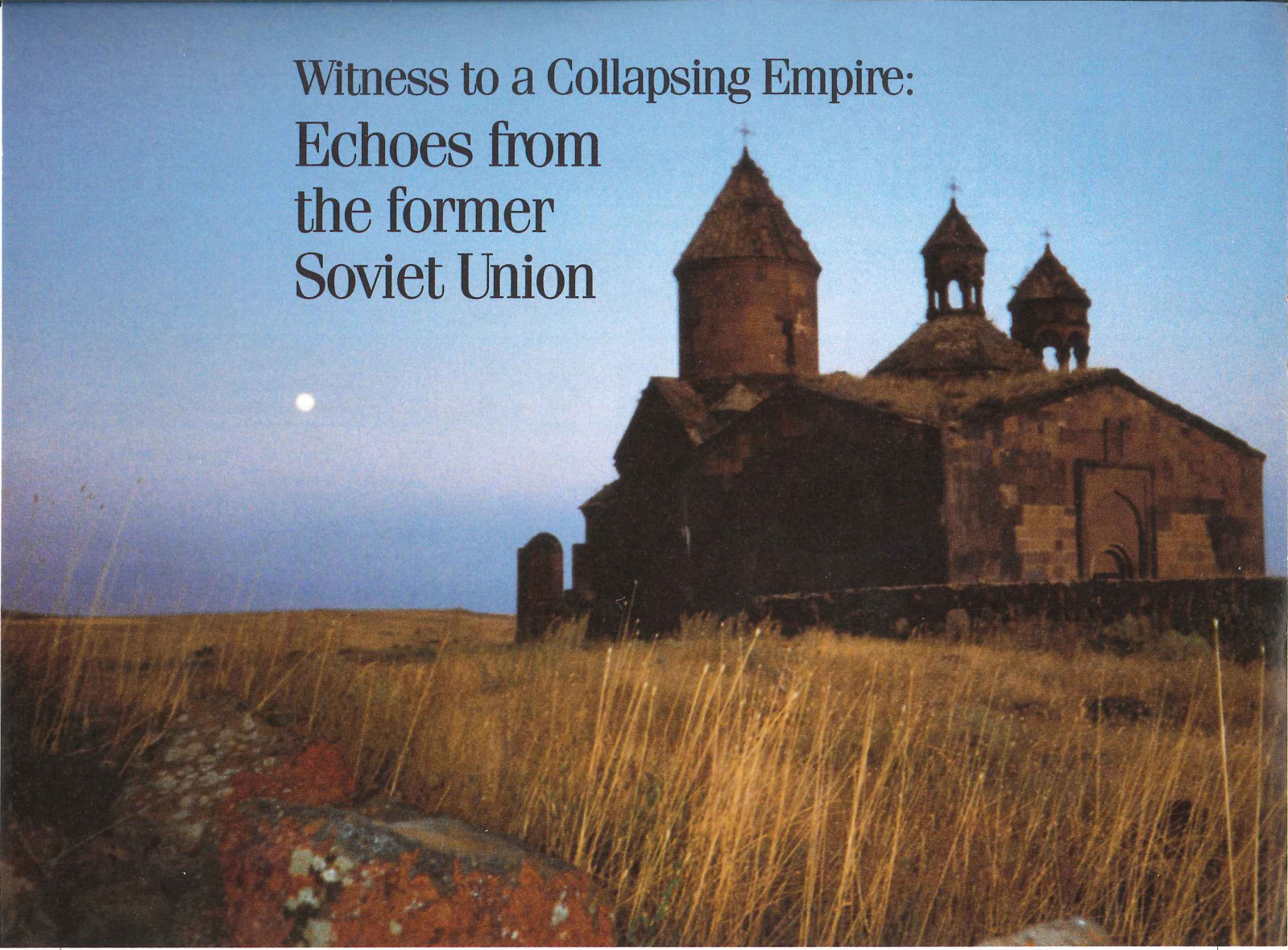
As diplomats, perhaps one last pilgrimage to the Kremlin or the Ministry of Foreign Affairs would have been more appropriate. But we chose to say good-bye to Russia in St. Petersburg at the Piscariovskaya Memorial to the victims of the 900-day siege and the “Great Patriotic War”. The glorious Soviet fatherland is no more, war veterans accept humanitarian assistance from a benevolent Germany and the city’s Lenin Museum now houses the American Commercial Office.
Our Russian friends reminded us as we stood at the foot of the monument that some things remain sacred. The heroism of those Leningraders who survived the blockade, and those who did not, is one of them. The hardship endured in those years entitled the survivors to a privileged status in Soviet society and defined their identity as well as that of their children and their grandchildren. If you have come to know us, we were told on the eve of our departure, you will understand these things.
We arrived in Russia in August 1990 eager to get to know these people whom we had discussed and pondered for ten months in our Russian language class. At the time it was not Russia, but the Russian Socialist Federative Soviet Republic, one of the fifteen republics which made up the Soviet Union. It was five years into Gorbachev’s glasnost, and we felt fortunate to be posted to Moscow at a time when the Soviet peoples were rediscovering their voices. We would spend the next three years listening and trying to understand those voices as we witnessed such events as the crackdown in the Baltics, the August 1991 failed coup, Ukraine’s referendum on independence, the dissolution of the USSR, and the wars in the Caucasus.
We could not see these historic developments on the horizon in the fall of 1990 as we settled into our work at the Embassy. What we could see was the rain. For three weeks in September, it rained every single day. Moscow, with its overabundance of grey Stalinist buildings, poorly lit streets and sparse greenery can be onerous under the best conditions. The unrelenting cloud cover threatened very early in the posting to deplete our reserves of enthusiasm which we had brought with us from Canada along with the ninety boxes of food products and toiletries. Three years later, veteran expatriates were still dredging up memories of the 1990 downpour as they chided newcomers who dared to complain about the difficult living conditions in today’s Moscow.
The city was very different then; safer, but also less colourful and vibrant. Whereas today’s foreign community has access to a wide variety of food stores, shops and Western style restaurants and hotels, the choices in 1990 were very limited. It required you to be imaginative and enterprising while in Moscow, and well organized on your trips outside the USSR. Forget sightseeing in Helsinki, or a leisurely stroll down the Champs Elysées, every “out” (four-month intervals were recommended) became a power shopping trip planned like a ministerial visit. Laden with suitcases of drycleaning, and armed with your wish list and those of several colleagues, we would drop our bags at the hotel and dash to the nearest well-stocked department store. When finally confronted with the best of what capitalism had to offer, we were surprised to find the whole experience a little overwhelming. The contrast with Moscow’s empty shops and the poor quality of Soviet consumer goods was unavoidable. This was an early indication that boarding a flight to the West did not mean that we were leaving Moscow behind.
Our first trip home to Canada for Christmas provided a further taste of the Soviet Union’s magnetism which had developed in us after only four months. As we left our suburban Moscow apartment in the early morning darkness for the airport, we felt we were abandoning Russia in its hour of need. Perhaps it was the talk, oft repeated in the coming years, of possible famine, or the thickening air of political uncertainty.
Once in Canada, we found ourselves riveted to the TV and devouring newspaper accounts of events in the USSR. Shevardnadze resigned the day after we got home, warning that conservative forces were threatening President Gorbachev’s policies of glasnost and perestroika.
The Baltic Events We returned in January 1991 to news of the crackdown in the Baltics. Little did we know that this would be a harbinger of the tumultuous events which would follow that year, shaking the Soviet Union to its core.
Thirteen people were killed by Soviet troops outside the television tower and the parliament buildings in Vilnius, Lithuania. Merv Meadows, our colleague at the Embassy, was in Vilnius that night and for several days was the Lithuanian Government’s only link to the outside world. He was honoured with the Lithuanian Medal of Honour #86. The Lithuanians recognized Boris Yeltsin with Medal #87 for his public support of the Lithuanian Government during the storming of the parliament by Soviet troops.
Minister Clark instructed the Embassy in Moscow to maintain a presence in the Baltic states for an indefinite period. These were still the days when solo travel by NATO country representatives was prohibited. Throughout the next three months, we worked together with other diplomatic colleagues to create a solid network of contacts in Estonia, Latvia and Lithuania.
We were impressed by the determination and resolve of the many young Canadians of Baltic descent who were working as advisors to these fledgling governments. A Latvian-Canadian woman who had been in the park across from the Ministry of Internal Affairs in Riga on the worst night of violence, showed us the tree which had saved her from a stray bullet. Flowers and poems lay at the foot of other trees in honour of those less fortunate than her.
A special bond was formed between diplomats, journalists and other foreigners who witnessed first hand the events leading up to the breakup of the Soviet Union. On February 7, 1991, Lithuania was where the story was. Or at least that’s how the late Jeannette Matthey would have put it. Jeannette, CBC Radio’s Moscow correspondent, was in Vilnius along with other members of the Canadian press corps to cover the non-binding “poll” on Lithuanian independence. Chris and Roman Waschuk, an Embassy colleague, were there to monitor the referendum as informal observers. Their presence almost became the story.
For the Lithuanians, the international observers offered reassurance that the world would not forget them again in their hour of darkness. But the Soviet Foreign Ministry took a dim view of international interest, and took particular exception to the “interference in the domestic affairs of a state” allegedly perpetrated by Norwegian, Australian and Canadian diplomats while observing the Lithuanian vote. This struck us as particularly odd given the presence of diplomats from several other Western countries.
The vote was conducted in an almost festive atmosphere with children accompanying their parents to the polling booths. The ballot boxes, more often than not, were covered in the Lithuanian tricolour which was still banned under Soviet law. Chris and Roman dragged themselves to the 2 a.m. press conference to hear the preliminary results. They were met by an ebullient Jeannette. Having gone for her usual 10k run a few hours earlier, she was, as always, in eager pursuit of the latest chapter in the unfolding Soviet saga.
This was but one of the many stories which we diplomats would “file” alongside Jeannette. We reported through our telexes to External Affairs in Ottawa, and she through her unforgettable voice to Canadians across the country. Prior to leaving Canada, we had listened for Jeannette’s reports each day as we travelled to and from Russian class. Those of us who worked and played alongside Jeannette during her time in the Soviet Union were greatly saddened by the news of her death from breast cancer in October of last year. She knew what a privilege it was to be in Moscow at that point in history. And she didn’t let any of us forget.
The August Coup and its Aftermath It was mid-summer, and while Gorbachev was making his first appearance on the G-7 stage in London, negotiations on the Union Treaty were reaching a successful conclusion in Moscow. The proposed treaty spelled the end of the USSR as it was known; it would be replaced by a Union of Sovereign States. These and other changes were too much for conservatives in the Ministry of Defence, the KGB, Ministry of Internal Affairs and elsewhere.
At that time we were living on Kutuzovsky Prospekt just up the street from the Supreme Soviet of the RSFSR, commonly known as the Russian White House. On Monday morning, August 19, several army and KGB divisions moved into Moscow. We heard rumblings outside but dismissed it as heavy trucks. Wrong.
For the next four days, those Embassy personnel who were not assisting the consular section in contacting Canadians across the USSR, were out in the streets assessing the military presence and speaking to the Russians on the barricades. We had never seen tanks in other than static displays. The first T-72 and T-80 tanks seen protecting the bridge over the Moscow River on Dorogomilovskaya Street were an unforgettable sight. Some of us tried to get a better look at the tank crews. Were they Central Asians as had been the case during some of the worst bloodshed in the Baltics? They were not. Peter Bates, a colleague at the Embassy, suggested that such close observation in a Volkswagen Jetta (even with diplomatic plates) was not likely to win the approval of any T-80 tank crew.
It became quickly apparent that this was a coup against Gorbachev, but one that lacked the decisive will or momentum to achieve its goal. When asked why they had parked themselves on the bridge near the White House, the soldiers replied they were told to move their armoured vehicles to Moscow and await further orders on arrival. The soldiers were calm, relaxed and open to the pleas of passers-by, including mothers and grandmothers, who begged them not to use their weapons in anger against the Russian people. Soon we saw flowers sticking out of tank turrets and soldiers posing for pictures with civilians on armoured vehicles. It would not always be this friendly.
On Tuesday, August 20 around 5:00 p.m., a telephone call to the Embassy from an official in the Russian government warned that the White House would come under attack within the hour. Several Embassy staff raced over to the White House, video cameras at the ready. The attack never came. Efforts to get into the Parliament that night proved unsuccessful; the White House was sealed off, in case of attack. It was later revealed that KGB helicopter gunships were to attack the building but General Shaposhnikov, Commander of the Soviet Air Force, threatened to use air force interceptors to shoot down the helicopters, sealing the fate of the coup plotters.
In anticipation of the attack, we settled in for a vigil. The rain began in the evening, and it continued into the early hours of the next day. The Muscovites, who were busy fortifying the barricades around the White House in scenes which came to resemble those from Les Misérables, were defenceless against the incessant downpour. But their spirit and determination to take a stand against the coup was undiminished. News broadcasts from underground radio Mayak crackled at the centre of huddled groups. Word that some of the plotters were found in a drunken stupor electrified the defenders of the White House. The news spread through the crowd followed by waves of cheers which echoed around the building. “How long are you prepared to stay here?”, we asked them. “Until our President is returned to Moscow.” This would be the night of greatest uncertainty, when three young men were killed as the tanks made one final attempt to reach the White House. We went to bed with the feeling that, one way or another, it would be over by morning.
Had the plotters found their heretofore lack of nerve to take decisive action? Would they order a full-scale attack on the White House? These were the questions being asked by journalists and diplomats inside the White House on Wednesday. However, by late morning, the coup had fizzled. Gorbachev returned to Moscow in the early hours of Thursday morning. Politics in the Soviet Union would never be the same.
Soon the Baltic States would achieve independence and Ukraine would embark on the same path. We travelled to Kiev in early December for the Ukrainian referendum on independence. Gorbachev’s entreaties to salvage the Union were increasingly falling on deaf ears. Seeing the polling stations decorated with Ukrainian national symbols, we were reminded of the scenes in Lithuania earlier that year. Canada was the first Western country to recognize an independent Ukraine. In the streets of the capital we saw people waving both the Canadian and Ukrainian flags. It was a good day to be a Canadian in Kiev.
We ushered in the New Year in Red Square. This marked not only the end of the Soviet Union, which had officially ceased to exist on Christmas Day, but the mid-way point in our posting. As we watched the spectacular fireworks display, and the Russian flag flying atop the Kremlin, it struck us that we were among the last diplomats accredited to the Soviet Union.
Newly Independent States
For us, the breakup of the Soviet Union translated into more travel to establish contacts with the governments, commercial organizations and people of the newly independent states. Canada opened offices in Alma Ata, Kazakhstan and Yerevan, Armenia and these were staffed out of Moscow. Working out of hotel rooms equipped with a laptop computer and a satellite communications unit brought with it the feeling of being on the front lines of Canadian diplomacy.
We learned through trial and error. It took only one sojourn at the Hotel Kazakhstan to know that on all subsequent trips, the small suitcase would be for clothes, and the large one of food. Diplomats and journalists traded packages of instant noodles along with their theories about the future course for Kazakhstan. The metal cover of the satellite fax unit, when leaned against the hotel room door, doubled as an early warning device when the 3 a.m. shouting in the hallway became all too disconcerting.
With the changed political landscape came the possibility of travel to areas previously off limits to foreigners. Nizhny Novgorod (formerly Gorky), the site chosen for Sakharov’s internal exile, was known to us as a symbol of Soviet repression. Now in the forefront of Russia’s privatization campaign, the city was actively promoting itself to potential foreign investors. Following a tour of a local factory, we could now raise vodka glasses (yet again) and toast the fact that former enemies could now sit at the same table and drink to good health and mutual prosperity.
But the erosion of Soviet totalitarianism also took the lid off centuries-old ethnic strife. Increased travel took Embassy personnel into the war zones of the Caucasus.
On arrival in the Georgian capital of Tbilisi, Chris and an Embassy colleague noticed that almost everyone was carrying a Kalashnikov or packing a sidearm. There was no welcoming party, as promised; a bad sign. Phone calls to the Ministry from the airport barber shop, the only place with a working phone, went unanswered. As obvious foreigners, the gauntlet of persistent cab drivers determined to test out their broken English or Russian on us, was unavoidable. The haggling was the usual routine and even somewhat informative: the high price of gas, difficulties with getting spare parts, poor road conditions, etc.
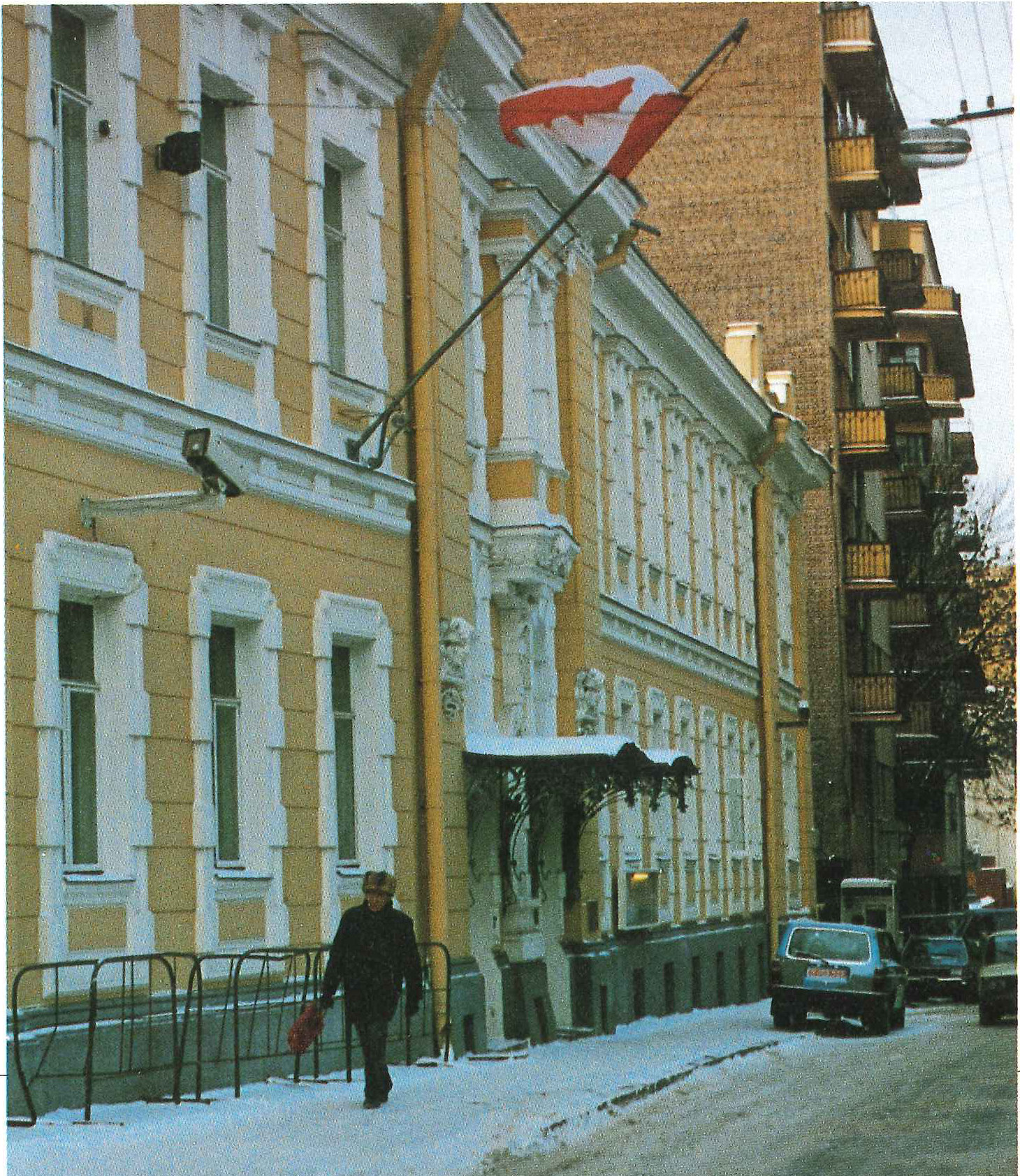
We checked into the Metechi Palace, an oasis of first world comfort in a city which was suffering more and more deprivation. The sign at the door asked guests to check their weapons. If this was not enough to persuade someone to part with their gun, all guests had to pass through a metal detector before entering. Our Georgian military hosts were quite relieved to find us at the hotel but spoke sternly about taking an unknown cab in Tbilisi.
Wearing black berets and combat fatigues our two military escorts picked us up at 11:00 a.m the next day. They looked in their thirties but were actually quite younger. After some delay due to fuel shortages, we boarded an Aeroflot Tupolev-134 (DC-9 equivalent) for our 40 minute flight to Sukhumi. As foreigners, we were allowed to board the aircraft first. What followed was a descent into chaos.
When it became known that fuel was found for our aircraft, a crowd of soldiers and civilians gathered around the stairs to the aircraft, appropriately called the “trap” in Russian. There were 120 seats on the plane and perhaps 300 who wanted to go to Sukhumi.
Pandemonium erupted when an attempt was made to end the boarding process. One soldier drew a knife on those who suggested that he consider taking the next plane. He was forcibly dragged down the aircraft aisle to the doorway when we heard him click off the safety on his rifle. The aircraft had just been refuelled. Another round of shouting and gesticulation. Finally, a woman dressed in black and wearing a small portrait of a fallen son, was able to calm this weary soldier. And the flight proceeded well as we flew over the verdant forests and fields of Georgia, a major food exporter during the Soviet years.
As the plane approached the war zone, a wide turn was made over the Black Sea to avoid possible Abkhazian heatseeking missiles. The aircraft was decelerating and coming around to its final approach when the pilot started yelling in Russian, “Na zad! Na zad!” or “to the rear!” All of a sudden, the forward compartments usually occupied by attendants were quickly vacated. The battle for Sukhumi intensified. In the weeks that followed, two Georgian aircraft were shot out of the sky killing all onboard.
Stifling heat and the distant rumble of shelling welcomed us to Sukhumi, a former idyllic city on the Georgian Black Sea coast. The Abkhazians were now shelling the Soviet-era equivalent of the Riviera in retaliation for Georgian attacks earlier that day. The next morning, we were given a tour of the damaged city. Georgian forces were firing shells back at Abkhazian positions visible just across the Gumista river.
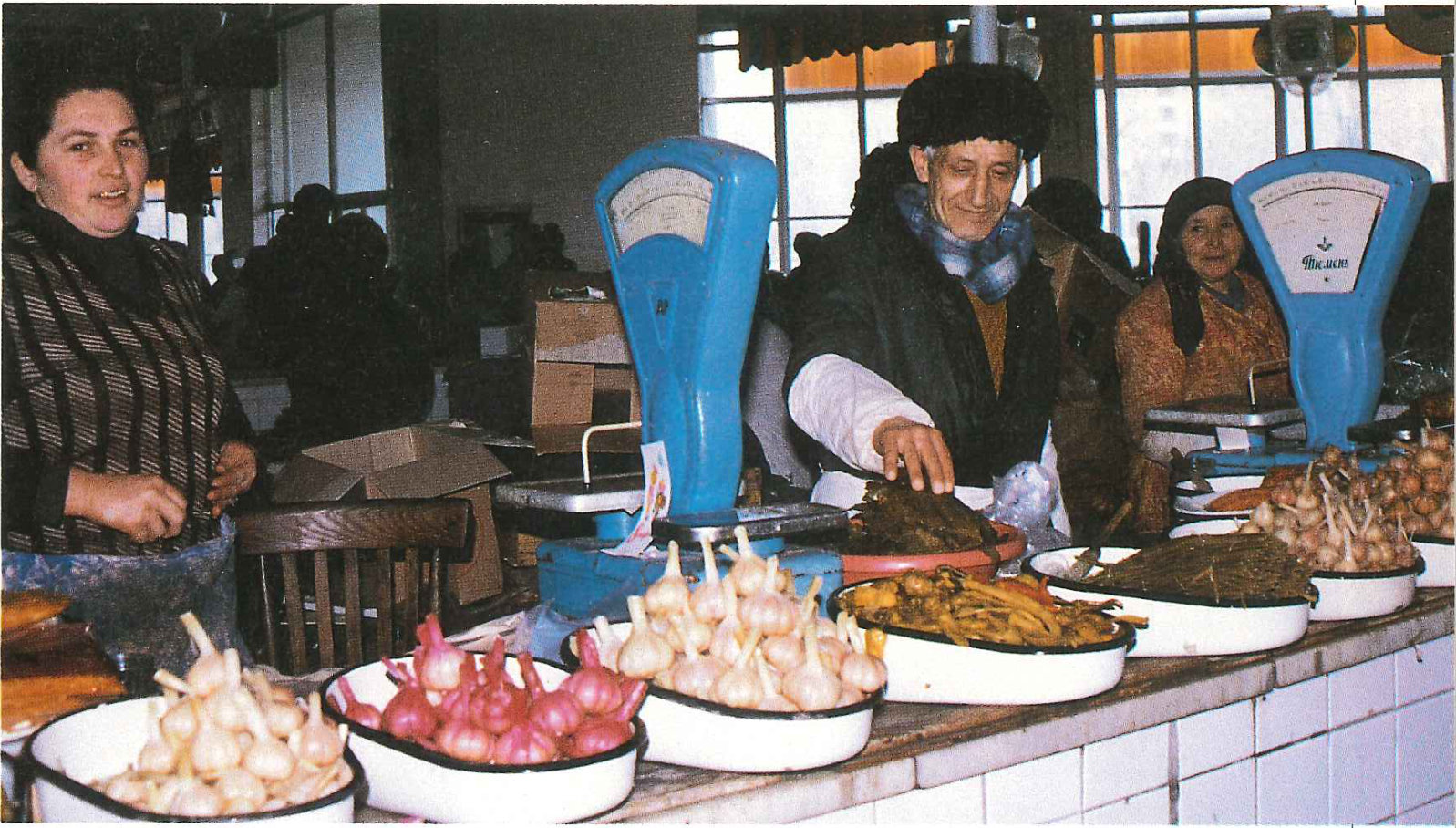
One Georgian family, a middle-aged couple living with the husband’s parents, showed us the damage to their two-stores house caused by an Abkhazian shell. Despite the damage and rebel advances on their city, they refused to leave their home. We were led past their still which remained in operation, up to the second storey. The shell pierced the upper wall and destroyed the contents of the bedroom. Fortunately, the family learned when to expect Abkhazian shelling and escaped injury by gathering in the safety of their basement.
We wanted to continue our tour, but our new friends had other ideas. The women disappeared and the men proceeded to speak of their plight. The elderly man thought he had seen enough violence for one lifetime during the “Great Patriotic War”. He joined the Soviet army of the Caucasus, and chased the fascists across Ukraine and Eastern Europe to Berlin. And then he walked back to his home in Sukhumi.
In a matter of minutes, the women had prepared a tasty dish of eggs, shallots and chopped meat and served it with cucumbers on the side. The vodka, distilled a few feet away, began to flow. Vodka toasts well before noon could be considered above and beyond the call of duty, but refusal would have been misinterpreted. In the Caucasus, a guest could be feted for days before being asked the purpose of the visit. We left it to our Georgian military escorts to extricate our group. Just as we were leaving, the elderly man brought us over to the front of the house to show us something which he revered. It was a bust of Josef Stalin, a Georgian by birth. “He was a great man. We could use a leader like him today,” he said.
Epilogue
Knowing what the history books had taught us about the pain and suffering which Stalin wrought on his own people, statements like these were difficult to comprehend even after three years in what was the Soviet Union. Maybe we had not come to know these people after all.
We continue to watch the story unfold with interest from Canada. It was difficult to sit through the televised reports of the October raid on the Russian White House, I the building which we had passed every day on our way to work. Since returning to Canada, we can’t help but wonder what has become of the children in Lithuania, the younger defenders of the White House, the factory director, the family in Sukhumi.
They are many miles away, but their voices still resonate.
View the original scanned pages →
Originally published in bout de papier, Vol. 11, No. 1 (1994) — Spring 1994 // Printemps 1994, pp. 18–21. Read the rest of this issue →



