
bout de papier, Vol. 20, No. 3 (2004) — Winter/Spring 2004 // Hiver/Printemps 2004, pp. 28–31
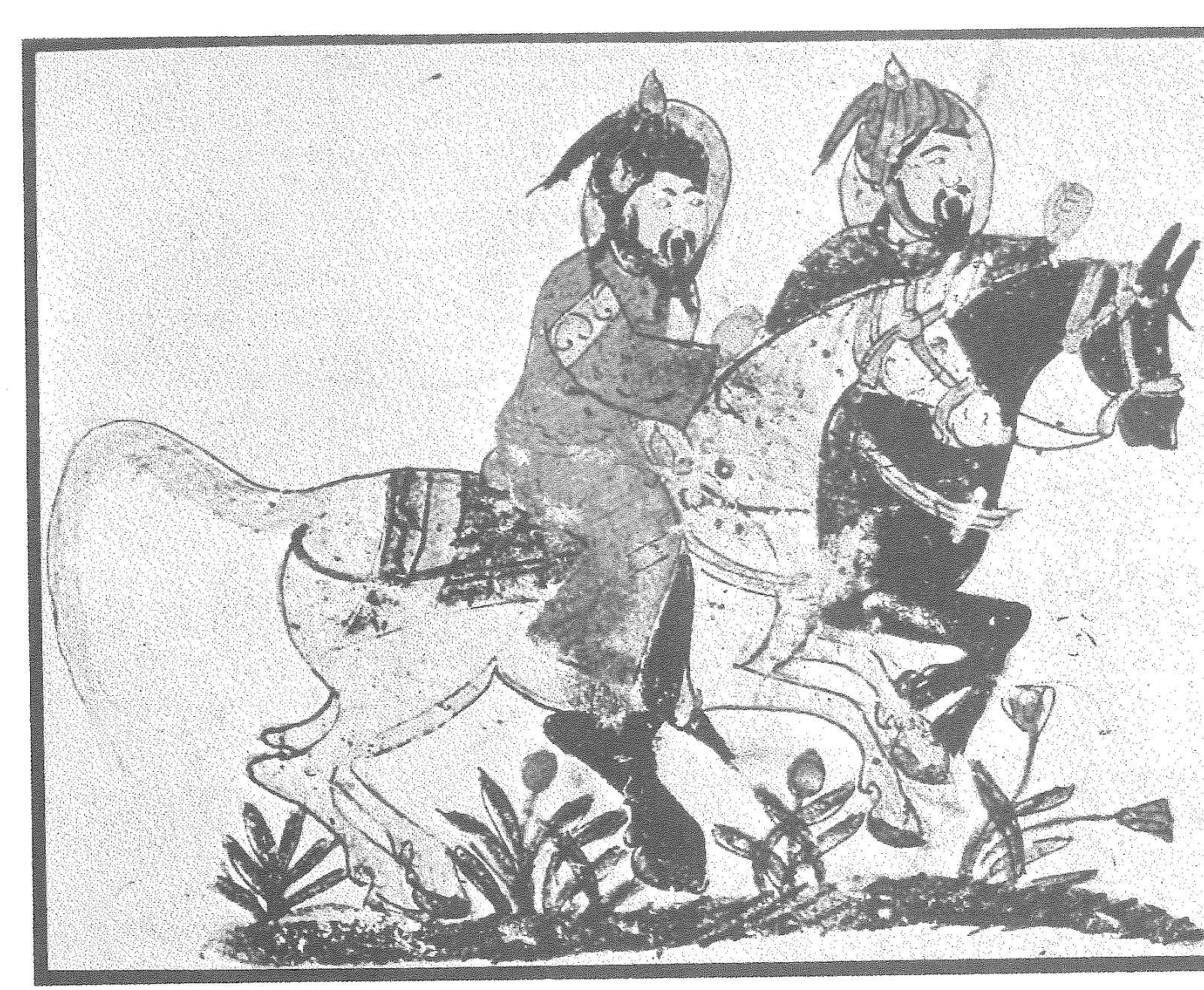
indeed, before the invention of firearms Yuicide terrorists are not new to this world; and explosives, few terrorists had any hope of escaping alive after an attack. With the exception of Samson, who reportedly killed 3,000 Philistines when he brought down the temple of Gaza, or (if Roman accusations to that effect are true) the Christian incendiaries who contributed to the great fire in Rome in AD 64, most ancient terrorist attacks were highly targeted affairs. The group most enshrined in legend are the Assassins, who gave their very name to the craft. The name, in fact, comes from the Arabic Hashishiyyin — the hashish users. They were an Ismaili (“’Sevener”) Shi’a cult, founded in Iran in the late eleventh century, later spreading into northern Syria. They flourished in their mountain hideouts for about 150 years. Their mastery of disguise was legendary. Assassin fedayeen could infiltrate the most closely guarded palace, disguised (as circumstances required) as Moslem scholars, Christian monks, or as members of their intended victim’s bodyguard, to strike their victims down with their daggers — they used no other method. The terror of their name spread far beyond the Middle East; they were even reputed to have struck down important victims as far afield as Germany, Italy and Mongolia.
The Grand Master of the Order, “the Old Man of the Mountain,” instilled such loyalty in his fedayeen that they would go to their deaths at his command, be it to kill an enemy or (according to some crusader accounts) jumping off cliffs to impress the Grand Master’s guests. Death was the usual outcome of a mission. Assassin fedayeen rarely made any effort to escape capture, and never expected, nor received, rescue. Martyrs’ names and deeds were recorded in a book of remembrance kept at the Order’s impregnable headquarters, the castle of Alamut (“the eagle’s nest”) high in the Elborz mountains in north-west Iran. At Alamut and in the Order’s Syrian daughter houses, there were reputedly gardens which replicated the Koranic descriptions of Paradise. There, recruits to the Order — selected from pious youths with a taste for warfare — were, after basic training, drugged with hashish and introduced to the garden, to experience all the delights which the Koran promises to martyrs. Needless to say they were very solly to leave, but were promised that so long as they carried out the Grand Master’s orders to the letter and to their death, they would return to this paradise, on the wings of angels. As with today’s suicide bombers, the parents of fallen fedayeen took pride in their fate. One mother, who had rejoiced in the news of her son’s death on a mission, blackened her face on learning he had escaped alive.
The Assassins’ origins lie in the great split between Sunni and Shi’a, which arose early in Islam’s history. The Shi’at Ali (the Party of Ali — the Prophet’s son-in-law) were those who believed in a hereditary line of succession. The first Caliphs were proven leaders; under them the forces of Islam stormed out of Arabia, to destroy the Persian Empire and overrun Roman Syria, Egypt and North Africa. Ali eventually did become Caliph in 656, but was assassinated in Najaf soon thereafter. An attempt by his son (and thus the Prophet’s grandson) Husayn to rise against his father’s slayers, the Umayyid Caliphs, led to his martyrdom at Karbala in Iraq in 680. As recent events have shown, Shi’ites still flock to the site to commemorate his death with acts of penitence and lamentation. For several generations, the line of Ali and Husayn continued, their descendants keeping a low profile in Mecca or Medina, away from the Umayyid centre of power in Damascus. They attracted adherents from Moslems who believed the Umayyids had fallen into worldly ways or that the benefits that should accrue to the faithful were not being fairly shared out. In particular the Shi’a movement was popular among newly converted non-Arab peoples on the fringes of the Islamic world, in North Africa and Iran.
Over time however the line of Ali began to split and branches died out. The belief grew in the Mahdi, a hidden Imam, who would return at the appointed time to restore Islam to how it should have been in the time of Ali. This discontent was exploited by the Abbasids, who mobilized the Shi’a of eastern Iran to overthrow the Umayyids in 750 and re-establish the Caliphate in a new city they founded in Iraq, Baghdad. The Abbasids soon found it expedient to repudiate their Shi’ite roots, as their newly won empire had a Sunni majority. This drove Shi’ites back underground to practice taqiyya, dissimulation, hiding their actual beliefs, while awaiting the coming of the Mahdi. In such isolation, the Shi’a movement split into sub-sects of “Seveners,” and “Twelvers,” depending on how many descendants of Ali there had been before the true line had gone into occlusion. Off-shoot sects adopted mystical practices and elements of other religions. Many believed that the martyrdom of Ali and Husayn cried out for vengeance. It was a religious duty to slay those they deemed to be unrighteous.
The Assassins arose from the Sevener or Ismaili sect. The line of Ali split at the death of the sixth Imam, Jafar, in 765. His son Ismail was disinherited, and the majority accepted his son Musa as Imam. This branch — the Twelvers — are now the official religion of Iran. A rump group remained loyal to Ismail’s claims, and as a sect within a sect became even more secretive and prone to occult beliefs. Central to their faith was a belief in the infallibility of and absolute obedience to their Imam and to his spokesmen or da’is. A well-organized secret society, the Ismailis attracted both the disadvantaged, seeking hope of overthrowing the established order, and discontented intellectuals who found little in mainstream religion.
In 908, Ismaili missionaries from Syria, having won many converts from the Berbers of Tunisia, were able to establish a state there. Their leader proclaimed himself Mahdi. In 969 this Ismaili group, who called themselves the Fatimids, after the Prophet’s daughter, conquered Egypt, where they founded Cairo and proclaimed a rival caliphate to that in Baghdad. For a time they even took over much of Arabia, while infiltrating cells into Abassid territory in hope of overthrowing their rivals. The situation in the region was fluid and the Byzantines were resurgent, their armies moving down into northern Syria and even as far as Lebanon and Galilee. Then, as the Roman reconquista ran out of steam, the Seljuk Turks appeared out of Central Asia, overrunning Iran, Iraq, Syria and Asia Minor. Recently, and zealously, converted to Sunni Islam the Seljuks were a threat to Christians and Shi’as alike. In the West, Pope Urban answered Byzantine pleas for mercenaries, and reports of Seljuk depredations against Christian pilgrims, by proclaiming what became the First Crusade. By 1099 Antioch and Jerusalem had fallen to the Crusaders. Their feudal principalities along the Levantine coast survived for the next two centuries.
In Persia, one response to the Turks was the rise of the Assassins. The founder of the order, Hassan-e-Sabbah, son of a Twelver religious scholar, was born sometime in the middle of the eleventh century in Qom, Iran, then as now a key spiritual centre. If terrorist profiling had existed at the time, Hassan’s origins would have set off a few alarm bells. His father came originally from southern Iraq, and the family had Yemeni roots. While he was still a child, Hassan’s family moved to Rayy, now a suburb of Tehran, where he pursued a religious education. There he met and was converted by some Ismaili da’is, and quickly rose in their ranks. This attracted the unfavorable attention of the Turkish governor. Hassan fled to Egypt, but fell afoul of a succession dispute that was to split the Ismaili movement from its Fatimid sponsors. Having backed the wrong faction, Hassan fled back to Iran, to resume his work organizing Ismaili cells among the remote and war-like peoples of the Caspian coast. Hassan’s great break-through came in 1090, when his agents took the castle of Alamut by stealth. In 1092, Hassan dealt his first blow against the Sultanate, the assassination of the Seljuk grand Vizier (in effect Prime Minister) Nizam-e-Mulk. Riding to his harem tent, Nizam was approached by an Assassin disguised as a religious scholar, pretending to deliver a petition, and was stabbed to death. Hassan exulted: The killing of the devil is the beginning of bliss. From then until his death in 1124, Hassan’s fedayeen carried out some 50 carefully targeted assassinations against Seljuk officials and the Sunni religious establishment.
Seljuk efforts to defeat this terrorist threat were a failure. Hassan’s influence among the warlike Elburz tribes was very strong and Alamut was virtually impregnable. When the Seljuk Sultanate began to disintegrate in the twelfth century, the Assassins exploited the contused political situation, helped by the tear they inspired, the existence of many sympathizers, even within the establishment, and just plain venality, which allowed them to bribe their way into the most closely guarded strongholds. From his base in the Elburz., Hassan extended his control throughout the Caspian region and into the remote deserts on the borders of Afghanistan. Efforts to build Ismaili cells in the major cities, however, never flourished. Both Sunni and Twelver Shi’ite townsfolk resented the presence of heretics, and urban Ismaili communities were frequently massacred. In 1132, after several failed attempts, the Assassins finally won a permanent pied a terre in Syria in the mountainous no man’s land between the Crusaders and Moslems.
In 1094, the split between the Fatimid Caliph and the Ismailis became complete and final, and the Fatimids too became targets. In 1121 a troop of ten Assassins from Aleppo struck down the Fatimid commander-in-chief, and in 1130 the Caliph himself was slain. The Fatimid response was a series of stringent security and surveillance measures. This included a “smart borders” initiative. Merchants were only allowed to cross at the border post of Ascalon if their identities and those of their camel drivers could be confirmed. Caravans were held at the border until the authorities in Cairo had received a list of the names of the merchants and their entourage and a list of their merchandise. These were checked again once they arrived on the Egyptian side of Sinai. (The officials at the border were, however, enjoined to show the merchants every honour and not to vex them unnecessarily.) In Cairo, the names and particulars of every inhabitant were recorded, no one could move house without official permission and government agents checked out anyone who harboured strangers. A mass round-up yielded many Assassin agents, including the tutor of the Caliph’s children. The Fatimids boasted that an Assassin could not leave Alamut without his every movement being tracked. Nonetheless, throughout the latter half of the twelfth century, the Syrian branch of the Assassins, under Rashid ad-din Sinan, an Iraqi from Basra, kept up the fight against both the Fatimids in Cairo and the Turkish emirate in Mosul. In the end he met his match (and vice versa) in Saladin. Sinan’s fedayeen were unable to penetrate Saladin’s security, but allegedly came close enough — leaving a poisoned dagger on his pillow — to persuade the great Kurdish leader of the folly of trying to capture Sinan’s strongholds.
After Hassan-e-Sabbah’s death in 1124 the steam gradually ran out of the movement. The number of Assassin attacks declined precipitously, although in 1139 they achieved a major coup with the assassination of the Caliph of Baghdad. Over time, the Order took on the look and feel of a small territorial state, albeit a rather heterodox one; however, the authority of Hassan’s successors as Grand Master remained absolute. The Assassins blindly followed in 1162, when Grand Master Hassan II proclaimed himself to be the hidden Imam and released his followers from the constraints of Islamic law. Almost forty years later, his grandson Mohammed II reversed the fatwa and restored Islamic observances, and his followers again accepted this without question. By the thirteenth century Assassin attacks seemed more focused on preserving their territorial integrity and revenues than on propagating the cause. Some operations were little more than contract killings or efforts to extort protection payments.
Rarely were the centres of Sunni power now targeted; indeed, to attain local political objectives, the Assassins sometimes allied themselves with Sunni leaders, and in Syria, even with the Crusaders. The Syrian chapter actually found itself forced to pay tribute to (and on occasion carry out missions for) their Christian counterparts, the Orders of the Templars and Hospitallers. Unlike temporal rulers, the Masters of these Orders had no fear of the Assassins, because, if struck down, they were easily replaced. When Syrian Assassins tried to extort protection money from the crusading French king Louis IX, the Masters of the Christian Orders forced them to relent. Only rarely did the Assassins target the Crusaders, and when they did it was for political or financial, not religious, reasons. The assassination, in 1192, of Conrad of Monferrat, King of Jerusalem, by fedayeen disguised as monks, was variously described as a revenge killing for his plundering of Assassin property or instigated by either Saladin or Richard the Lionhearted. Both stood to gain by his death, and one of Conrad’s attackers survived long enough to claim the killing was done at Richard’s behest. Fedayeen, however, were often given such cover stories to sow dissension among their foes.
By now the Order’s days were numbered. Since the early part of the thirteenth century Ghengis Khan’s Mongols had been extending their power over Central Asia. In the 1240s his grandson Hülegü moved against the prevailing power in Iran and the “Stans,” the Khwarismian Turks. They were soon swept aside and the cities of Central Asia laid waste. In 1256 the shock and awe of the Mongols descended on Iraq. Baghdad fell on February
20, 1258; the city was razed to the ground, and the last Abbasid Caliph and all his family were hunted down, wrapped in carpets, and trampled to death (the Mongols did not like to shed royal blood). The Assassin’s Grand Master, Rukn ad-Din, tried to come to terms with the new super-power. Hülegü would tolerate no in dependant power bases, and Rukh ad-Din was persuaded to surrender his fortresses. The commander of Alamut was tempted to hold out, but, after a few days’ siege, lost his nerve and surrendered. His fortresses gone, Rukn ad-Din was put to death. In Syria, the Order lasted a little longer. In the 1270s, the Mameluk Sultanate of Egypt systematically overran the Crusader states. The Assassins too fell under its control. Their castles were taken over and their operations subordinated to Mameluk objectives. By the turn of the fourteenth century the fedayeen and the Old Man of the Mountain were no more. Pockets of Ismailis remained in Iran, Syria and India. Today they follow a spiritual leader who claims descent from the last ill-fated Rukn ad-Din. Now however their leader — the Aga Khan — is best known for his wealth and his good works.
View the original scanned pages →
Originally published in bout de papier, Vol. 20, No. 3 (2004) — Winter/Spring 2004 // Hiver/Printemps 2004, pp. 28–31. Read the rest of this issue →



