
« … j’ai compris que moi aussi j’avais quelque chose à raconter dans le sens que je pense que chaque Rwandais l’a vécu d’une certaine façon. Donc juste le fait d’en parler, tu permets aux autres de penser, de la petite histoire de chaque personne, des choses comme ça. Ça permet d’informer les gens qu’est-ce qui s’est passé sur tous les aspects, comme un miroir cassé. Chaque personne peut regarder dans un miroir cassé, mais tu vois un objet différent dans chaque miroir. Donc, l’histoire de chacun et de chacune, ça devient comme un casse-tête qui complète l’histoire de qu’est-ce qui s’est passé au Rwanda. »
Annita Muhimpundu, genocide survivor
It was 2006, and my friend and I had been travelling around eastern and southern Africa for a few months. Blessed by the naiveté of youth and moments of excellent luck, we had managed to make it to the end of our trip relatively unscathed. Despite this, a visit to Rwanda for our last few days on the continent had not been an easy sell: to get to Kigali, on our budget, we would need to take a long-distance bus for 24 hours through two land borders departing in the middle of the night from River Road in downtown Nairobi.
Armed with only the exact cash needed in our pockets, we purchased our passage for later that evening. She struck up a conversation, this tall, beautiful woman who began to ask us the normal questions: “Where are you from? What are you doing here? Where are you going?”
We hedged and mumbled, wary of a stranger’s questions during this interaction. Toeing the very careful line between rude and discreet we managed to leave without alienating her.
We left the station with our tickets in hand, planning to return for our departure that evening. She waved us goodbye, “I’ll see you later tonight.”
When we returned to the bus station, she made a beeline to our sides. She took my hand as I boarded the bus. We found ourselves carried along to a set of seats towards the back and nestled in amongst her travelling companions. They were a church choir who had come to Nairobi for a competition and were headed back home to Kigali. We were, no doubt, a cause of excitement – tourists were still a rare commodity in the area, let alone backpackers.
It was hard to make small talk. Politics, religion, and ethnicity were obviously off the table, but questions about families, friends, location of origin? Each one was a potential landmine of suppressed trauma, either personal or inherited. It was an unexpected realization and caused a large amount of discomfort, a reminder of my privilege as a Canadian.
“I’m Tutsi,” she volunteered.
“He’s Hutu,” she added, pointing at the father of their flock. “Rwanda is so much more than the genocide. I’m glad you will see.”
“I can’t wait to see its beauty,” I replied. “I’ve read so much about your country.”
It is hard to determine where the story of a conflict begins. History sprouts in all directions, and the past is, after all, multi-dimensional. For a long time, the ruling Tutsi minority had been privileged and prioritized in Rwanda. The Belgians, who had been mandated the country following the First World War, had developed a more direct colonial rule than their German predecessors but also supported the Tutsi monarchies. ID cards issued by the colonial authorities in 1932 furthered the division between the two groups.
By 1945, a Hutu counter-elite began to develop and gained the sympathy of the newly arrived Belgian clergy. The Tutsi fell out of favour. The colonial power replaced the majority of Tutsi chiefs and sub-chiefs with Hutu and a series of attacks against Tutsi in November 1959 sparked violence across the country. This transition created the first community of Rwandan refugees as a wave of Tutsi fled over borders. Local elections in 1960 saw Hutu representatives gain control all across the country.
Rwanda was granted independence in 1962, and by 1964 well over 200,000 Tutsi Rwandans had fled into neighbouring countries, mostly landing in refugee camps. The large majority settled in Uganda.
Tutsi leaders had begun mobilizing in the Ugandan refugee camps in the 1960s but were far from united. Some began running incursions into Rwanda from the camps. Attacking at night, they became known as “Inyenzi” or cockroaches, the dehumanizing language later used to encourage genocidal actions. Between 1961 and 1966, they ran as many as 10 known raids which resulted in retaliation, with 10,000 Tutsi being killed and many more fleeing. Little else was achieved.
The mid-1980s saw the emergence of the Rwandan Alliance for National Unity (RANU), an organization of Rwandan exiles initially formed to intellectually discuss a return to Rwanda. The organization became more militant as Uganda faced its challenges, threatening the stability of the Rwandan diaspora. RANU later became the Rwanda Patriotic Front (RPF) having determined that gaining the right for refugees to return to Rwanda was the goal and the use of force was the only possible way to achieve it.
On October 1, 1990, the RPF entered Rwanda, starting a guerilla-style civil war that lasted until August 4, 1993, when they signed the Arusha Accords with the Rwandan Government in Tanzania. With these accords came a commitment to a transitional government and a UN peacekeeping force.
On the evening of April 6, 1994, a plane carrying the President of Rwanda, Juvenal Habyarimana, was shot down over Kigali and the following morning Prime Minister Agathe Uwilingiyimana and her Belgian contingent of bodyguards were executed. Moderate Hutu and Tutsi politicians who had supported the peace accords had been murdered and roving militias were going door to door executing Tutsi families, predominantly using machetes. The violence was immediate, visible, and extreme; rape was a purposeful tool.
International forces arrived in Kigali and left again, mostly taking with them citizens from their own countries.
The United Nations Mission Assistance to Rwanda (UNAMIR) was meant to oversee the implementation of the Arusha Accords and maintain peace between the two groups. However, when the violence of 1994 broke out, ineffective rules of engagement left UNAMIR helpless to respond. Over approximately 100 days anywhere from 500,000 to 800,000 people were killed. Almost no one escaped unscathed.
International bodies failed to declare what was happening as a genocide and therefore were not required to act. In response, in 2000, Canada took the lead in the development of the Responsibility to Protect Doctrine. There are three pillars to the doctrine. First, the State must protect its citizens. Next, the international community must assist States to protect their citizens when unable. The third pillar is the explicit responsibility of the international community to protect citizens when their State is manifestly failing. It was adopted at the 2005 United Nations World Summit and while there are limitations, as there always are in international diplomacy, it still represents a clearer path for the international community. People with far more agency than I as a 13-year-old, had tried to make a difference, incremental improvements to our little world.
In April 1994, I was a not-particularly sophisticated 13-year-old. The internet existed in a world that hadn’t yet met mine. News was delivered twice a day, by paper in the morning, and television at night. The images and coverage coming back from Rwanda were bleak. The horror of the genocide and how much of it could have been prevented forever changed the way I saw the world. The moment was a harsh introduction to global politics and the first time I understood that terrible things can happen in our world. I felt helpless in the face of global realities.
I followed the story of the genocide as it unfolded years after the violence. I read as the horrors were discovered and then I read as they were being dissected in academia and the press. I read the letters sent from loved ones, the personal accounts, the journal articles trying to explain a series of failures that defy explanation. I read about what-ifs: What if there had been no downed Black Hawk in Somalia? What if there had been no Bosnian War? What if the UN had left its forces in Rwanda and allowed them to intervene? What if? What if? What if?
I thought of my studies as we arrived at our first border crossing between Kenya and Uganda. The sky was dark, the moon hiding, and the only thing initially visible from the bus windows were the fires burning outside of the Kenyan border gate. Our new friends made sure we didn’t get lost as we ducked around a chain-link fence and into a small building to surrender our passports before reboarding the bus. My thoughts were on refugees as we drove the rough road across the country; I couldn’t imagine arriving in fear and desperation, leaving everything I knew behind to start anew.
“Where are you staying?” our new friend asked. The sun was setting, and we were approaching Kigali.
“Hotel Rwanda,” we responded. We hadn’t booked a room, but we were confident that there would be availability.
“Do you mean Mille Collines?” she asked, referencing the hotel at the center of a Hollywood film that had been released a few years earlier.
Hotel Rwanda was a cheap hotel, without hot water, in the Muslim quarter of Kigali. We could see that she was failing to fit us into a mould of other Westerners she had seen – those with endless budgets or needs of guaranteed security.
After a brief exchange between her and the priest, they instructed us to stay on the bus when we arrived, letting everyone else off first. Once we descended, our luggage was waiting for us next to a taxi and a moto-taxi. A decision had been made. They were taking us to the hotel to make sure we had a place to stay the night.
The priest jumped on the moto-taxi, and we climbed in the cab. The fare had been determined without us, eliminating the typical foreigner surcharge and our friend looked back at us as she climbed into the car with a smile.
“You will be safe in Rwanda,” she said. “But we wanted to make sure you found the hotel and got a room.”
After she confirmed with the clerk there was a space for us, she gave us each a huge hug and then surprised us: “Thank you for coming to Rwanda.”
With that, she jumped on the back of the waiting moto-taxi and disappeared down the road.
Our first full day in Rwanda was spent visiting the Kigali Genocide Memorial, which was a well-developed punch to the gut. There on the wall hung a Tim Hortons t-shirt, pierced through and blood-stained. The next room with life-size photos of children and their last words had a lasting impact.
“Don’t worry, Mommy, UNAMIR is coming,” lingers, as it is meant to, a dig at the collective guilt the world shares.
Our last night in Rwanda we sought a room at the Mille Collines. The front desk clerk was not amused, our dusty clothing and overstuffed backpacks ruining the esthetic of the opulent lobby, but he reluctantly let us check-in.
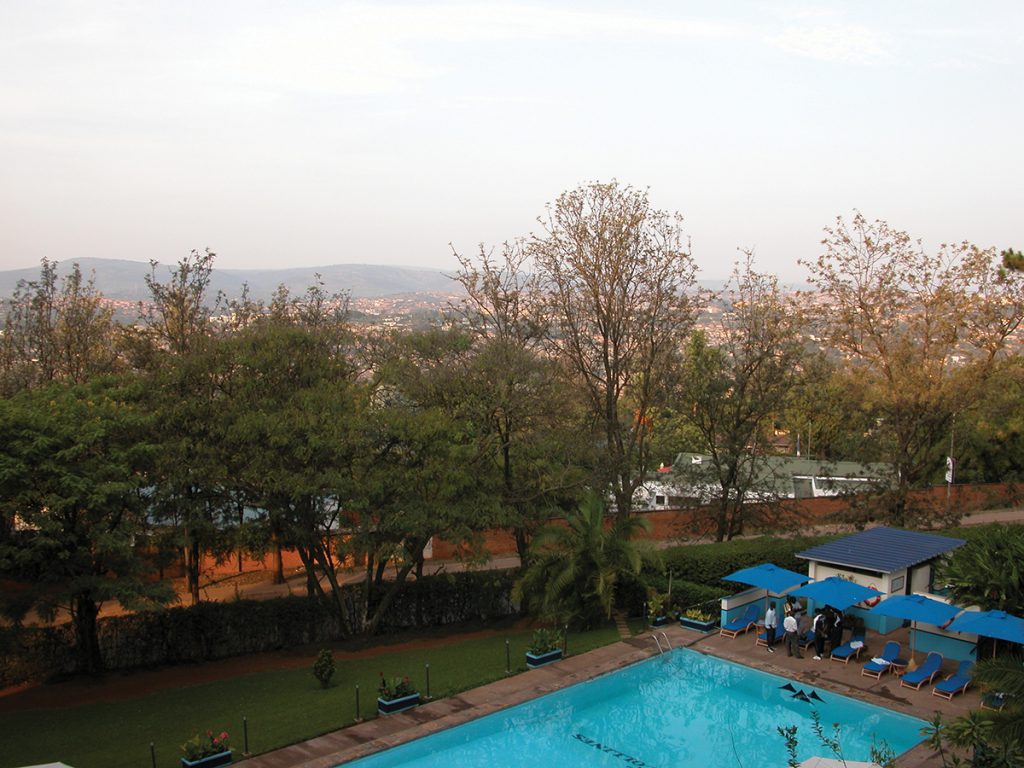
The hotel was nearly empty, but the pool had returned to its original purpose. As I sat around it, I replayed scenes from the film “Hotel Rwanda” in my head until we were distracted by the evening. The next time I sat on that patio it would be close to a decade later.
When I began work in 2008 on my master’s in history, Concordia University started a project recording the life stories of people who had lived through mass violence, including Rwandan refugees. I was honoured to be trusted to listen to people’s stories and save them for the future. In the Hall Auditorium, I heard a student recount how he was wounded and sought refuge at the Mille Collines, hiding out in bushes near the pool. He was speaking to Paul Rusesabagina, the protagonist of “Hotel Rwanda”. A man either lauded as a hero or villainized as a genocide denier.
The film that purportedly told Rusesabagina’s story took a significant amount of artistic licence, as did the other films that covered the topic such as “Shooting Dogs” and “A Sunday in Kigali.” These films brought awareness of the Rwandan genocide to North American audiences, so did it matter that they were inaccurate? Academically, I argued it did. The white saviour narrative found in most of the films was especially harmful. The reality was that foreigners in Rwanda were quickly evacuated; various militaries flew into the conflict only to collect their citizens. It was the Rwandan Patriotic Front who eventually captured Kigali, ending the genocide in July 1994 with little help at all.
In 2010, seeking international experience, I haphazardly threw in an application for the only position available at Foreign Affairs and International Trade: Foreign Service Administrative Assistant. One year later I received a letter of offer and left my other career for new horizons. When I was eligible, my first choice was evident: Nairobi, Kenya. The High Commission in Kenya is responsible for our office in Kigali and when the High Commissioner asked if I’d be willing to go to Kigali to assist with the 20th anniversary commemoration of the genocide my response was immediate and affirmative. I had been selected to join the Management and Consular Officer stream and I was simultaneously training while fulfilling my duties, so this opportunity aligned personally and professionally.
The advanced days on the ground were focused on logistical issues. Canada sent our Parliamentary Secretary for the occasion and the city was full of foreign dignitaries. The Mille Collines was the official hotel for VIP guests, assigned by the host government. Layers of memory came back as I set foot in the lobby, and I spent the next couple of days sitting around the pool for meetings and meals. This time the hotel was full.
The following day everything came full circle: the actual anniversary. Events started in the stadium and ended with a “Walk to Remember.” Each step I took forward cast me back. I remembered voices and words; images from reality and fiction; auditoriums full of people seeking to understand. I remembered how helpless and hopeless I had been as a young girl on the cusp of maturity. Thirteen-year-old me might not have been able to do anything, but 33-year-old me could help to make sure the event was not forgotten. A small role in diplomacy restoring the power I had lost so long ago and a confirmation that I was right where I was meant to be.


