bout de papier, Vol. 20, No. 4 (2004) — Spring/Summer 2004 // Printemps/Été 2004, pp. 15–18
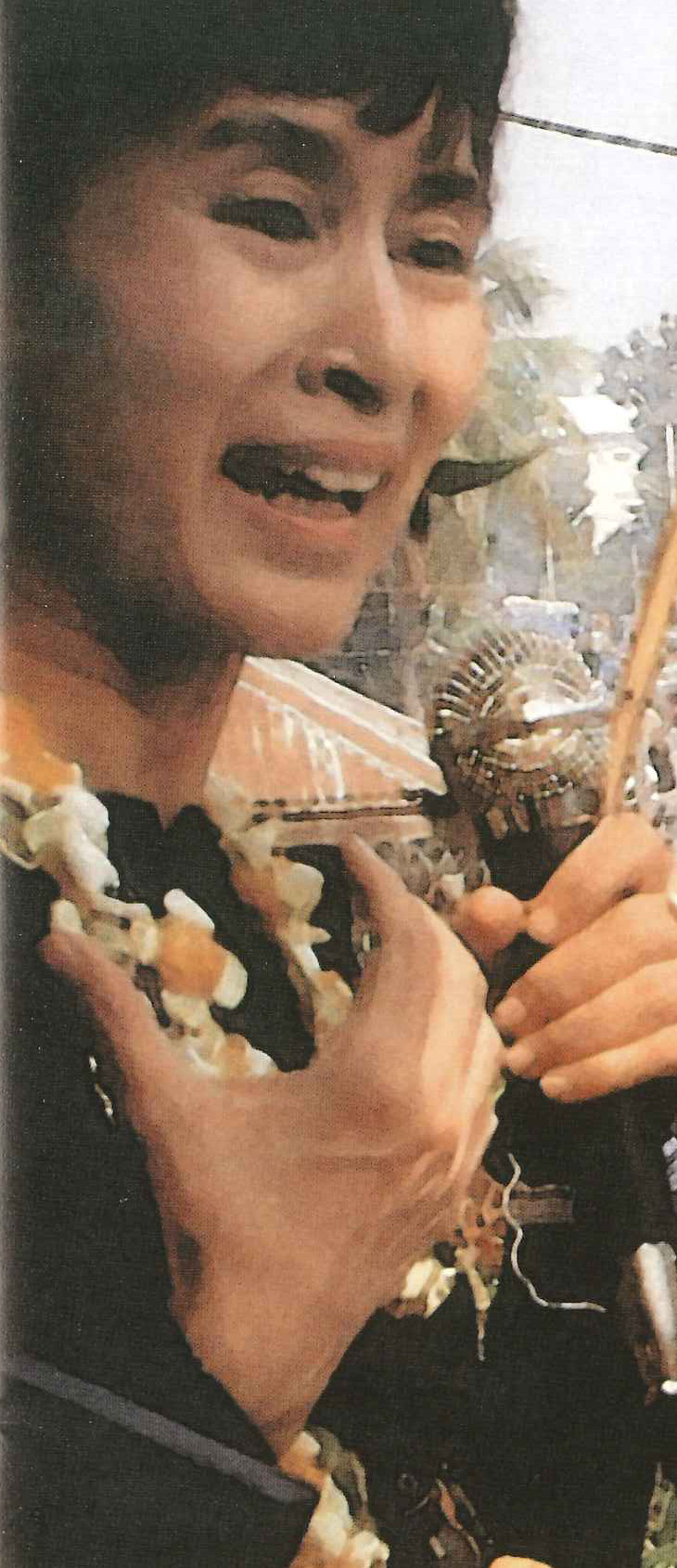
Far away from the centres of global power and international media, wedged in between India, Bangladesh, China and Thailand, lies the fascinating, culturally rich country of Burma (Myanmar to its longtime military rulers) where an epic drama has played out for decades between a stubborn, authoritarian and entrenched military caste and the democracy movement led by a legendary, charismatic and strong-willed woman, Nobel Peace Prize Laureate Aung San Suu Kyi.
There is a climate of fear but within this climate of fear I’m very
proud to say there are many, many brave people… they’re committed enough to
carry on with their work, in spite of their fear. Those are the really courageous ones and I’m very proud of them. AuNG SAN Suu KYI, APRIL 2000
Described by the Acting Director of the Norwegian Nobel Institute as “a unique woman, some say the most shining of recent Nobel winners,” the Lady — as Aung San Suu Kyi is known to millions of Burmese — brings to mind Margaret Thatcher’s memorable phrase about herself, “The Lady’s not for turning.” Suu Kyi’s single-minded leadership of the democratic opposition to military rule in Burma has won her admiration around the world. Though she has not left Burma since 1988 and has spent much of that time under house arrest, she has become a global figure like Nelson Mandela.
Aung San Suu Kyi is a slight, slender figure who casts a huge shadow in her own country, Burma. Since 1988, this youthful grandmother has been locked in a struggle with the generals who have run Burma since a coup in 1962. There is no end in sight to their confrontation.
As Political/Economic Counsellor at the Canadian Embassy in Bangkok, accredited to Burma, as well as Thailand and Laos, from 1998 to 2003 and as Chargé d’Affaires to Burma in 2001-02, I had the privilege of meeting with Aung San Suu Kyi on a regular basis over the course of several years and discussing a wide range of subjects with her.
The following is an attempt to convey the atmosphere of those meetings and those years. My two Ambassadors during my five years in Bangkok, Bernard Giroux and Andrew McAlister, also met separately and regularly with her during their own visits to Burma.
On our visits, we would also meet with senior Burmese Government officials where we would press, among other things, for the release of the approximately 1,500 political prisoners in Burma. My meetings with Suu Kyi generally occurred either at her house or at her NLD Party Headquarters. Those with senior government officials — including Ministers — were held in their Ministry buildings including sometimes in the red colonial-era Secretariat building, the very building where Suu Kyi’s father, independence leader Aung San, was gunned down with eight of his colleagues six months before independence as he was leading a meeting of the Governor’s Executive Council in July 1947. On occasion, after meeting with Suu Kyi, I would go to a meeting with Ministers in this very Secretariat building.
Rangoon is a picturesque city still marked by its colonial past. Downtown there are dozens of blocks of crumbling colonial-era shop houses, tenement blocks and commercial establishments. In the more affluent residential areas, including the diplomatic quarters, many of the finest buildings have been beautifully restored as embassies and ambassadorial residences. These areas are marked by broad tree-lined avenues. There is a lake in the centre of the city. Suu Kyi’s family home is set in a compound that lies on the shore of the lake, at 54 University Avenue, a curving tree-lined boulevard. It was in this home that she was detained under house arrest from 1989 to 1995 and twice more in later years. The avenue in front of her house is closed to traffic.
The first meeting that I had with Suu Kyi was in 1999, the last in 2003. To get to her house in 1999, I first had to go through a security check at the roadblock on University Avenue manned by military personnel and plainclothes security personnel lounging on a wooden bench under a tree. I would show my passport and explain who I was going to see; however, as a matter of policy, I and other diplomats would never ask permission of the authorities for such visits. The security personnel would gather around to examine my identification documents, talk into walkie talkies and write down the information from my documents in a big ledger sitting on a wooden table under a tree by the side of the road. Security personnel would also snap my photo as well as that of the automobile. After a delay that varied from a few to many minutes, the car would be allowed to proceed to the next checkpoint. Forty metres further on, Suu Kyi’s compound was marked by a high wooden picket fence topped by tattered NLD flags. The gate would be opened from inside by some attendants and / would pass through, driving down a short twisted driveway to her lakeside house that Suu Kyi had inherited from her mother. I would be shown by an attendant into a sitting room, sparsely furnished with a window seat, a small table and a large Warhol-like painting of her father. From the window, one could see the lake.
After a short wait, Suu Kyi would come in by herself. We would sit in the window seat and talk, sometimes about the past but mostly about the present and the future. Exceedingly well-informed about developments, despite the physical restrictions placed upon her, and interested in the wider world, she had a broad perspective and provided trenchant analysis of a range of subjects. At a certain point an attendant would enter with some tea and snacks and the Lady would pour the tea. After the meeting Suu Kyi would escort me to the door.
DETENTION AND RELEASE
During 1999 and 2000, Suu Kyi’s party — the National League for Democracy (NLD) — and its members came under increasing pressure from authorities who also refused to engage her in discussions about the future of the country. Sometimes access to her and the NLD would be blocked. Foreign diplomats were turned away by authorities when we attempted to attend a commemorative function at NLD Headquarters in May 2000. In the meantime, Suu Kyi, although freed from house arrest since 1995, was in fact confined to the Rangoon area. It was her attempt in August and September 2000 to travel outside Rangoon to visit her beleaguered party members that resulted in a further 19 months of house arrest until May 2002.
During that period, rumours abounded about both her health and whether she would be released. The speculation was reminiscent of what had occurred in the period leading to her release in 1995 following the earlier period of house arrest from 1989 to 1995.
Pressured by the international community and faced with a deteriorating economic and social situation, Burmese authorities released Suu Kyi from house arrest on May 6, 2002. After her release, she made her way in a white Toyota sedan to NLD Headquarters, a ramshackle building in central Rangoon, to be greeted by hundreds of joyful supporters, including monks in crimson robes, massed in the street outside. Yellow-jacketed party stewards had to block a path for her through the crowd. In her first public statement to the cheering crowd, she said “It’s a new dawn for the country,” adding that dawn is only the beginning of the day. “We only hope the dawn will move forward very quickly into full morning.” In remarks broadcast live throughout much of Asia and other parts of the world, but ironically and ominously, not in Burma itself, she said she would do “everything I can to make sure that democracy comes to Burma.” She hoped that Burmese authorities would finally engage in substantive discussions with her and the democracy movement.
Those hopes were to be disappointed but were still fresh when I met with her a few days after her release, one of the first diplomats to do so. We met in the NLD Headquarters conference room on the second floor, which had been set aside for her use. It was a blistering hot pre-monsoon day in Rangoon with the temperature around 40 degrees Celsius in the building. I awaited my meeting with her in the sweltering main floor area jammed with party workers holding meetings and preparing papers. Foreign journalists — granted rare journalist visas — stood around, fanning themselves in a vain attempt to cool down. I regretted having left my bottle of water in the car. I eyed longingly and apprehensively the barrel of water sitting on the floor with a cup hooked to its side.
Before I could decide whether to hazard a drink, I was summoned upstairs for a meeting with the Lady, one of a long line-up of people — party leaders and activists, diplomats, journalists — she would meet with that day after her long confinement. Despite the demands on her time, she was, as always, very gracious and concerned about my comfort. She said I should take off my suit jacket. She herself looked very cool, composed, elegant and untroubled by the heat. She had on, as always, her traditional ankle-length Burmese sarong; her black hair was tied back with white jasmine flowers. She looked remarkably younger than her then 56 years. There was an air conditioner in the room powered by a generator (due to perennial power cuts in Rangoon) but it did not work very well. Every so often, the Lady would get up and bang the unit with her hand.
There was also a telephone in the room which for some reason unknown except possibly to the Rangoon telephone exchange could only be used for incoming calls. Suu Kyi had received calls from foreign dignitaries congratulating her on her release.
I was struck at the time by how confident and serene she appeared despite having just been released from her many months of confinement and despite the frustrations of dealing with intransigent military authorities.
She was also remarkably well-informed for someone who had been under detention. During her house arrest she had continued her usual practice of listening to shortwave broadcasts of BBC and Radio India.
RISE OF A DEMOCRACY LEADER
Aung San Suu Kyi is the daughter of Burmese independence leader Aung San, who was assassinated when she was two years old and who remains an honoured figure in Burma, even by the very military leaders whose nemesis is his daughter. Her mother Daw Khin Kyi was a distinguished figure in her own right who served as Burmese Ambassador to India. Suu Kyi spent much of her youth going to school in
In our country… we experienced chaos and instability when the multiparty democratic system was put into practice right after gaining independence before the nation had a chance to become strong.
SENIOR GENERAL THAN SHWE CHAIRMAN, STATE PEACE AND DEVELOPMENT COUNCIL MARCH 200|
India and England. She then raised a family with her husband Michael Aris, an Oxford scholar. In 1988 she returned to Rangoon to care for her ailing mother. Her visit coincided with the beginning of the uprising against military rule. Begun by students, the demonstrations soon spread through many sectors of Burmese society. She quickly assumed a leadership role in the movement, at first due to the fact that she was her celebrated father’s daughter and then increasingly because she was such a charismatic figure in her own right.
The movement ended in tears as demonstrators were gunned down in 1988 in the streets of Rangoon by the military. Despite this quashing of the democracy movement, the military attempted to gain legitimacy for themselves by holding elections in 1990, the first and only ever held since a military coup brought the soldiers to power in 1962. The military apparently fell victim to their own propaganda which proclaimed their popularity with the people.
In fact, Aung San Suu Kyi’s party, the NLD, managed to win 82% of the seats in the 1990 elections, winning polls even in districts populated by military families. However she and her party were never allowed to take power; the results were annulled. Instead she spent much of the period since the election under one form or another of detention. She was under house arrest from 1989 to 1995 and then again from September 2000 to May 2002 and again from May 2003 to the time of writing (July 2004).
Despite this, by every account and indication, she has retained her vast popularity with the Burmese people. This was borne out after her release in May 2002 when she was allowed to begin her series of visits to different parts of the country. Huge crowds lined the route in the hot sun to see her pass, straining to hear her every word despite efforts by the authorities to keep them away.
In Rangoon itself, her name is spoken in awe and whispers, so powerful is her image and so pervasive is the control apparatus of the Burmese state. But even those sympathetic to the regime — including the small set of venture capitalists, entrepreneurs and real estate speculators who have sprung up in Rangoon in the 1990s — do not deny that she would win an election if one was called today.
I would meet the Lady several more times in the 12 months after her release until she was rearrested in May 2003. Some of the meetings would be at her Headquarters and other times we would meet in her home. On these latter occasions, we would sit at a small wooden table in a room furnished with a wooden bench, some chairs, a desk, a TV and VCR and family photos including that of her late husband, her parents and her children.
She had met her husband Michael Aris when she was a student at Oxford. They had eventually settled there and raised two sons after a period of time in Bhutan where her husband, an Oxford don and Tibetan scholar, was conducting research. During her long period of house arrest from 1989 to 1995, her husband and sons were occasionally allowed to visit. But when her husband fell terminally ill in 1999, the regime caused widespread anger when it refused him a visa so he could pay a final visit to her. He died without ever being able to say goodbye.
DETAINED AGAIN
The last time I met Suu Kyi was May 5, 2003. Little did I know at the time that it would be the final time we would meet nor that this would be the last time any diplomat would meet with her for over a year. Normally, I would meet her alone. On this occasion, I was joined by a couple of Dutch diplomatic colleagues. Suu Kyi, as always at these meetings, was unaccompanied.
Aung San Suu Kyi was about to leave the next day on what would turn out to be an ill-fated month long voyage to the North, to remote Kachin State, her longest visit yet outside of Rangoon. Since her release from house arrest in May 2002, she had made a series of voyages to various parts of Burma where she was met by ever larger crowds. She had just returned shortly before from another remote area, Chin State. The crowds which greeted her throughout her travels were all the Canada has long pressed Burmese authorities to take substantive action, including the release of political prisoners, the beginning of a serious dialogue with Aung San Suu Kyi about the political and constitutional evolution of Burma and a clear timetable for the constitutional process. In the absence of such action, Canada has imposed various measures against the regime. These include selective economic measures. Since 1997, the Canadian government has urged the Canadian business community to refrain from entering into further investment agreements or commercial ventures in Burma until improvements are evident.
The United States strengthened its sanctions against Burma in 2003, imposing an import ban. US economic sanctions were renewed in 2004. The European Union renewed its “common position” on Burma in 2004, which imposes a variety of measures and restrictions on Burmese authorities including an asset freeze and visa restrictions.
I have always believed that the future stability and happiness of our nation depends entirely on the …n….ess of all parties to work for reconciliation. During the many years that I spent under house arrest, many parts of the world have undergone almost unbelievable change, and all changes for the better were brought about through dialogue… Only discipline and courage devoid of any grudge will help us achieve our desired aims and aspirations. Pro-democracy forces should work slowly, steadily, thoughtfully, and courageously.”
more remarkable because her trips were never reported in the tightly controlled Burmese media. Despite this, people heard she was on the way, alerted by the Burmese language broadcasts of BBC and Voice of America and by the warnings of the authorities that people should not go and see the Lady. People would stand for hours in the hot sun waiting to see her pass.
In the course of that last fateful trip to Kachin State, she and her party muuru be met by growing joyous crowds. And then on May 30, 2003, disaster struck. Her party was attacked en route in the dead of night by a criminal mob. There were many injuries and reports of fatalities. The attack was not completely unexpected; she and her party had been subjected to increasing harassment during both this particular trip and previous ones. The attack provoked widespread outrage.
For a time there was much confusion and fear about both the number of casualties and the fate of Suu Kyi and her septuagenarian deputy, U Tin Oo. Eventually, it was determined that she was being kept in detention in a government facility where she remained until September until she was admitted to the hospital for an operation. She was then returned to her home where she remains under house arrest at the time of writing (July 2004).
U Tin Oo was at first thought to have suffered serious injury; there was also concern that he might not have access to necessary medication. Eventually, it was determined that he was being held in a very remote army camp up near the Burmese/Indian border. He too was detained for several months until finally also being returned to house arrest at his home in Rangoon.
Other senior members of the NLD were also detained. NLD offices including the Headquarters building were padlocked. All phone lines to the leaders were cut. In fact Aung San Suu Kyi had not had a working phone in her house for years though she was listed in the Rangoon telephone directory.
FINAL MEETING
But when we met at NLD Headquarters in central Rangoon on the hot afternoon of May 5, 2003, we did not know what awaited her or U Tin Oo, with whom I met separately immediately before my meeting with her. My Dutch colleagues and / drove up together to NLD Headquarters, located in a building set only a few feet back from the sidewalk. We were closely observed by a number of men planted in chairs in the café across the street. As usual, the Headquarters was a beehive of activity with people sitting and standing, meeting and talking. On the walls there were various graphic depictions of the Lady. We were escorted upstairs and sat in the hallway chatting with U Tin Oo until Suu Kyi arrived up the stairs in a swirl of smiles and handshakes. She led us into the second floor conference room which she used for meetings. Since her release from house arrest the year before, / noticed that she had overseen several small changes to the room to make it more homey. The back of the chairs had been covered with cloth and there was lace under the glass table top. As always, Suu Kyi sat very straight in her chair, like the attentive student she had once been and made her points very firmly with her Oxbridge accent.
At the time of writing, the regime continues to hold well over 1,000 political detainees and refuses to release Suu Kyi or Tin Oo or to allow them to participate in the national convention working on a new constitution; the convention was reconvened in May 2004 after having been suspended since 1996. Without their leader being allowed to participate, the NLD announced that it would not participate in the Convention, which is being held in a military camp near Rangoon.
MEMBER OF BuRMA COLONIAL POLIC Aung SaN Suu KyI, 1996
Delegates to the convention were told by the regime that they should “avoid speaking ill of others,” including the government, and maintain the confidentiality of the proceedings and that they are not allowed “to walk out individually or in groups or to mock others.”
Since my meeting with her in May 2003, the only foreign officials allowed to meet with her have been the UN Secretary General’s Special Envoy, a UN Human Rights Special Rapporteur and representatives of the International Committee of the Red Cross.
Despite this latest battle of wills, I have no doubt that the Lady is as serene, confident and determined as ever. In the meetings we had, I was always impressed by her resilience in the face of obstacles that would have broken the spirit of most people. Indeed the more difficult the political situation became, the more determined and buoyant she would become. She was, and is, a political leader at the top of her game.
In Burma, the past belongs to those who control the present.”
GEoRge ORWELL MEMBER OF BURMA COLONIAL POLICE SERVICE, 1921-1928
View the original scanned pages →
Originally published in bout de papier, Vol. 20, No. 4 (2004) — Spring/Summer 2004 // Printemps/Été 2004, pp. 15–18. Read the rest of this issue →