
bout de papier, Vol. 9, No. 4 (1992) — Fall 1992 // Automne 1992, pp. 35–36
At first we did not see anything. Then our point man, outlined in gray, slowly sank to his knees and signaled for us to do the same. Some dozen of us, about ten meters behind on a wet beach in northern Trinidad, held our breath and quietly followed him onto the damp sand. Although the moon had been up for a few hours, the rush of rain-laden clouds allowed only infrequent views of the shadowy world ahead. Slowly, in the distance, the movement of a dark mass, contrasted against the lighter sand, caught our eyes and we crept forward, all the time keeping quiet and low to the ground. It was our first Leatherback turtle.
With quiet dignity, a large and slow female Leatherback pulled herself along in the wet sand. After watching the beach from offshore, possibly for hours, she had seen no threats and was now heading for a spot just above the tide line where she would dig her nest and lay her eggs in the dry, warm sand. Molly Gaskin, a Trinidadian naturalist and our guide, who often patrolled the turtle beaches to protect the reptiles from human predators, cautioned us to refrain from approaching the turtle until the nesting ritual began. We watched from the darkness as the turtle slowly and meticulously began to dig a nest. Once started on her nesting task, she would enter a trance-like state and nothing would stop her from completing her mission, and we could approach her without causing distress.
In the distance we saw the small clouds of sand which inefficient flippers heaved into the air as the nest slowly materialized. These same flippers are considered a delicacy by some Trinidadians. An hour earlier, during our walk along the beach we had come across the rotting carcass of another Leatherback which had come ashore only to meet machete-wielding locals. After cutting off the flippers, the killers had left the huge reptile, weighing 300 kg or more, to bleed to death in the sand.
Earlier in the evening, we had encountered eight locals sitting in the dark on a fallen tree trunk at the edge of the forest above the beach. We had nearly passed by them. But glowing embers from cigarettes emerged from the depths of the rainforest, while the dark-skinned and darkly clad owners remained hidden from view. The sweet smell of ganji was in the air as the dark forms quietly watched our passage. When we came nearer, we noticed the machetes stuck in the soft earth before each person. Their purpose on the beach was not in doubt. Sinister in the dark, the eight figures made more than a few of us nervous. To add to our worries, the diminutive Molly challenged the shadowy group over turtle hunting and berated them about killing these large gentle creatures. The rest of us, fearing the worst, looked around for a place to run. To our surprise — and relief —the locals responded gently that they would never think of hurting any turtle and were only “liming”, the local patois for gossiping. With uncertainties remaining we continued along the beach but I cast several furtive glances over my shoulder in the expectation of seeing dark silhouettes, machetes held high, racing after us.
We watched for half an hour while the Leatherback dug her nest. She was well-committed, and we could approach without causing her distress. Flashlights could now be safely switched on. In their beams we saw that the Leatherback was below the tide line, her passage interrupted by a palm log washed ashore on the beach. The sand recorded her laboured passage along the full length of the log. The turtle had stopped just short of reaching the end. Once ashore, a female Leatherback has only a limited time before the 80-85 eggs which she will lay that night, begin to come. Impeded by the beached log and unable to stem the flow of her eggs, the turtle had dug a nest which was obviously not above the tide line. Her efforts would be wasted and her eggs would die.
She was impervious to our presence. We inspected her meter-and-a-half long body and felt her soft shell. Tears rolled from her eyes, natural lubricants generated from a gland close to the eye which produces “tears” to rid the turtle’s system of excess salt ingested while eating in the salty sea. Washed away while under water, the excretions from the glands give a false appearance of crying when the turtle is on land. On her neck and front flippers were what looked like pink lesions, as if she had been in a fight. These were the aftermath of the mating ritual and apparently caused no discomfort. Her mate was probably lying offshore, watching and waiting for her return. Our Leatherback would come ashore up to half a dozen times between March and August to lay eggs and then would wait two years or more before returning to this same beach.
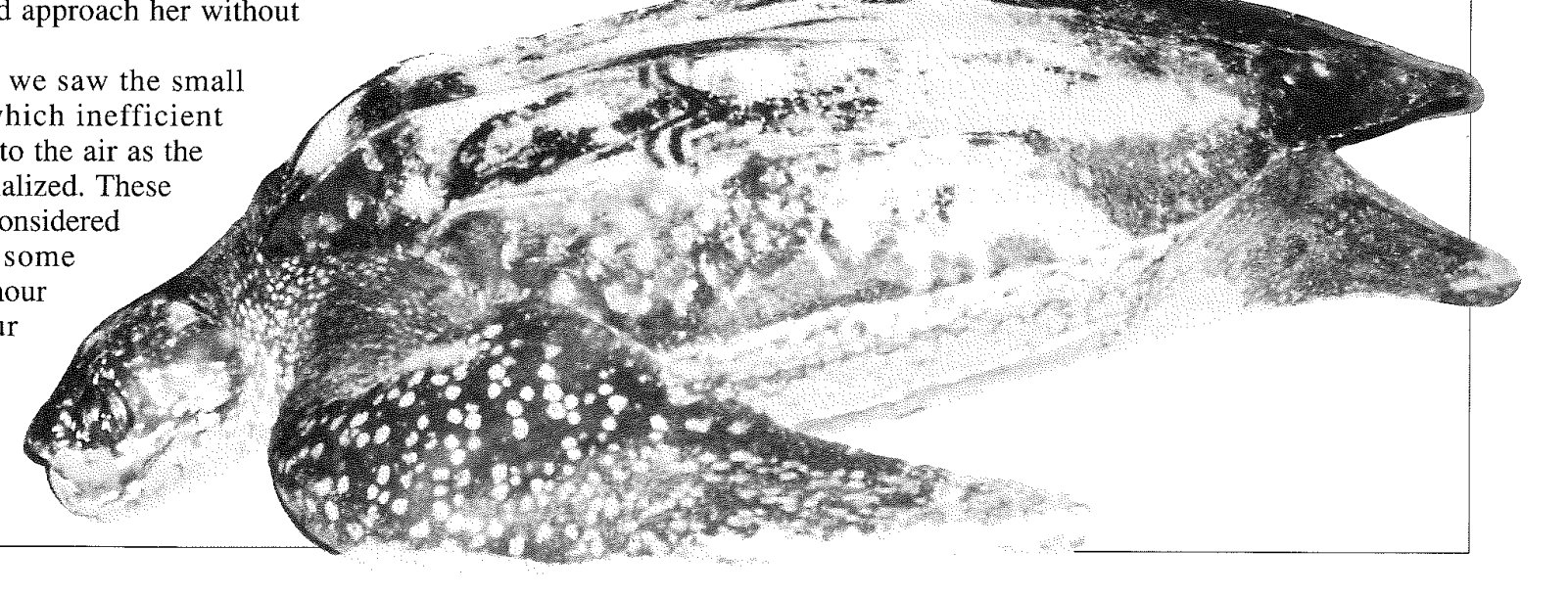
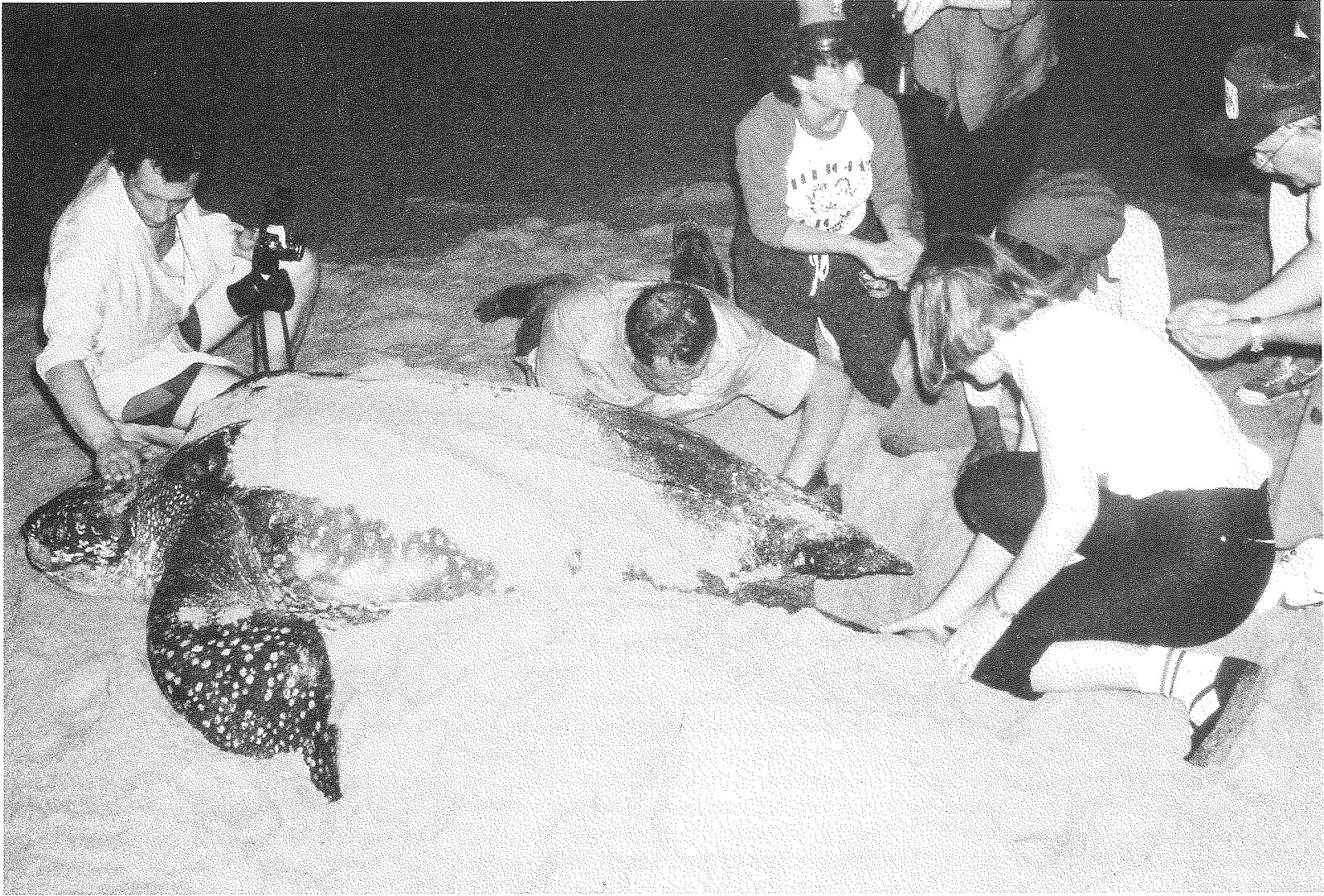
The eggs began to come. One after another they dropped into the shallow nest. They looked for all the world like large ping-pong balls. Surprisingly heavy and with a tough soft shell, the eggs were designed to survive the 20 cm drop into the nest. To assist nature and to avoid the certainty that the eggs would not hatch, we dug a new nest up the beach above the tide line and away from the log. A human chain quickly formed to ferry the eggs to their new home. It probably took twenty minutes before all the eggs had been laid. Her human assistants moved back from the turtle, some to watch what came next and others to close the nest which we had dug.
What followed can only be described as the “turtle tango”. It began slowly. The nest was filled with sand and packed down. Next the Leatherback embarked on a stately and determinedly erratic movement back and forth over the area where the nest was located. Her goal was to hide its precise location from predators. The turtle’s dance before us was both amusing and dignified. Before long, we could not be certain where she had dug her nest. Some five meters away, others in our group were performing their own “dance” to hide the resting place of the eggs which we had moved. Amid laughter and much self-consciousness, our friends were using palm fronds and feet to imitate the turtle in hiding any telltale signs in the sand of where the eggs might be.
The “turtle tango” complete, the Leatherback turned toward the ocean. Leatherbacks have poor vision on land and rely on the moonlight shimmering on the waves to guide their return to the water. We quickly saw that our strong flashlight had the same effect. To prevent her complete disorientation, we doused our lights and watched the Leatherback struggle back to the warm Caribbean water. Her passage was slow, the exhausted flippers finding little purchase in the sand. As she reached the water’s edge, her efforts took on a new eagerness. She entered the water and achieved buoyancy to permit a more graceful departure. We last saw her gliding quickly through the water. Then she dived, leaving only her wake.
We would never see whether our efforts to assist Mother Nature were successful. But Molly carefully noted where we had reburied the eggs. In about two months time, she would begin her watch for the hatchlings. If she were lucky enough to be present when they broke through the surface of the sand, she would use a strong flashlight to guide them down to the water in much the same manner in which the mother Leatherback had followed the moon to the water’s edge. But the actuarial statistics for turtles are grim. Even with the help which we provided, we knew that only a few of the hatched Leatherbacks would live to maturity.
We had experienced something unique. An opportunity to participate in one of nature’s miracles had been granted to us. Even as we walked back along the beach, the sudden torrential tropical downpour could not dampen our excitement. Completely sodden, and with shoes hanging from our belts, we reached our cars where dry sets of clothing and purely medicinal brandy waited.
View the original scanned pages →
Originally published in bout de papier, Vol. 9, No. 4 (1992) — Fall 1992 // Automne 1992, pp. 35–36. Read the rest of this issue →



