
bout de papier, Vol. 9, No. 4 (1992) — Fall 1992 // Automne 1992, pp. 11–14
“We may be the first Canadian officials to visit Pyongyang since the Korean War,” said my enthusiastic companion, Gordon Houlden, who had just managed to manoeuvre himself to be the first off the plane so as not to be deprived of his due historic recognition. “In fact, we may be the first Canadian officials here since 1945.” We speculated further as to whether any officials from the Canadian Embassy in Tokyo might have visited Korea during the 1930s. Choosing to assume that they had not, I proclaimed, “Gordon, we might be the first Canadian officials here since Confederation!”
The cause of all this hyperbole was the visit by a Canadian delegation of Members of Parliament and Senators to the Inter-parliamentary Union (IPU) meeting in Pyongyang, Democratic Peoples’ Republic of Korea (26 April to 4 May 1991). The Department provided a foreign policy advisor to the delegation as several issues of international importance were to be debated.
I think the forbidden fruit of Pyongyang tasted the sweetest for me because I had already spent two years in Seoul observing North Korea “through a glass darkly”. Seoul is not necessarily the best vantage point from which to assess life in North Korea. The legacy of the Korean War and decades of South-North confrontation still colour most images of the North.
I had only seen North Korea through binoculars, staring across the Demilitarized Zone (DMZ) as its Propaganda Village from Freedom Village on the southern side. Propaganda Village, we were told by the US guards at Panmunjom, was a bit like a movie set. No-one actually lived there, and the lights were turned on and off by automatic timers. The strange four-to-six storey buildings looked like a cardboard pop-up village, strangely out of place with the surrounding countryside. The village sported a giant steel frame flagpole (naturally slightly higher than the almost equally giant pole on the southern side) and a massive flag, reported by our US guides to weigh several tons when wet (how did they know?).
Just getting to Pyongyang had been an adventure. It is only 200 kilometres from Seoul to Pyongyang, a trip which could be covered by air in less than an hour and even by train in three to four hours, including formalities at the military demarcation line (the word “border” is not used). However, while the South Korean delegates to the IPU meeting were allowed to travel north through the truce village of Panmunjom (by walking across the demarcation line, going by car to Kaesong, the first major North Korean city north of Panmunjom, and then by train to Pyongyang), that privilege was not extended to diplomats resident in Seoul. I had the option of flying first either to Tokyo or Hong Kong, and then to Beijing where I could change to another flight for Pyongyang. But I had decided to take an even more exotic route. Just a few months before, with warming relations between the Republic of Korea and the People’s Republic of China, a passenger boat service had opened between Inchon in Korea, just west of Seoul, and Weihai on China’s Shandong peninsula. This was the way I chose to get to Pyongyang — by slow boat to China.
The Japanese-built ship, under Panamanian registry, was operated by a Korean-Chinese joint venture. It was full of South Korean traders and a large number of ethnic Koreans from the minority area of Yanbian in China near the North Korean border. With the establishment of direct links, these people could now visit relations in the south and at the same time engage in some buying and selling. The selling consisted of Chinese medicines sold on the streets of Seoul. The buying consisted of South Korean electronics for use or resale back home.
Once in Weihai, I hired a vehicle and was driven to Qingdao (justly famous for its beer) and then went on to Beijing by train. The overnight boat journey, the four-hour drive and the sixteen-hour train ride made me appreciate the distances involved. From Beijing, where I met the IPU delegates, we took a very uncomfortable Soviet-built Chinese aircraft south across the Yalu River to Pyongyang.
And now we were at Pyongyang Airport, staring at a Soviet-looking building adorned with the first of many portraits I was to see of the “Great Leader” ’, President Kim Il-sung The contrast with Seoul’s Kimpo airport could not have been more striking. Kimpo is a sea of 747’s dressed in the livery of airlines from many points on the globe. The only aircraft in sight in Pyongyang were a couple of small twin-jet Ilyushin aircraft of Chosun Minhang, the North Korean airline.
That was not the only contrast. We sped along the road into town, passing only the odd olive-drab army truck lumbering along. In Seoul, we would have been mired in a bumper-to-bumper traffic jam of Hyundai, Kia and Daewoo cars. Even more amazing, in Pyongyang not only were there not any cars, there were not any bicycles. In fact there did not seem to be many people.
We learned later that bicycles, the universal form of transport in China, had been banned in Pyongyang by the Great Leader. One morning early, before breakfast while I was out jogging, I noticed a solitary rider on a bicycle furtively slip into an alley. Elated at this chance to prove that there was indeed dissent in North Korea, I set out in pursuit. The rider turned out to be a municipal worker and I was told that there was special dispensation for those performing selected duties.
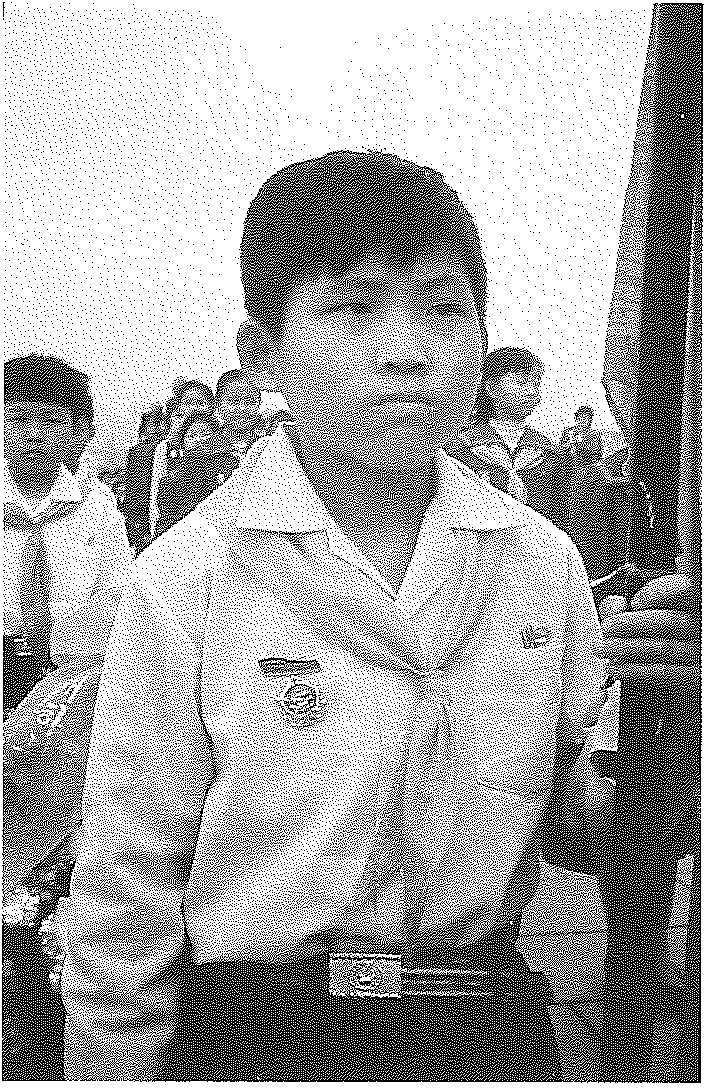
If bicycles were noticeable by their absence, the ubiquitous Kim Il-sung button was a universal adornment and could not be missed. Try as we might, we could not unravel the mystery of these buttons which were worn by almost all North Koreans. There were several variations, and our deduction was that they marked some form of rank or status within the hierarchy. But our liaison officers, normally quite helpful, clammed up when we broached the subject of the pins. “What happens if you lose your pin?” we asked. “No-one ever loses his pin”, was the answer. This seemed to be true since I scoured the parks on my morning jogs but found nothing. In fact I could not even find a piece of scrap paper or a cigarette butt. It was as if litter had been banished from the kingdom.
“Could we get a pin for a souvenir?” “No, that would not be possible. These are not souvenirs. They are our way of expressing our respect for our Great Leader.” We noticed that in the few shops that existed, with generally very little that one would want to buy, there nonetheless was quite a good supply of lapel pins on sale. There were pins showing the flame of Juche, there were pins with the North Korean flag, there were pins with workers, stocky damsels and soldiers … but there were no pins of Kim Il-sung. One of our party swore that he would get a pin before he left and on our final morning there he was with a Kim Il-sung button. It was different from the others I’d seen so I surmise that it was a special version reserved for unusually persistent foreigners.
And where were all the people? Pyongyang has a population of two million, but the streets were almost empty. Part of the reason for the eerie, vacant feeling is the almost total absence of traffic, except for the occasional motorcades of Mercedes. (There are reportedly more Mercedes in North Korea than in South Korea, and every second car in Pyongyang seems to be a Mercedes-Benz).
Another reason for the emptiness is the absence of commercial life. In most Asian cities, the streets are a hive of commercial activity with sidewalk merchants, small boutiques, vegetable and fruit sellers. In Pyongyang there were a few sterile, empty looking shops with a handful of customers. There were two vegetable shops near our hotel which had prominently displayed decorative arrangements of their wares. The vegetables never seemed to move and no-one seemed to buy them. We never saw a single person with a bag of onions or a string of garlic or a cabbage. Eastern European diplomats stationed in Pyongyang told us that the vegetables had appeared suddenly about two days before the IPU meeting had opened (probably brought in from China) and would disappear just as quickly — in fact they made monthly shopping trips to Beijing to buy staples.
Yet the people we saw did not seem to lack food. They looked healthy, with strong white teeth. The children looked plump and •bright. Pyongyang was a far cry from the poverty in many parts of Asia. On May Day in Pyongyang, families strolled in the carefully tended parks, singing the praises of the Great Leader. Insofar as one could tell, they looked happy.
North Korea is a conundrum. It is a nation heavily in debt. Mismanagement of the economy has resulted in gross misallocation of resources. Reportedly, it cannot feed its population and must even import that most basic staple, rice. By contrast, South Korea has so much surplus rice that it can no longer afford to store it. Some of the misallocation of resources can be plainly seen; a mammoth gilt statue of Kim Il-sung overlooking the Taedong River; two stadia that would rival any in North America for size; a velodrome; an indoor ice-skating rink; the glowing Tower of Juche, an Arc de Triomphe that parallels in beauty and symmetry that in Paris; and the tallest hotel in Asia, the 105-storey Rugyung Hotel. This vast structure, with five revolving restaurants at its apex, sits in mute testimony to the folly of egoism and central planning. Its uncompleted, empty concrete shell, pockmarked with window apertures open to the elements, looks like a brooding pyramid with vacant eye sockets fixed on the town below.
On the night of our arrival, all the neon in the city was turned on. Giant jets of water shot out of the Taedong River and the Tower of Juche glistened silvery in the background, its glowing flame looking like one of those phoney fires around which Cubs and Brownies sit in church halls on winter nights in Canada. One of our party, a parliamentarian, was heard to remark from the balcony of our hotel, “It looks just like Tokyo at night”. Unlike Tokyo, however, all the neon goes off at once, at midnight, by the flick of a central switch.
Our hotel had the same air of unreality. Coming out of the elevator on each floor, you were confronted with a full-length mirror at the end of each corridor. The mirror (our sneaky minds suspected what was behind) commanded a view of the entrance to each room. And there was that unaccounted-for floor space in the areas behind the mirrors. Each room had a full-length mirror covering one entire wall. No doubt we were overly suspicious or that the floors which the elevator bypassed, the 35th to the 39th, were the centre of operations for the “watchers” were just that — rumours. But, just in case, I made a point of undressing frontally in front of the mirrored wall each night, so as not to deprive any would-be watcher of his (or her) just reward!
No description of a visit to North Korea would be complete without reference to a “mass gymnastics” display. This appears to be one of the principal means of mobilizing people, especially the young and all those idle hours when people are not reading the collected works of Kim Il-sung. The mass gymnastics routine is laid on for most important visitors and the IPU delegates were no exception.
We were taken to Kim Il-sung stadium at dusk and on entering the stadium we could see that it was already full. The section directly across the field was a mass of flash cards wielded by several thousand participants. Suddenly the field came alive with a sea of young people dressed in athletic costumes of various colours, and the recorded music began.
What followed was a non-stop, two-hour routine of music and calisthenic drills cum dance numbers all set against a changing backdrop of flashcard scenery. Most have seen card manipulation techniques on televised American college football games but this was unlike anything I had ever seen. I counted more than 120 individual sequences, some static but more often than not sequential. Thus a flower blossomed before your eyes or an egg hatched.
The choreography and discipline to produce such a show are truly remarkable, and, as some of the delegates remarked, quite frightening. The largest round of applause from the audience came when the portrait of Kim Il-sung was flashed. The response was either spontaneous or Pavlovian, depending on your point of view. The discipline of the performers, some of whom were as young as six and who numbered more than 10,000, was no less remarkable.
The show left many wondering at the untold hours of effort that had gone into producing such a spectacle. But perhaps from the regime’s point of view, the effort was not unproductive because it instilled a sense of discipline and shared goals and certainly filled up time that in the West would have been turned to more leisure activities.
The experts will say that the people of Pyongyang are a specially selected and privileged lot, who have kept their noses clean and have been rewarded accordingly, and so you cannot judge North Korea by the capital. I am sure that is a valid point.
To try to get some perspective, I desperately wanted to get out of Pyongyang and see the countryside. I found out there was a tour to Mt. Kumgang (Diamond Mountain), reputedly Korea’s most famous scenic spot, located on the east coast very close to the DMZ.
The spectacular and almost totally unspoiled scenery of the Diamond Mountains was something I will never forget. The area is a major tourist asset, and inasmuch as I would like all Koreans to have a chance to visit this lovely spot which holds so much significance in Korean mythology, I shudder to think of the toll that its development will bring — wall-to-wall cars and people, cable cars, souvenir shops, restaurants and hotels — like the similar tourist area of Mt. Sorak just south of the DMZ. For now it is almost totally untouched, and I like to think that I have seen it at its best. The only scars on the landscape are the giant slogans of Kim Il-sung carved at strategic points into the hillside.
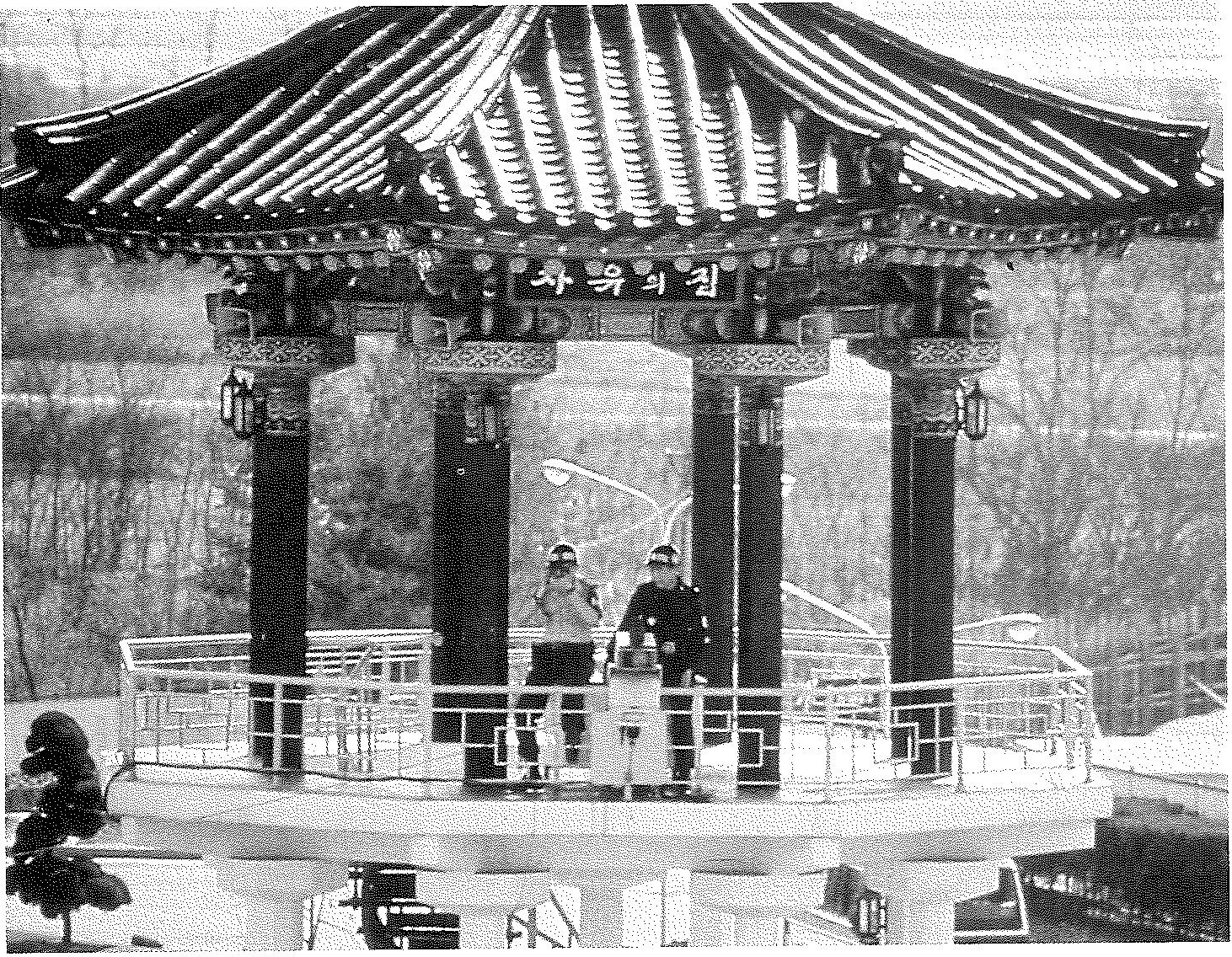
Although we drove for six hours across the peninsula to the east coast and then south almost to the DMZ, I cannot honestly say that I saw a lot of North Korea. We passed a number of neat-looking villages at a distance, and passed through the fairly large (and quite rundown) town of Wonsan, but Ialways felt that the real North Korea was at a distance, on the other side of the glass. The only places we stopped were at isolated tourist rest houses. There were no gas stations, no roadside cafes, and almost no traffic. In fact on the way to Pyongyang, I counted less than a hundred vehicles that passed us in a trip halfway up the country over a five-hour period.
That was not the only excursion I made. With permission of our IPU delegation leader, Gordon Houlden and I booked a trip to Kaesong and the truce village of Panmunjom. We travelled by night train to Kaesong, in a coach totally segregated from the other passengers. When we emerged from the VIP holding room where we had been kept at Pyongyang Station, all the other passengers were seated, no doubt wondering who these damned foreigners were who, yet again, were keeping them waiting. When we got to Kaesong, I was skeptical that I would be allowed to go to Panmunjom, since I had made no secret of the fact that I was posted in Seoul and had visited the site from the other side. I was sure a last-minute excuse would be found.
There was a delay, but in the end we set off and I started my camera rolling. I was quite sure that I would be told “no photography” as is common on the other side, but no-one said anything so I kept it going. We got to the first barrier and were introduced to our guide, Major Kang of the Korean Peoples’ Army. Major Kang must have graduated at the top of his class in public relations school because he was the sort of person you could not help but like. He had a smile that went from ear to ear. My only other experience of North Korean soldiers had been at Panmunjom when they had peered in the window of the Military Armistice Commission meeting room with stone-like glances. Having just come from a US Army briefing which included a blow-by-blow description of the 1976 axe murders in the DMZ, actually seeing the North Koreans always sent a shiver down my spine. But here was Major Kang cracking jokes and flashing a smile that would have loosened up the tightest visitor.
The other surprising thing was the almost total absence of military preparedness. There were fences and tank traps, but hardly any human sign of a military presence. This contrasted markedly with the other side where you approach the DMZ through an armed camp and are checked in and out with strict military security. The bulk of North Korea’s forces are supposed to be deployed within just a few kilometres of the DMZ but they are obviously well out of sight of the casual visitor. Not only at Panmunjom, but in the other parts of North Korea I saw, overt physical security is much less evident than in the south where military checkpoints and barriers are still commonplace. I am sure there are reasons to explain this, such as other more pervasive forms of control, but nonetheless the contrast caught my attention.
With one notable exception, which was an outdated and atrocious propaganda film that reminded me of the Manchurian Candidate, our North Korean DMZ tour was very low-key and friendly. It was a strange experience to arrive in that same Military Armistice Commission meeting room. This time the unfriendly, scowling faces peering in the windows and taking our photos were American GIs, not North Koreans. One of the tenets of the North Koreans is that South Korea is a puppet government with all the strings being pulled by the United States, the occupying power. I live in Seoul and know the reality, but at that moment I put myself in the place of a North Korean cadre or official allowed to visit Panmunjom for the first time. What would be seen would reinforce the line one had been fed all one’s life — staring across from South Korean would be tough-looking American GIs — imperialists incarnate, in the flesh. Speaking personally, I think the somewhat theatrical setting at Panmunjom and the way in which it is handled play into the hands of the North Korean propaganda machine and provide more grist for their mill.
On the issue of propaganda, I pulled out what I thought would be my trump card. I asked to visit the North Korean model village, the so-called Propaganda Village in which I had been told no-one lived. “Why do you want to go there?” I was asked. “Because I have been told that no-one actually lives there”, I said, “and I want to know the truth”. “Then let’s go”, said Major Kang.
We drove out of the DMZ and turned off the main highway onto a dirt road which led us through several villages all of which seemed to have the same strange-looking four-to six-storey apartment buildings that I had observed at Propaganda Village from the southern side. We re-entered the DMZ and drove to the base of the giant flagpole. There was a small welcoming committee who gave us some facts and figures. While they were talking, I set off with my videocamera to see if it was really a Potemkin village.
I came to a school and although I didn’t see any children, I could hear their voices coming from a classroom. “Maybe it’s a tape recording”, a suspicious voice within me said, but then I looked at the scuffed and chipped playground equipment and concluded that either someone had gone to an awful lot of trouble to fool me, or else it really was a school. I did find a piggery with live pigs and saw chickens and geranium pots with budding geraniums on balconies. I did pass outhouses that smelled remarkably real. We even visited an apartment (probably a model apartment) but as we walked up to the third floor I looked at the weathered doors, and piles of laundry on the first and second floors, and concluded real people lived there. The one strange thing was that I did not see many people. When we asked where they were, we were told that they were working in the ginseng fields. That seemed reasonable, since it was mid-day, and I did not see many people around in other villages either, including those well out of sight of prying binoculars from south of the DMZ. So while I am pretty sure that Propaganda Village is lived in, one can never be certain. When I showed my video to US staff of the Military Armistice Commission after my return to Seoul one of them said, “Damn! I’ve looked at that place through my binoculars for hours and have never seen a soul move.”
Whether Propaganda Village is or is not inhabited, and by how many people, is not really important. What is important is to try to get at the truth. As I found after my trip to North Korea, truth is an elusive and sometimes illusory commodity. Perceptions are also important even though they may have little basis in fact. Having been in North Korea and listened to the North Korean world-view, no matter how distorted it may seem, I think I have a much greater understanding of what the impasse on the Korean peninsula is all about and why its solution is so difficult despite an apparent ardent desire for reunification on both sides of the demarcation line. I only wish more Koreans, both northerns and southerners, could have the experience that I had, of going through the looking-glass and seeing what is on the other side. That will have to happen before unification can become a reality.
View the original scanned pages →
Originally published in bout de papier, Vol. 9, No. 4 (1992) — Fall 1992 // Automne 1992, pp. 11–14. Read the rest of this issue →



