
bout de papier, Vol. 8, No. 4 (1991) — Fall 1991 // Automne 1991, pp. 16–19
“In the process of negotiating, bargaining and hammering out this constitution, the Namibians developed a special Namibian way of resolving internal differences and contradictions. The method is:
In the national interest,
• Remain level-headed;
• Respect one another; and • Strive for the best for your country.” (Moses Katjiuongua, Constituent Assembly of Namibia, February 9, 1990) n a typical February day in Namibia o the sky is a dazzling blue. The air is effervescent, clear and dry. The sun is high, bright and hot. Namibians do not get the February blahs; they get sunburn. February weather is one way in which Namibia differs from Canada. Constitutional negotiation is another.
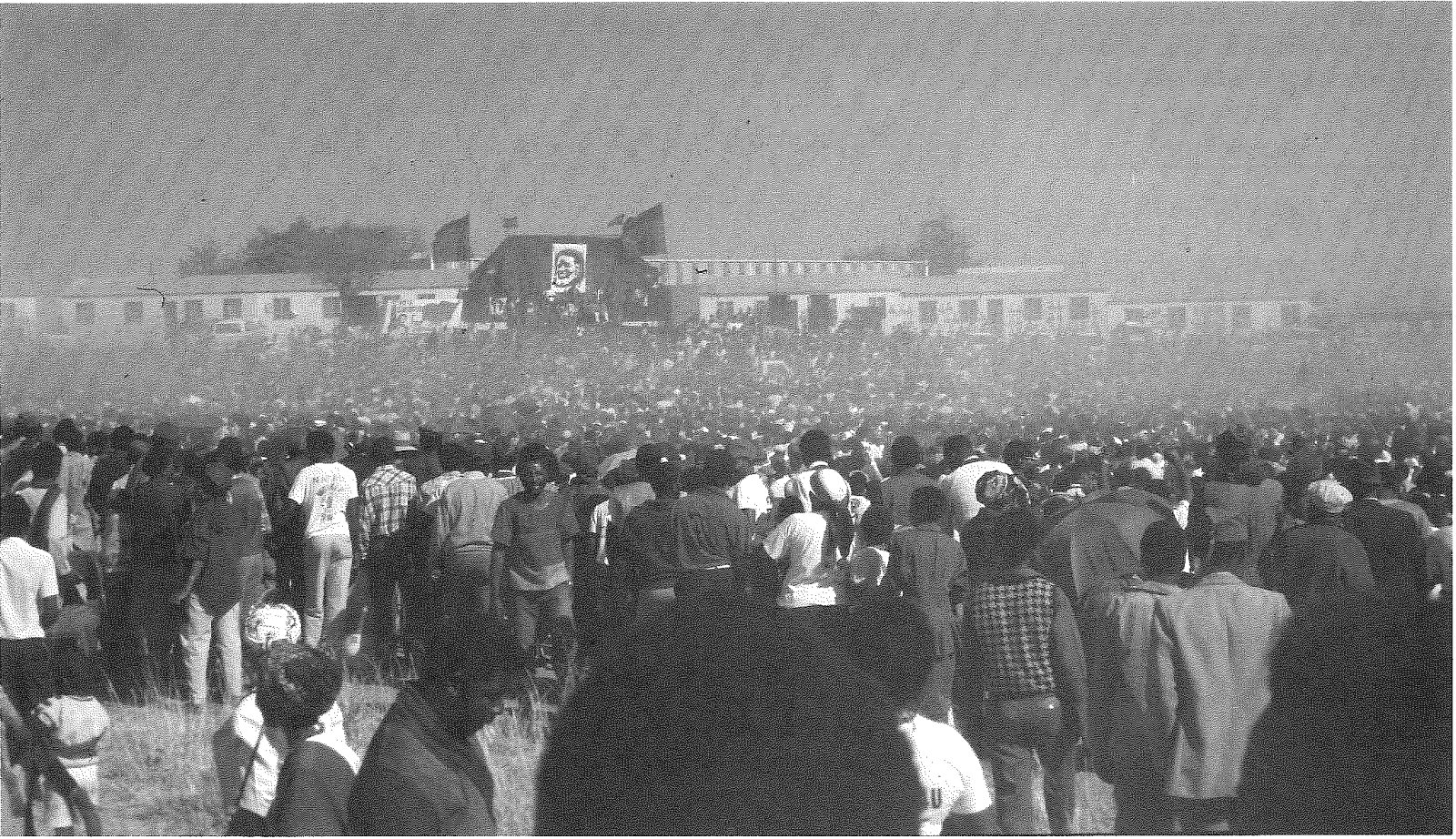
February 9, 1990, was a typical Namibian day as far as the weather was concerned. In other ways it was quite exceptional. The Constituent Assembly was to hold a special session, not in the assembly chamber, but on the front balcony of the colonial legislative and administration building (colloquially known as the Tintenpalast, or “ink palace” for the generations of colonial bureaucrats who had scribbled away their careers in its high-ceilinged office). On this occasion, the front of the building had been hung with a banner on which the preambular paragraphs of Namibia’s new draft constitution had been lettered
The opening music was another indicator that things had changed, and would change still more. “Nkosi Sikelel’ i Africa” has been adopted by liberation movements throughout southern Africa. It sounds best when sung a cappella by several thousand angry people. It had a particular resonance, however, when played by the South West Africa Police Band, the grey uniforms of which had symbolised brutal repression only a year earlier.
It had taken a long time for Namibia to keep this appointment with history. Seventy years since South Africa had been granted a League of Nations mandate over the former German colony of South West Africa.
16 bout de papier Vol.
Twenty-four years since the beginning of the armed struggle for independence. Twelve years since the UN Security Council had adopted Resolution 435, providing for Namibia’s independence. About ten months since the independence process had begun on April 1, 1989.
But it was only eighty days since the Constituent Assembly had first convened. In less than three months, working to a set of constitutional principles approved by the Security Council, the Namibians had successfully negotiated a constitution. By Canadian standards, it was breathtakingly rapid.
If it had been quick, it had not been easy. Namibia’s independence process almost ended in disaster on the day it began. In circumstances which have yet to be explained, exacerbated by errors and omissions which do not reflect well on any of the major players, the worst fighting of the independence struggle broke out on the very day when a formal cease-fire was to come into effect. About 350 people died violently and needlessly.
The fighting was brought to an end by adroit diplomacy on the part of the USA, the Soviet Union, South Africa and the Front- Line States. The independence process resumed, but without the euphoria which had marked the early days.
There was a daunting agenda to implement. Discriminatory and repressive legislation had to be repealed. An amnesty had to be declared. Over 40,000 exiles had to be repatriated. Detainees had to be released. Voters had to be registered, and an election had to be held. Each of these steps was achieved only after long, intensive negotiations between the South African colonial administration, responsible for implementing the process, and the United Nations Transition Assistance Group (UNTAG) which had to be satisfied that the process met the standards laid down by the Security Council for a free and fair election.
The first campaign rallies were held on April 1, months before the passage of any legislation to govern the election. A bewildering variety of political parties emerged. At one point there were over forty. A consolidation process began to take place, however, once the outlines of the electoral law became clear. The election would be based on the proportional representation system, with the entire country forming a single constituency. Small parties, thus, had considerable incentive to form alliances to increase their chances of winning one of the 72 seats in the Assembly. In the end, ten parties or alliances contested the election, and seven won seats.
It was not a perfect campaign. At different points in the process, the UN’s impartiality was questioned by virtually everyone. There was so much intimidation (the threat or use of force) that a special commission was established to investigate.
Anton Lubowski, a prominent human rights lawyer and leading SWAPO activist, was gunned down at the gate of his Windhoek home. There were several other murders of party activists. In the remote town of Outjo, an UNTAG office was attacked with grenades, killing a locally-engaged security guard. Disruption of political rallies was common. I attended one rally in Katutura (a Soweto-like township near Windhoek) where a smoke bomb went off, causing a brief panic.
Much of the political violence was laid at the doors of the police, in particular the autonomous counter-insurgency unit known as Koevoet (the Afrikaans word for crowbar, literally “iron foot”). After one particularly egregious incident, the investigative commission condemned Koevoet’s special constables as “untrained, and probably untrainable for normal police duties”. After “ several months of controversy, Koevoet members were confined to their base, and later were disbanded. UNTAG initially was not satisfied that it had been disbanded, and efforts had to be repeated. Political violence diminished considerably after the UN persuaded parties to negotiate and sign a code of conduct.
The election finally took place over the period November 7-11. Almost everyone had tried to vote on the first day, and in some places there were serious crowd control problems. At one polling station in the Ovambo region, an elderly man had been seriously injured after having fallen and being trampled. However, before he would allow an ambulance to take him to the hospital, he had insisted on being carried in to vote. Many voters showed a similar sense of commitment: one of my most vivid memories of eighteen months in Namibia is of thousands of people standing stoically under a blazing sun, patiently waiting their turn to vote.
Most of them did: 676,220 people cast votes, about 96.4 per cent of those who had registered. The votes were counted twice: teams of five South African colonial officials sat at counting tables directly across from equal numbers of UNTAG counterparts. Each side did its own count; then the results were reconciled. When all the results were in, the South West Africa People’s Organization (SWAPO) had won 41 of the 72 seats, followed by the Democratic Turnhalle Alliance (DTA) with 21, United Democratic Front with 4, Aksie Christelik Nasionaal (ACN) with 3, and finally the National Patriotic Front, Federal Convention : of Namibia and Namibia National Front, each with a caucus of one.
The constitution had to be adopted by a two-thirds majority. The largest party had been denied the 48 seats which would have permitted it to impose its will on the Assembly, and no other had the 24 seats which would have permitted it to block adoption of the constitution. The message from the people to the politicians could hardly have been clearer: they must work things out together.
Early indications were that things were going very well indeed. One of the running controversies in the lead-up to the election had been to ensure that the 1982 Constitutional Principles would govern the drafting of the constitution.
The 1982 Principles were negotiated by the Western Five group of countries (Canada, France, Germany, the UK and USA — the five western members of the Security
Council when Resolution 435 was adopted
• in 1978) with “the parties concerned”. Their most important provisions were for periodic, genuine and secret elections, and a declaration of fundamental rights. While the 1982 ; Principles were incorporated by reference in a Security Council resolution, they were not reflected in Namibia’s electoral legislation. There had been enough contradictory statements by SWAPO representatives to give rise to doubts about that party’s intentions.
Doubts were resolved during the Assembly’s first session. The Assembly unanimously adopted the 1982 principles as the basis of Namibia’s constitution. It was thus committed to a set of constitutional specifications which it would either meet or exceed. Discussion began with a series of plenary sessions in which each party presented constitutional proposals. Once all members had an opportunity to speak, an all-party committee was established to reconcile all the proposals and combine them into a single text.
This committee met in camera for most of December, reporting to the Assembly at two-week intervals. On December 20, in their second report, they informed the Assembly that agreement had been reached on all substantive issues and recommended that a committee of three respected constitutional lawyers be briefed to resolve a number of legal issues concerning the electoral system and the upper house of the legislature, and to put the text into proper legal language.
The resulting draft was tabled in the Assembly on January 25, 1990, and plenary debate began January 29. It quickly became apparent that several important questions of substance remained. The draft provided for preventive detention without trial but after extensive plenary debate, the Assembly could not reach agreement. Party representatives consulted in private while the plenary carried on with other less contentious articles.
The plenary session was discussing proposed functions for the public service commission when SWAPO’s Hartmut Ruppel asked for the floor to announce that agreement had been reached on the question of preventive detention. He explained that the draft provision (which formed an exception to the article guaranteeing freedom from arbitrary arrest and detention) had been included in good faith, but that the underlying principle of the article might have been overlooked. They had agreed, he said, “to give human rights a chance,” and to remove these contentious paragraphs. All 72 members of the Assembly were in their seats, and the public galleries were crowded, but for several electric seconds no one spoke and no one moved. Then, suddenly, applause broke out.
If the debate had its moments of high drama, it also had a few of low comedy. One member objected to Article 97 which provides that the State may grant political asylum. The member feared that this would create a loophole for “sects which have no respect for the state”, and, embarrassingly, he named an identifiable group. The Chair glowered, and several seconds limped by painfully. The article was then adopted unamended. Clause-by-clause consideration of the constitution was completed on February 2. Not one provision was put to a vote. In all cases the debate continued until consensus was reached.
A week later, in front of the Tintenpalast, the session was called to order, and the Chair put the crucial question: adoption of a constitution for Namibia by consensus. There were no objections and, with one rap of the gavel, it was done.
There were speeches by all seven party leaders. They were generous in praise of the document, of each other, and in particular of the consensus-building skills of Hage Geingob, who had chaired both the Assembly and the all-party committee. They noted that Namibia had drawn on the experience of the world in drafting this document, and hoped that the world would find something valuable in Namibia’s experience. Some drew attention to points on which they had reservations, but which they had chosen to accept in the interest of consensus. There being no further business, the Assembly adjourned. Namibia became independent on March 21, 1990.
It is interesting to leaf through Namibia’s constitution from a Canadian perspective.
“The official language of Namibia shall be English.” How could this be possible in Namibia, where English is the mother tongue of only a minority of the small white minority? The most widely-spoken language is Afrikaans. English, however, carries the least historical and ethnic baggage. And, as Article 3 goes on to provide, nothing prohibits the use of any other language as a medium of instruction. Nor is Parliament precluded from passing legislation to permit the use of other languages for legislative, administrative, or judicial purposes in areas where such languages are spoken by “a substantial component” of the population.
Chapter 3 contains an extensive charter of fundamental human rights and freedoms which is deeply entrenched. In that regard, the Chapter on amendments contains an article worth quoting in its entirety: “Article 131: Entrenchment of Fundamental Rights and Freedoms.
No repeal or amendment of any of the provisions of Chapter 3 hereof, insofar-as such repeal or amendment diminishes or detracts from the fundamental rights and freedoms contained and defined in that Chapter, shall be permissible under this Constitution, and no such repeal or amendment shall be valid or have any force or effect.” There is no “notwithstanding” clause.
Permissible amendments require a two-thirds majority of both houses of Parliament. A referendum may be held if the upper house does not provide the required majority. The upper house is a National Council composed of two representatives from each region. Regions are defined by a Delimitation Commission, solely on a geographical basis, “without any reference to the race, colour or ethnic origin of the inhabitants of such areas.”
Namibia’s flag debate lasted only as long as it took for the applause to die down when the design was presented to the Assembly. A bold geometric design, it adroitly combines the colours of all the major parties: SWAPO’s red, green and blue; DTA’s red, white and blue; UDE’s green, blue and white; and NPF’s red, green and yellow.
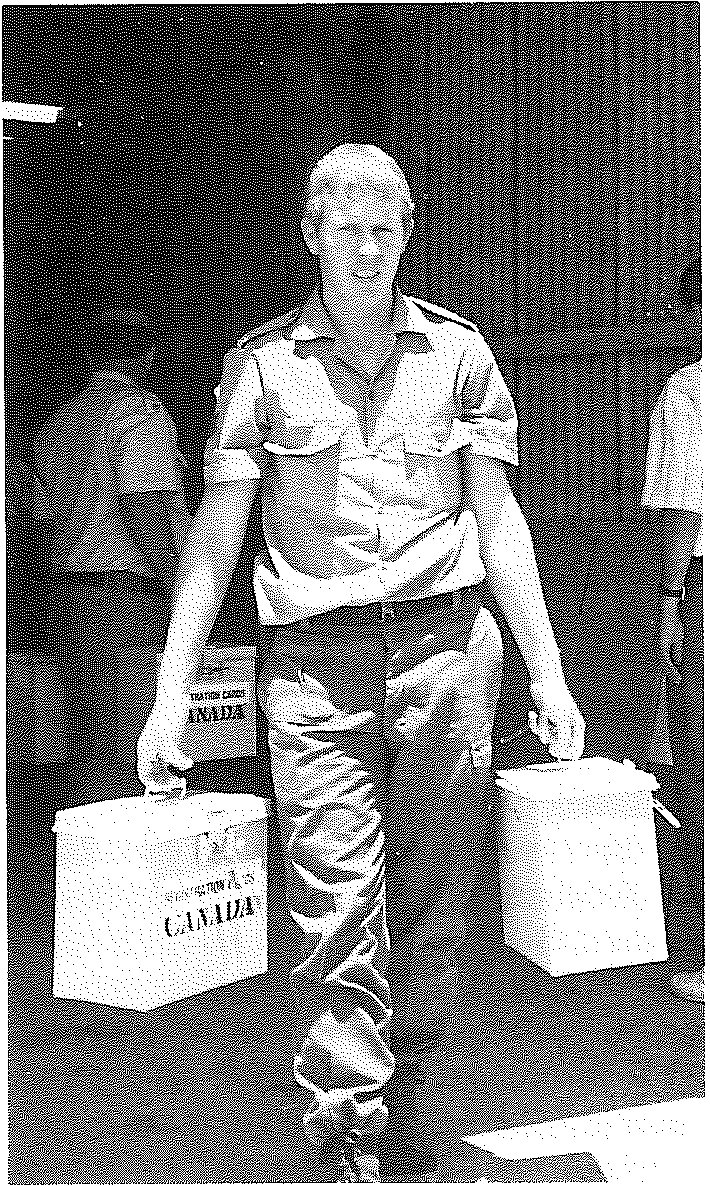
Elsewhere on the same planet, but seemingly in a different world, Canada’s constitutional reform circled the drain of Meech Lake. The collapse, when it came, did not go unnoticed in Namibia. “Your Prime Minister looked so sad”, commented one Namibian friend, after seeing a report on the television news. Expressions of puzzlement and concern became more and more frequent, and some even wondered whether Namibia owed Canada technical assistance. After all, Canada had provided most of their ballot boxes.
Comparisons are odious, and constitutions are not generally produced for export. In many ways, the Namibians faced a simpler challenge; they were starting afresh, not trying to amend an existing constitution. They did not have to grapple with the thorny question of the division of powers in a federal state; their Constituent Assembly was elected for only one purpose and was able to concentrate its efforts on that single task. They did not have to decide what to do with existing institutions for ten provinces, two territories, as well as the federal government. All they had to do was summon up sufficient good will and common purpose among seventy-two people who, for more than a generation, had been on different sides in a murderous struggle that left over 15,000 dead.
Our case is somewhat more complex. We have thirteen governments, creatures of our present constitution, trying to negotiate reforms in which they have deeply vested interests. This is a thirteen-sided zero-sum game in which the stakes consist largely of powers to tax and spend. Each of the thirteen seeks to maximize its gains and to minimize its concessions. Viewing the matter in that light, we can hardly be surprised by the lack of success to date.
Still, it is tempting to speculate: suppose that the experience of the past century has been enough to convince us that the existing process of federal-provincial negotiation is unlikely to succeed in the task of constitutional reform. If we concluded that something radically different were required, we might take a good, hard look at the Namibian model.
It would be a fallacy, of course, to suggest that because a certain process worked in Namibia, it necessarily would work in Canada. It would be just as fallacious to suggest the opposite. If a constituent assembly were tried in Canada, it would not succeed or fail because of anything that had happened in Namibia.
If we held an election for a constituent assembly of 72 members on a basis of proportional representation, it would take roughly 180,000 votes, coast to coast, to gain a seat. Conducted on a single-constituency basis, such an election would owe nothing to existing provincial or constituency boundaries, which would make easier a complete break with the existing system. To help ensure this, sitting members of federal, provincial and territorial legislatures might be excluded. One could expect that single-issue parties and other such formations, as well as the old-line parties, would contest the election.
Once these 72 had been elected, ensconced in the National Conference Centre, and told that their sole task was to adopt a new or amended Canadian constitution by a two-thirds majority, what might they achieve? What might they not?
View the original scanned pages →
Originally published in bout de papier, Vol. 8, No. 4 (1991) — Fall 1991 // Automne 1991, pp. 16–19. Read the rest of this issue →



