
bout de papier, Vol. 8, No. 3 (1991) — Summer 1991 // Été 1991, pp. 40–41
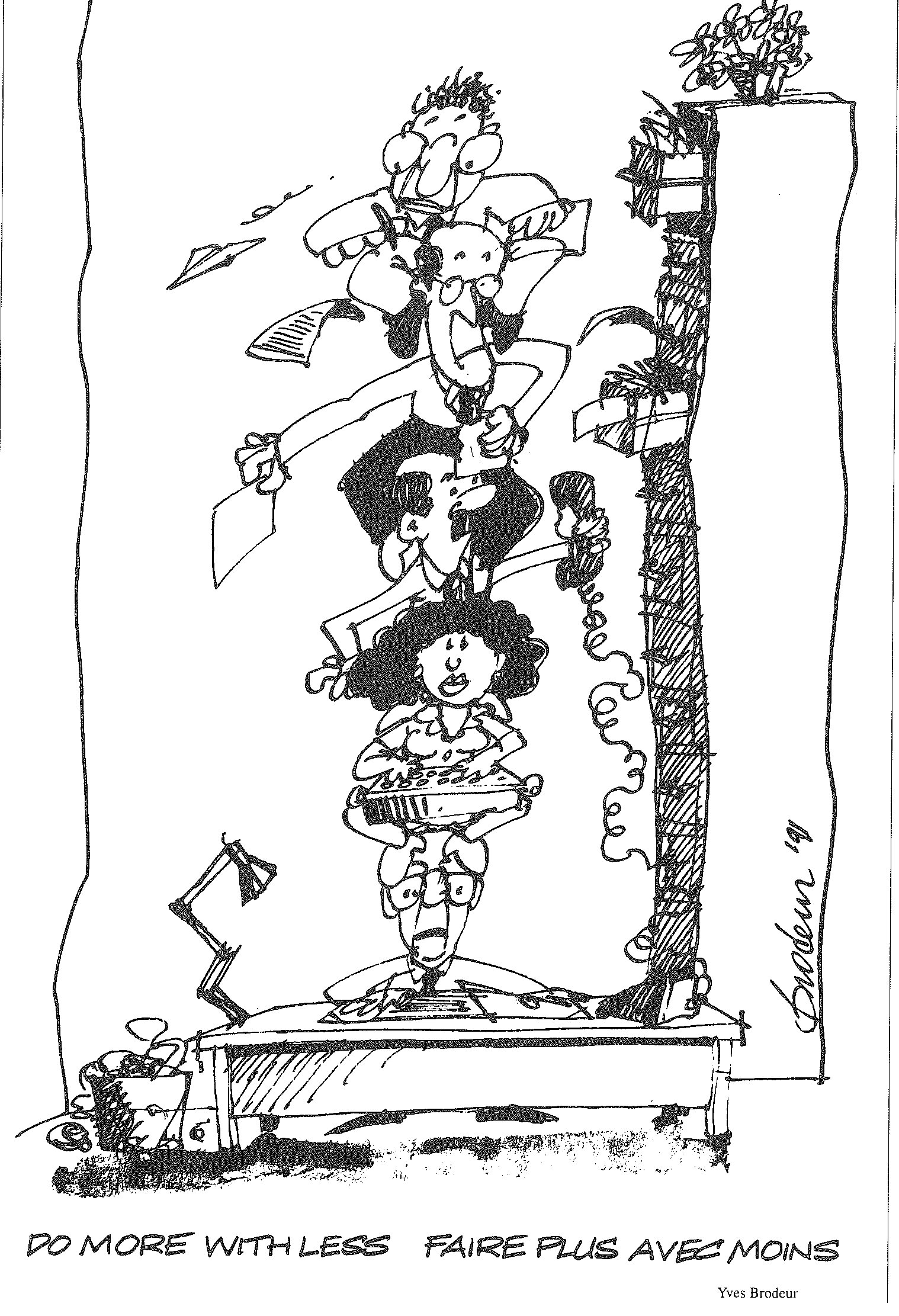
Has the latest round of budgetary cuts affected the capacity of the Foreign Service to deliver programs overseas and provide foreign policy advice to the government? A recent article in the March edition of Playdiplomat, the magazine of policy advice and nudity for foreign service officers, has shed some interesting insights on the issue. Excerpts of the article are printed below.
Playdiplomat has visited a number of posts to see how the new leaner, meaner foreign service is working. These vignettes from the front lines and the home front show a Department of External Affairs in a remarkably buoyant shape.
All is Quieter on the Western Front
The new regional Canadian Embassy in Strasbourg covering the U.K., France, Belgium, the Netherlands and Germany is a nondescript yellow and red gypsy caravan nestled in a quiet picnic area off the main highway leading into town. Despite the modest surroundings, morale is obviously high. Credit for this, his staff say, is largely due to Ambassador Greg “Eat My Elbows” Dornebusher, former NHL star and defeated candidate in the provincial leadership convention in Manitoba.
Ambassador Dornebusher is a new model, action-oriented diplomat. His sharp smile sets off the rugged handsomeness of a face etched with 500 stitches. He is certainly not awed by his seemingly enormous task.
“We’re loaded for moose, eh! I got a team here which can deliver the goods, no questions asked. Hell, all them prissy missions in Europe were overstaffed anyway, eh!”
The staff at the Embassy is small but projects an image of professional efficiency. Arnie Shacklebach, the Ambassador’s driver and Suzie LaTokya, his secretary, are long time friends from earlier in his career, especially his stint in minor leagues in Sault Ste. Marie. Halstead Ridley Kinleydown, the political counsellor and Jean-Pierre Montague d’Estampe, the cultural, immigration and consular officer are busy in the back offices of the caravan. Jake Dunlop, the Trade Commissioner for Western and Eastern Europe, is away with an industry mission on bull insemination techniques in Southern Spain. Five Finance officials fill out the roster of the Embassy but they are housed in the Savoy chain of hotels in the major capitals.
Halstead Kinleydown steps down the stairs of the caravan, carefully brushing the waistcoat of his Savile Row suit. He goes around and feeds some sugar to the horses at the front of the caravan. “Downsizing has not really hurt our ability to report on events in the different countries. I just rip out articles from Der Spiegel, L’Express, and The Economist and fax them to Ottawa from the post office down the road. The Ambassador particularly likes to sign off the articles from Paris Match.”
He continues, patting the thick neck of the horse. “Where I think our service has deteriorated somewhat is on the organization of ministerial visits. When we read in the newspapers that some European Minister is going to Canada, we just send them a pamphlet on the Ottawa-Hull region and the brochure from Customs Canada on what they are allowed to bring into the country.”
Counting bundles of money in his small office, Jean-Pierre Montague d’Estampe admits the he originally feared that downsizing might make his consular/immigration tasks impossible. “A couple of things helped, though. One was the user fees. We are glad the government decided to treat our services as professional services. So, just like lawyers and doctors, we charge anyone who calls fifty dollars for three minutes. That’s cut down on a lot of calls. Our location has helped too. The gypsies down the road have stabbed a lot of people coming here about lost passports. And, since we keep moving, prospective immigrants have a hard time finding us.”
In the Belly of the Beast
The Lester B. Pearson Building casts its majestic, sombre shadow on the dark inky sky of a late cold winter Ottawa night. Only the bright neon lights of the Harvey’s franchise, the new tenant on the ground floor of Tower A, betray the solemnity of power which resides there.
In the corner of the eighth floor in a spacious office decorated with large prints of sunflowers and Sudanese dung beetles, Garrotte W. Kinsbert III twirls a pencil in his hands slowly. He is Assistant Deputy Minister for the Asia-Pacific, Middle East, Latin America, Affirmative Action and International Fisheries Issues Branch. weighs each of his words as carefully as an unrepenting smoker would exhale in a federal building.
“Downsizing has taken a certain toll. We have ten person years here in the entire branch. If you don’t count the cleaning ladies, we are seven.”
He flicks one of his fingers at a non-existent crumb on the lacquered top of his empty desk. “It hasn’t affected our ability to give policy advice, though. It is a question of management. You decide what the priorities are, what your resources are, and then you just drop the rest.”
Kinsbert III pauses for a second, then continues. “For example, we don’t do memoranda for the Minister or for Cabinet anymore. That used to take at least three or four people drafting, endless consultations with countless divisions, and a couple of days to clear them through the DGs, ADMs and Deputies. Now, I either answer the Minister’s question over the phone or tell the Minister’s office to ask our Washington Embassy. Same thing for Qs and As, instruction telexes and talking points for ministerial visits. Washington is delighted with the work. We draw the line, however, on speeches and letters to the public. My staff likes reworking the old classics.”
Mr. Smith ET AL go to Washington
The young executive assistant to the special assistant of the political counsellor in charge of the Multilateral Affairs Division of the Economic Section is flustered. He hurriedly crosses the rotunda of the gracious Canadian Embassy.
“I must apologize. My research assistant forgot to tell my administrative assistant to contact the assistant deputy head of our Press Relations Division to have her contact the deputy protocol officer of the Economic Section who would have ensured that you were met by two liaison officers and their drivers at the hotel. Glad you made it over here anyway.”
He leads the way to the panelled offices of Quinston Wintertown. The political counsellor’s office is filled with a buzzing crowd of elegant earnest men in pin-striped suits and fashionably-attired young women, all engaged in deep conversation. Snatches of conversation — “government agenda,” “spin on the issue,” “cashing our political chips with administration,” “downsizing,” — stab the air.
Quinton clears his throat and the room becomes noticeably quieter. Thirty-five pairs of eyes turn to the patrician features of the young diplomat.
“The Reagan revolution has come to the Canadian foreign service. We are in a process of structural readjustment. This may inconvenience some, but that’s tough. It’s a major thrust of the government’s agenda. And we in Washington certainly intend to make that sacred thrust a sacred trust. And we will do our part, no matter what the sacrifices.”
A hearty chorus of “hear, hear” goes up from the Multilateral Affairs Division of the Embassy’s Economic Section.
From the Heart of Darkness
The door of the Canadian High Commission in Harare is slightly ajar. The offices appear abandoned. A small piece of paper is pinned near the lion’s head door knocker. It reads “And the last one out of Africa, please turn off the lights, or at least the generator.”
View the original scanned pages →
Originally published in bout de papier, Vol. 8, No. 3 (1991) — Summer 1991 // Été 1991, pp. 40–41. Read the rest of this issue →



