
bout de papier, Vol. 8, No. 2 (1991) — Spring 1991 // Printemps 1991, pp. 47–48
“Actually, Lydia,” said LDC Liebnitz one day to the lady of his life, “Jimmy the Turk isn’t as bad as they come. If you want really obscure reports, you should see the ones his grandfather Hamish wrote and my father had to decipher in the ’20s. I ran across these ones today, on events in the Empire of Tang in the Year of the Rat.”
“Look at this outline map of Tang, showing its states numbered I to 20. All state boundaries run exactly north-south or east-west. The map is divided east to west by the Hai River and north to south by the Bai mountain ranges, creating four quads. (Neither the Hei nor the Bai stop adjoining states from being considered neighbours.) The map also shows the Imperial Capital and three foreign Enclaves; these four cities are not part of any state, and are not counted as states in any way.”
“There had been no Emperor for 20 years. Each state had its own leader. Factions of states formed and vied to have their faction chief chosen Warlord of Tang. To be a chief, your faction had to have at least 5 states, with 3 of them (including your own) in one quad. For a chief to be named Warlord, his faction needed to include at least twice as many states as the next strongest faction, to control 2 of the 4 states around the Imperial Capital (the Home States), and to have the support of an Enclave.”
“During the year of the Rat, Hamish spent the entire spring travelling throughout the Empire disguised as an itinerant egg roll vendor. On the last day of the fourth moon he sent back a status report noting the following items:
(a) Factions account for 16 states. Each faction controls one Home State, but no member of the same faction is now adjacent to that state.
(b) The four non-aligned states are: Comrade
Mao’s socialist bastion, which is a Home State; Long, which has fewer neighbours than any other state; Deng, in the SW quad, which is suffering a civil war between Lord Ping and General Pung; and President Sun’s Christian revolutionary state, which has the support of its neighbouring Enclave.
(c) Lord Bing of Pan State leads the Zisha faction. Pan touches none of the other states in the faction; all the rest front on the Hei River.
(d) Kulian faction, the largest, is headed by the leader of Ming State. Ming is the state with the most neighbours, but only two are in Kulian.
(e) Lord Ji heads the Beihai faction, but his province fronts neither the Hei nor the Bai. Clockwise from the south, his only neighbours are a non-aligned state, the state of Jiang and two members of his own faction. (f) Lord Li rules the Home State of Kao.
Clockwise from Kao are Lord Rong’s state, Lord Kung’s state and Shan state, which adjoins Kao.
(g) Among the states in one quad, Tan abuts
Fu, Wei has Tan to the north, Fu abuts Cao, Cao abuts Wei, Wei abuts Fu but Tan does not abut Cao.
(h) Among the states in another quad, Lord
Niu’s state abuts Lord Qing’s, Lord Xi’s abuts Lord Niu’s along the Hei, Lord Niu’s abuts Lord Wan’s, Lord Wan’s has Lord Qing’s on the east, Lord Xi’s abuts Lord Wan’s but Lord Xi’s does not abut
Lord Qing’s.
(i) Lord Gan’s state (Hu) has Lord Zhou’s
(Xing) on its eastern border.
(j) The states bounded by neither the Hei nor the Bai include three non-aligned, two Beihai members (including Nan state) and two Kulian members (including
Lord Du’s state).
(k) Yang state has Zang state to the west.
There are bridges across the Hei from both to Lord Tian’s state.
(l) Qin state has three Beihai states as neighbours.”
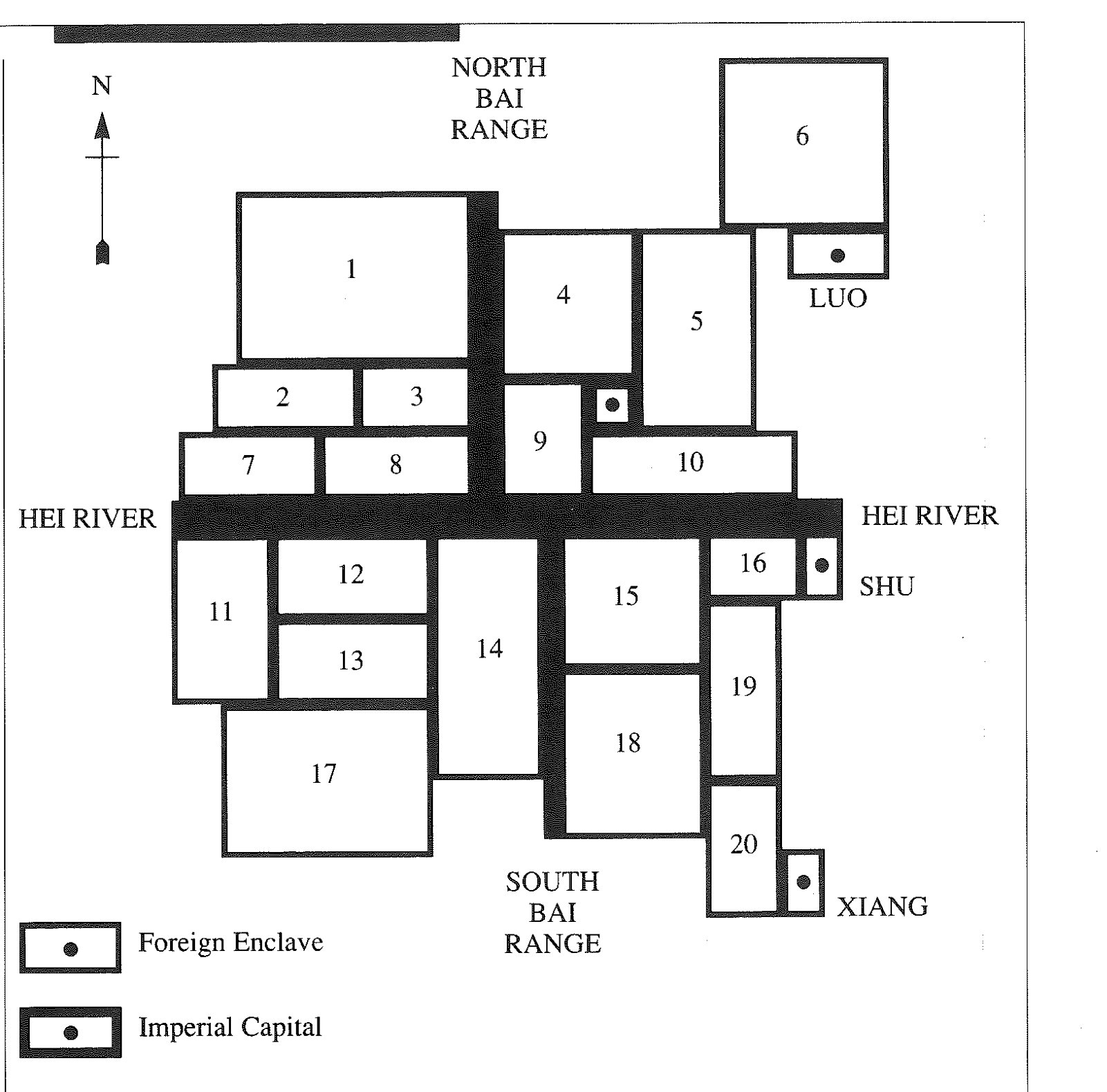
“As I say, that reflected the status quo on the last day of the fourth moon. Then all hell broke loose. Over the next 10 days, here is what happened:
(a) Ping defeated Pung and declared for the only faction that did not so far have a state in the quad. General Pung crossed the border north to An state, which tell into a non-aligned condition of chaos. (b) Kulian gained the support of Luo Enclave by bribery.
(c) The forces of Guang state successfully attacked west across their border into Lord Han’s state, annulling his factional allegiance.
(d) Zisha forces had Marshal Chang assassinated, placing their puppet in charge of his state. But the old Marshal’s mistress, pretending love for the usurper, poisoned his bird’s nest soup. Chang’s son took over with the aid of the neighbouring state of Bo, whose faction he joined. (e) The Qingiu Gang of Shu Enclave staged an uprising and forced the governing council to support the faction of the neighbouring state.
(f) Finally, Beihai’s Lord Fan attacked one of his neighbouring states east across the Bai and routed the forces there, converting the state to his faction; the defeated forces fled west across their own Bai border with Lord Yuan’s state, which was reduced to civil war and non-alignment.”
“Well, that was Hamish’s second report, from the middle of the fifth moon. Father had to make sense of the mess, and in particular to say whether any faction chief became warlord. What do you think, Lydia! Hello? Hello?”
Can you duplicate the feat of Liebnitz Père by: (a) listing, for each of the 20 numbers on the map, the name of the state and the name of its leader (Deng will have 2), all as of the last day of the fourth moon; and (b) say who was named Warlord of Tang in the fifth moon? While you’re working on it, can you suggest a way to wake up Lydia?
View the original scanned pages →
Originally published in bout de papier, Vol. 8, No. 2 (1991) — Spring 1991 // Printemps 1991, pp. 47–48. Read the rest of this issue →



