
bout de papier, Vol. 8, No. 2 (1991) — Spring 1991 // Printemps 1991, pp. 36–37
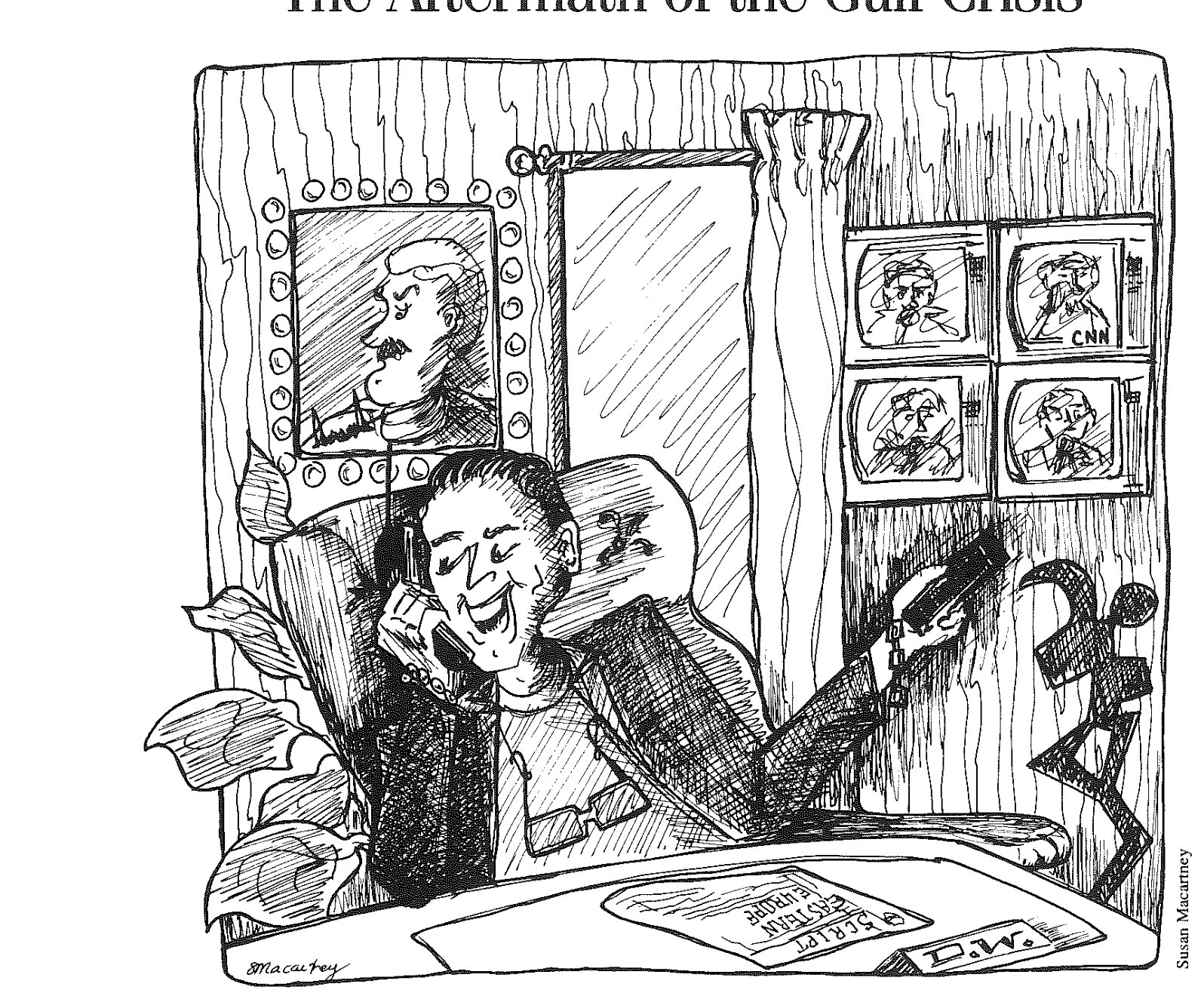
A debate is raging furiously between a number of diplomatic historians and TV critics. Has the Gulf crisis changed the nature of diplomacy through the use of television?
Television’s Impact on Diplomacy
Lloyd Bucklewash, distinguished historian of Canadian foreign policy at the University Toronto, puffs on his pipe. “No doubt about it, television is changing the rules of the diplomatic game. Saddam Hussein uses CNN to announce his latest bargaining proposals and to manipulate Western public opinion. The Allies show their military hand through television. Hussein and Bush address each other’s citizenry live and in prime time”
Putting his pipe on a pile of treaties and international conventions, he continues. “This is just the beginning. The values and norms of the television industry will soon permeate all aspects of traditional diplomatic practice. It’s already happening. Have you visited the External Affairs building recently? Go there.
Look around, observe their behaviour, listen to their conversation. The old fart school of diplomacy which we historians have grown to love in Canada will soon be a thing of the past.”
The Lester B. Pearson Studio
Sure enough, the External Affairs building does seem to have changed over the last months. Large autographed posters of various Deputy and Assistant Deputy Ministers (ADMs), framed in small make-up lights, line the walls of the front lobby. Smiling, big chested blondes in tight sweaters stand at the entry to the Towers, now renamed Studios A, B, C and D. Guards from the Canadian Corps of Commissionaires are nowhere to be seen.
The diplomats wandering the halls appear to dress differently. There are not many three-piece, pin-striped suits in the crowd. Most men sport sunglasses and wear loafers without socks. Italian linen sports coats cover i-shirts and beige casual slacks. Women breeze by in flimsy, one-piece leisure suits, cut low in the breast. Gaudy golden jewellery hangs around their necks.
The conversation in the hallways, cafeteria, offices and library has a different ring to it.
– “P.G.., how’s it going, big guy. Listen, we’re putting together a new concept for a memo on Central America. Have your people come over, we’ll break bread, and let’s cut a deal.”
– “Julie, how are you, babe? You look fab! Heard you knocked the big guys dead in N.Y.C. during your UNGA run. Let’s do lunch, tomorrow!”
– “I’m worried, Louie. I went to casting to see if I could audition for a lead role in some of the blockbuster issues this year. No way. They say I’m all washed up. My name is associated with too many of the old foreign policy clunkers.”
The Major Studio Heads
The influence of the television industry is more evident in the luxurious eighth floor suites of Studio A. The conversations emerging from these offices are lightyears beyond the hushed, reserved, guarded whispers of traditional diplomacy.
“L.M. honey, talk to me, talk to me. It’s D. W. on the phone. I love you, too, babe. Listen, sweetheart, that script your production crew penned on economic assistance to Eastern Europe just blew my mind. DY-NA-MITE! I swear, legs, if the Minister picks up the option for this pilot, we’re laughing. We’re on easy street. It’ll be a blockbuster. We can probably syndicate it within the department. Let other divisions get a cut of the action. One problem, L.M., is the casting. I think the lead role should come from one of my divisions — Agreed? Great. I love you, babe. Catch you later.”
In the office next door, another studio head is yelling into the phone. “Howie, you call THAT a scenario! I’ll tell you what it is. It’s dullsville. It’s a dog! El stinko! Now, Howie, I like you as a director. But remember, in this business you’re only as good as your last memo. Now, either your production crew gets me a good scenario for the Minister’s trip to Thailand, a good dialogue for his scenes with the Crown Prince and a happy ending or I’m cutting your budget for future productions.”
In a conference room down the hallway, other ADMs are discussing the department’s strategic priorities. These are set out in the form of a network program grid on a chart at the front of the room. Gold chains are dropping from the necks of several of the participants.
“Donnie, Donnie. I love you. It’s fab. It’s wonderful. It’s contemporary. It’s us. It’s now. What programming!”
Another voice interjects, “Let’s not rush this, big Don. OK for the Summit 7 spectacular — it’s a big blockbuster, special like a Bob Hope special. OK for another year of South Africa — it’s big, it’s popular, it’s got good ratings, even better than Roots. OK for NAFO fishing — it plays well to our regional audiences. OK for some old reruns of Canada and the Latin America connection — it’s like Desi Arnaz on I Love Lucy. But, come on guys, let’s drop the MTN Round from prime time. It’s dullsville. It has no sex appeal. Sort of like Let’s Make a Deal without any deal.”
Pin-Striped Television
Maury Caulfield, soap-opera critic for T.V. Journal, jabs his finger in the air. “Yeah, I bet those political analyst types are crying about how television has changed diplomacy since the Gulf crisis. Well, I have a bigger beef. They should check out how the pin-striped crowd is destroying a marvellous medium. You heard me. TV executives are now so enamoured with anything to do with diplomacy, they are forcing it down our throats. In the process, they are destroying TV. You don’t believe me. Just watch the CBS Evening News, or the Johnny Carson Show or the soaps.”
The CBS Evening News
It is true that the CBS Evening News does seem slightly different than before. The writing does have the echoes of foreign ministry memoranda and cables.
“Good evening, this is the CBS Evening News, drafted by Leslie Schoor and Daniel Stahl, approved by Jack Whitaker, then approved by Norm Robertson, prepared in consultation with the news bureaux of Europe, Africa and the Features Section, recommended to the announcer by William Paley and read by Dan Rather.
“The objective of this broadcast is to inform you of recent developments in the Middle East, United Kingdom and heartland USA and to put forward a variety of insights, political viewpoints, sound bites and policy options for your consideration in the lead-up to the end of the day.
’The first issue is the Kuwait crisis. It would appear that, according to an interesting tidbit picked up at a small dinner party offered by the Mexican Ambassador on the occasion of the departure of the dean of the Kenyan diplomatic corps, the Bulgarian Ambassador, who is also known for his taste in wine and women, the Iraqis are contemplating withdrawal from Kuwait. Our Rome correspondent, however, says his contacts, who asked to be protected, have assured his wife during a recent bridge tournament that the opposite is true based on rumours they have heard from Vatican envoys in Baghdad.
“Margaret Thatcher is planning a comeback. The background to this issue dates to the signing of the Magna Carta when nobles raised swords against King John. Throughout the Middle Ages…
“And that’s the way it is. Do you agree? Dan Rather reporting.”
The Johnny Carson Show
It is also true that the Johnny Carson Show seems different. His opening monologues bear striking resemblances to Ministerial intervention notes.
“Here’s his excellency, The Honourable John Carson.”
“Good evening ladies and gentlemen. It is with great pleasure that I am able to be here with you tonight in Los Angeles on the occasion of the opening of this new show which is a continuing tribute to the vibrancy and strong bonds between our production team and our faithful audience.
“Los Angeles is a great and fair city. It has historic connections with the rest of the country. It has Spanish origins. Our production team has Mexicans too. These elements of a common cultural heritage bind our two sides together in a warm and understanding relationship.
“I want to raise with you tonight a series of jokes which, I hope will lend themselves to a peaceful but comic resolution which is satisfactory both to your side a nd mine. My officials, Ed McMahon and Doc Svenson, can go into the details if needed.
“Finally, I would like to note my intention to pursue subsequent bilateral discussions with Suzanne Somers, Sly Stallone and Mother Teresa. These should be productive, informative and frank.
“Thank you. We’ll be right back after a word from our sponsors.”
The Soaps
And yes, it is true that the soap operas are changing too. The recent plots of As The World Turns and The Young and the Restless are revolving around familiar themes. Will Nadine and Jim be posted and where to? Will Todd ever get his promotion to the EX level? Will Wayne ever stop muscling in on Cheryl’s territory. Will Sally find true happiness in Lagos? Will Denise be invited to the French Ambassador’s residence for a quick roll and canapé?
In Guise of a Conclusion
Both television and diplomacy are thus victims in their own way to Saddam Hussein’s invasion of Kuwait. Diplomatic historians and TV critics are right to worry. We can only hope and pray that with the passage of time the situation will return to normal so that cookie-pushers and couch potatoes can go back to their respective professions with their heads held high
View the original scanned pages →
Originally published in bout de papier, Vol. 8, No. 2 (1991) — Spring 1991 // Printemps 1991, pp. 36–37. Read the rest of this issue →



