
bout de papier, Vol. 8, No. 2 (1991) — Spring 1991 // Printemps 1991, pp. 20–21
One of the periodic pleasures of being the spouse of a member of the foreign service is the opportunity to visit out-of-the-way places. Without question, the tiny native settlement of Arimae in the southern region of the Darien province of Panama is out of the way. Arriving by road requires the simultaneous cooperation of the weather, the roads and the off-road vehicle; not to mention one’s kidneys. This is the Darien Gap, a terrain so formidable that linking the southern and northern legs of the PanAmerican Highway has been impossible, because of the jungle which is so dense that routing out guerillas and narco-traffickers has proven impossible.
The most direct route is one hour by small plane to La Palma at the mouth of the Rio Sabanas; a long hour by outboard river canoe to Santa Fe; and then a half hour by jeep to Arimae. What from the air looks like tropical forest turns out to be jungle swamp with a few patches of solid ground supporting isolated huts and, rarely, villages of a dozen or fewer homes.
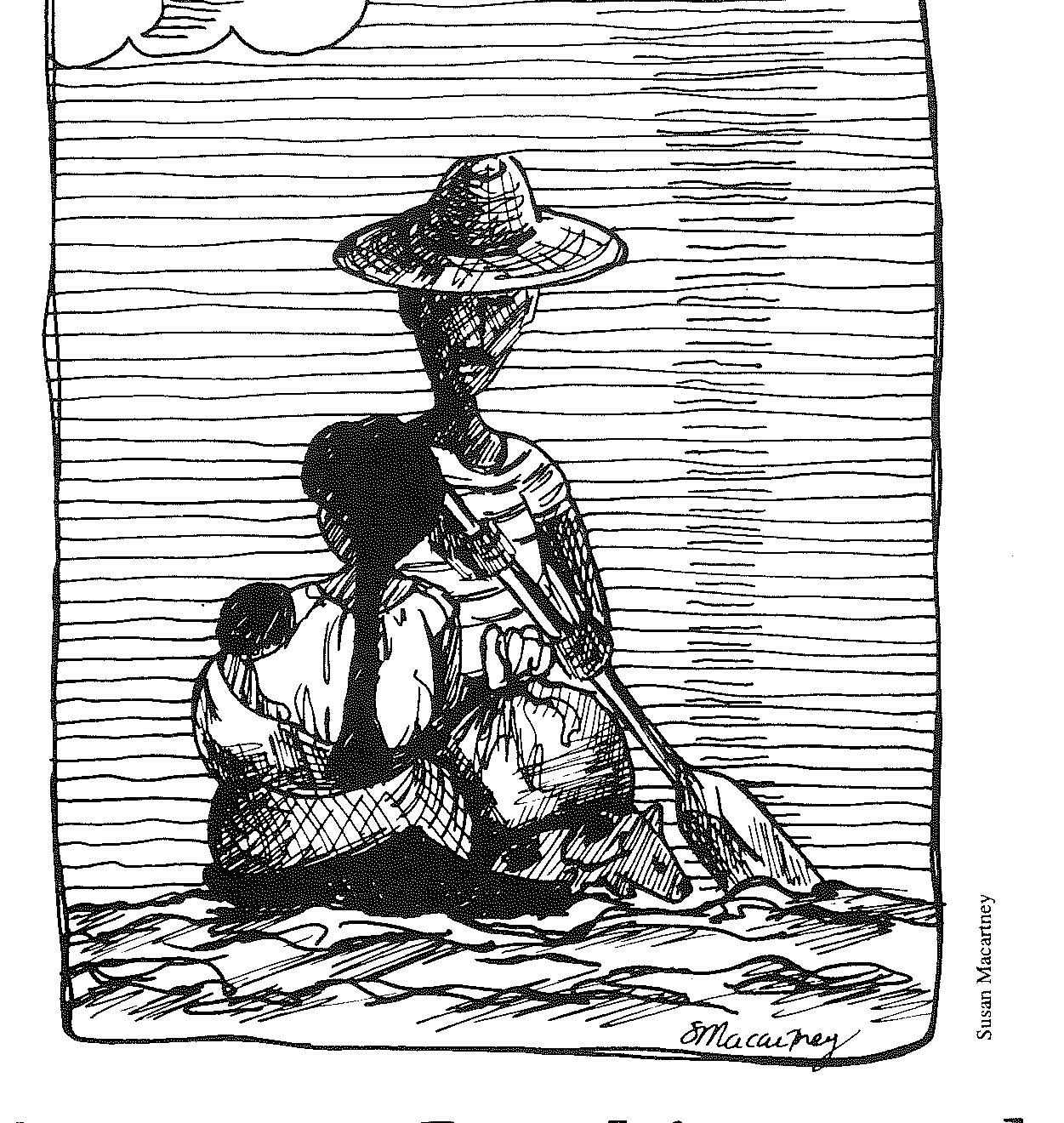
Travelling, fishing, transporting supplies, and visiting are all done by dugout canoe. By the time the family, their goods, dogs and any stray passengers are loaded aboard, there might be only three inches of free board left. Needless to say, everyone sits very quietly as papa paddles along….
Being important guests, we were transported in a larger dugout canoe, with extended sideboards and outboard motor, which certainly made it safer to cross the wide river mouth. Even so, any shifting to relieve cramped muscles provoked alarming rocking and increased the opportunities to be soaked by the bow wave. The impressiveness of one’s arrival is determined by how elegantly one can clamber over the bow of the boat and scramble up the steep muddy bank without being covered in ooze and muck. The added obstacles of intervening canoes, slippery concrete slabs and helping hands only enhance the challenge.
Arimae is a ten-hut village with a school room, a street light (but no streets) by the soccer field, and a canteen-cum-store which sells matches, oil, salt, and a few other basics. The electric generator is cranked-up for soccer games and town meetings. Even in this elevated area, after two days without rain, the ground is saturated with water; so much water and yet scarcely drinkable, that aqua-ducts and sanitation are top priorities. Homes are built in the traditional way on stilts with open sides and thatch roofs. Hammocks and the occasional handhewn table are the only furniture. Ancient school desks in the roofed meeting place are reserved for chiefs and male guests.
The purpose of our visit to Panama was to hand over a variety of Canada Fund cheques. Arimae was receiving a “chicken cheque”; a small sum which would buy hens and a rooster, build a coop and provide some instruction in poultry production. It is traditional for the women to have scratch hens about the village and the ones we saw looked fat and succulent from feeding on the grains of rice that fall to the ground from the husking mortar. However, the need for increased protein in their diet was apparent in the red hair and pot bellies among the toddlers.
As usual, it was the people that made the day and provided the most entertainment. Just about the time I was thinking, and not for the first time, that the concept of “noble savage” was a load of fertilizer, I met two people.
Very wisely, the village had not made any arrangements in honour of the occasion as it would have been unseemly to second guess the fates by assuming that we would actually arrive. It seemed that the Bishop, who was to accept aquaduct cheques, had the same feeling as he went to a different village in the other direction whence it would take over an hour to fetch him. So, leaving the men to socialize as they waited for someone to find the village jefe and collect everyone for the ceremony, I went for a look-about.
The first person I approached was a lone woman pounding rice with a double-ended pestle in a wooden waist-high mortar. I hefted the pestle which weighed several kilos and admired the dexterity with which she removed the husk and avoided breaking the grains. We each agreed that children were a worry to raise, housework was never done and husbands were always hungry. Then she asked a few pertinent questions of her own; who was I (unimpressed), why was I there (pointed to the fat hens about her feet), how long was I staying (relieved that I wouldn’t have to be fed with one of her hens). Throughout the conversation she never missed a stroke with the pestle nor lost a grain of rice to the mooching hens; a lady with her priorities firmly in place. In an insightful twist on an old saying, she summed it all up by commenting, “You’re coming and looking and going.
The second person was the village chief. Under pressure from the boatman, who foretold dire consequences if we missed the tide, and the Ambassador who paced about consulting his watch, it had been decided to proceed with the ceremony without the chief Naturally, ten minutes into the speeches, he arrived.
Barefoot, sweaty from the fields, with raggedy pants and torn T-shirt he could give lessons in aplomb and grace to any seasoned diplomat. Without a twitch or stammer, he greeted the crowd, unhurriedly shook hands in order of protocol, welcomed the guests and granted permission to proceed with the ceremony.
When the Bishop arrived another ten minutes later, and expressed some confusion over “our” chicken project as he was also discussing a chicken project for the village, the chief pointed out that, as chief, his responsibility was to get chicken into the stomachs of his village. He has chosen the Canada Fund (through INCADI, a Panamanian NGO) as the most direct, and the fastest, method of achieving this goal. During the resulting period of discussion and clarification, the chief stood quietly with the cheque firmly in hand, a gentleman with his priorities also firmly in place, and a striking symbol of the new reality in developmental assistance. A reality in which the recipient firstly expresses choice, and secondly, appreciation.
A chicken cheque will not save the world, but if among all the coming and looking and going, some learning also takes place, there will be more chicken in the pots and fewer pots on the children!
(For those readers who may spy a potential for conflict between the regional development interests of the church and a local NGO, that is not the case. Neither the Bishop nor the NGO were distressed and immediately set about deciding how to coordinate their efforts better on this and other projects.)
View the original scanned pages →
Originally published in bout de papier, Vol. 8, No. 2 (1991) — Spring 1991 // Printemps 1991, pp. 20–21. Read the rest of this issue →



