
bout de papier, Vol. 8, No. 1 (1990), pp. 34–36
As a little boy, my favourite books were those found in my grandmothers’ libraries, especially those by authors like G.A. Henty, R.H. Haggard, Robert Louis Stevenson, John Buchan, C.S. Forrester, and Sax Rohmer. Through them I carefully followed Wolfe in Canada, Moore in Spain, Hornblower on the high seas, Richard Hannay and Nayland Smith on the tracks of evil bolsheviks, huns and devil worshippers. They were set at a time when most of the world’s landmass was still coloured red and the sun never set on the British Empire. Full of honour and treachery, bravery and comradeship, danger and dash, all calculated to make a small boy’s blood run wild around the heart. It is a pity they are no longer considered socially acceptable.
The best tales were those of Kipling — the Jungle Books and Kim, of course, but also his Soldiers Three — Mulvaney, Ortheris and Learoyd, and Plain Tales from the Hills. So when I decided to do Delhi, Agra, Jaipur and Udaipur and still had a couple of days left there were no second thoughts about adding on a trip to Pakistan, particularly, when there was a chance of making the journey into the Northwest Frontier. With any luck I would get a chance to see the Khyber Pass, where through the pages of my grandmothers’ Boys’ Own Annuals I had passed many a rainy afternoon fighting for the Queen Empress and King Emperor.
With the war and the Pass officially closed to foreigners, we required special permission from the Pakistan Government. With a driver and van hired from the mission, and armed with a hearty lunch basket, and in the company of some friends from the Embassy — Jim, Michaelina and Iley — I set out westwards along the Margalla Hills.
Evidence of the bygone Raj, the legacy of which still haunts modern day Pakistani and Indian politics was everywhere. We passed the tall grey stone obelisk to the memory of John Nicholson, Lion of the Punjab, who died at Delhi during the Mutiny in 1857. There is a poignant inscription on his memorial, which applies with equal justice to many of those who served the Imperial cause: ’Mourned by two Races with equal grief’.. Proof of a longer past lay across the road, in the ruins of temples dating back to the time of Alexander the Great.
At Attock, where the waters of the Kabul meet those of the Indus, we turned north alongside the massive fortification of the same name built in 1583 by Akbar, the great Mughal emperor who united northern India and left Fatehpur Sikri as his permanent monument. The old bridge, which offers the best view over the confluence of the two rivers, was closed except for military traffic but diplomatic plates and our determined driver resulted in the guards turning a blind eye to our passage. We crossed over the rushing, swirling waters three hundred feet below.
Rejoining the Grand Trunk Road, we drove through Nowshera. It is still a military town and its imperial era white-washed barracks and villas, with their picket fences and verandahs, line the road. A short time later we were in Peshawar, the last main town before the Khyber Pass. After a couple of missed turns, we found our way to the Office of the Agent for the North West Frontier where passes are issued. We munched on Peshawar muffins, substantial beasts heavy on molasses and bran baked that morning by Michaelina, who kept us constantly chuckling with her tales of the foreign service. Jim eventually emerged from the Agent’s Office alongside “Sher,” famed Khyber Rifles from the Pathan tribes whose job is to control their tribal cousins.
Ruggedly handsome, Sher wore the traditional costume of the region, grey shalway kamis — loose baggy trousers and a flowing shirt, a greasy brown turtleneck and a black leather jacket. He wore a black beret with the insignia badge of the Rifles. Its distinctive red and silver crest would be our passport, his leather bandolier of cartridges and Lee Enfield, which he prominently displayed beside him in the front seat, our guarantee of safe passage. The cheap, ill-fitting running shoes were not in keeping with the image of the fierce warrior.
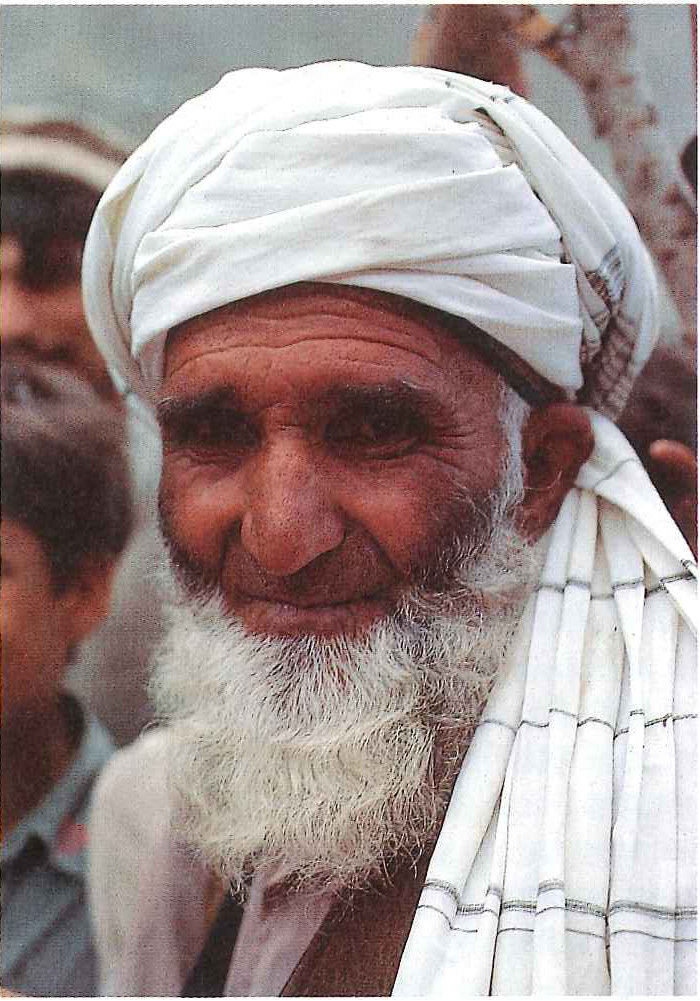
Spread across both sides of the Pakistan- Afghan border, the Pathans, especially those from the Afridi tribe have guarded the Khyber Pass since the early days of the Raj in return for money and the freedom to run a protection racket and raid the caravans that once plyed the Grand Trunk Road between Kabul and Delhi. Their reputation as warriors is formidable. It is said that if you find a snake and Afridi in your bedroom, you should kill the Afridi first.
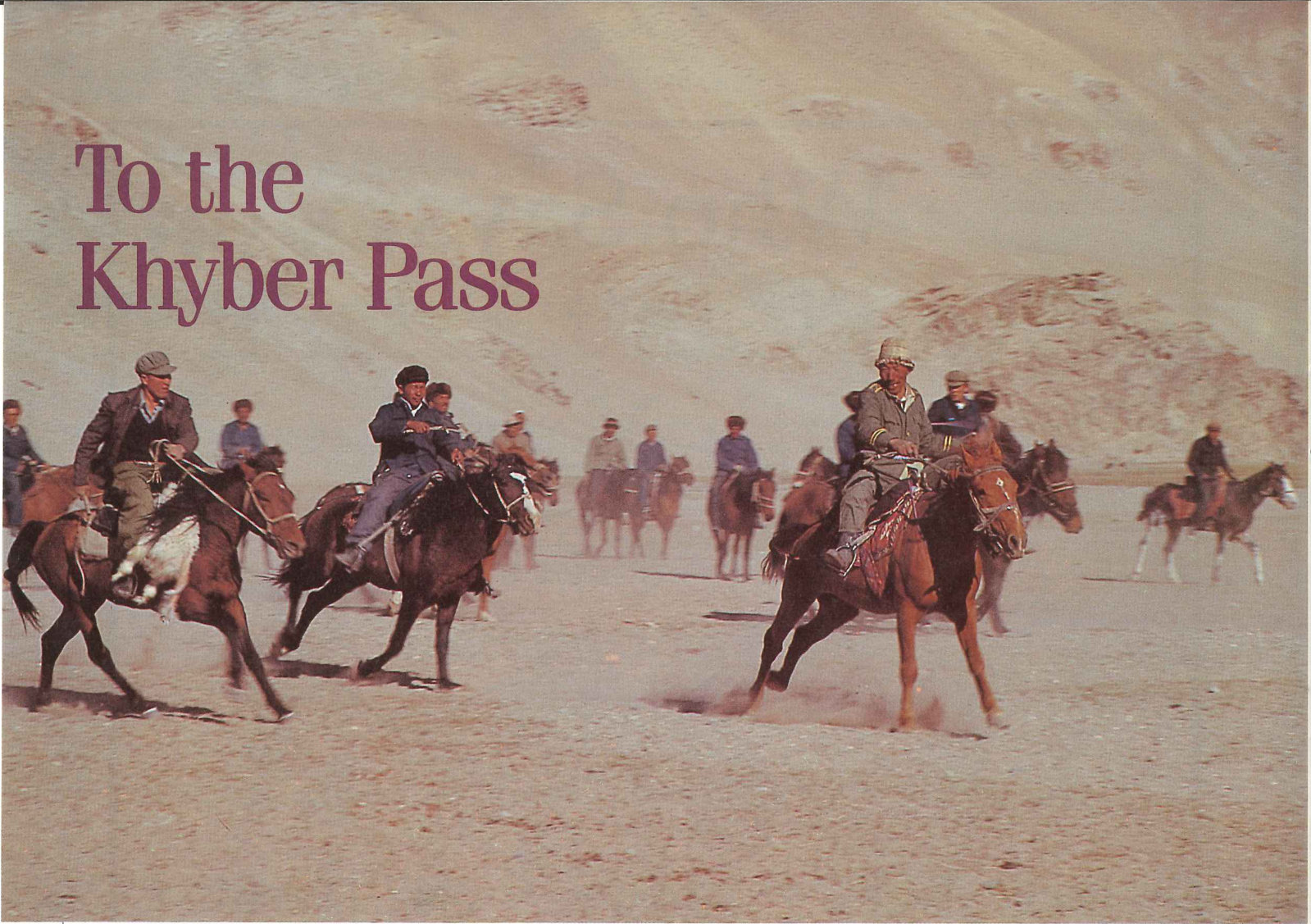
We left Peshawar and passed a series of Afghan refugee camps — it is estimated that somewhere around three million Afghans sought sanctuary on the Pakistan side of the frontier during the period of Russian occupation. We stopped in a camp, later in the day, to watch a buzkashi game. It is the Afghan equivalent of polo, except that teams are fluid and instead of a mallet you use your hand. As for the ball? At the start of the game a goat is held aloft by its hind legs, a knife is whipped out and the head cut off. The goat’s body is thrown high in the air and the match begins as rival horsemen tackle, grab, gouge and beat each other to gain the goat. Russian mythology, with a helping hand by thriller writers like Ken Follet, say that during the war, the Afghans substituted Russian prisoners for the goat.
The objective is to cross an imaginary goal line at either end of the field. The essential feature of the game seems to be to prevent anyone from reaching the goal. More often than not it seemed to be one rider fighting the other twenty-five or so horsemen. Play goes on until the bruises, cuts and wounds become unbearable. The game, as the Economist not long ago remarked, sums up Afghanistan, with Mr. Najibullah, the Russian’s client ruler, fighting hard to avoid becoming the headless goat.
The Khyber Pass begins at Jamrud, about a 45-minute drive from Peshawar. We stopped at the Bab-I-Khyber, a stone gateway above which flew Pakistan’s green national banner with its inset pale crescent moon, On one of the round blockhouses we found a plaque in English and Urdu containing an abbreviated history of the pass and some doggerel from Kipling’s ’Arithmetic on the Frontier’:
A scrimmage in a Border Station —
A canter down some dark defile —
Two thousand pounds of education
Drops to a ten-rupee jezail —
The Crammer’s boast, the Squadron’s
pride,
Shot like a rabbit in a ride!
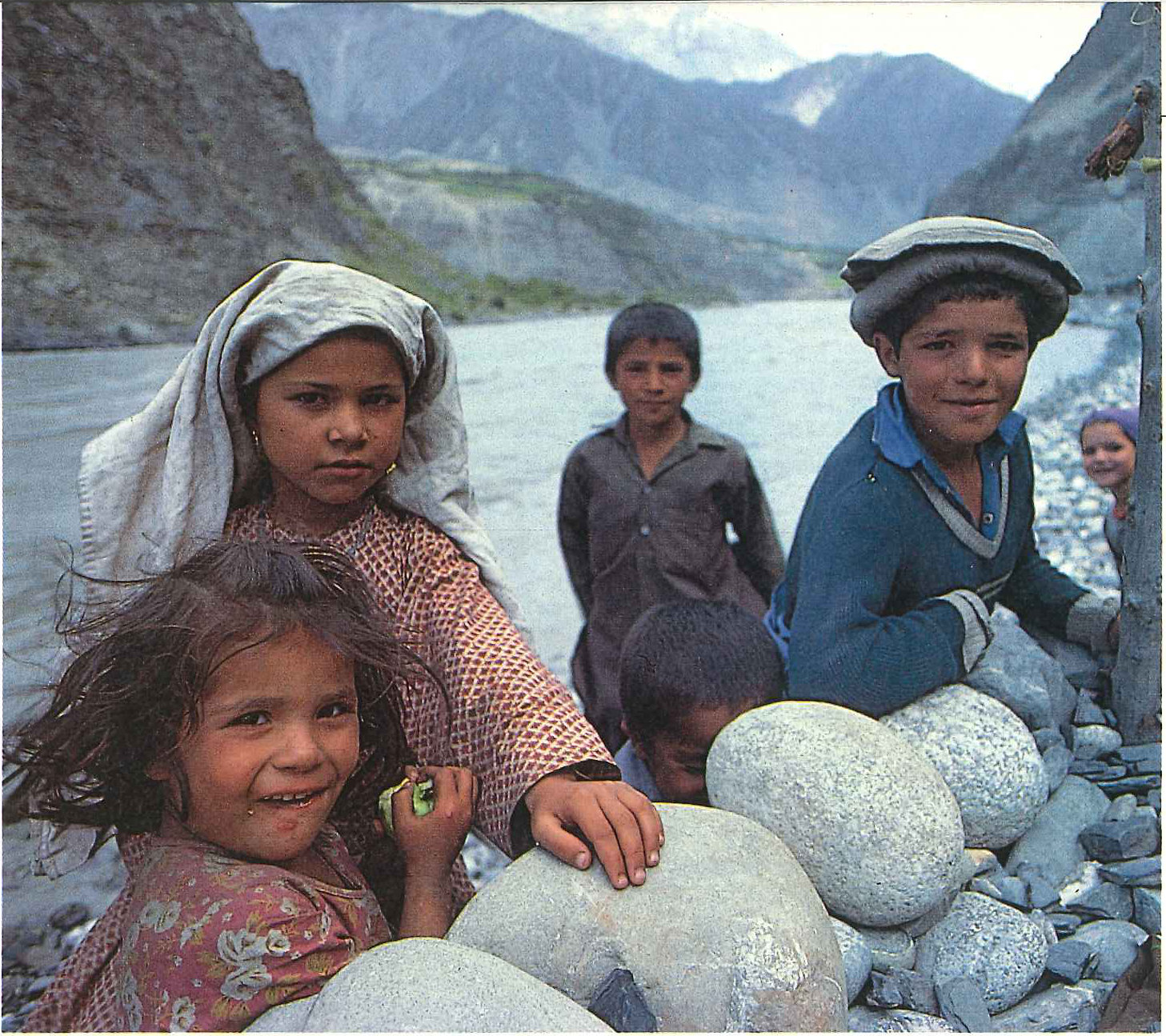
Back of the gate were the battlements of Fort Jamrud, built in 1836 and still serving as an outpost for the Rifles. We were quickly surrounded by children, mostly those of refugee mujahideen. Curiosity was mutual. They were especially intrigued by Iley’s black skin and kept wanting to touch her. She was novel to them but their own racial groups are amazingly diverse in complexion, physique and culture: a polyglot heritage of Chinese, Turkish, Russian, Caucasian, Mongolian, Punjabis and Sindhis who, as history’s pages turned, made the frontier their home.
Once into the Pass, signs warn motorists not to stop or stray onto the side roads. To this day, government has no authority on either side where tribal law prevails. Customs officers are helpless to prevent the heavily laden smugglers who pass on the side roads. There was a fair amount of traffic on these roads, modern Japanese pick-ups full of mysterious bundles and men with rifles, as well as old trucks decorated with the most ornate panelling I have ever seen — bright, colourful patterns with pictures of landscapes, mosques and flowers.
A series of medieval-looking forts with high mud walls and studded gates. I was told they were preserves of local smugglers, for whom banditry, or dacoity to use the local term, has been a way of life for centuries. A fair bit of the booty is in drugs. Pakistan produces heroin, providing an estimated one-third of US and European consumption. It is for this reason, as much as the war in Afghanistan, that the Khyber is closed to outsiders.
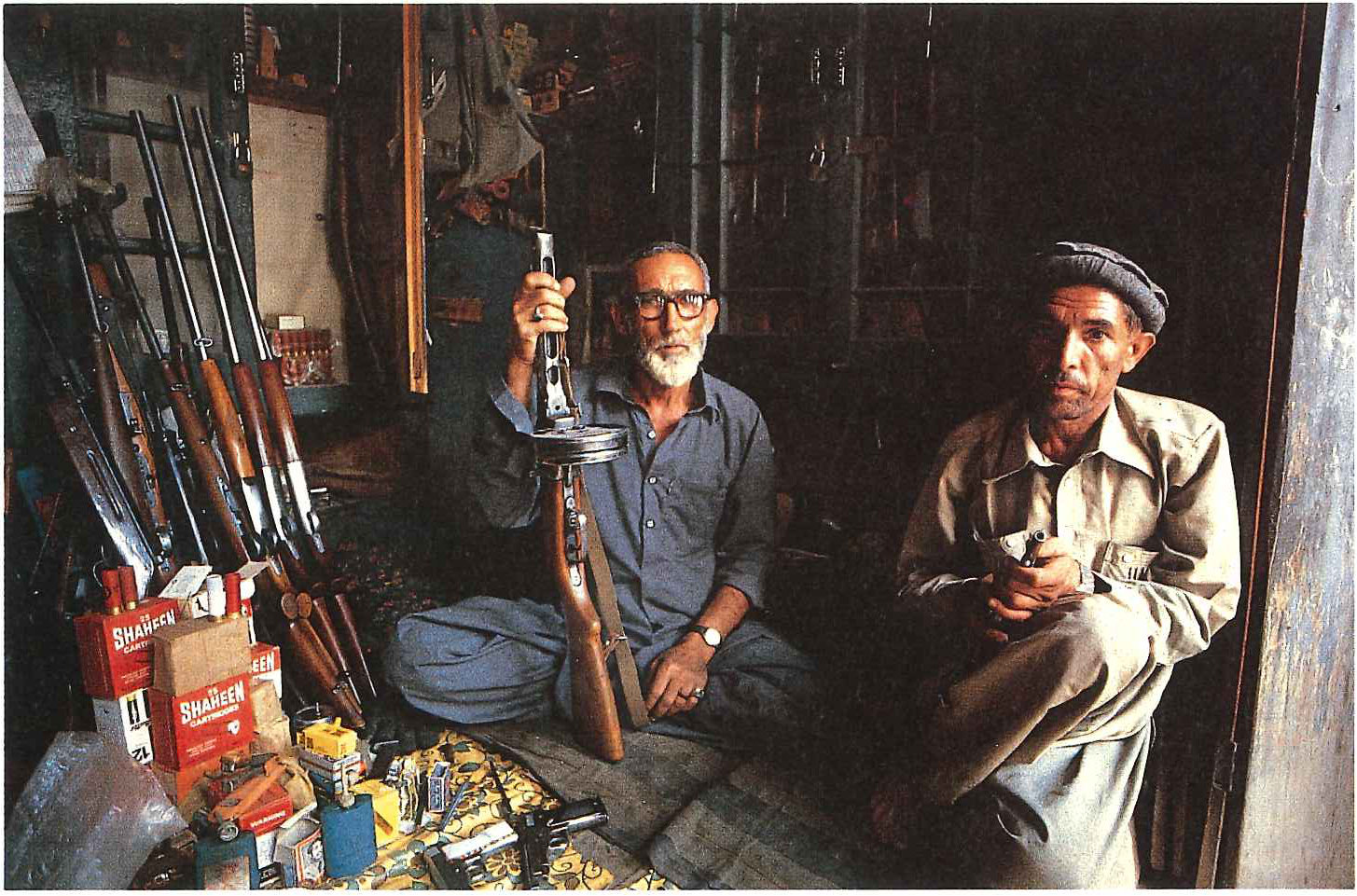
The war and drug trade has brought in huge amounts of money. Today, some of the forts are said to have marble floors and Jacuzzis. The war made sophisticated weaponry easily available. A man on the Frontier is not considered dressed without a gun. Many forts are now said to be mounted with anti-aircraft guns.
Around another bend and then we began to climb the Sulaiman Hills. The view back was truly spectacular and I had renewed respect for the armies who had fought their way south and north for generations. While Alexander probably used a more northern route, the Afghan Mahmud of Ghazni came through the Khyber in 1000 A.D. as did the later Mughal emperors. The British first marched northwards in 1838, losing thousands in the process. We passed a series of fortifications, built by the British after the First Afghan War as part of their “Forward Policy” to contain the Russian threat. Many of them are still occupied. Rather incongruously, beneath one blockhouse, labelled No. 1, whitewashed rocks had been arranged with the message, ’Punjab Regt. welcome you to Shagai.’
At its narrowest, we saw what appeared to be a series of sewerholes — mines laid during the Second World War when there was fear Hitler’s tanks might use the time-honoured invasion route. On the rocky ledge of the road were blocks of concrete on which were sculpted the crests of regiments — English, Scot, Irish, Welsh, Anglo-Indian and Pakistani, whose soldiers had defended the Pass over the past century. Higher up the hills was a Buddhist stupa, a relic of a much earlier conqueror.
After we had climbed for nearly 1800 feet we came to Landi Kotal, a dirty little frontier town reputedly the centre of the world’s smuggling and heroin trade. Microwave ovens and colour television sets lay on the dusty ground in front of dark shop fronts. Trade is based on the barter system, with Afghan carpets, handicrafts and leather goods exchanged for cigarettes, paper, lamps, chemicals and spare parts.
I read in The Frontier Post, the North West’s daily English paper, that a fair bit of Afghanistan’s legal imports are smuggled back to Pakistan and offered for sale at the Hayatabad market, near Peshawar. The gun trade is prolific and the paper reported that the capture of a phenomenal quantity of arms in the mujahideen’s latest offensive in Kunar had resulted in a significant drop in the price of the popular Klashnikov rifles!
Every man in Landi Kotal carried a rifle, unkempt, barefoot children played in the streets and there was a charcoal byre cooking some concoction at every corner. Women remained in pardah — secluded from public view. Those we spotted running to wells for water were wrapped in a cocoon of cloth. We had arrived at teatime, a legacy of the imperial era which will never disappear. Nearly an hour later, after we had eaten our lunch, a short, stocky man in a rolled-up cap ambled up to the Office of the Khyber Agency and gave us permission to proceed to Michni, the last station before the frontier.
Michni was only about three miles away but it took us nearly half an hour after retracing our way through Landi Kotel. We were met by three Khyber Rifles who told us our papers were not sufficient to enter their fort. As compensation, we could walk with them along the cliff face. There was not a tree to be seen, the rock-face was rough, bare and grey and the cold wind forced us to put on our jackets, sweaters and the yak-wool gloves I had bought in Nepal.
But we had come through the Pass and from our vantage point looked own on the plains below. The actual border with Afghanistan was perhaps three miles on, marked by a white line. About thirty miles distant, we could see plumes of smoke from Torkham, the first town on the Afghan side.
Beyond Torkham on the road to Kabul is Jalalabad. Jalalabad has a certain notoriety. In 1842, four years after invading Afghanistan, the British had decided to withdraw. Despite assurances of safe-passage the 16,500 soldiers and camp-followers led by the gout-ridden General Elphinstone were slaughtered as they struggled through Afghanistan’s snowbound passes. There was but one survivor — Surgeon Major Brydon, and in Jalalabad he met his rescue party. Shah Shuja, the ruler the British left behind, lasted a few months before he was assassinated.
The expedition had been a disaster. A parliamentary committee deplored the “loss of England’s character for fair dealing, loss of character of success … exhaustion of the treasury,” and the creation of a “hostile population.” Afterwards, a British officer observed, “Everything is reverting to the old state of things, as it was before we entered the country.” Two more wars, in 1878 and 1919, and numerous border skirmishes would follow.
Now more than a century later, the Great Game goes on. The region was once again the site of conflict, this time between the Russian-backed Afghans and mujahideen. The Rifles told us Torkham and the area around it had changed hands three times in eight weeks. During our visit, it was once again back in the hands of the Afghan mujahideen. With the Russians scheduled to pull out of Afghanistan six weeks after our visit, after a disastrous decade of occupation, the country would once again revert to its natural state of incessant turmoil.
Since Alexander, foreign invaders have come and gone; the lucky leave alive. Those tempted would do well to read Kipling and remember his advice:
When you’re wounded and left on
Afghanistan’s plains,
And the women come out to cut up
what remains,
Jest role to your rifle and blow out
your brains
An’ go to your Gawd like a soldier. A
View the original scanned pages →
Originally published in bout de papier, Vol. 8, No. 1 (1990), pp. 34–36. Read the rest of this issue →



