
bout de papier, Vol. 8, No. 1 (1990), pp. 24–26
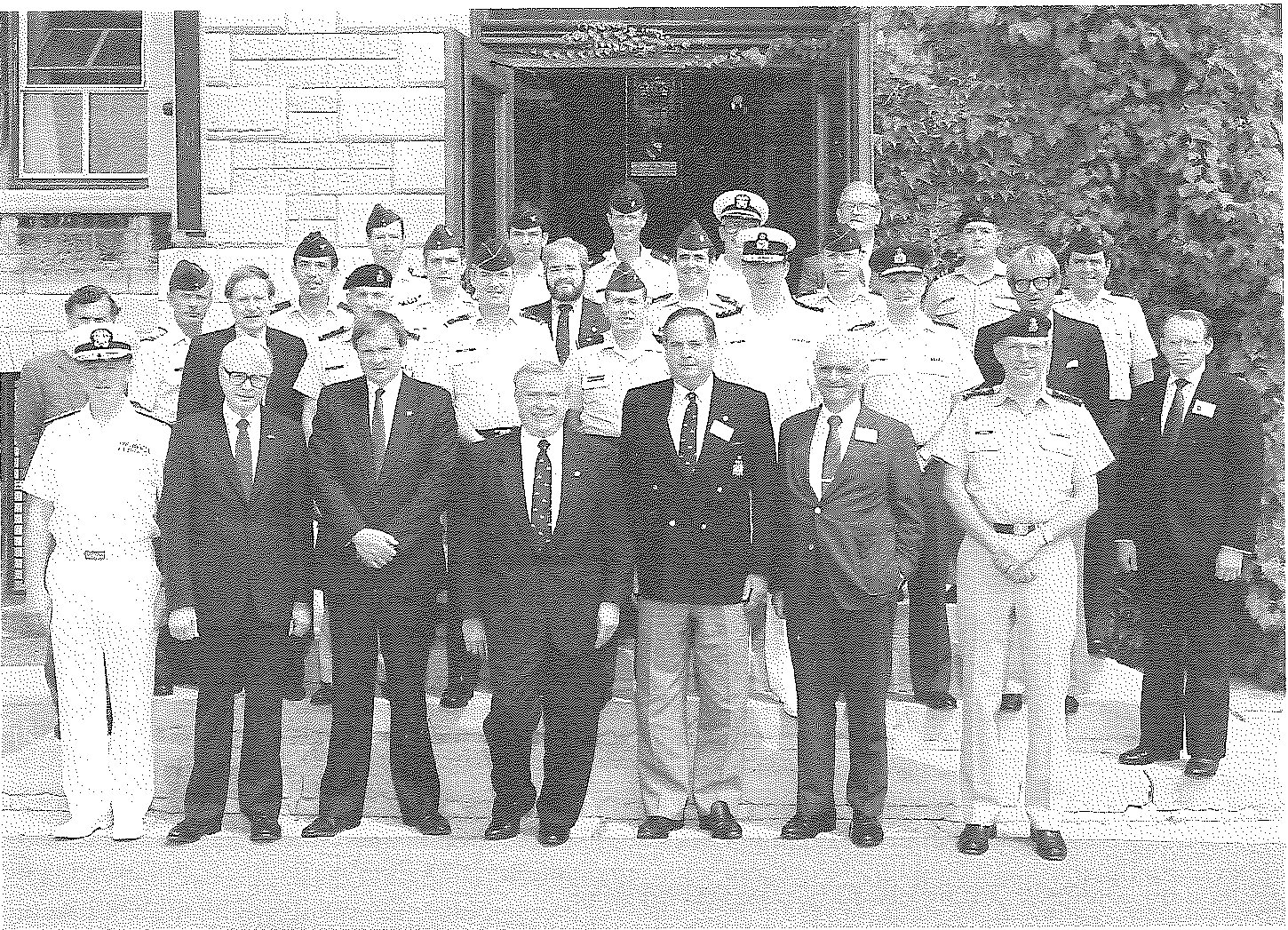
August 18, 1990 marked the 50th Anniversary of the so-called “Ogdensburg „Declaration” which established the Canada-USA Permanent Joint Board on Defence (PJBD). Ironically, on that precise date two years before the PJBD came into being, President Franklin Roosevelt, who may have been unwittingly inspired by two Canadians who would later become members of our own Department of External Affairs, had offered the assurance that the United States “would not stand idly by” if Canada were threatened by any outside Power. Roosevelt spoke these words at the George Richardson Memorial Stadium of Queen’s University in Kingston, Ontario, 100 kilometres southwest of Ogdensburg, New York. It is only fitting, therefore, but no more than coincidence, that the PJBD should have combined its 50th Anniversary commemoration this August 18 in Ogdensburg with its 186th regular meeting in Kingston.
With Ogdensburg and Kingston accounted for, the only loser in the 1990 host city stakes would seem to be Heuvelton, which lies ten kilometres to the southeast of Ogdensburg. It was actually at the Heuvelton junction that FDR stopped his private railway car on August 17, 1940. It was there the car remained while Roosevelt and Prime Minister Mackenzie King dined together that evening (and King watched in astonishment — so he confided to his Diary — as the President demolished a “huge steak”); it was there the two leaders spent the night aboard the railway car (and King worried what the air conditioning might do to his health); and it was there that the famous “Ogdensburg Declaration” was actually issued as a press release the following morning.
The manner in which history inadvertently short-changed Heuvelton in favour of Ogdensburg did not sit well in later years with the former Executive Director of the Canadian Institute of International Affairs and onetime senior Canadian diplomat, the late John Holmes. Joel Sokolsky, Associate Professor of Political Science at the Royal Military College of Canada, Kingston, relates how Holmes, upon learning of Heuvelton’s historical role, was determined — one imagines with mock seriousness — to have the Ogdensburg Declaration rechristened the Heuvelton Accord. The town’s historical linkage to FDR has, at least, been assured through the work of William van den Heuvel, President of the Roosevelt Institute, after whose ancestors Heuvelton was named.
The popular interpretation of the Ogdens-burg story has President Roosevelt touring US military installations in up-state New York in mid-August 1940. Having recently inspected the coastal area of Newfoundland, the thought occurs to him to discuss the more pressing question of North American coastal defences with the Canadian Prime Minister. He telephones Ottawa and in no time Mackenzie King is at the President’s side. Searching for a means of securing Canadian consent to defence projects which the Americans wished to carry out on Canadian territory, Roosevelt, the wartime neutral, presents King, the belligerent, with the text that is to become the Ogdensburg Declaration. There is little discussion of the text and, after King and Roosevelt attend a religious field service the morning of August 18, they issue mimeographed copies of the statement to the press. As Col. C.P. Stacey wrote in the International Journal in 1954: “No international agreement of comparable importance has ever been concluded more informally.”
Certain elements of the above interpretation have withstood the scrutiny of historians. However, the account underplays the efforts of Mackenzie King to involve the USA more fully in the war effort, especially on behalf of the United Kingdom, as well as what Stacey describes as a new interest on the part of London and Washington in Canada’s “possible role as a channel of communication and influence between the two great powers.”
To place events in their correct perspective, one must recall the atmosphere of anxiety generated by the fall of France to Hitler’s armies in June 1940. Retired Canadian Ambassador John Stiles recalls the sudden realization that spring that Britain itself might fall to the German Blitzkrieg with the prospect of imminent Nazi attacks against North America. Stiles adds: “I remember taking my COTC course at the University of Toronto much more seriously after that!” In his Memoirs, Hugh L. Keenleyside, distinguished diplomat, author, federal and British Columbia mandarin and first Canadian Secretary (later Chairman) of the PJBD paints the following picture:
“On 8 August 1940 the great German air attack on the British Isles began. Those in North America who shared the knowledge and deepening fears of President Roosevelt and Prime Minister King expected every day to hear that the invasion of Britain had begun. It was apparent to them that if the Germans were able to land in force, the almost unarmed soldiers and civilians of Britain could not long maintain an effective opposition. The collapse of British resistance and the installation of a Quisling-style government under German control in London would certainly and quickly be followed by a demand on the nations of the New World for co-operation with the fascist powers. Rejection of this demand would invite early attack; acceptance would mean the betrayal of the social, political, economic and even spiritual ideals which, although consistently dishonoured by both public and private behaviour, were still the proclaimed hallmarks of North American democracy.”
The preoccupation with continental defence spread quickly into the public domain. Business Week magazine reported at the end of August: “The Canadian public had a shock a few weeks ago when defense authorities offered a map demonstration of how — theoretically at least — enemy planes could reach this continent from Norway in five hops, no one longer than 800 miles…. Canadians were startled into demanding quick action in protecting their Arctic coasts.”
In this atmosphere of impending disaster — so novel to North Americans accustomed to live in a “fireproof house”, far from the conflagrations of Europe — both Roosevelt and King were forced to shorten their focus and contemplate the possibility of German attacks against the North American continent itself. Their strategy was twofold: to bolster coastal defences, especially in the northeast, along the Newfoundland shore, and to transfer whatever military resources they could to Britain. Earlier that spring, King informed his External Affairs Liaison Officer, Dr. James Gibson (until 1947 King was his own SSEA), that even before the outbreak of the war in Europe, President Roosevelt had been profoundly annoyed with USA intelligence estimates of coastal defences in the Pacific northwest. FDR told King that he was so dissatisfied with the intelligence he was receiving that he had gone personally to inspect the region. For the same reasons he had, more recently, conducted a similar personal sortie to the northeast Arctic coast, and, as noted, to the east coast of Newfoundland. In the President’s view, there was a clear need to increase USA contributions to the Allied war effort. This was not a simple task for Roosevelt — not only was the USA officially neutral but FDR had to contend with a sizeable portion of the American public determined to see that it remained so. In these circumstances, Canada was frequently portrayed as the “linch-pin” between the United States and Britain. Certainly King liked to see the country in that light; and, notwithstanding the voluminous correspondence carried on by Roosevelt and Churchill, there is no doubt that Canada and the Canadian Prime Minister were useful and at times necessary intermediaries.
In his book Arms, Men and Governments, Col. C.P. Stacey, the former Official Historian of the Canadian Army’s General Staff, reviews some of the developments leading up to Ogdensburg. Drawing on Col. Stacey and Mackenzie King’s own recollection of events as recorded in his diary, it is possible to reconstruct the following chain of events:
9 July: Mr. Justice Felix Frankfurter, a personal friend of FDR, suggests to the Canadian Minister in Washington, Loring Christie, that King should visit FDR at Hyde Park to discuss “a common plan of defence”.
12 August: King sends a message to FDR through Christie dealing with the transfer of US destroyers to Britain and adds the hope that “if and when discussions for the transfer of such destroyers were undertaken there would be an opportunity for discussing the most effective means of strengthening naval defences on our side of the North Atlantic.”
14 August: J. Pierrepont Moffat, US Minister in Ottawa writes to Sumner Welles, Under-Secretary of State in Washington, of a growing “public demand” in Canada for “some form of joint defence understanding with the United States”. Welles passes this letter to FDR on 16 August.
15 August: Christie conveys King’s message in person to FDR who indicates that he has been thinking of proposing to King that he send a delegation of US Staff Officers to Ottawa to discuss the question of the direct defence of North America, especially the possibility of “base facilities for United States use” on the east coast of Canada. He hints that he will make definite suggestions to King along these lines “as soon as the beginning of next week”.
16 August: the President receives Moffat’s letter of the 14th and, to Stacey’s mind, “this appears to have triggered one of those impulsive acts for which Roosevelt was noted”: at a noon press conference, he reports that the United States is carrying on conversations with Canada on western hemisphere defence. As Stacey observes, “This might have seemed a little premature.” No matter — in less than two hours Roosevelt is on the phone to King to report what he has said and to invite him to Ogdensburg. Impulsive or not, FDR in this way was not only pursuing his own interests but responding to King’s request delivered through Christie four days earlier and to Moffat’s recommendation, received earlier that very day.
The uncomplicated spirit of the times is captured in King’s diary entry. He noted that “shortly before two o’clock, the ’phone rang and the girl at the switchboard said it was the President of the United States who wished to speak to me. The President said: ’Hello, is that you Mackenzie?’… I replied: Yes. He then said: ’I am going tomorrow night in my train to Ogdensburg. If you are free, I would like to have you come and have dinner with me there…. I gave an interview this morning to the press in which I said that I… was taking up with you direct the matter of mutual defence of our coasts on the Atlantic…. I have told the press that we will be meeting together. Are you free tomorrow night?’ I said: ’Yes’.”
King declined Roosevelt’s offer to send his car to meet him at Ogdensburg or at the Canadian end of the Thousand Islands Bridge: “I replied that I would have my own car and would go direct across to Ogdensburg.” Following a brief stop at the US Embassy on Wellington St. to secure a visitor’s visa, King drove to Ogdensburg “at high speed” in Dr. Gibson’s recollection, accompanied by the US Minister, J. Pierrepont Moffat. An unscheduled crossing was arranged of one of the two ferries that regularly ran at that time between Prescott and Ogdensburg and King arrived in Heuvelton in time to join FDR aboard the railway car for dinner.
The Prime Minister had not consulted his Cabinet colleagues before his departure except to secure from Defence Minister, J.L. Ralson, a list of military supplies which the Canadian forces were attempting, with limited success, to acquire in the USA. Even his own office was caught off balance by the speed of events. Dr. Gibson remembers being told by the Duty Officer at Laurier House that the Prime Minister had left Ottawa suddenly, accompanied by Moffat. Sensing that duty would call when King returned 48 hours later, Gibson seized the initiative and was waiting in the third floor Library of Laurier House when King returned on Sunday evening, August 18. The PM thrust a sheet of paper into his hands, mimeographed hours earlier by the President’s staff aboard the railway car. Aside from King’s marginal notations, Dr. Gibson read for the first time the text of the “Ogdensburg Declaration:”
“The Prime Minister and the President have discussed the mutual problems of defence in relation to the safety of Canada and the United States.
It has been agreed that a Permanent Joint Board on Defence shall be set up at once by the two countries.
This Permanent Joint Board on Defence shall commence immediate studies relating to sea, land and air problems including personnel and material.
It will consider in the broad sense the defence of the north half of the western hemisphere.
The Permanent Joint Board on Defence will consist of four or five members from each country, most of them from the services. It will meet shortly.”
Events continued to move with extraordinary speed. Col. (ret.) O.M. Biggar, K.C., of Ottawa was named Canadian Chairman with Hugh Keenleyside, of External Affairs designated Secretary. On the US side, Roosevelt named the Mayor of New York, Fiorello Laguardia as American Chairman and J.D. Hickerson, Assistant Chief of the European Division of the State Department, as Secretary. Most of the remaining members were drawn from the services, the most active of them in Dr. Gibson’s memory, being the American, Lt. Col. (later General) J.T. McNarney. On 26 August, the Board met for the first time in Ottawa.
In his book The United States and Canada, Gerald M. Craig points out that Mackenzie King’s supporters defended his precipitate action in agreeing to the establishment of the PJBD on the grounds that the crisis facing Canada and the US appeared to be immediate, the role of the Board was advisory only and that, in any event, there were few people in Canada at that time willing to reject military cooperation with the USA. King’s detractors, on the other hand, professed incredulity that this Prime Minister who “had spent twenty years before 1940 in resisting all proposals for Anglo-Canadian military cooperation … now in a few hours, without consulting his own colleagues let alone Parliament, agreed to a close, and permanent, military association with the USA”. Dr. Gibson’s recollection is that a certain aura of achievement accompanied the announcement of the Board’s establishment. Canadians had been long enough consumed by wartime activity at that point and any news which focused on the “north half of the western hemisphere” was greeted as an antidote to the European war effort. ’The PJBD was a counter-irritant against certain elements in the country that believed Canada should be doing more in Europe, sending more troops overseas.”
I have attempted to show earlier that even if Roosevelt’s statement to the press and subsequent telephone call to King on August 16, 1940, may have been impulsive acts, the Ogdensburg meetings and subsequent Declaration were the natural outcome of activities in the preceding days: notably King’s letter to Roosevelt of August 12, delivered to FDR three days later, proposing discussions of western hemispheric naval defences, and the August 14 US Embassy report of the growing public demand in Canada for joint defence cooperation with the United States, which was read by the President on August 16.
In a broader context, the Ogdensburg Declaration and its inherent pledge of mutual defence support was the natural end product of signals exchanged between the neutral President and the belligerent Prime Minister over the preceding two years. Like willing but shy partners at a dance, the two leaders had been “sidling up” to one another, so that by the time they met at Ogdensburg they were, in Keenleyside’s words, “already clearly committed to the principle of joint defence of North America”. (King recorded in his Diary that just before departing for Ogdens-burg on August 17 he drove to Government House where he informed the Governor General, Lord Athlone, that he expected that a joint defence board would result from his talks with Roosevelt.)
The first overt step in the pas de deux had been taken by the US President two years to the day before the Ogdensburg Declaration, on August 18, 1938, in Kingston that the USA “would not stand idly by” if Canada were threatened militarily. King had responded promptly to this overture when he acknowledged at Woodbridge, Ontario two days later that Canadians had their own obligation to ensure that Canada was made as immune from attack or invasion as possible and that “should the occasion ever arise, enemy forces should not be able to pursue their way either by land, sea or air to the United States across Canadian territory.”
What was not acknowledged at the time, nor has ever before been acknowledged in print, is the contribution which two future External Affairs Officers quite plausibly made to the formulation of Roosevelt’s undertaking and hence, to a degree, to the manner in which Americans perceive their defence relationship with Canada.
Shortly before Roosevelt’s Kingston speech, Benjamin Rogers and Dr. R.A. Mackay* had jointly authored a book entitled Canada Looks Abroad. In a chapter on Canadian defence, Rogers and Mackay wrote:
Benjamin Rogers was then the Acting National Secretary of the Canadian Institute of International Affairs and a member of the Royal Commission on Dominion-Provincial Relations. He joined External Affairs in July 1938 and was later named Canadian Ambassador to Peru, Turkey, Spain and Morocco). Dr. R.A. Mackay was, at the time, a distinguished professor at Dalhousie University. He later enjoyed a successful second career with External Affairs which culminated with his appointment as Associate Undersecretary and subsequently Ambassador to Norway and later the Canadian Permanent Representative at the United Nations in New York. He returned to academia with a stint at Carleton University in the 1960s.
“Since the Great War there has been no doubt of American naval supremacy on both coasts of North America, and it is scarcely conceivable that the United States would stand idly by and see Canada invaded on either flank since such an eventuality would constitute a real threat to the security of the United States.”
The publication of Canada Looks Abroad around April 1938 attracted a good deal of attention and was reviewed in the New York Times. It is reasonable to suppose that FDR may have read this review or that the book may have been drawn to his attention by his Canadian advisors in Washington or the US Embassy in Ottawa. One can easily speculate that the expression “would not stand idly by” might have appealed to someone writing a memorandum for the President, and in turn to the President himself. Whatever inspired Roosevelt may never be known. However, the original text** of his Kingston address reveals a last-minute alteration, written by the President’s hand, wherein the original sentence:
“I give to you assurance that the people of the United States will never tolerate the domination of your soil by any other Empire”
Becomes:
“I give to you assurance that the people of the United States will not stand idly by if domination of Canadian soil is threatened by any other Empire.”
As we have seen, Kingston begat Ogdensburg which in turn begat the PJBD. Fifty years later, Prime Minister Mulroney and President Bush would issue a joint statement at Ogdensburg rededicating their governments to the Ogdensburg Declaration and reaffirming “our strong support for the institution to which it gave birth, the Permanent Joint Board on Defence.”
“Mackenzie” and the President would surely approve.
** The original copy of FDR’s address is the property of the Roosevelt Institute at Hyde Park and was loaned to the Frederic Remington Art Museum in Ogdensburg for a special exhibit in conjunction with the 50th Anniversary Commemoration of the founding of the PJBD, 18 August 1990. Other interesting revisions to the text written in by Roosevelt include the tightening up of a sentence which originally described the Dominion of Canada as a “Sister in the sisterhood of the British Empire” – FDR changed it to simply “a part of the British Empire” — and the deletion of the immediately following cryptic remark: “That is as it should be.”
View the original scanned pages →
Originally published in bout de papier, Vol. 8, No. 1 (1990), pp. 24–26. Read the rest of this issue →



