
bout de papier, Vol. 8, No. 1 (1990), pp. 37–38
In Vol. 7, No. 2 of bout de papier, Hugh Stephens described the rigours of learning Chinese and concluded that had he not learned the language, “going to China would have been like having no eyes or ears. It would have been as if I could never reach out and touch China.
The most vivid of the chances I had to “touch” China usually involved chance encounters in trains or restaurants, away from the trappings of officialdom and the laboured banalities of bureaucrats (from both sides), and protected by the anonymity that springs from muttered conversation over beer in the train compartments at night.
I remember particularly an evening spent in Harbin in the fall of 1986. I don’t know why I remember it so well, for nothing extraordinary happened — just a conversation over dumplings and beer in a grimy restaurant off the square in front of the train station. It was a warm September night, and I was there to accompany an oil delegation on a visit to Daqing oilfield. I had tried to entice some of the members into a noodle shop for dinner, but only one (who hailed from Hong Kong originally) would agree, and the rest had retreated to the more formal, and more expensive, restaurant in the International Hotel. I joined them later in the tiny darkened bar, full of tiny glass tables and signs for Japanese beer, and presided over by a young man in an immaculate white jacket and Nike shoes. We talked for a while, then most of the group retreated to their rooms to overcome culture shock and jet lag, and I escaped into the night air.
There is something particularly sweet about these moments of liberated solitude on a mission. I felt free, and for the first time that day, not worrying about anyone but myself, not obliged to provide fresh answers to the same old questions, and not worrying about the behaviour of any of my companions. I wore old clothes and sneakers — I would never be inconspicuous, but at least I didn’t look official.
Ileft the hotel and crossed the street to a small square, where a group of young men in singlets were murmuring and shouting around a table under a street lamp. They were playing pool; the light lay across their table like a sleeping cat. There was no chalk and apparently little finesse involved: the cues were held backward, the ball hit with the blunt end of the instrument. The resounding thwack! of the cues and the hollow thunder of the rolling balls echoed off the stone walls of the neighbouring buildings.
The men remained intent on the game, oblivious to my presence until one of the players glanced up at me. He looked at me levelly, muttered something to his companions, (who also gave me a cursory glance), then sank the last remaining ball with what appeared to be an impossible bank off the corner. Hustlers are the same in any culture.
I left them to their game and wandered down toward the train station. The street was quiet, except for the occasional truck rattling by and belching exhaust like some dying prehistoric beast. The buildings seemed more mysterious in the night. Many were Russian architecture, reflecting headier, more cosmopolitan days gone by; their domes delicately pierced the night sky. Down an alley, two old men sat in a pool of light cast by a single bulb strung from a house, playing a game of cards — a complicated and fiercely competitive variation of rummy. The older of the two, whose long wisps of beard gently brushed the table, slapped the cards down roughly, his knuckles pounding the table, while the other roared his dismay. Seeing me, the older man motioned for me to play him, but I told him that by the time I learned to play I’d have hair as white as his.
Down in the square by the train station, I found a few restaurants still open, each with one or two customers. I chose the nearest one, which contained about six tables, a glass case displaying plates of food and bowls of dumplings and noodles, and a fat, harried-looking man who was calling instructions to a lethargic young woman who seemed to be ignoring most of the words. Four young men occupied another table — one was in army uniform, and looked so young and fresh-scrubbed that I thought he must be having one last night with his buddies before heading off for training. They glanced up when I came in. One muttered “Wai guo ren (foreigner)” and another said “Hallo” in thickly accented English. I ordered a bowl of dumplings, more for rent than for nourishment, and a big bottle of beer.
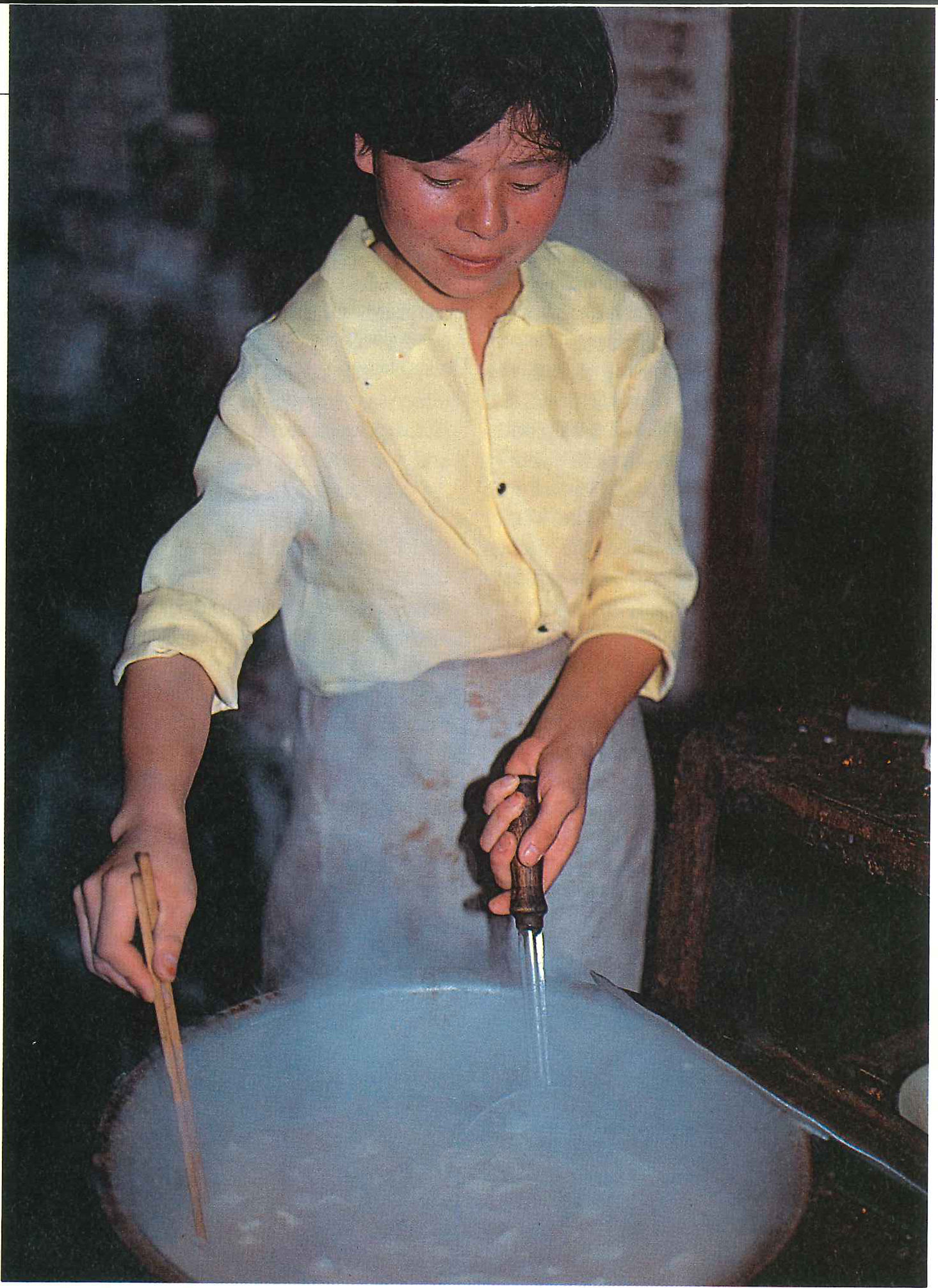
The young woman brought me the dumplings, steaming hot in a plastic bowl, and some wet chopsticks. The fat man, with nothing to yell at her, watched her walk sullenly back to the kitchen, then brought me a bottle of beer and another scarred plastic bowl (for drinking). He glanced furiously at the kitchen again, then leaned his face against the window and gazed through the steam at the railway station. “How’s business?” I asked.
“Not bad” he said, turning a chair around and sitting backward on it at my table. “This time of night things are slow, but it’ll pick up again in the morning, especially when the train comes in. You’re a foreigner, aren’t you? From what country?”
“Canada.”
“Canada’s a good country. How many people? There are more people than that in this province! China has too many people. Does the government restrict how many children you can have? That’s good — but you need more people. We need fewer — too many people in this country. We should send some to Canada.”
He seemed eager to chat and the other table was wrapped up in a discussion of army life. I poured some beer into an extra bowl and we both drank.
“You a student?” he asked.
“I’m studying Chinese” I said, hoping that I didn’t sound evasive. No lies, but not the whole truth. “Sometimes I accompany business delegations to help them along, do some interpreting. I live in Beijing. How long have you had this place?”
“Three years, but it’s not mine. My kid brother owns it, and I run it for him at night. I work at a factory during the day. It’s a lot harder now having a private restaurant. You have to stay open more to compete with the state restaurants. Mostly people like ours better, because the food’s better. How are the dumplings?”

“Excellent. They must be the best in Harbin.” They were mediocre, actually, but the beer and the companionship were making them taste better all the time.
“A lot of officials don’t like us private restaurants. I usually end up dishing up a free meal or two to the local Party guy, or someone from the Harbin government. We have to keep them happy, I guess. Do officials in Canada have so much power?”
“Sometimes” I said, “but it’s not so common. Government officials can be all the same, no matter what country you’re in.”
The man grimaced as he opened another bottle of beer. “So tell me, how much do people make in Canada a year…?”
I’m not sure how the conversation ended, except that the night manager refused to let me pay for the noodles or the beer, and I was forced to hide a folded up note under one of the beer bottles. I hope he found it. It was late when I got back to the hotel, and I had to pound on the front doors until the night guard, grumbling in his underwear, let me in.
The life of a restaurateur in Harbin doesn’t interest most people, but for a few hours his life was very important to me, and I have wondered about him at times — whether the restaurant is still running, whether he is still yelling at the same waitress, or another like her. Would he be as friendly with a foreigner now? Probably not. Is he still dishing out free food to party people? Probably — and perhaps in greater amounts, to keep himself out of trouble.
There were no great revelations that evening — just two people filling a couple of hours shooting the breeze. I learned something about a fellow human being trying to manage his life in a time of great uncertainty and apparent hope. I killed a few hours on a lonely autumn night hundreds of miles away from my family. Nothing to stick in a report (although there is probably a rule somewhere which says that I should have), not enough for a self-congratulatory discourse on the “mood of the people”. But then again, gaining knowledge rarely involves great revelations: it is a process of acquiring, bit by bit, information and understanding that eventually fit into larger whole — like the “paint by numbers” pictures I used to do as a child, or like learning Chinese itself. Being able to speak Chinese helped me to reach out and touch China on that evening. But perhaps more important, it allowed China to reach out and touch me as well.
View the original scanned pages →
Originally published in bout de papier, Vol. 8, No. 1 (1990), pp. 37–38. Read the rest of this issue →



