
bout de papier, Vol. 7, No. 3 (1990), pp. 31–33
As my postings have both been in the Arab world (Cairo, 1976-1980, Amman 1984- 86), I am often asked what it is like to work in the Middle East. Two notions which I believe to be misconceptions, frequently come up: First, that unless an “Arabist” one functions at a tremendous disadvantage in the area; and, second, that women should not even consider postings to the Arab world.
As one who has been offered language training in Arabic twice, for a full academic year of three terms in 1976-77 and again for a summer term in 1984, I have my own views on the advantages and limitations of some degree of Arabic proficiency and its impact on Foreign Service postings.
Arabic is a remarkably rich and difficult language. Its script adds to the challenge for a Western student. Among major languages, it is often ranked just behind Japanese and Chinese in the intensity of effort required to reach elementary proficiency. Hence, of course, its allure.
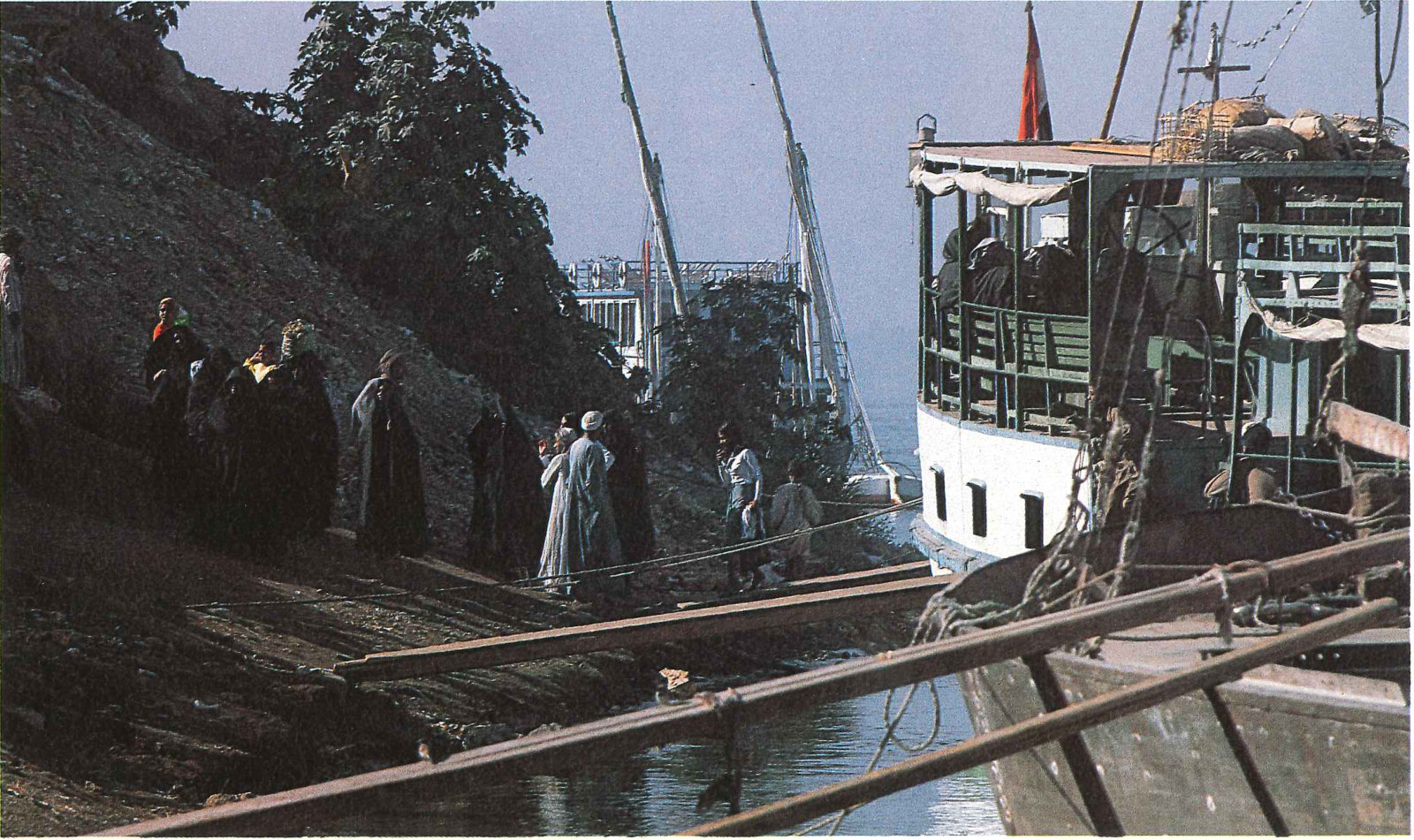
After a full year of rather hard work in studying Arabic, my efforts were rewarded with only a very humble level of ability: I could understand much of everyday conversation (given the right dialect and accent): I could read much of the newspaper, which Ferry down the Nile (Bahr el Nil) in the Arab world is a sadly unvaried fare replete with articles extolling the same heroes of Arab nationalism and vilifying a predictable cast of plotters and miscreants. I could, with dictionary at hand and frequently consulted, manage a few pages of fiction. Not, all in all, a very satisfactory outcome, but, as I looked around me, par for the course with notable exceptions (one of our Foreign Service colleagues serves as head of the Arabic language program at the American University in Cairo).
I knew that I would not get very far with Arabic at this unexalted level, and my early experiences confirmed my apprehensions. However, it was nice to be able to pick up on life around me, and to feel, however modestly, a part of it. Furthermore, my Arab acquaintances seemed flattered (if amused) that I had attempted to learn the language, and I felt it gave me an “in” I might not otherwise have had.
Arabic proved most useful, in fact, in consular cases. When Canadians turned up in distress in remote outposts of Egypt, Libya or the Sudan, my Arabic allowed me to communicate on a basic level with local authorities unused to dealing with foreign officials. The most useful feature of my Arabic was the confidence it inspired in colleagues and visitors that I would be able to cope with any unforeseen emergencies, however limited my real ability to do so.
Nevertheless, my experience with colleagues in Arab posts was that their usefulness rarely bore much direct relation to their language skills, all the more so as Arabs are excellent linguists themselves. It is rare, in any Arab country I have visited, not to encounter in most walks of life, individuals whose English or French far outstrip the Arabic of foreigners. A great deal of literature on the Arab world has now been translated. Much of it was written in European languages in the first place. With virtually instantaneous translation of Arab broadcasts and newsprint (by FBIS and other sources available to Canadians posted in the area, most of the key economic, political and cultural information is available to all). Furthermore, Arabic language skills do little to facilitate acquaintance with the Arab elites as English and French are both widely used by them. In this milieu, its members are often puzzled and sometimes irritated by strangers’ attempts to introduce their own tongue into conversation.
Furthermore, the assumption that Arabs will be dazzled by the brilliance of foreigners having mastered their tongue is highly questionable. In my experience, Arabs are very much drawn to human qualities, for example, of courage, loyalty, kindness, frankness, fairness rather than to purely intellectual ones. Accordingly, a strategy aiming to impress one’s new contacts by overwhelming them with language and intellectual skills is bound to misfire. In turn, the very human qualities they admire in others makes them splendid friends once a relationship is established.
Thus, professional success is not likely to be greatly enhanced by Arabic language skills. Indeed, precisely because they had to work a bit harder, several of my foreign colleagues who spoke no Arabic were by far the most widely known and respected.
The Department has now been training officers in Arabic for well over two decades. This policy is excellent for two reasons: First, the language courses often allow the students to develop affinities for the cultures of the Middle East, which might not otherwise be the case, and with months invested in language studies, encourage commitment to regional specialization, a plus, in my view, for a middle-sized foreign ministry with world-wide interests: Second, it serves notice to the region that we take it seriously — seriously enough to invest time and money in the human resources we deploy there. The Canadian public and media are impressed by the enhanced professionalism of the officers involved. This is important in an era where we must constantly worry about the Department’s domestic constituency. Finally, the contribution of some degree of language proficiency to one’s own level of confidence is not to be discounted.
However, Arabic language skills do not guarantee professional success in the Middle East in the absence of qualities more highly prized by one’s hosts. Nor does the absence of Arabic lead to a less interesting assignment than for the Arabists.
Equally troubling is the second myth affecting assignments to the Middle East; that women encounter insurmountable problems and should be discouraged from postings in the area. In fact, several factors favour women over men in diplomatic posts throughout most of the Arab world. In Cairo, a number of my most successful foreign colleagues were women. This was true again in Amman, where the first woman trained as an Arabist by the Foreign and Commonwealth Office was assigned until recently.
However, there are countries where cultural values excluding women from many positions of economic and political responsibility are such that a posting probably is not advisable. Among these, Saudi Arabia would seem the most prominent.
During my last assignment in Amman the difference between the status of single male and single female diplomatic personnel became even more clear to me. Jordan, in spite of the highly Westernized veneer that greets foreign visitors, remains a deeply conservative society dominated by the family unit. Jordan is also a prosperous country by LDC standards, where daughters are considered much too fondly to be married off lightly to foreigners who might cause them to move abroad. For this reason, single foreign men are regarded as somewhat of a threat to the family unit and treated with some suspicion: It took a full year before my best Jordanian friend — from a conservative bedouin family — invited me to his family home. After this first cautious introduction to Jordanian home life; the barriers to other families fell very quickly, and, in my second year, my social life was almost entirely Jordanian and Palestinian. However, negotiating this first hurdle had been no easy matter.
My single female colleagues, on the other hand, were nearly immediately on arrival subsumed into the daily life of several Jordanian families as the local social instinct was to protect any friendly female person from such predatory attentions as might have come their way. Consequently, my female colleagues had a year’s head-start on me in terms of actually exploring Jordanian society from within.
On the positive side, my local contacts took an active personal interest in me from the start: They considered an unmarried man in his early thirties a regrettable aberration and devoted much effort over the next two years to marrying me off. Incidentally, it was this personal interest that led me into a productive professional relationship with several local luminaries who normally took no interest in diplomats. Thus, single men were not entirely neglected in Amman. We did envy our female colleagues though. What these realities made clear to me, once again, was how very important the personal level remains in establishing relationships in the Arab world, a pleasant challenge for a North American.
An assignment to the Arab world is rich and rewarding. The Department’s reluctance to post female officers to this area strikes me as misplaced. In any event, it is likely to erode over time. Any colleague with a strong interest in other people and a disposition to value the personal over the professional will find a fascinating universe opening up to them, it they elect an assignment in the Arab world.
View the original scanned pages →
Originally published in bout de papier, Vol. 7, No. 3 (1990), pp. 31–33. Read the rest of this issue →



