
bout de papier, Vol. 7, No. 3 (1990), pp. 8–9
I recently visited the Tyrell Museum of Paleontology in the dinosaur country of Alberta and had an opportunity to meditate upon the towering bones of the Tyrannosaurus Rex. In his time, the Tyrannosaurus was the Chief Executive Officer. The Boss. Numero Uno. When he bellowed, no one challenged and his was the final word. However, in spite of his size and position, he did not adapt to changes around him — and so he perished. His fossilized remains, strung together with wire, trapped in unimaginable time, stand as a haunting reminder that survival depends upon adaptation.
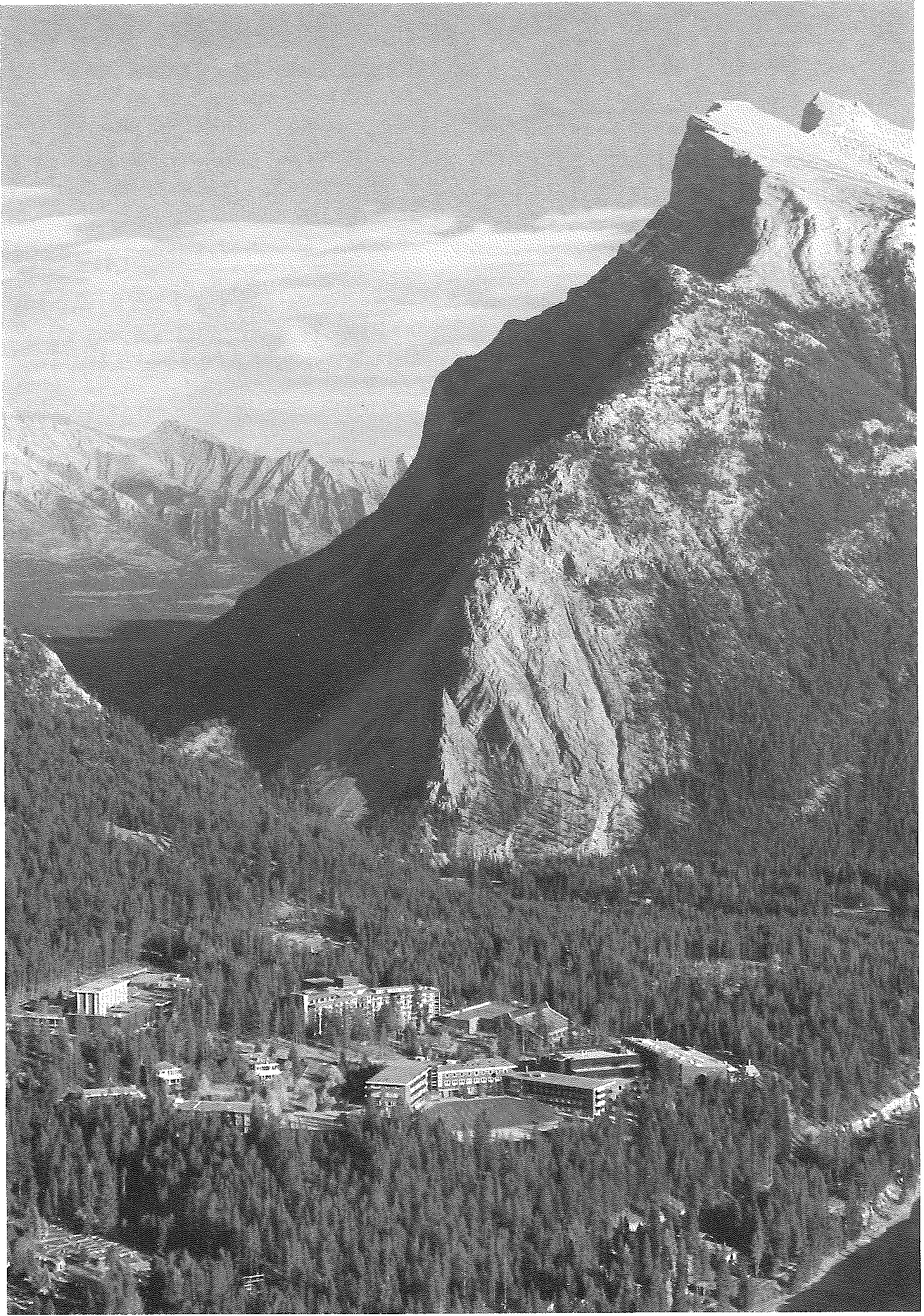
About forty years ago, a group of educators from the universities of British Columbia, Alberta, Saskatchewan and Manitoba, recognized that the executive class of Canada, both in government and the private sector, either hones its skills or runs the risk of ending up with the Tyrannosaurus in the bone yard. These visionaries put aside the normal rivalries between universities and agreed to establish a joint venture senior management school so as to draw upon the combined forces of the four universities. They chose to locate it in the spectacular surroundings of the rockies, in Banff, colocated with the already established Banff School of Fine Arts. (To this day, the executive participants rub shoulders at evening cultural events with well-rounded oboe players from the Soviet Union and wraithe-like ballet dancers from Montreal.)
The result was the Banff School of Advanced Management (BSAM), generally called “Beesam” by its graduates. It is an institution that is unique on the continent, now drawing executive participants from across Canada and around the world, with faculty from the four major consortium members and from elsewhere in Canada and the United States. Our escutcheon features, as you might surmise, the Tyrannasaurus Rex and the motto: “Adapator Aut Pereo”, in recognition of an essential truth.
Now, why executive development? I find it passing strange that I should address this question in an in-house publication that will be read by my own colleagues (Trumpet fanfare left stage, please) who, as a group, often demonstrate the most remarkable managerial flaws since Claudius left the scene.
The Banff School of Advanced Management is sitt
First of all, let us look at the profile of the average senior upper middle manager in the private sector. He or she is probably about forty five years old; regarded as ’solid’ by the peer group; the product of a linear education in a narrow band that is now dated; limited in experience to one or two companies since graduation; has been divorced 0.7 times — and wonders if he will have his job next year.
The organization is being narrowed at its base; the apex of the pyramid of progression is flattened; new and needed technology is assaulting his free time and psyche; national and foreign competition is vicious; the politico-economic-legal environment is thunderously complicated and; worst of all, the organizational loyalties of the past are one with Nineveh and Tyre. Future shock writ large.
Above all else he knows he must perform efficiently in competition with his peers and damn the torpedoes. The stark bottom line ultimately decides whether or not he has a job. Full stop. The fundamental energies are devoted to that end in the new world where survival for companies and individuals is no longer a perceived birthright and survival depends upon being personally more adept and corporately more efficient.
Review in your mind, please, the front page of the business section of any major Canadian paper over the past two years. The recent news of one major firm axing five hundred middle managers and another’s early retirement incentive followed by a wholesale twenty five percent cut back of staff in all departments is typical. The list is long, somber and more of the same lies ahead. Heraclitus showed a certain perspicacity when he observed that the only constant in the observable universe is change.
In comparison, the Public Servant’s lot is, especially that of the Otta-crat, more salubrious. He fits much of the private sector profile, except he is like Lilli Tomlinson’s sketch of the telephone operator – immortal. (Alas, I date myself!) Job security for the EX crowd is close to absolute, at least historically, and the rare and much vaunted ’Night of the Long Knives’ is really a gentle brushing out of long-frayed edges. He also manages in a different world, beyond the bottom line, as Plumptre attempts to show in his book of the same title. The Deputy Minister’s job is therefore, in selected ways, more difficult. It is featured by the effective absence of outside objective measuring mechanisms and, of vast consequence, an internal ethos that tends toward in-breeding and the recruitment and promotion of self-image. Such a condition most frequently leads to extinction outside of government, just as it is often actually rewarded in the public sector, especially in closed organizations with vertical career structures.
Yet, when all is said and done, both public and private sector executives have overlapping interests in adapting to the torrent of change imposed by external and internal conditions. There is a broad and growing recognition that if the nation is to somehow successfully deal with the problems facing us, the process must be managed more knowledgeably, sensitively and competently. This will require a new and more open and comprehensive management with a broader awareness of the whole gamut of tugs and pulls that constitute their true (as opposed to perceived) environment. Leading companies and a few governmental organizations have recognized that need long ago. Their success is possibly because they have recognized that renewal of their most important asset — people — is essential for both the executive and the aims of the corporation or bureaucracy. Many more give copious lip service to the idea, of course.
That is what the Banff School of Advanced Management is all about. The over four thousand graduates of the intensive six week course undertake not so much an executive training program but rather a broad executive development experience, involving an examination on everything from economics to organizational behaviour, corporate law and ethics. Three and four week programs are popping up like dandelions around the country in various places, but the BSAM Board has taken the decision to stick with the six week format. Our reasoning is that if a mid-career executive development course is to be more than a quick fix that will ultimately wear off and fail, it has to be long enough and sufficiently intensive and detailed so as allow for a higher order of development to take place at the individual level.
To this extent our ’competition’ is the American Ivy League. In Canada, we stand nervously alone, continuously monitoring our niche and our curriculum, ever seeking to offer not what can be taught from available academic resources, but rather determining what must be taught and then reaching out to find the required talent wherever it may be found.
What does all this have to do with the Department? I would only mention that BSAM has had a long association withthe Department, most especially the Trade Commissioner Service, over twenty years. Of the fifty Foreign Service participants, over half have been appointed as Ambassadors to date. It seems there is more in these mountains than snow capped peaks, ballet dancers, pulchritudinous oboe players and a neighbourhood deer named Georges, fleeing my wife’s wrath for eating our flowers.
View the original scanned pages →
Originally published in bout de papier, Vol. 7, No. 3 (1990), pp. 8–9. Read the rest of this issue →



