
bout de papier, Vol. 7, No. 2 (1989), pp. 13–15
by Geoffrey Murray
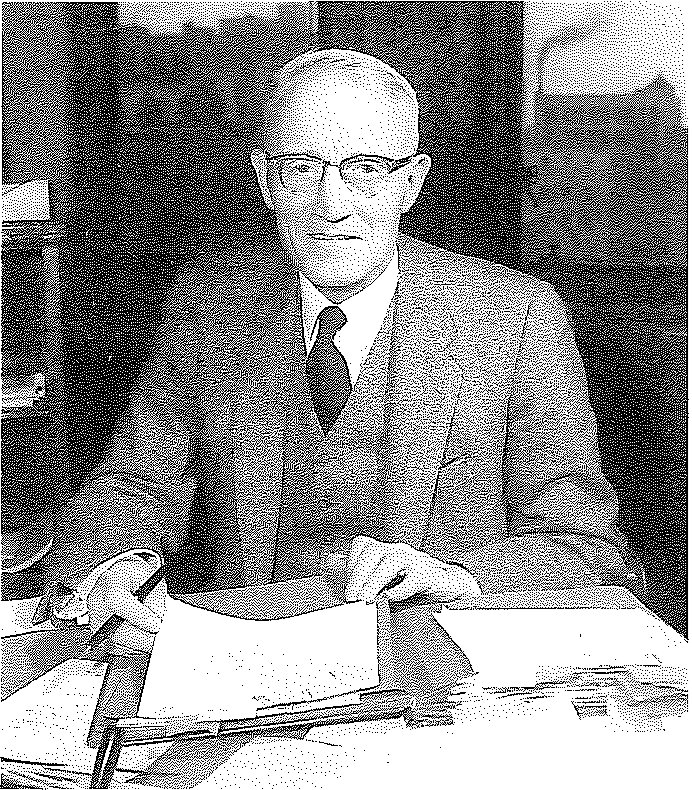
“Howard Green received little attention out here in his passing…He came to a reunion of External retirees (all ranks) on 12 Sept. ’87 at the Uplands Golf Club in Victoria and though he rose to speak with some difficulty, he delivered himself of what we all recalled as standard Howard Green: pride in Canada and its unique role in the world, especially as evidenced in peacekeeping; pride in the people who served in External Affairs and represented the country ‘so well’ abroad; and pleasure that he had been associated with all of us and worked with us to further Canada’s humanitarian and peaceful objectives” Extract from a letter of mid-July 1989 to Jim Nutt from Gordon Brown in Victoria
In mid-January 1960, after five years’ absence at the United Nations in New York, I cut short a two-year official secondment with the Secretariat to take the helm of the UN Division, high in the East Block attic. At the outset, the Undersecretary made clear that our new Minister, Howard Green, was determined to show the world and the Canadian public that the Progressive Conservatives in power were just as capable as their Liberal predecessors of making Canada’s influence fully effective in the world organization. Since Norman Robertson wanted to keep in close touch with this significant aspect of Departmental work, he arranged for the UN Division to report directly to him, an easy working arrangement which I naturally welcomed and benefited from.
That began three years of close encounters with Howard Green, and a series of intermittent arguments, which usually opened with his query, “Well, what do you think, Geoff?” Working from my own recent exposures at the United Nations, I was often on the dissenting side of group discussions chaired by the Minister in pursuit of “Canada’s humanitarian and peaceful objectives”, “, primarily at the General Assembly and its political offshoots. Regularly in Ottawa and all too often back in New York, that became an exacting experience that gave me my own perspectives on how Canada’s policy and diplomacy unfolded in the Diefenbaker years. I should make clear that my dissent was not so much concerned with where the Minister wished to go with his foreign policy, but how he proposed to get there. In External Affairs, we never had any professional doubts that it was the political leadership who decided the substance of policy, the public service who worked out formulations, strategies and tactics for carrying it out.
It soon became apparent that the UN Division’s primary role was intended to be advice and assistance on strategy and tactics. Without too much ceremony, Departmental management began early in my tenure to strip away large chunks of our divisional turf. The appointment then of General Tommy Burns as Government Adviser on Disarmament required a separate division to support him, so our disarmament section was sheared off to form a nucleus. Since Tommy Burns and I were veterans of Suez and all that, our two divisions were soon soul mates on the ground floor of the East Block, darting across the hall through the green baize doors on a daily routine of keeping in touch. We both began to hear regularly the rumbling of ministerial thunder, from Sir John A’s old office immediately overhead. For Howard Green, UN and disarmament affairs marched hand in hand, across a broad front of his foreign policy, for as long as he was Minister.
Other UN subject matter resided elsewhere, either in the Department or in other departments around town. We were far from idle, however, as the custodians of UN philosophy and folklore, the purveyors of procedural precedents and institutional proprieties, the arbiters in interdepartmental and intradepartmental consultations. To keep up with ministerial requirements — in the House and elsewhere — we strove to track and coordinate Canada’s manifold UN activities, whether within the international family of UN organizations or among the interested national actors across the town and country. Our information was solicited, our advice sought and inevitably our rhetoric of chapter and verse requisitioned, from many quarters and often on very short notice. But the calls from overhead were our top priority and never so insistent as when the annual Assembly approached, and with it the need for Canadian “initiatives”. The whole division was “brain-storming” furiously on that requirement, about a decade before that technocratic buzzword gained currency around Ottawa. I continue to marvel at the imaginative ways my troops responded.
Before his appointment in June 1959, all I knew about Howard Green was that he had been the most relentless critic on the Opposition benches in Parliament, against the Liberal Government’s policy and performance in the Suez crisis of 1956-57. At the autumn Assembly in 1957, Wallace Nesbitt M.P. had informed me rather smugly that Pearson’s role in that crisis may have won him the Nobel Peace Prize, but it had also helped the Progressive Conservatives to victory in some ridings. Yet by the autumn of 1959, at the fourteenth Assembly, Howard Green was firmly espousing wide-ranging proposals for disarmament and arms control, including the unconditional banning of nuclear tests and other measures to reduce the hazards of radiation in the atmosphere. And there were signs that Canada wanted to be active in other UN fields, where previously our profile had been relatively low.
While I was still an international bureaucrat, I was agreeably surprised when a tall and spare, austere and white-haired Canadian minister took his place at the First Committee’s horse-shoe desk. He seemed to find his way quite quickly in the UN maelstrom, which often bewildered newcomers. While there was not the easy bonhomie and banter that accompanied Pearson whenever he strolled about UN precincts — by then he was a household god — Howard Green soon attracted favourable comment with his solemn speaking style, his ready smile and outstretched hand, his earnest engagement in corridor consultations. Clearly, there was a personal warmth in it all and something distinctly Canadian.
Mr. Green made a special point of wooing the smaller member states and especially the new arrivals. It transpired a year or so later that Canada opened its first post in Yaounde, partly as a result of Howard Green’s impromptu chatting with his immediate neighbour in the First Committee, the representative of Cameroun. It fitted neatly with Departmental concerns, even then, about improving Canada’s bilingual image abroad, for Cameroun also used both our official languages. Expansion of Canadian representation in francophone Africa strained our departmental resources then stretched painfully thin. But the Minister believed, quite firmly in my view, that Canada had to win over the new UN members arriving increasingly from Africa, once the “winds of change” began to blow vigorously in that continent. He showed a similar attitude toward the states of Latin America, not only were they our hemispheric neighbours but that usually constituted a solid voting bloc at the United Nations, at least until the Castro regime turned Cuba into a client of the Soviet Union. Our continuing relations with Cuba, and the anguish these caused in Washington, complicated Green’s position on joining the OAS, which he appeared to favour in spite of opposition in Cabinet and the country at large.
Eventually, when I got to know him better, I realized that the Minister’s wooing of smaller states, his fatherly figure and plain talk speeches were rather skilful camouflage for shrewd political calculations, tinged with salty humour — comparable in some ways to Pearson’s easy affability. He was determined to attract broad third world support to his crusade for disarmament in its several dimensions. His operational strategy and tactics at the UN were hinged on a fatal, false premise, however. He was fond of saying: “Your know, Geoff, it’s just like the House down here, just the same”. That meant to him that the UN members, like the Parliamentary members back home and their constituents, were susceptible to the brand of parish pump politics that Howard Green had mastered in the House of Commons, on the hustings and especially in the Tory landslide. In pursuing many of our “initiatives” at the UN, he seemed quite confident that he could win and carry support from a sizeable group of small and middle-sized members, most of whom were firmly associated with the rapidly enlarging non-aligned group, the emerging “third world bloc”.
There seemed no way of convincing Mr. Green that Canada, as a “committed” member of NATO, clearly on one side of the cold war, could not hope to put itself somehow at the head of the non-aligned, no matter how appealing the cause Canada might be advocating. Nations just emerging from one form of white domination, European colonialism, were not about to let their “initiatives” and priorities, as an emerging majority at the UN, be usurped by other powers, on either side of the cold war. At the same time, by adjusting Canada’s positions on some of these complex disarmament questions in ways thought to have third world appeal, we risked losing the support of our traditional allies and friends in Western Europe, even the neutralists, who were acutely conscious of the security implications of many arms control measures. I have never forgotten the puzzled looks on the faces of some of our closest Nordic friends as they listened to Howard Green explain some of his more extreme shifts of Canadian position. My own close contacts were quite blunt in expressing their skepticism and concerns, which I of course passed on to our own delegation.
In his thinking about the Assembly, Howard Green tended to confuse its “democratic” forms and procedures with its political and diplomatic functions. In doing so, he overestimated what Canada could hope to accomplish through assumed past influence and friendly persuasion. He discounted the diplomatic exigencies for reaching political compromises and satisfactory balances of national interest. He failed to appreciate how much Canada’s earlier middle-power “successes” had depended on support and assistance from like-minded states and especially our most powerful friends and allies in the United States. Beyond question, our known and respected position in the progressive wing of NATO had accounted for much of the political clout we had wielded earlier as a middle power in the United Nations. Green showed scant concern for all this and not much of the needed patience for the sophisticated manoeuvring that UN “successes” usually required
Accordingly, success often proved elusive for him, notwithstanding exhausting efforts. His policy initiatives were not always inherently ill-advised — some made very good sense and a few did succeed — but his diplomatic tactics were too often heavy-handed, ill-timed or misdirected. Departmental representatives may have been partly to blame; occasionally, we were rattled by the erratic turn of events. But a much greater impairment was the tight rein which the Prime Minister held on Green’s diplomatic moves. That put restraints on his officials too, checkmating most opportunities for creative diplomacy.
From the beginning, the Diefenbaker Government wanted to change the focus of Canada’s foreign policy. In particular, they saw the Commonwealth evolving as a much greater influence in world affairs and international relations than their predecessors had acknowledged. In the same vein, Diefenbaker ministers seemed determined to restore in significance Canada’s relations with Britain, and especially economic relations. The Dief seemed confident that he had a close rapport with President Eisenhower. Yet it appeared quite soon that the newcomers had fallen into a pattern of “policies” that closely resembled those of their Liberal predecessors.
By 1960, it was conventional wisdom to assert that the Diefenbaker Government was pursuing the same foreign policy as the Liberals but with differences of “emphasis” Proponents would point to outward manifestations: the continuing support for the UN, the Commonwealth and NATO; the continuing participation in UNEF and other peacekeeping operations; the continuing commitment to multilateral programmes for development assistance and to other international institutions for economic cooperation; the continuing Canadian contribution to social causes for alleviating the plight of less fortunate peoples. Howard Green’s tireless and earnest pursuit of disarmament and arms control, his consistent stands against nuclear tests, radiation hazards and nuclear proliferation; the Government’s growing preoccupation with human rights, apartheid and international law…all these were hailed by commentators as the differences of “emphasis”
Howard Green was fond of uttering the comforting but complacent cliches about “Canada and its unique role”. In the forties and fifties, that role had to be Canada actively seeking paths of moderation and mediation, as a middle power deeply concerned with maintaining international peace and security, through collective action by “like-minded” tain that the Government’s mainline policy was intended to make collective security work effectively, in its several major manifestations — political, economic, social. This meant pursuing vigorously, various means for strengthening multilateral systems of international peace and order. It was said to be a policy of functionalism, and “practicability” was the litmus test whether proposals for international action safeguard peace were deserving of Canada’s support and advocacy. Once adopted, we manifested Canadian support in the three key international organizations — the UN, NATO and the Commonwealth – and usually in concert with our close friends and allies, in the so-called “special relationships” with us.
The Diefenbaker Government, virtually from the outset of its tenure, was much more selective and parochial than its immediate predecessor, in approaching foreign policy. Especially after Pearson emerged as Leader of the Opposition, in the aftermath of Suez and in the aura of the Peace Prize, the new PC leadership seemed very determined to make their own mark in the “heady world of diplomacy” that the media were fond of extolling. The Prime Minister participated in the general debate at the twelfth Assembly in 1957. Canada continued to support politically and materially, the UN Secretary- General’s efforts to stabilize shaky situations through UN peacekeeping “presences”. But significantly in critical situations (Lebanon 1958, Congo 1960), the Government seemed content to stay in a supporting role, it showed no real desire, nor credible capacity, to resume leadership of the “fire brigade” of middle powers, seeking to strengthen the UN hand generally in world affairs. We were much less disposed than earlier to consult closely with our more powerful friends and allies, whether at the UN or in NATO, about crisis management. We tended to talk too much among ourselves and listen too little to others.
In the Commonwealth, in keeping with the change of focus mentioned earlier, the Government and specifically the Prime Minister did show some desire to exert leadership but not without some awkwardness, even at the Commonwealth Heads of Government Conference in London, 1961, where Diefenbaker gained some credit for the withdrawal of South Africa. And by then Green was forging ahead with his disarmament crusade, confidently at the UN, often uncomfortably at NATO ministerial meetings, where the Big Three were showing increasing signs of irritation and frustration, about Green’s frequent departures from the NATO party line. Howard Green had no doubts about the necessity for the alliance as a security shield, but he held firmly to the belief that its members – beginning with the big powers — must be prodded into more flexible positions on disarmament and arms control.
The Diefenbaker Government’s mainline policy aimed at “speaking out clearly about where Canada stands” on big international issues and mobilizing support at home and abroad for these Canadian views. It was markedly less concerned with systematically seeking international cooperation, on practical ways of “building a better world order” Thus the Tory policy emerged as one of nationalist rather than internationalist inspiration, reactive rather than creative in its conduct, populist rather than idealistic in its appeal. It was closely tailored to win applause from the folks back home in the far-flung federal ridings, to be sure, but certainly in Howard Green’s case, it stemmed from clear conviction that something must be done urgently, to move the whole disarmament situation off the dead centre of political impasse and sterile negotiating sessions. His aim was to galvanize international public opinion and not necessarily to satisfy diplomatic exigencies.
In the end result, it was a policy that was flawed by and finally foundered on its internal contradictions, as Basil Robinson has documented so well in his authoritative report on “Diefenbaker’s World”. Its most dramatic consequence no doubt was the abyss which opened in Canada’s relations with the United States and which yawned even at the peak of the Cuban missile crisis. But differences with Britain and other European allies were also acute, at a time when Canada should have been moving ever closer to West Europeans bent on institutionalizing their own integration. And I seriously doubt whether Canada’s stature in the Commonwealth, or that of the association itself, was much enhanced in those years. Certainly, some Commonwealth members at the UN were no more supportive of Green’s initiatives than other third world countries.
By the time of the shoe-banging summit Assembly of 1960, Khrushchev was rambunctiously seeking to substantiate the Soviet Union’s superpower status, all around the globe, in outer space and in a “peaceful coexistence” politically challenging on a broad front. For military planners and cold war strategists, it was no time for Canada to be breaking step in NATO’s ranks, making its own waves at the UN and occasionally, crying “a plague on both your houses” in tense East-West arguments. The hardliners in the West wanted to hunker down in their Alliance trenches. Our Canadian endeavours on disarmament were hampered, not enhanced by cold war rhetoric. Diefenbaker’s celebrated riposte in 1960 to Khrushche’s rough attack on Hammarskjold, whatever it accomplished back home, back-fired for Green’s current campaign at the Assembly.
Was Howard Green so wrong in persisting stubbornly, especially when Khrushchev’s brash call for “general and complete disarmament” threw the Western hardliners into defensive disarray? Conceivably with forethought and planning, the Western side might have made initiatives like Green’s their own joint cause, or at least fleshed them out as a positive response. Some of my experienced international contacts at the UN thought that the West should try to respond in that way. But political imagination and will were lacking in Western capitals, in the wake of the Big Four Summit’s collapse in May, and it was well beyond Canadian capability to rally our allies. The dismal spring meeting of NATO Ministers in Istanbul, just before the U-2 incident that aroused Russian ire, showed how bleak our prospects were that summer.
The Diefenbaker Government, above all Howard Green, need not be judged too harshly for not finding their way safely out of the bewildering maze of foreign policy dilemmas that faced Canada in those years. For Howard Green, the longer term conundrums had to give way to more immediate demands. He saw then, as his first duty and responsibility, to sound a clarion call against the growing perils the world faced, if governments and nations did not act urgently to halt the headlong nuclear arms race. From talking to scientists — beginning with Mrs. Donna Green — and listening attentively to what they had to say, he drew his own conclusions about the awful risks inherent in amassing arsenals for overkill. Even in the peaceful uses of atomic energy, he worried much about nuclear proliferation and the hazards of radiation, again from listening to experts but also from heeding the concerns of ordinary Canadians on the West Coast, where fallout from the weapons tests was heaviest.
Today, with the veil of secrecy parted, we can all see much more clearly what was actually taking place in the late fifties, in the whole nuclear field and in many parts of the world. Many of the recent revelations tend more to confirm than deny that Howard Green’s crusade was not only solidly based but altogether timely, even ahead of its time. We may still wonder, even now, whether his warnings and admonitions were simply the gut reactions of a canny and caring, grassroots politician, or more profoundly avant garde and visionary in their import. Either way, Howard Green showed steady courage and great determination, in responding firmly to duty as he saw it. This exemplary leadership kept us marching, loyally and affectionately at his side, even on dark days when we knew professionally, we were all moving along diplomatic paths that predictably led nowhere.
Genffrey Murray from 1055-K4 was a Editor’s Note: Howard Green, Secretary of State for External Affairs from 1959 to 1963, died June 26, 1989 in Vancouver, Canada
View the original scanned pages →
Originally published in bout de papier, Vol. 7, No. 2 (1989), pp. 13–15. Read the rest of this issue →



