
bout de papier, Vol. 7, No. 2 (1989), pp. 28–29
Story and Photos by Daryl S. Copeland
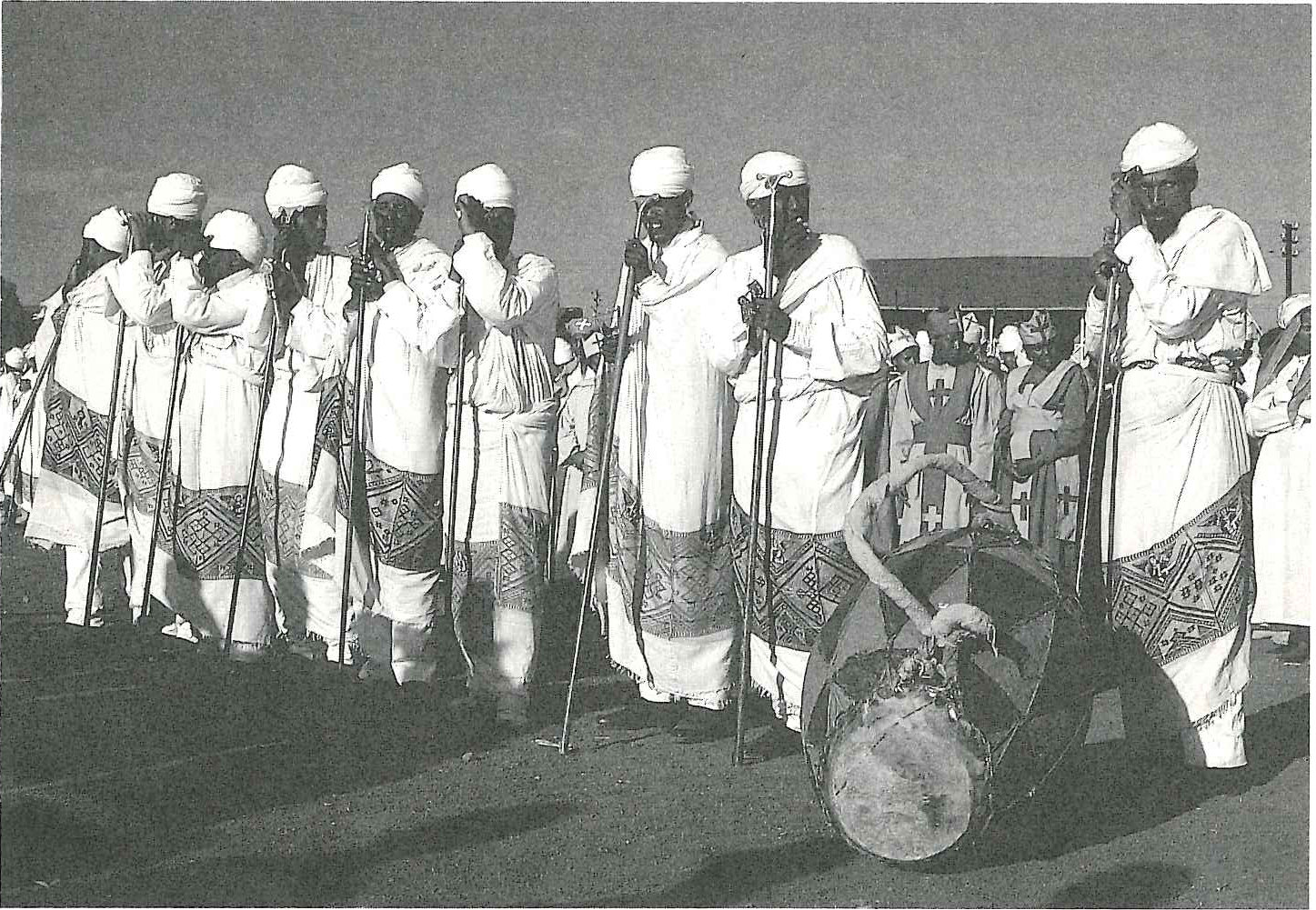
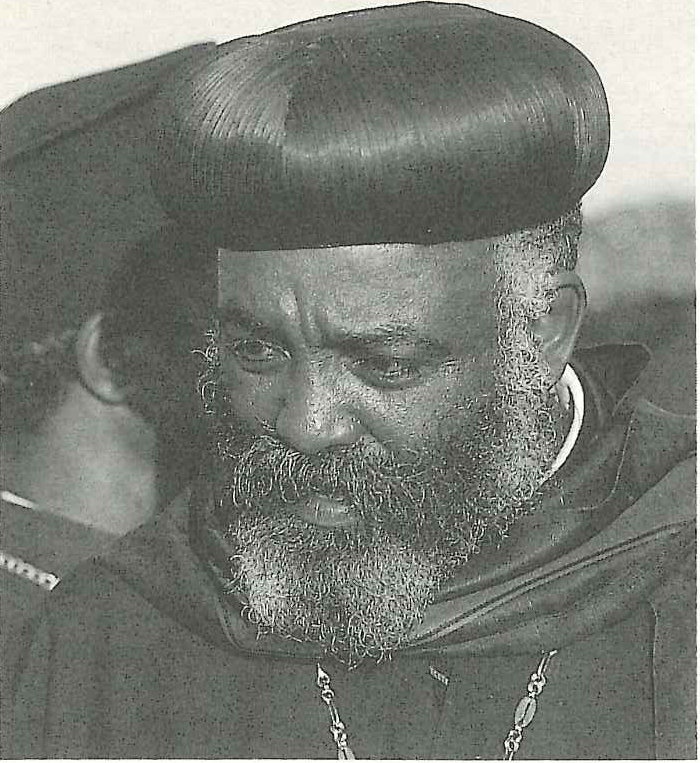
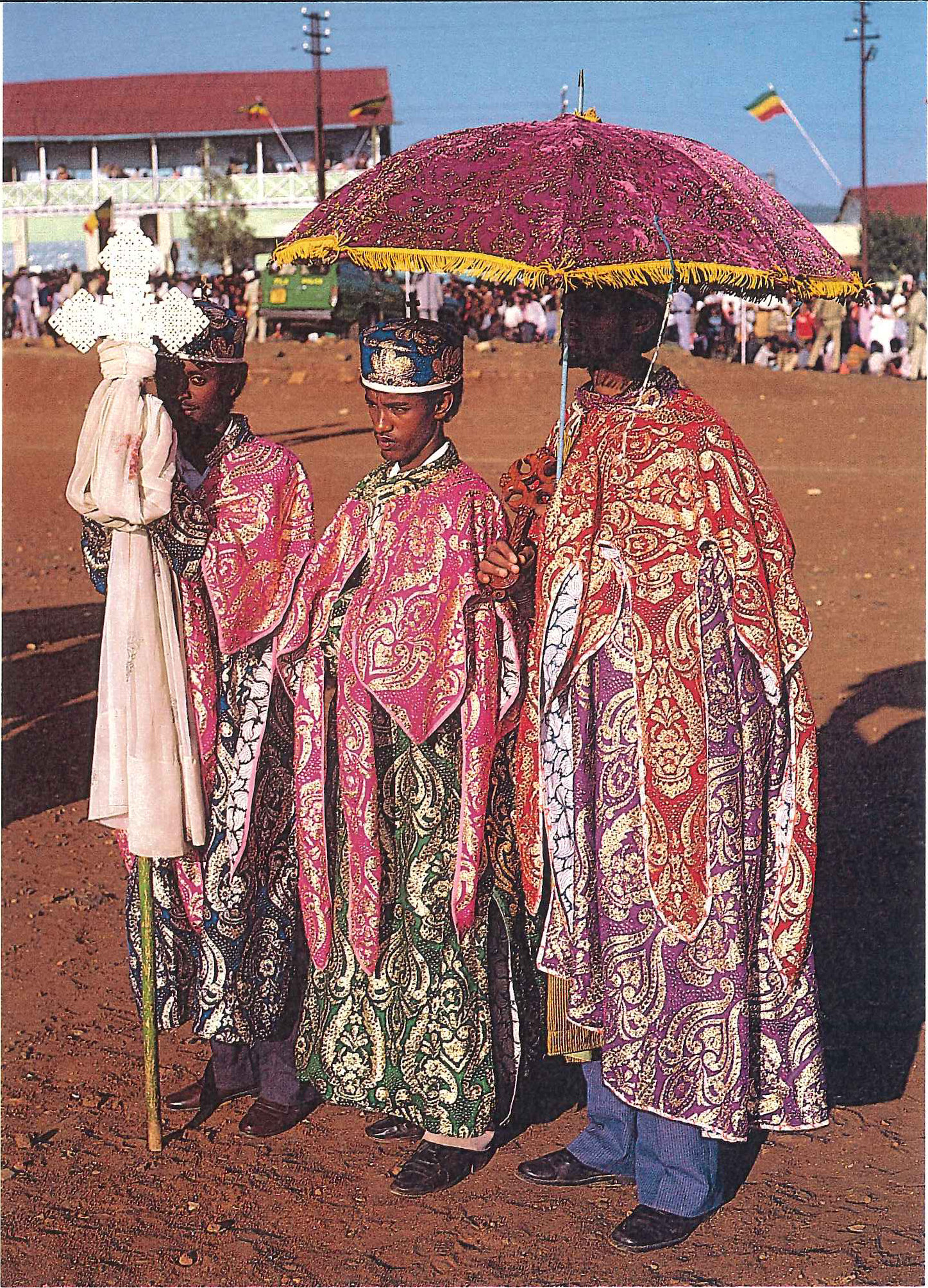
The scene was dazzling. Thousands of clerics from provinces all over Ethiopia were gathered to celebrate the festival of Maskal at St. Gregory’s Square in Addis Ababa. An amazing variety of elaborately embroidered robes shimmered brilliantly in the late afternoon sunshine. Reflecting upon the exotic ritual unfolding before me, I could not escape the conclusion that images of famine, drought and civil war seem to have blinded the world to much of the sheer wonderment still to be found in this ancient empire.
The traditions of the Ethiopian Orthodox church, which has evolved separately from the Christian mainstream since the third century A.D., have played a central role in defining the country’s unique character. The origins of Maskal, which are described in a remarkable religious tract called the Tefut, represent a good case in point. According to the Tefut, the remains of the “True Cross” (upon which Christ was crucified at Golgotha) were split into four parts in the middle of the fifth century A.D., following the schism which resulted from the Council of Chalcedon. The Christian church was divided into four patriarchates — Rome, Constantinople, Antioch and Alexandria — and each received part of the Cross. Almost 1000 years later, the Calipha of Egypt jailed the Alexandrian Patriarch during a general persecution of Christians. When this news reached Emperor Dawit of Ethiopia, he appealed to the Calipha for religious tolerance, but was ignored. Not one to take such treatment lightly, Dawit marched on Cairo with an army of 300,000 men. He declined the Calipha’s offer of a large quantity of gold in exchange for peace, and settled instead for Alexandria’s fragment of the “True Cross” with which he returned to Ethiopia.
Dawit’s son and heir, Zar’ Yacob, responding to instructions received during a celestial vision, installed the fragment at the monastery in Gishen in a box made of gold, which was itself enclosed in progressively larger boxes made of silver, copper, lead and steel. Local lore has it that this treasure lies buried near the present-day church of Egziabherab. It is also said that tragedy will befall anyone who attempts to remove the relic. Gishen, a four day mule ride into the Ambasel mountains from the nearest, road remains a place of pilgrimage for the faithful.
To add to the historical complexity of the issue, some academics have speculated that the Christian dimension of Maskal is relatively recent, and that pagan and Hebraic rites indicate a more ancient and complex origin. Although this may indeed be the case, the contemporary celebration of Maskal is based on a widely shared belief in the presence of a portion of the “True Cross” in Ethiopia.
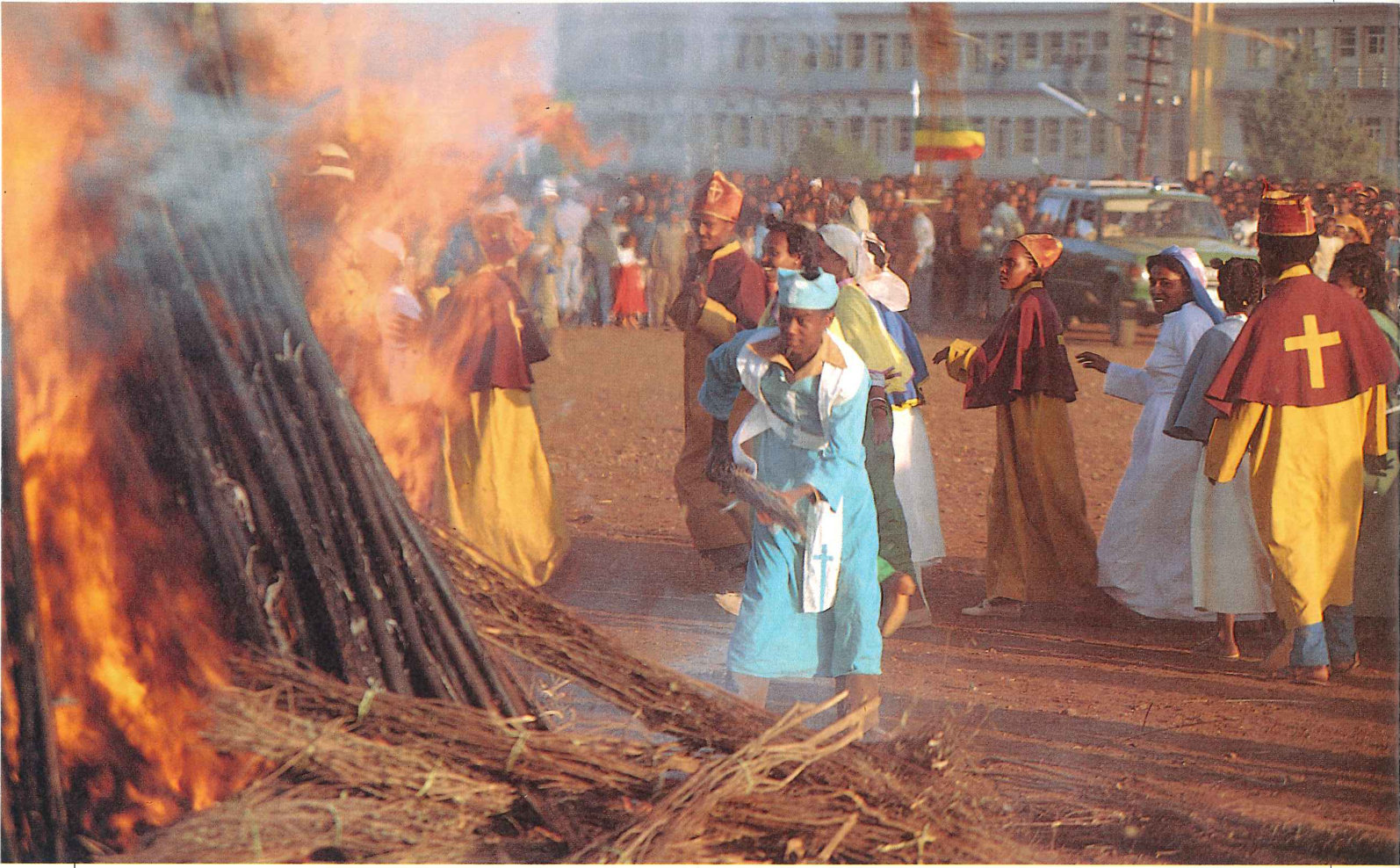
The most important symbol of the Maskal celebration is the Damara, a large pyramid of dry wood around which the devoted gather. In the late afternoon the Damara is ceremoniously ignited, to the accompanyment signing, dancing, and fervent religious expectation.
There are a number of interpretations of the purpose of this exercise. Some claim that it signifies the purification of the soul and the absolution of sins, while others maintain that the direction of the smoke and final collapse of the pyramid portends the course of future events. The latter explanation apparently derives from the success of Roman Queen Helena (274-328 A.D.), mother of Constantine the Great, who is said to have discovered the whereabouts of the “True Cross” in the Holy Land. According to legend, she set fires, burned incense, and by tracing the smoke was able to determine the location of the buried Cross.
In addition to the various historical and religious implications, Maskal’s contemporary prominence also seems related to the fact that it immediately follows a dramatic change of seasons. Maskal is celebrated on September 27, at the end of the long rains when the rugged rural landscape explodes in a burst of wildflowers and the hills are again bathed in that clear, penetrating light which typifies high altitudes. This is traditionally a time of regeneration, the resumption of work and the reopening of communications. Anyone who has lived in Ethiopia for a year or more will testify that after three or four months of unremitting gloom, the timing couldn’t be better.
Whatever explanation is preferred, one thing is certain, the chanting, the flickering shadows, and the sight of the Damara blazing in the evening twilight combine to create a spectacle not soon to be forgotten.
View the original scanned pages →
Originally published in bout de papier, Vol. 7, No. 2 (1989), pp. 28–29. Read the rest of this issue →



