
bout de papier, Vol. 7, No. 2 (1989), pp. 16–19
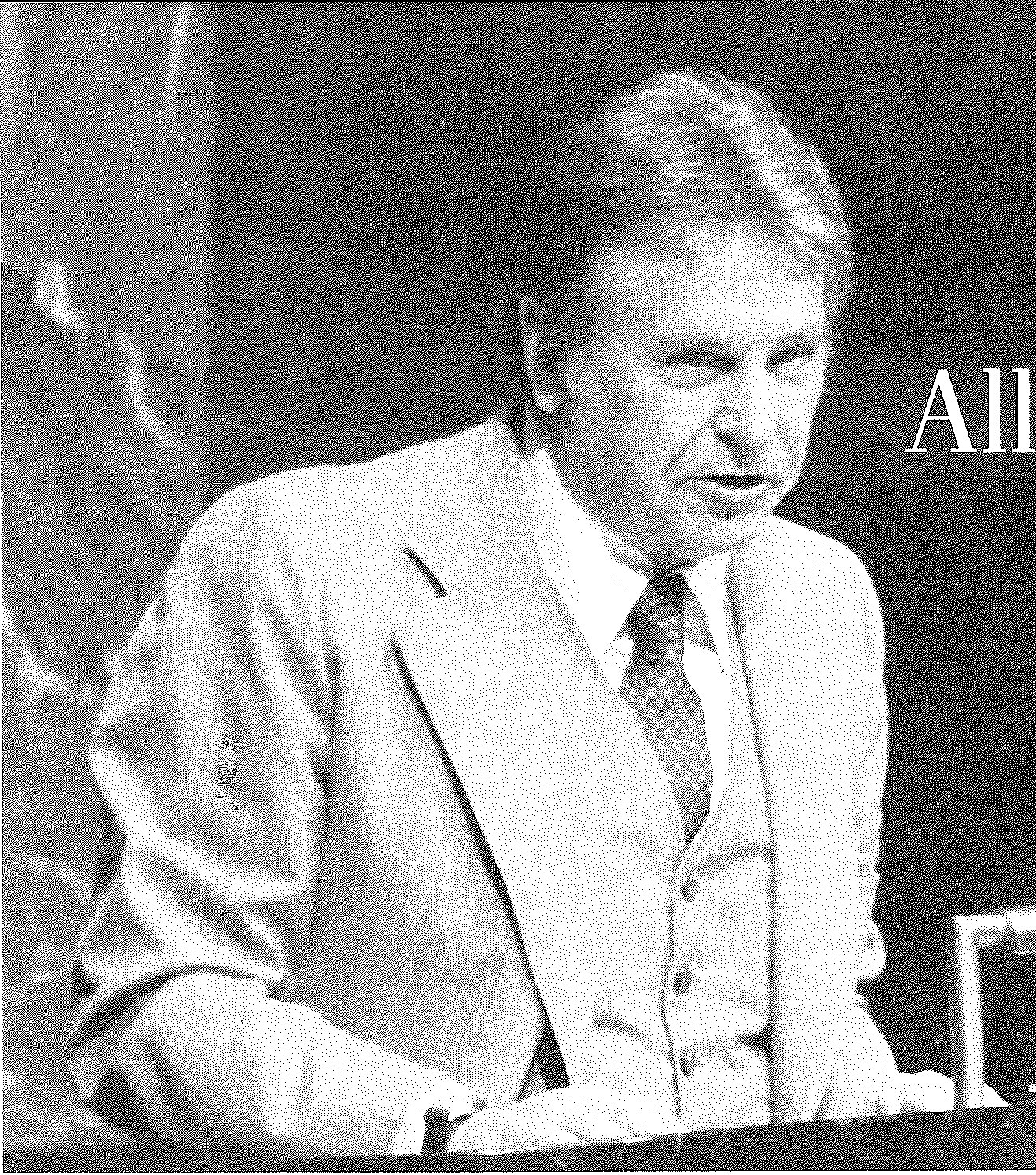
Canny, shrewd, machiavellian are the adjectives applied to the current Liberal Leader in the Senate, Allan Joseph MacEachen P.C. To many, he is the personification of the consummate politician. Yet, his involvement in politics only came after he had first established a reputation as a clever economist, with an excellent future as a scholar-teacher. Born in 1921, this son of a coal-miner grew up in depression-struck Cape Breton. Fluent in Gaelic, he is a Cape Bretoner fiercely proud of his Scottish heritage. Shy and intensely private, there is little about him of the garrulous bonhomie exuded by most politicians. A populist, his is not the Liberalism of Bay Street, but rather that of one who believes the state has a moral duty to look after the sick, the poor and the elderly. At the same time, he believes Government must not become so intrusive as to threaten the rights of the individual, especially in the marketplace.
As Labour Minister he introduced far-reaching revisions to the Labour Code in 1965. As Minister of National Health and Welfare, he brought in National Medicare in 1967. He later served as Minister of Manpower and Immigration and of Finance. Twice he served as Secretary of State for External Affairs (1974-76, 1982-84), thrice as Government House Leader (1967-68, 1970-74, 1976-79). He was appointed Deputy Prime Minister in 1977 and reappointed to the position when the Liberals regained power after the nine-month Clark government in 1980. Summoned to the Senate on June 29, 1984 by Pierre Trudeau, he has been leader of the majority in the Red Chamber ever since.
As Secretary of State for External Affairs he oversaw a major review of Canadian aid (1975) and trade (1983) policies. His first stint as Foreign Minister, which coincided with the Ford Administration, saw major developments in North-South relations. He co-chaired the Conference for International Economic Co-operation (December 1975- June 1977). He also put in place the legislation for the never-built Mackenzie Valley pipeline.
During his second term as SSEA, he formally instituted the practise of quarterly meetings with the American Secretary of State. His second round as Foreign Minister coincided with the appointment of his former MIT school chum, George Shultz, as steward for USA foreign policy. It was a period of East-West tension, the Grenada invasion, the KAL 007 disaster, and much of MacEachen’s energies were devoted to the peace initiative undertaken by Pierre Trudeau from 1983-84.
The bulk of this interview was conducted in December, 1987 and concluded in March, 1989 External Affairs on September 27, 1982.
bout de papier: You grew up in Cape Breton. What made you decide to leave? MacEachen: Life in a coal mining town in the thirties was not very attractive; that provided the impulse to move on and get educated. Fortunately, I was able to do it and went to University.
bout de papier: You were at St. Francis Xavier during the Moses Coady years. MacEachen: Yes, both as a student and later as a member of the faculty at the University. I was a friend of Dr. Coady and spent a lot of time in his company. He talked a great deal and I enjoyed listening to him and, of course, he was very active in not only talking but in doing. He was constantly on the road organizing what he would describe as economic institutions such as credit unions, fishermens’ co-operatives, consumers’ co-operatives — a complete network of institutions that are still in place in the Atlantic provinces. It was quite an exciting period for him and for people who were interested in what he was doing.
bout de papier: Was there a Coady philosophy?
MacEachen: He did have key ideas. They probably were not unique to him, but he brought them together and put them in what he would consider to be a rather coherent social message or social philosophy. One of the fundamentals was that ownership of economic institutions by the people was fundamental to social development. Economic power, if not shared by the people in some way, would hinder human development. He thought, and expounded it ceaselessly, that the entry ticket for people to share the benefits of society was education, continuing education. He developed a program of study clubs and meetings in which this educational push was manifest. All of that was happening in the late thirties, forties and into the fifties and still is to some extent. There is at the University now the Coady International Institute, which is very active in training Third World students in the techniques of community development, adult education and co-operative organization. Dr. Coady’s techniques are particularly appropriate to countries or communities in an earlier stage of development.
bout de papier: What was the role of the government in all this?
MacEachen: The government was not excluded, or to put it another way, this sort of Coadyism was not confined entirely to co-operative organizations. He talked a lot about the mixed economy, a theme that is so accepted now that it is seldom mentioned. Obviously, there was a place for the public sector, for the private sector and for group ownership or, the ownership of the economic institutions directly by the people. I would say that the government, in his mind, ought to have had a direct role in supporting and fostering what could be done by the people in organizing themselves. This philosophy is more easily sold when people have their backs against the wall, for when they become more affluent they seem to be less keen in taking the time and the effort to run their own affairs.
bout de papier: What is the economic philosophy of Allan MacEachen now? MacEachen: One thing that I am not is a socialist. In my earlier period I might have tended to becoming an avowed socialist, but I did not. I never adopted what I considered to be the extreme public sector ideology of either the British Labour Party, the C.C.F., or until recently, the New Democratic Party. I never embraced that philosophy. The turning point in my thinking was my period at M.I.I., when it became quite clear to me that increased public ownership and increased intrusion of the state into business were not the solution. Having said that, I am not opposed, in fact I favour, public sector activity, not as a matter of ideology, but as a matter of necessity, efficiency and appropriateness. That’s where I stand. I think that over time even the socialist parties have revised their approach, certainly in Canada, Europe and the United Kingdom. The restructuring that Labour parties are now undergoing comes from the necessity of shedding their excessive economic ideology.
bout de papier: What made you decide to go into politics?
MacEachen: I had always been interested in politics.
bout de papier: Why the Liberal Party? MacEachen: I did not become a member of any party until I ran in 1953. I was not an active member of any party, but I was interested in politics from an academic as well as a practical point of view. When I first stood for the federal nomination in Cape Breton in 1949, it did not arise from any carefully laid-out plan to become a politician. It was in part encouragement from friends, in part a dare and a bit of adventure to stand for nomination for the Liberal Party against the official candidate of the party who had retired from the Supreme Court of Nova Scotia, and who had decided to return to politics. He was 75 at that time and had served in the House of Commons with Laurier. Though he had had a distinguished career on the bench, I thought his decision a bit wrong because it did not seem to me to be very sensible for a person at that stage of life to return to Parliament. Others agreed with me, but not very many others because I was badly beaten for the nomination. I returned to lick my wounds at the University where I disappeared into the academic life and continued my interests in the work of the Antigonish Movement. I did a fair amount of radio work and speaking and then went off to M.I.T. In the spring of 1953, I was finishing up at M.I.T. There was to be a federal election in the summer of 1953 and I came from Cambridge and stood for the nomination again. This time I won. There were two other contenders, but the fact that I had tried earlier and apparently had made a favourable impression helped me to win the nomination. I was elected in the August 10, 1953 election under the leadership of Mr. St. Laurent. The impression of principle and integrity that he made on me was certainly a key factor in my decision to run. He was an impressive person.
bout de papier: The fifties were said to be the golden years of Canadian diplomacy. What were some of your impressions?
MacEachen: Mr. St. Laurent was regarded as a man well versed in foreign affairs. Obviously Mr. Pearson and Mr. Martin were the most evident foreign policy speakers in the House of Commons. Mr. Green was prominent for the Tories, as was Mr. Drew to some extent. There was a glamour attached to foreign policy that no longer exists. The United Nations was much more respected and was regarded as a possible creator of a new political order. On the departmental side, I did not know the officers well. When I went to an ECOSOC meeting in 1956 in Geneva the departmental head of the delegation was the late R.A. MacKay, who deservedly was one of the “golden boys”, both for his background and his contribution. We were travelling companions on my first visit to Scotland following the meeting in Geneva.
A lot has been written and spoken about the golden era of the fifties. It was golden in image and in substance. I would give it all the applause that it deserves. Particular opportunities and a favourable environment existed at the time. It was easier to highlight foreign policy and foreign policy achievements. The country was more interested in foreign policy developments than it is today. This was stimulated by the post-war idealism and the expectations for the United Nations.
bout de papier: You have referred to yourself as a “Pearsonite”. Is that correct? MacEachen: Yes, I think that’s right. There have been occasions, in my later career, as a minister carrying major responsibilities, when I would have appreciated talking to him about problems, that is, if he had survived. I have personal reasons for my high regard for Mr. Pearson. He took an interest in me and encouraged my career. He put up with all my moods, both as a member of his staff and a member of the Cabinet, and following his resignation, we maintained the relationship. I was a political colleague but also a friend. Mr. Pearson certainly had a knack of finding the happy conclusion to problems. He also had a facility in finding appropriate phrases. The ability to put the solution in words indicated that he had found it in his mind. He certainly had a troubled period as Prime Minister. It was rocked by difficulties — no doubt about that, but I don’t think it was caused by his leadership. Some people said that Mike was ineffective and weak. The contrary is true. He was strong, and at times he showed more independence of action than even Mr. Trudeau. Mr. Trudeau was in fact more collegial than Mr. Pearson. At times, Mr. Pearson was more likely to make important decisions on his own than Mr. Trudeau because Mr. Trudeau established a cabinet system which he followed completely. Going to the Prime Minister and settling a problem in the Pearson era was possible both by ministers and by premiers. That seldom happened, if ever, in the Trudeau era. When policy decisions were required, they went through the Cabinet. It was a difference of style.
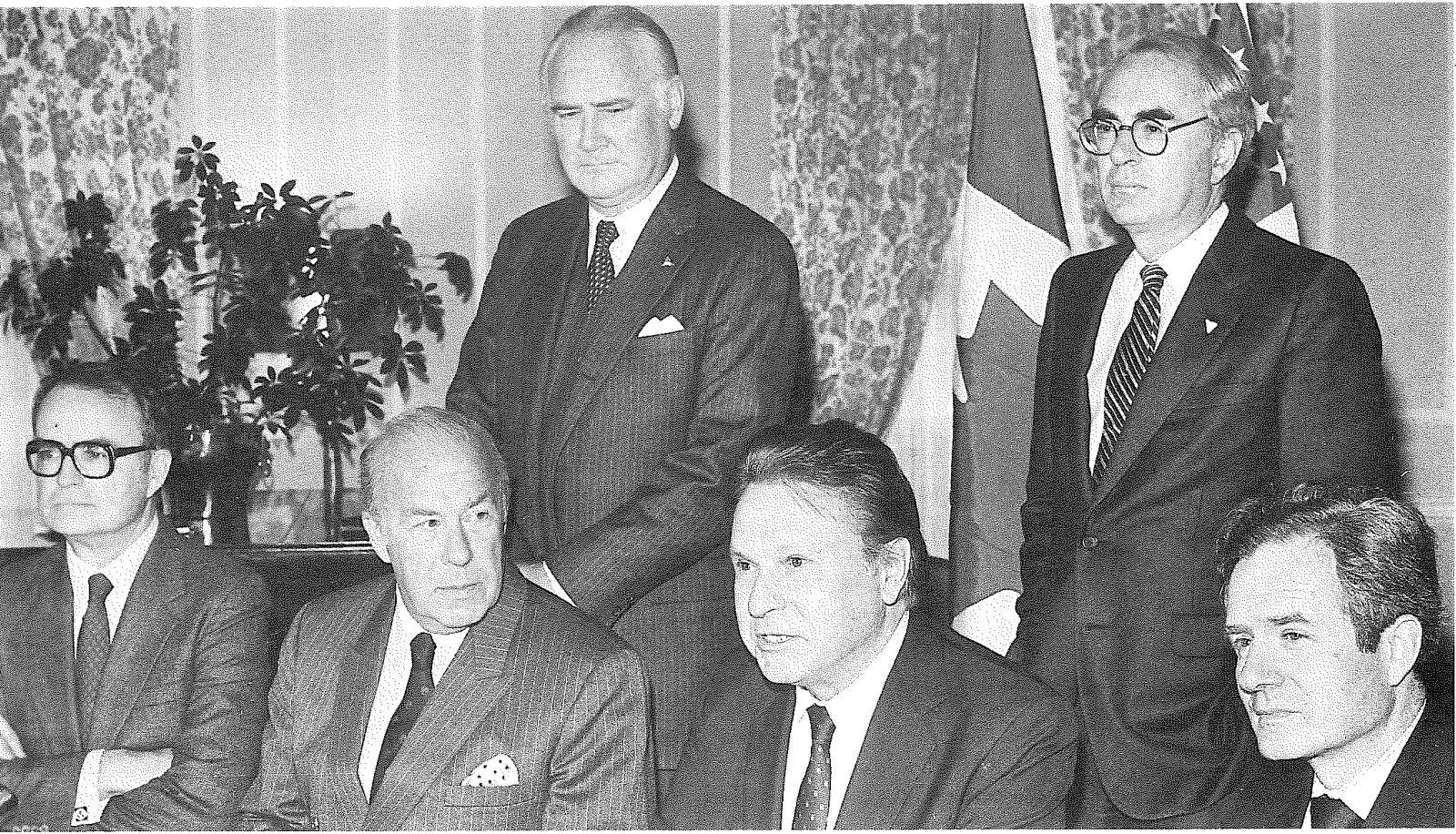
To suggest that Pearson was indecisive is wrong. When one looks back on his period as Prime Minister, one has to conclude it was a period of solid achievement. Legislation was passed and the major problems were addressed. That was a reflection of his ability to lead, his daring and openness. He exhibited a readiness to change and to take on new things. He generally created a good atmosphere in the Cabinet and in the caucus. He had his difficulties at times, but he mastered them. He was usually confident and never became openly depressed. That was very important to keeping up morale.
bout de papier: You were Foreign Minister from 1974-1976. Major events were taking place; North/South conferences, the end of the Vietnam War, implementing the full force of the Third Option. You had a lot on your plate.
MacEachen: Yes. You mentioned the Third World. When I became Secretary of State, one of the top items on my agenda was the design of an International Development Strategy for the balance of the 1970’s. This was the first time such a strategy had ever been developed for our foreign aid. I am pleased that this strategy inspired our policy for more than a decade. The 1970’s was also a time when the new international economic order was on the forefront of the agenda, when it was promulgated at the United Nations and when it entered into every international conference. Certainly major efforts were made to create better conditions for the Third World countries. It was a dominant feature of the international preoccupation. One might pause to say that it is vastly different from the situation today when it is not an international preoccupation. International development is on the margins.
bout de papier: Should it be?
MacEachen: I do not think so, but it is. In 1974, the international community had created, at the instigation of the President of France, the Conference on International Economic Cooperation as a way, through a limited forum, of addressing these problems. The Conference, which Canada co-chaired, did not achieve all that the developing world wanted, although it achieved a certain amount. The developing world overlooked the fact, mainly because of ideology, that they had a forum in which the United States, as the major industrialized country, was involved and in which it was prepared to continue. They lost that opportunity by ending the conference and returning to the global forum, namely the United Nations. Nothing much has happened since.
When I became Minister, Mr. Trudeau wanted Canadian foreign policy to address the human condition, as he put it, and that meant that we were involved in economic issues like Third World economic equality. We were involved in human rights where we could make our imprint. The Conference on Security and Co-operation in Europe was part of that thrust as were the questions of nuclear exports and non-proliferation. For several years, Canada was the leading non-nuclear weapons state fighting proliferation. We were at the origin of the nuclear exporters’ club, the London club, which tightened nuclear exports rules, and we pioneered fullscope safeguards. There were other major items that preoccupied the Department at that time, including the Law of the Sea, the declaration of the 200-mile economic zone, the development of economic cooperation agreements with Japan and the European Community, and of course energy diplomacy in its many facets. It was a very productive period in many ways. These were items that were very much in the Prime Minister’s mind as part of the mandate of the Minister of the External Affairs. While there was some progress made in each of these fields, we realized that not much had happened in those years in arms reductions, particularly in the reduction of strategic weapons.
bout de papier: Was this, then, the prelude to Trudeau’s peace initiative? What role did politics play in the initiative?
MacEachen: The Peace Initiative had deep roots. Recall Trudeau’s initiative in recognizing China, in promoting detente, in proposing a policy of suffocation at the UN in 1978. I think the Peace Initiative was a good idea. Knowing Mr. Trudeau and his views on East/West relations and on the nuclear build-up, it was a natural cause for him to pursue, particularly at a time when the tensions between the Soviet Union and the US had reached a debacle over arms control talks, the KAL incident, the Reagan Administration’s hawkish approach and talk of evil empires, and the apparent transition in Soviet leadership after Brezhnev died. You may also recall that Mr. Trudeau was very active at the Williamsburg Summit in pushing for progress on arms control and a common statement of purpose to that effect. I think it was a genuine and necessary effort whether it had political overtones or not.
bout de papier: How closely were you involved?
MacEachen: We were closely involved through the Department and through the Prime Minister’s Office. It was a cooperative endeavour because the initiative was prepared jointly by senior members of the Department with members of the Privy Council Office and the Prime Minister’s Office. We met, for example, on one occasion at the very beginning at Meech Lake and examined a series of proposals that had been put together to constitute the elements of the peace initiative. It was a cooperative effort. It certainly wasn’t a flash in the pan. Some of the notions that were put forward at that meeting at Meech Lake were dropped because they were unrealistic, and others were agreed to and pursued in Mr. Trudeau’s mission throughout the world. I think the ideas were sound and their pursuit was sound
I thought at the time, and still believe, it would have been better if the effort had been launched months earlier so that Mr. Trudeau would have had an opportunity to advance his ideas over a longer period of time. If he had had an extra year, I think he would have had more time and we would have been able to do our task with greater systematic intensity. That particular aspect troubled me at the time.
bout de papier: The biggest part of any Foreign Minister’s agenda is the Canadian- American relationship.
MacEachen: There is no question that dealing with the Americans is the major job of a Canadian Foreign Minister. Any Canadian Foreign Minister will realize early on that the United States pursues its own interests and responds in its foreign policy to the opinion of its public and publics. It is true that the atmosphere in which these relations are conducted is important — it is an advantage for the President and the Prime Minister to get along very well or at least to talk to each other, and for the ministers to be amiable with one another. However, amiability will not dominate the U.S. decision making process in situations in which American interests are involved and public opinion is exerting itself. They will not in any way put aside the advancement of their interests just to be good friends with Canada.
One must understand that. Obviously the Americans will attempt to accommodate and to be reasonable, but I have not found in any case where their interests are substantially involved, that they will lay off simply because Canada objects or has a different policy. The U.S. pursued Canada on our energy policy, on our investment policy and other policies which were advanced by Canada in the national interest. The U.S. opposed Canadian government policies because they felt these policies were not in their interests. Recently, they have virtually succeeded in removing many of these policies. I think that is a lesson for us.
It is my experience over a wide range of issues — maritime boundaries and fisheries, pipelines, acid rain, trade, and so on – that we have to be extremely well prepared and tough in our approach in order to put sustained pressure on the United States. We also need mechanisms to ensure that our agenda receives attention at the highest level. This was the intent behind the quarterly meetings which George Shultz and I instituted. That practice has been continued and I believe it will remain an important feature of Canadian diplomacy.
bout de papier: Charles Ritchie says a good Foreign Minister is one who has the ear of the Prime Minister, as well as a vision of foreign policy.
MacEachen: It would be intolerable to be Foreign Minister and not get along well with the Prime Minister, or if he didn’t listen to you or respect your turf. A Prime Minister is bound to take an interest in foreign policy, has to and ought to if for no other reason than the frequency with which he has to represent Canada at major meetings abroad. Nevertheless, the Foreign Minister is the Prime Minister’s principal adviser and his principal implementer. Furthermore, the Foreign Minister derives authority from the Parliament of Canada and as such has statutory responsibilities to fulfil. This is not a presidential system, though the PMO at times likes to believe it is. The Secretary of State for External Affairs has to be given an opportunity to fulfil those responsibilities.
bout de papier: Were your efforts to steer policy development at CIDA something that you are most proud of when you were at the helm?
MacEachen: I was and remain very interested in international development. As I indicated, in the 1970’s, we put together a statement on development policy, which I think has pretty well stood the test even until the present time. What is equally important is that we added to the resources which Canada devoted to development and ensured that those budgets were well defended in the Cabinet. I believe there has been a serious erosion in this regard under the present government.
bout de papier: A final comment?
MacEachen: Progress in foreign affairs is made incrementally. The grand flash performance is a rare event for any Foreign Minister. How many Suez solutions are there? Not many. There are not often opportunities of that magnitude. Progress is made usually incrementally, but nevertheless made. If you look over the history of the last 15 to 20 years you will find that certain causes, such as international development, human rights and arms control, have all been measurably advanced.
bout de papier: Mr. MacEachen thank you Har much
View the original scanned pages →
Originally published in bout de papier, Vol. 7, No. 2 (1989), pp. 16–19. Read the rest of this issue →



